

Prevention of Late-Onset Sepsis in Neonates: Nursing Infection Control Strategies: A Systematic Review
 By Dr. Robertson Prime, Research Fellow
Updated October 17, 2026
14 min read
About 2,800 words
In this review
Abstract
Background: Late-onset sepsis, an infection of the bloodstream that begins after the first 72 hours of life, is one of the most common and serious complications for preterm babies in neonatal units. Many infections are linked to care, through hands, central lines and the unit environment, and so nursing practice plays a central part in prevention.
Aim: This systematic review aimed to examine the burden of late-onset sepsis in preterm infants and the effectiveness of nursing-relevant prevention strategies.
Methods: Evidence was identified through targeted searches of openly accessible bibliographic records, publisher websites and the reference lists of key reviews. Five sources published between 2002 and 2023 were included: a large cohort study, a before-and-after hand hygiene study, a meta-analysis of central line care bundles and two Cochrane reviews of enteral supplements, synthesised narratively.
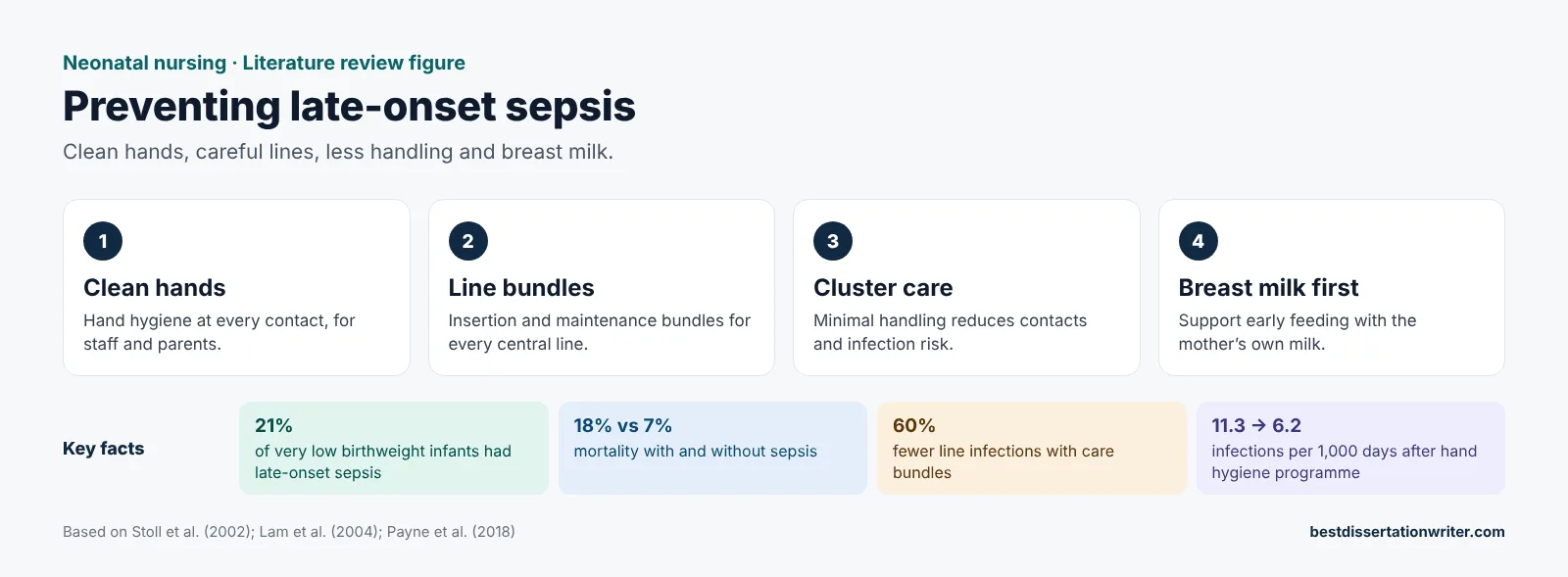
Findings: In a cohort of very low birthweight infants, 21% had culture-proven late-onset sepsis, and 18% of infected infants died compared with 7% of uninfected infants. A multimodal hand hygiene programme raised compliance and cut healthcare-associated infections from 11.3 to 6.2 per 1,000 patient days. Central line care bundles were associated with a 60% reduction in line infections. Enteral lactoferrin may reduce late-onset sepsis (risk ratio 0.80), with low-certainty evidence.
Conclusion: Neonatal nurses should lead hand hygiene, central line care bundles and minimal handling, involve parents in infection prevention and support breast milk feeding.
Keywords: late-onset sepsis, neonatal sepsis, infection prevention, hand hygiene
Introduction
This systematic review critically examines recent evidence on late-onset sepsis and its implications for neonatal nursing practice.
Preterm babies are especially vulnerable to infection. Their immune systems are immature, their skin is thin and easily damaged, and many need central lines, ventilation, feeding tubes and frequent handling. Neonatal sepsis that develops after the first 72 hours of life is known as late-onset sepsis. Unlike early-onset sepsis, which is usually acquired from the mother around birth, late-onset sepsis is often acquired in hospital, through hands, equipment and the environment.
The consequences can be severe. Sepsis can cause rapid deterioration, shock and death, and survivors are at greater risk of chronic lung disease, brain injury and poorer neurodevelopmental outcomes. Infections prolong hospital stays and cause great distress to parents. Because many infections are linked to care, they are widely regarded as largely preventable.
Neonatal nurses carry out most of the care that can either introduce or prevent infection. They handle babies many times each day, access central lines, prepare feeds, manage skin care and teach parents. Infection prevention is therefore a core nursing responsibility, and evidence on which strategies work is essential for safe practice.
A systematic review approach was chosen to bring together evidence from a large cohort study, quality improvement research, a meta-analysis and Cochrane reviews, and to judge its strength.
Neonatal sepsis also carries a heavy emotional cost. Parents describe the sudden deterioration of a baby who had been doing well as one of the most frightening moments of their neonatal journey. Explaining what is happening, involving parents in decisions and supporting them through uncertainty are important parts of nursing care when infection occurs.
Review question
What is the burden of late-onset sepsis in preterm infants, and how effective are nursing-relevant strategies to prevent it?
Background to Late-Onset Sepsis
The risk of late-onset sepsis rises as gestational age and birth weight fall. The most common organisms are coagulase-negative staphylococci, which live on the skin and colonise central lines, but Gram-negative bacteria and fungi cause some of the most dangerous infections. Risk factors include central venous catheters, mechanical ventilation, prolonged parenteral nutrition, delayed enteral feeding and long hospital stays.
Prevention strategies fall into several groups. Hand hygiene is the foundation, because hands are the most common route of transmission between babies. Central line care bundles combine practices for insertion and maintenance of lines. Minimal handling and clustering of care reduce the number of contacts. Feeding strategies, especially early feeding with breast milk, support the baby’s gut and immune defences, and supplements such as lactoferrin, probiotics and prebiotics have been tested as additional measures.
Diagnosis of late-onset sepsis is difficult, because early signs such as temperature instability, apnoea, feeding intolerance and lethargy are non-specific. Nurses are often the first to notice that a baby is not right, and prompt recognition, blood cultures and antibiotics can be lifesaving. At the same time, unnecessary antibiotic use carries its own risks, including resistance and disruption of the developing gut microbiome.
Parents also have a role. In units that welcome parents to provide care, they handle their babies frequently and need to know how to clean their hands, protect lines and recognise warning signs. Involving parents in infection prevention can empower them and extend the reach of good practice, provided that they receive clear teaching and support.
Skin care is a further consideration. The skin of extremely preterm babies is a weak barrier, and damage from adhesives, friction or harsh cleansing agents can allow organisms to enter. Gentle skin care, careful choice of dressings and adhesives, and protecting the skin around lines are therefore part of preventing neonatal sepsis, although the evidence for specific products is limited.
Search Strategy and Methods
Evidence for this example was identified through targeted searches of openly accessible bibliographic records, publisher websites and the reference lists of key reviews. Search terms combined keywords for the outcome (“late-onset sepsis”, “neonatal sepsis”, “nosocomial infection”, “central line-associated bloodstream infection”) with terms for the population and interventions (“preterm”, “very low birth weight”, “neonatal intensive care”, “hand hygiene”, “care bundle”, “lactoferrin”, “prebiotics”), joined with the Boolean operators AND and OR. A full systematic review for assessment would run the same strategy in CINAHL, PubMed/MEDLINE, the Cochrane Library and Embase and report the number of records screened in a PRISMA flow diagram.
Sources were eligible if they described the burden of late-onset sepsis in preterm or very low birthweight infants, or evaluated strategies to prevent hospital-acquired infection in neonatal units, using cohort studies, quality improvement designs, trials or systematic reviews. Studies limited to early-onset sepsis or to antibiotic treatment were excluded.
Five sources published between 2002 and 2023 were included: a multicentre cohort study, a before-and-after study of a hand hygiene programme, a systematic review and meta-analysis of central line care bundles and two Cochrane systematic reviews of enteral supplements (Table 1). The quality of each source was considered using the Critical Appraisal Skills Programme (CASP) checklists, drawing on the certainty ratings reported by the reviews, and findings were synthesised narratively.
Key Findings on Late-Onset Sepsis
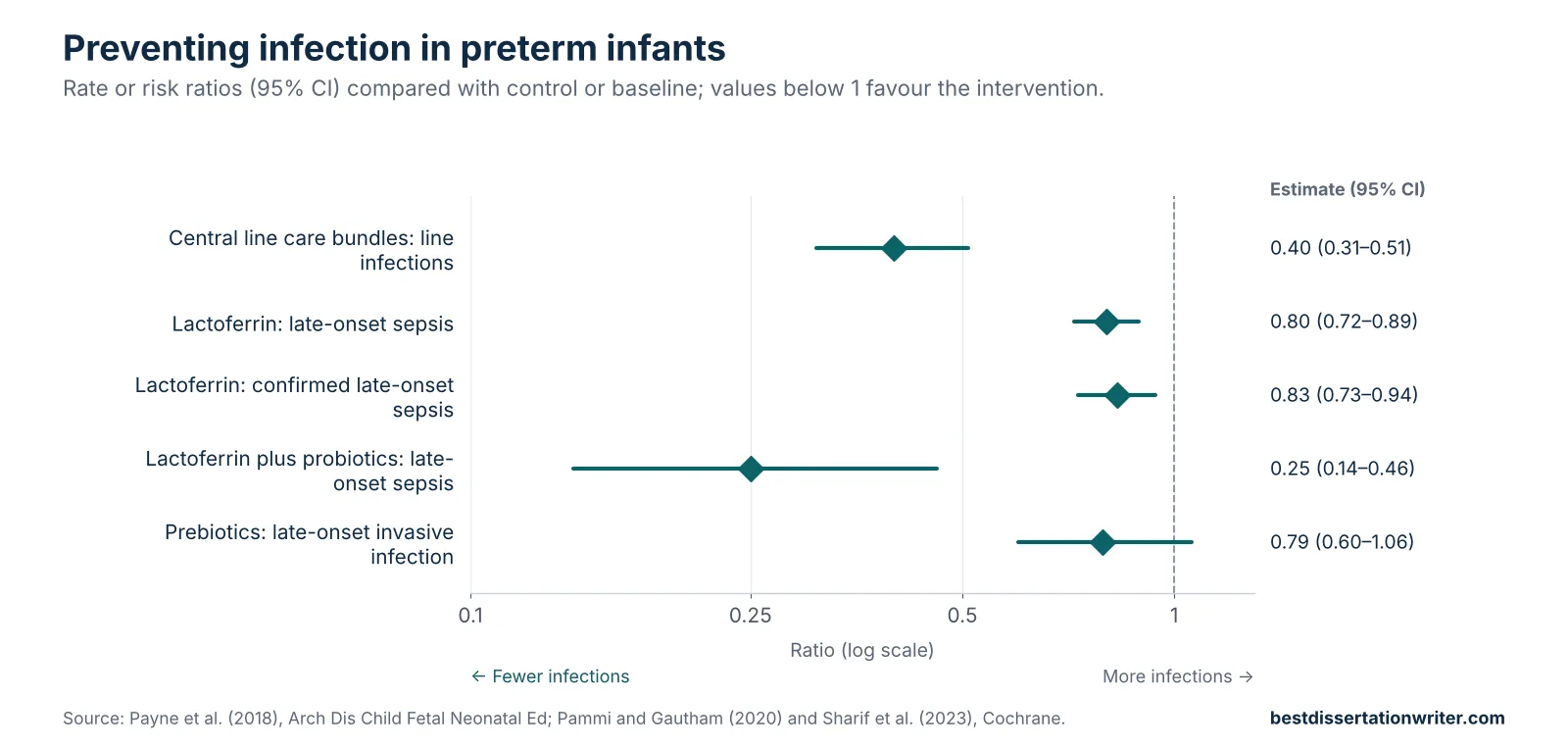
Three themes were identified: the burden of late-onset sepsis, hand hygiene and central line bundles as core prevention strategies, and the role of enteral supplements. Table 1 summarises the included sources, and Figure 1 shows the effects of the main prevention strategies.
| Author, year | Design | Setting and sample | Key finding |
|---|---|---|---|
| Stoll et al. (2002) | Multicentre cohort study (NICHD Neonatal Research Network) | 6,956 very low birthweight infants, USA | 21% had culture-proven late-onset sepsis; mortality 18% vs 7%; mean stay 79 vs 60 days. |
| Lam et al. (2004) | Before-and-after study of a multimodal programme | One neonatal intensive care unit | Hand hygiene compliance improved; infections fell from 11.3 to 6.2 per 1,000 patient days. |
| Payne et al. (2018) | Systematic review and meta-analysis | 24 studies, mostly quality improvement, several regions | Central line care bundles: rate ratio 0.40 (60% reduction in line infections). |
| Pammi and Gautham (2020) | Cochrane systematic review | 12 trials, 5,425 preterm infants | Lactoferrin may reduce late-onset sepsis (RR 0.80, low certainty); little effect on mortality. |
| Sharif et al. (2023) | Cochrane systematic review | 7 trials, 705 very preterm or VLBW infants | Prebiotics: late-onset invasive infection RR 0.79 (CI includes no effect, low certainty). |
Theme 1: The Burden of Late-Onset Sepsis
A cohort study of 6,956 very low birthweight infants admitted to centres of the US National Institute of Child Health and Human Development Neonatal Research Network found that 21% of those surviving beyond three days had at least one episode of culture-proven late-onset sepsis (Stoll et al., 2002). Coagulase-negative staphylococci caused 48% of infections, and around 70% were caused by Gram-positive organisms. Infection rates rose as birth weight and gestational age fell.
Infants with late-onset sepsis were more than twice as likely to die as uninfected infants (18% compared with 7%), and mortality was 36% with Gram-negative infections and 32% with fungal infections. Survivors stayed in hospital longer, with a mean stay of 79 days compared with 60 days. The authors concluded that late-onset sepsis was an important risk factor for death and prolonged stay and called for urgent prevention strategies.
Although these data are now dated and rates have fallen in many units since, the study remains a landmark description of the burden of infection in very preterm babies. It highlighted the role of prolonged intravascular access and ventilation, which point directly to nursing practices around lines and airways, and showed why infection prevention must be a priority in every neonatal unit.
Theme 2: Hand Hygiene and Central Line Care Bundles
A neonatal intensive care unit introduced a multimodal programme that included problem-based hand hygiene education, a minimal handling protocol with clustering of nursing care, alcohol-based hand rub, better hand hygiene facilities and ongoing audit with feedback (Lam et al., 2004). Hand hygiene compliance before patient contact rose from 40% to 53%, and during high-risk procedures from 35% to 60%. The number of patient contacts per hour fell from 2.8 to 1.8, and healthcare-associated infections fell from 11.3 to 6.2 per 1,000 patient days.
The study is notable for linking hand hygiene with workload. By clustering care and reducing unnecessary handling, the programme reduced the number of hand hygiene opportunities, making compliance more achievable. However, it was a before-and-after study in one unit, so other changes may have contributed, and compliance remained well below ideal levels even after the intervention.
A systematic review and meta-analysis of 24 studies examined care bundles to reduce central line-associated bloodstream infections in neonatal units (Payne et al., 2018). Most were before-and-after quality improvement studies, and no randomised trials were found. Pooled analysis showed a rate ratio of 0.40, equivalent to a 60% reduction in line infections after bundles were introduced. It was unclear which bundle elements were most important, and the authors called for research on implementation and essential components.
Bundles typically include hand hygiene before handling lines, sterile insertion with full barrier precautions, skin antisepsis appropriate for preterm skin, careful dressing care, hub decontamination before access, limiting the number of times lines are opened and daily review of whether the line is still needed. Many of these steps are carried out by nurses, and units that have reduced infections often describe nurse champions, checklists and regular feedback of data as key to success.
Theme 3: Enteral Supplements and Feeding
A Cochrane review of 12 trials with 5,425 preterm infants examined enteral lactoferrin, a protein found in breast milk with antimicrobial properties (Pammi and Gautham, 2020). Lactoferrin may reduce late-onset sepsis (risk ratio 0.80) and confirmed infection (risk ratio 0.83), but the certainty of evidence was low, and there was probably little or no effect on mortality. Lactoferrin combined with probiotics showed a larger reduction in sepsis in a few small trials, with low-certainty evidence.
A Cochrane review of seven small trials with 705 very preterm or very low birthweight infants examined prebiotics, substances that encourage the growth of beneficial gut bacteria (Sharif et al., 2023). Prebiotics may reduce late-onset invasive infection (risk ratio 0.79), but the confidence interval included no effect, and the certainty was low. The authors called for large, high-quality trials before prebiotics are adopted into practice.
These reviews suggest that enteral supplements may offer modest additional protection, but the evidence is not strong enough to recommend routine use. By contrast, supporting mothers to provide breast milk, which naturally contains lactoferrin and prebiotic sugars, is low-risk and has wider benefits. Nurses play a key role in supporting expression, safe storage and early feeding with breast milk.
Antimicrobial stewardship is also relevant. Because the signs of infection are non-specific, many preterm babies receive antibiotics for suspected sepsis that is not confirmed. Prolonged courses can disrupt the gut microbiome and increase the risk of resistant infections. Nurses can support stewardship by documenting signs accurately, ensuring blood cultures are taken before antibiotics where possible and prompting review when cultures are negative.
Discussion
This review found that late-onset sepsis is common in very preterm babies and substantially increases the risk of death and prolonged stay. Hand hygiene programmes and central line care bundles are associated with large reductions in infection, while enteral supplements such as lactoferrin and prebiotics may offer modest additional benefits supported by low-certainty evidence. The strongest evidence therefore supports basic infection prevention practices that nurses deliver every day.
The evidence for bundles and hand hygiene comes mainly from quality improvement studies rather than randomised trials, which limits certainty. Infection rates may fall for many reasons, including wider changes in practice and staff awareness. Nevertheless, the consistency of large reductions across many units and countries, together with the strong biological rationale, supports these practices as standard care.
Nursing workload and staffing are closely linked to infection. When nurses care for too many babies, hand hygiene and careful line care become harder to sustain. The finding that clustering care reduced handling and improved compliance suggests that organising work thoughtfully can help, but adequate staffing remains essential. Units should also monitor compliance and give nurses regular feedback on infection rates.
Parents are increasingly involved in their babies’ care, which brings opportunities and responsibilities. Parents can be powerful allies in infection prevention if they are taught hand hygiene and understand why it matters. Clear teaching, accessible hand rub and reminders can help parents to protect their baby and other babies on the unit.
This review has limitations. The cohort data are more than two decades old, the hand hygiene study was conducted in a single unit, the bundle review included no randomised trials and the supplement reviews had low-certainty evidence. This review relied on openly accessible, English-language sources and did not involve independent double screening. Future research should identify the most effective bundle components and test supplements in large trials.
Finally, surveillance and transparency matter. Units that track infection rates, share them openly with staff and investigate each case to identify learning are more likely to sustain improvement. Nurses should be involved in these reviews, because they understand how care is delivered at the bedside and can identify practical barriers to good practice.
Implications of Late-Onset Sepsis Evidence for Practice
Neonatal nurses should practise and promote hand hygiene at every contact, use central line insertion and maintenance bundles, cluster care to reduce handling, protect fragile skin and support early feeding with breast milk. These practices mirror those used to prevent bloodstream infections in adult intensive care. Nurses should also recognise early signs of infection and act promptly.
Parents should be taught infection prevention as part of family-integrated care. Good infection control also supports other aspects of neonatal care, such as thermoregulation during skin-to-skin contact and developmental care that minimises unnecessary handling.
Education should be ongoing rather than a single event. New staff, students, agency nurses and visiting professionals all need induction in the unit’s infection prevention practices, and refresher training helps experienced staff to maintain high standards over time.
Conclusion
This systematic review examined the burden of late-onset sepsis in preterm infants and strategies to prevent it. Infection is common and increases the risk of death and prolonged stay. Hand hygiene programmes and central line care bundles are associated with large reductions in infection, while lactoferrin and prebiotics may offer modest benefits on low-certainty evidence.
Infection prevention is at the heart of neonatal nursing. Consistent hand hygiene, careful line care, minimal handling and support for breast milk feeding, delivered by well-staffed teams and shared with parents, can protect vulnerable babies from serious harm.
References
Lam, B. C. C., Lee, J., & Lau, Y. L. (2004). Hand hygiene practices in a neonatal intensive care unit: A multimodal intervention and impact on nosocomial infection. Pediatrics, 114(5), e565–e571. https://doi.org/10.1542/peds.2004-1107
Pammi, M., & Gautham, K. S. (2020). Enteral lactoferrin supplementation for prevention of sepsis and necrotizing enterocolitis in preterm infants. Cochrane Database of Systematic Reviews, (3), CD007137. https://doi.org/10.1002/14651858.CD007137.pub6
Payne, V., Hall, M., Prieto, J., & Johnson, M. (2018). Care bundles to reduce central line-associated bloodstream infections in the neonatal unit: A systematic review and meta-analysis. Archives of Disease in Childhood: Fetal and Neonatal Edition, 103(5), F422–F429. https://doi.org/10.1136/archdischild-2017-313362
Sharif, S., Oddie, S. J., Heath, P. T., & McGuire, W. (2023). Prebiotics to prevent necrotising enterocolitis in very preterm or very low birth weight infants. Cochrane Database of Systematic Reviews, CD015133. https://doi.org/10.1002/14651858.CD015133.pub2
Stoll, B. J., Hansen, N., Fanaroff, A. A., et al. (2002). Late-onset sepsis in very low birth weight neonates: The experience of the NICHD Neonatal Research Network. Pediatrics, 110(2), 285–291. https://doi.org/10.1542/peds.110.2.285
Cite this example
Best Dissertation Writers (2026) Prevention of Late-Onset Sepsis in Neonates: Nursing Infection Control Strategies: A Systematic Review. Available at: https://bestdissertationwriter.com/late-onset-sepsis-literature-review/
Best Dissertation Writers
Get expert help with your nursing literature review
Share your topic and deadline with Best Dissertation Writers and get support tailored to your module brief.