Developmental Care and Environmental Modification in the Neonatal Unit: A Scoping Review
 By Dr. Robertson Prime, Research Fellow
Updated October 17, 2026
14 min read
About 2,800 words
In this review
Abstract
Background: Developmental care is an approach to neonatal nursing that adapts the environment and the way care is given to support the brain development of preterm babies. It includes reducing noise and light, positioning, clustering care, responding to the baby’s cues and involving parents, and it is now part of everyday practice in many neonatal units.
Aim: This scoping review aimed to map the evidence on developmental care and environmental modification in the neonatal unit.
Methods: Evidence was identified through targeted searches of openly accessible bibliographic records, publisher websites and the reference lists of key reviews. Five sources published between 2002 and 2024 were included: a meta-analysis of NIDCAP, three Cochrane reviews and a quasi-experimental cohort study of single-family rooms, charted and summarised narratively.
Findings: A meta-analysis found insufficient evidence that NIDCAP improves medical or long-term neurodevelopmental outcomes, and a Cochrane review found limited overall benefit from developmental care interventions. Infants cared for in single-family rooms gained weight faster, had less sepsis and showed better neurobehaviour, linked to more developmental support and maternal involvement. Evidence on noise reduction and cycled lighting was very uncertain, although cycled light compared with continuous bright light may shorten stays.
Conclusion: Neonatal nurses can provide developmental care as part of compassionate, family-centred practice, while recognising that evidence for many specific interventions remains limited.
Keywords: developmental care, noise reduction, NIDCAP, neonatal unit
Introduction
This scoping review critically examines recent evidence on developmental care and its implications for neonatal nursing practice.
Babies born very preterm spend weeks or months in the neonatal unit during a period when their brains would normally be developing in the quiet, dark and protective environment of the womb. Instead, they are exposed to bright lights, alarms, voices, frequent handling and painful procedures. Concern has grown that this environment may affect brain development and contribute to the behavioural, attention and learning difficulties that are more common in children born preterm.
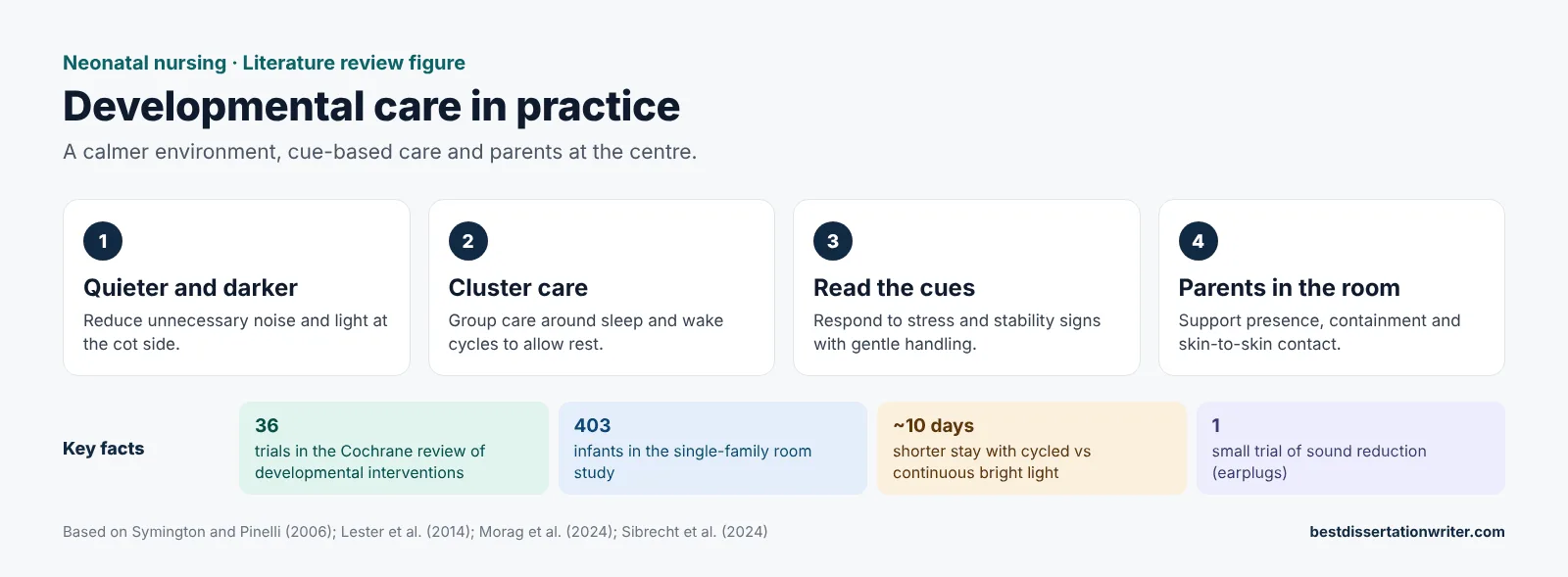
Developmental care emerged in response to this concern. It aims to reduce stress and support development by modifying the neonatal unit environment, adapting the way care is delivered and involving parents. Practices include reducing noise and light, positioning babies in flexed, contained postures, clustering care to allow longer periods of rest, observing and responding to the baby’s behavioural cues, and supporting skin-to-skin contact and parental presence.
Nurses deliver most of this care. They decide when and how to handle babies, control light and sound at the cot side, position babies, support parents and observe behaviour. The Newborn Individualized Developmental Care and Assessment Program (NIDCAP) provides a structured approach, in which trained observers assess each baby’s behaviour and write individualised care plans for nurses and parents. Simpler, unit-wide approaches are more common.
A scoping review approach was chosen because developmental care includes many different interventions, outcomes and study designs, and the aim was to map what is known and where gaps remain rather than to estimate a single effect.
Review question
What does the evidence show about developmental care and environmental modification in the neonatal unit?
Background to Developmental Care
Developmental care is based on the synactive theory of development, which suggests that preterm babies’ physiological, motor, state and attention systems interact, and that stress in one system can disrupt the others. Babies communicate stress through signs such as colour changes, irregular breathing, finger splaying and arching, and communicate stability through calm breathing, flexed postures and alert states. Care that responds to these cues may reduce stress and support organisation.
Environmental modifications focus on light and sound. Neonatal units can be noisy, with alarms, equipment, conversations and incubator doors, and recommended sound levels are often exceeded. Noise reduction strategies include quiet times, lowering alarm volumes, staff education, covering incubators and using earmuffs or earplugs. Light strategies include dimming lights, covering incubators and using cycled lighting that mimics day and night to support the development of circadian rhythms.
The design of units is also changing. Many new neonatal units are built with single-family rooms rather than open bays, giving each family privacy, space to stay and control over light and sound. Single-family rooms may make cue-based care easier to deliver and encourage parental presence, but they may also isolate families and increase nurses’ walking distances and workload.
Developmental care requires training and commitment. NIDCAP in particular involves extensive training of observers and changes to unit culture, which are costly and time-consuming. Understanding the evidence for different components helps units to prioritise approaches that are most likely to benefit babies and families.
Positioning is one of the most practical elements. Preterm babies lack the muscle tone to maintain flexed postures, and lying flat for long periods can contribute to flattened heads, shoulder retraction and hip problems. Nests, rolls and swaddling help to keep babies in midline, flexed positions that mimic the womb. Nurses must balance supportive positioning with safe sleep principles as babies approach discharge, gradually moving towards supine sleeping on a firm, flat surface.
Search Strategy and Methods
Evidence for this example was identified through targeted searches of openly accessible bibliographic records, publisher websites and the reference lists of key reviews. Search terms combined keywords for the intervention (“developmental care”, “NIDCAP”, “individualised care”, “noise”, “sound”, “light”, “cycled light”, “single-family room”) with terms for the population and outcomes (“preterm”, “neonatal intensive care”, “neurodevelopment”, “growth”, “length of stay”), joined with the Boolean operators AND and OR. A full scoping review for assessment would run the same strategy in CINAHL, PubMed/MEDLINE, the Cochrane Library and Embase and report the number of records screened in a PRISMA flow diagram.
Sources were eligible if they evaluated developmental programmes, NIDCAP, environmental modification or unit design for preterm infants, using any design. Systematic reviews were prioritised to capture the breadth of evidence, and a large cohort study of single-family rooms was included to reflect changes in unit design. Studies of single procedures such as pain relief were excluded.
Five sources published between 2002 and 2024 were included: a systematic review and meta-analysis of NIDCAP, three Cochrane systematic reviews and a quasi-experimental cohort study (Table 1). In line with scoping review methods, data were charted on design, interventions and outcomes. Quality was considered using the Critical Appraisal Skills Programme (CASP) checklists and the certainty ratings reported by the reviews, and findings were summarised narratively.
Key Findings on Developmental Care
Three themes were identified: the evidence for structured developmental care programmes, the effects of light and noise modification, and the effects of unit design and parental involvement. Table 1 summarises the included sources, and Figure 1 shows the uncertain effects of light and sound interventions.
| Author, year | Design | Setting and sample | Key finding |
|---|---|---|---|
| Jacobs et al. (2002) | Systematic review and meta-analysis | 5 RCTs (136 infants) and 3 cohort studies (185 infants) | NIDCAP reduced oxygen need; neurodevelopment better at 9–12 months but not 2 years; insufficient evidence overall. |
| Symington and Pinelli (2006) | Cochrane systematic review | 36 RCTs of developmental interventions | Limited benefit for chronic lung disease and NEC; longer stay; no major harms; evidence inconsistent. |
| Lester et al. (2014) | Quasi-experimental cohort study | 403 infants under 1,500 g, open bay vs single-family rooms, USA | Faster weight gain, less sepsis, fewer procedures and better neurobehaviour in single-family rooms. |
| Morag et al. (2024) | Cochrane systematic review | 20 studies, 1,633 infants | Cycled light vs continuous bright light may shorten stay by ~10 days; very low certainty. |
| Sibrecht et al. (2024) | Cochrane systematic review | 1 RCT, 34 very low birthweight infants (earplugs) | Higher development scores with earplugs; very low certainty; no unit-wide noise trials. |
Theme 1: Structured Developmental Care Programmes
A systematic review and meta-analysis of NIDCAP included five randomised controlled trials with 136 infants and three phase-lag cohort studies with 185 infants (Jacobs et al., 2002). NIDCAP reduced the need for supplemental oxygen, and neurodevelopmental outcomes improved at 9 or 12 months but not at two years. The authors concluded that there was insufficient evidence to support NIDCAP for improving medical and neurodevelopmental outcomes in preterm infants.
A Cochrane review of 36 randomised trials examined a wide range of developmental interventions, grouped into positioning, clustering of care, NIDCAP and environmental modifications (Symington and Pinelli, 2006). It found limited benefit for moderate to severe chronic lung disease and necrotising enterocolitis, very limited evidence of a positive effect of NIDCAP on behaviour and movement at five years, and no effect on cognition. Developmental care was associated with a longer length of stay, and no major harms were reported.
The review noted that most studies combined several interventions, making it difficult to determine which components were effective, that the few significant findings came from small trials not confirmed by others, and that none considered costs. The authors recommended more consistent evidence on important outcomes before clear recommendations could be made. These reviews are now dated, but they remain the main syntheses of structured programmes.
One reason for these mixed results may be the way programmes were compared with usual care. As the principles of individualised care spread, control groups in later trials often received many of the same elements, such as dimmed lights and supportive positioning, which would reduce any measured difference. Fidelity to complex programmes also varies, because they depend on training, staffing and the commitment of the whole team.
Theme 2: Light and Noise in the Neonatal Unit
A Cochrane review of noise and sound management found only one small trial, in which 34 very low birthweight infants were randomised to silicone earplugs or no earplugs (Sibrecht et al., 2024). Infants with earplugs had higher mental development scores at 18 to 22 months, but the evidence was of very low certainty because of the small sample, imprecision and high attrition. No studies evaluated interventions to reduce sound levels across a whole unit or room.
A Cochrane review of cycled light included 20 studies with 1,633 infants (Morag et al., 2024). Compared with dimmed light or near darkness, cycled light made little clear difference to weight, retinopathy of prematurity or length of stay. Compared with continuous bright light, cycled light may shorten the initial hospital stay by around ten days, but all evidence was of very low certainty. No outcome showed a clear benefit or harm.
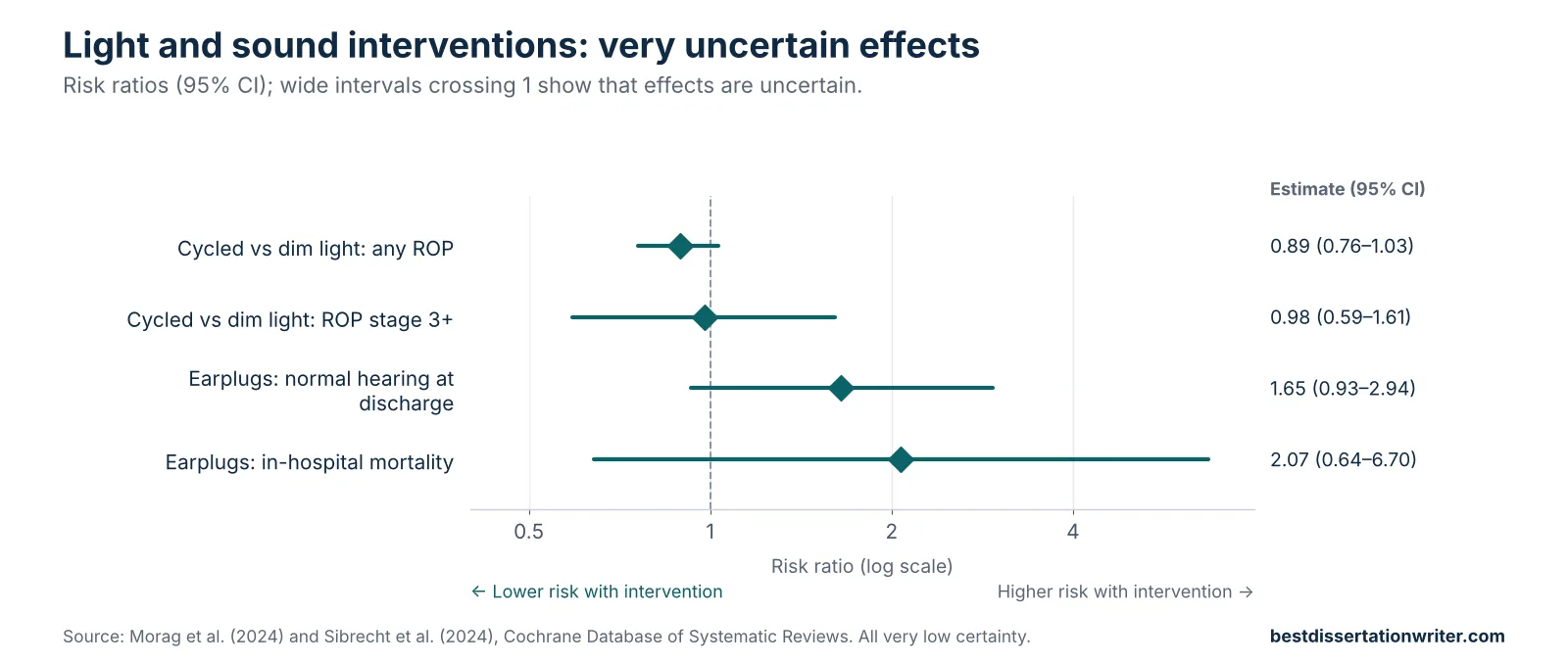
These findings show how little high-quality evidence exists for environmental modifications that are widely used in practice. Dimming lights and reducing noise are plausible, low-risk and valued by parents and staff, but their effects on outcomes remain uncertain. The absence of evidence should not be read as evidence of no benefit, but it does suggest caution in making strong claims and a need for better research.
Sound levels in neonatal units are influenced as much by behaviour as by equipment. Conversations at the cot side, handover discussions, telephones, bins and incubator doors all contribute. Simple measures, such as quiet hours, closing incubator doors gently, responding quickly to alarms and moving conversations away from the bedside, can lower noise without new technology, although their effects on outcomes have rarely been studied.
Theme 3: Single-Family Rooms and Parental Involvement
A quasi-experimental cohort study compared 151 infants born under 1,500 g in an open-bay neonatal unit with 252 infants cared for after the unit moved to single-family rooms (Lester et al., 2014). Infants in single-family rooms weighed more at discharge, gained weight faster, needed fewer medical procedures, reached full enteral feeding earlier and had less sepsis. They also showed better attention and less physiological stress, lethargy and pain on neurobehavioural assessment.
Mediation analysis suggested that improved weight gain and attention were linked to increased developmental support, while fewer procedures and less stress and pain were linked to greater maternal involvement. Nurses also reported a more positive working environment and more positive attitudes towards their work. As a before-and-after comparison in one unit, the study cannot prove that single-family rooms caused these benefits, but it suggests that environments that make developmental care and parental presence easier may improve outcomes.
This finding links developmental care closely with family-centred approaches. Parents who are present can provide comfort, containment and skin-to-skin contact, respond to their baby’s cues and protect them from unnecessary disturbance. Developmental care may therefore be most effective when it is delivered with parents rather than by staff alone.
Discussion
This scoping review found that the evidence for developmental care is mixed and often uncertain. Structured programmes such as NIDCAP have shown limited and inconsistent benefits, the evidence for light and noise modification is of very low certainty, and a cohort study suggests that single-family rooms, with greater developmental support and parental involvement, may improve growth, infection rates and neurobehaviour. No major harms have been identified, which supports continued use while better evidence is gathered.
The gap between practice and evidence is striking. Developmental care is widely accepted and taught, yet the trials that support specific components are small, old or inconsistent. This may reflect the difficulty of studying complex, multicomponent interventions that are delivered differently in each unit, rather than a lack of effect. Outcomes such as long-term neurodevelopment are also hard to measure and require long follow-up.
For nursing practice, a pragmatic approach seems sensible. Many of these practices, such as reducing unnecessary noise, dimming lights, clustering care, gentle handling, supportive positioning and responding to the baby’s cues, are low in cost and risk and are consistent with compassionate care. Nurses can adopt these while recognising that evidence for their specific effects is limited, and while avoiding claims that they guarantee better outcomes.
Unit design and culture also matter. Single-family rooms may support cue-based care and parental presence, but they require staffing models that prevent isolation of families and nurses. Open-bay units can still create quieter, calmer environments through behaviour, policies and equipment. Involving parents in planning and delivering this care is likely to be central in either setting.
This review has limitations. The included reviews of structured programmes are dated, the environmental reviews found very few or very uncertain trials, and the single-family room study was quasi-experimental in one unit. This review relied on openly accessible, English-language sources and did not involve independent double screening. Future research should evaluate bundles of developmental interventions with consistent outcomes and long-term follow-up.
Staff wellbeing and workload should also be considered. Cue-based care asks nurses to slow down, observe and adapt, which can be difficult when they are caring for several babies. Adequate staffing, training and leadership support are therefore preconditions for delivering individualised care consistently, rather than optional extras.
Implications of Developmental Care Evidence for Practice
Neonatal nurses should minimise unnecessary noise and light, cluster care around the baby’s sleep and wake cycles, use gentle handling and supportive positioning, and teach parents to recognise and respond to their baby’s cues. Developmental care complements kangaroo mother care and approaches such as family-integrated care that place parents at the centre.
Babies with neonatal abstinence syndrome may particularly benefit from a calm environment and swaddling, and developmental principles such as supine sleep in a safe cot should be modelled before discharge to support safe sleep practices at home.
Units can also make noise reduction part of their everyday culture by measuring sound levels, sharing results with staff and parents, and agreeing simple standards for behaviour at the cot side. Small, consistent changes in how the team works are often more achievable and sustainable than major redesigns of the neonatal unit.
Conclusion
This scoping review mapped the evidence on developmental care and environmental modification in the neonatal unit. Structured programmes have shown limited benefits, and evidence for light and noise modification is very uncertain, while single-family rooms with greater developmental support and parental involvement may improve outcomes.
Developmental care reflects a commitment to protect preterm babies from unnecessary stress and to involve parents in their care. Neonatal nurses can provide it as part of compassionate, family-centred practice, while supporting research to identify which elements make the greatest difference.
References
Jacobs, S. E., Sokol, J., & Ohlsson, A. (2002). The newborn individualized developmental care and assessment program is not supported by meta-analyses of the data. Journal of Pediatrics, 140(6), 699–706. https://doi.org/10.1067/mpd.2002.123667
Lester, B. M., Hawes, K., Abar, B., Sullivan, M., Miller, R., Bigsby, R., Laptook, A., Salisbury, A., Taub, M., Lagasse, L. L., & Padbury, J. F. (2014). Single-family room care and neurobehavioral and medical outcomes in preterm infants. Pediatrics, 134(4), 754–760. https://doi.org/10.1542/peds.2013-4252
Morag, I., Xiao, Y.-T., & Bruschettini, M. (2024). Cycled light in the intensive care unit for preterm and low birth weight infants. Cochrane Database of Systematic Reviews, (12), CD006982. https://www.cochrane.org/evidence/CD006982_cycled-light-intensive-care-unit-preterm-and-low-birth-weight-infants
Sibrecht, G., Wróblewska-Seniuk, K., & Bruschettini, M. (2024). Noise or sound management in the neonatal intensive care unit for preterm or very low birth weight infants. Cochrane Database of Systematic Reviews, (5), CD010333. https://www.cochrane.org/evidence/CD010333_sound-reduction-management-neonatal-intensive-care-unit-preterm-or-very-low-birth-weight-infants
Symington, A. J., & Pinelli, J. (2006). Developmental care for promoting development and preventing morbidity in preterm infants. Cochrane Database of Systematic Reviews, (2), CD001814. https://doi.org/10.1002/14651858.CD001814.pub2
Cite this example
Best Dissertation Writers (2026) Developmental Care and Environmental Modification in the Neonatal Unit: A Scoping Review. Available at: https://bestdissertationwriter.com/developmental-care-literature-review/
Best Dissertation Writers
Get expert help with your nursing literature review
Share your topic and deadline with Best Dissertation Writers and get support tailored to your module brief.