Bereavement Support for Parents After Neonatal Loss: A Qualitative Evidence Synthesis
 By Dr. Robertson Prime, Research Fellow
Updated October 17, 2026
14 min read
About 2,900 words
In this review
Abstract
Background: Neonatal loss, the death of a baby in the first weeks of life, is one of the most devastating experiences a family can face, and many of these deaths occur in neonatal intensive care units. The care that parents receive before, during and after the death can shape their grief for years, and neonatal nurses are central to that care.
Aim: This integrative review aimed to examine the evidence on parents’ experiences of neonatal loss and the bereavement support provided by nurses and other professionals.
Methods: Evidence was identified through targeted searches of openly accessible bibliographic records, publisher websites and the reference lists of key reviews. Five sources published between 2013 and 2024 were included: a Cochrane review, a longitudinal study of parental grief, a scoping review of nursing interventions, a systematic review and a qualitative meta-ethnography, synthesised thematically.
Findings: A Cochrane review found no randomised trials of bereavement support after perinatal death. A longitudinal study of 130 mothers and 52 fathers showed that grief followed different patterns for mothers and fathers over 13 months. A review of 47 studies found that support was often suboptimal in time with the baby, communication and follow-up, and parents wanted a private space to say goodbye. Nursing interventions included legacy creation, family-centred accompaniment and follow-up, and studies from low- and middle-income countries highlighted the role of staff, space and culture.
Conclusion: Neonatal nurses should offer private time, memory-making and clear, compassionate communication, involve parents in end-of-life care and ensure bereavement follow-up tailored to each parent.
Keywords: neonatal loss, neonatal death, bereavement, parental grief
Introduction
This integrative review critically examines recent evidence on neonatal loss and its implications for neonatal nursing practice.
Although most babies admitted to neonatal units survive, some die, often after a period of intensive care. Babies may die because of extreme prematurity, congenital anomalies, severe infection or brain injury, and many deaths follow a decision to withdraw or redirect life-sustaining treatment. For parents, the death of their baby brings the loss not only of a child but of the future they had imagined, often only days or weeks after birth.
The way parents are cared for at the time of neonatal loss matters deeply. Parents remember the words staff used, whether they could hold their baby, whether they had privacy and time, and whether anyone contacted them afterwards. Good care cannot remove grief, but poor care can add to it, leaving lasting regret, anger or distress. Parental grief may be complicated by trauma from the neonatal stay, guilt and the reactions of others who never met the baby.
Neonatal nurses are often closest to families at the end of a baby’s life. They prepare parents for what to expect, support them to hold and care for their baby, help create memories, coordinate practical arrangements and provide continuity at a time of chaos. They may also experience their own grief and moral distress, which can affect how they support families.
An integrative approach was chosen because the evidence includes a Cochrane review, a longitudinal study, a scoping review, a systematic review and a qualitative synthesis, which together describe both needs and responses.
Review question
What does the evidence show about parents’ experiences of neonatal loss and the bereavement support provided by nurses and other professionals?
Background to Neonatal Loss
Bereavement care after neonatal loss usually includes several elements. Before the death, it involves honest communication about prognosis, shared decision-making and planning for end-of-life care. At the time of death, it includes privacy, time with the baby, the option to hold, wash and dress the baby, involvement of other family members and spiritual or cultural rituals. After the death, it includes memory-making, information about practical matters, follow-up meetings and referral for further support.
Memory-making is now widely offered. Families may receive photographs, hand and footprints, locks of hair, name bands and other keepsakes. Some units offer cold cots so that parents can spend longer with their baby, and many have dedicated family rooms. These practices reflect a shift from earlier approaches, when babies were often removed quickly and parents were discouraged from seeing them.
Grief after neonatal loss can be intense and prolonged. Mothers and fathers may grieve differently, and fathers may feel that they must be strong for their partner or may receive less support. Siblings and grandparents are also affected. Some parents experience complicated grief, depression, anxiety or post-traumatic stress, particularly when the death was sudden or when they felt excluded from decisions.
Culture and religion shape how families experience death and what they need from staff. Practices around touching the baby, washing and dressing, naming, burial and mourning vary widely. Nurses must be sensitive to these differences and ask families what matters to them, rather than assuming that a single model of bereavement care fits everyone.
Neonatal loss also affects the wider family and community. Grandparents grieve both for the baby and for their own child, siblings may not understand what has happened, and friends and colleagues may not know what to say. Parents sometimes describe feeling that their baby’s short life is not recognised by others, which can deepen their isolation. Nurses can help by naming the baby, acknowledging the family as parents and providing information that families can share with others.
Search Strategy and Methods
Evidence for this example was identified through targeted searches of openly accessible bibliographic records, publisher websites and the reference lists of key reviews. Search terms combined keywords for the event (“neonatal death”, “neonatal loss”, “infant death”, “perinatal death”) with terms for the experience and support (“bereavement”, “grief”, “parents”, “end-of-life care”, “nursing”, “support”, “neonatal intensive care”), joined with the Boolean operators AND and OR. A full integrative review for assessment would run the same strategy in CINAHL, PubMed/MEDLINE, PsycINFO and the Cochrane Library and report the number of records screened in a PRISMA flow diagram.
Sources were eligible if they examined parents’ experiences of the death of a baby in neonatal care, parental grief, or bereavement interventions for parents and families, using any design. Reviews were prioritised to capture the breadth of evidence, and a longitudinal study was included because it shows how grief changes over time. Studies limited to stillbirth were excluded, although perinatal reviews that included neonatal deaths were considered.
Five sources published between 2013 and 2024 were included: a Cochrane systematic review, a longitudinal cohort study, a scoping review, a systematic review and a qualitative meta-ethnography (Table 1). The quality of each source was considered using the Critical Appraisal Skills Programme (CASP) checklists, and findings were synthesised thematically in line with integrative review methods.
Key Findings on Neonatal Loss
Three themes were identified: the limited evidence on bereavement interventions, the nature and course of parental grief after neonatal loss, and what parents value in care around the death of their baby. Table 1 summarises the included sources, and Figure 1 shows the size of the evidence base on bereavement support.
| Author, year | Design | Setting and sample | Key finding |
|---|---|---|---|
| Koopmans et al. (2013) | Cochrane systematic review | Trials of support after perinatal death | No eligible trials; family and social support valued; evidence on seeing and holding the baby inconclusive. |
| Youngblut et al. (2018) | Longitudinal cohort study | 130 mothers and 52 fathers after a child’s death in NICU or PICU, USA | Mothers’ grief fell between 3 and 13 months; fathers’ between 3 and 6 months; patterns differ. |
| Paraíso Pueyo et al. (2021) | Scoping review | 9 studies of nursing interventions in NICUs, all USA | Legacy creation, support groups, accompaniment and follow-up; little evidence of effectiveness. |
| Lakhani et al. (2023) | Systematic review | 47 studies, 1990–2021, many countries | Support often suboptimal; parents want private space, decision support and follow-up. |
| Wilson et al. (2024) | Systematic review and meta-ethnography | 12 qualitative studies, 9 low- and middle-income countries | Staff support, separate spaces and holding the baby valued; care shaped by setting and culture. |
Theme 1: Limited Evidence on Bereavement Interventions
A Cochrane review sought randomised trials of support for mothers, fathers and families after perinatal death, including neonatal death, and found none that met its inclusion criteria (Koopmans et al., 2013). The authors noted that primary healthcare interventions and strong family and social support were considered valuable, and that evidence on possible harms of practices such as seeing and holding the baby was inconclusive, although descriptive studies reported that these experiences were often very positive when guided by sensitive, experienced staff.
A scoping review of nursing interventions for perinatal bereavement in neonatal units identified nine studies, all from the United States (Paraíso Pueyo et al., 2021). Interventions included legacy creation, support groups, family-centred accompaniment and follow-up, parental involvement in care before death, intergenerational bereavement programmes, and technological and spiritual resources. The authors concluded that evidence on the effectiveness of nursing interventions was scant and called for evaluation of existing approaches.
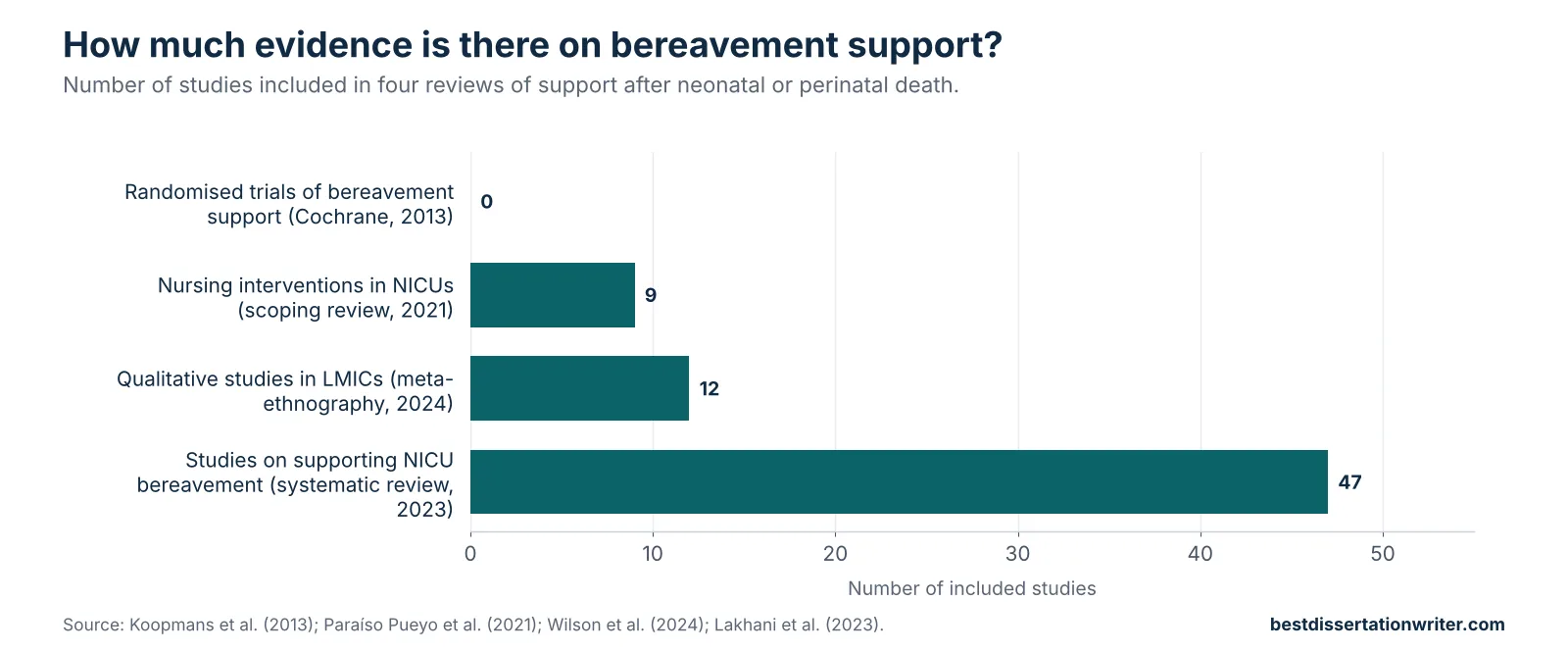
The lack of trials on neonatal loss reflects the sensitivity of the topic and the difficulty of randomising bereaved families, rather than a lack of need. It means that bereavement care after neonatal loss must be guided largely by qualitative evidence, parents’ accounts and professional consensus. Nurses should therefore pay close attention to what parents say they value, and units should evaluate their own bereavement services.
Theme 2: The Nature and Course of Parental Grief
A longitudinal study followed 130 mothers and 52 fathers of 140 children who died in neonatal or paediatric intensive care units, assessing grief at one, three, six and 13 months (Youngblut et al., 2018). Mothers’ grief decreased between three and 13 months, while fathers’ grief decreased between three and six months. Grief was more intense for mothers whose child was declared brain dead and for mothers of adolescents. The authors concluded that mothers and fathers may follow different patterns of grief and need different support.
These findings show that parental grief after neonatal loss is not a single process with a fixed timeline. Many parents are still grieving intensely months after the death, when contact with the neonatal unit has usually ended. Fathers’ apparently quicker decline may reflect genuine differences or different ways of expressing grief, and both parents may need support that recognises their individual experiences.
For nurses, this has implications for the timing and content of follow-up. A single bereavement meeting a few weeks after the death may not meet the needs of parents whose grief remains intense for many months. Information about where to find support at later stages, such as anniversaries and subsequent pregnancies, and contact from a known professional, may be valuable.
Subsequent pregnancies are a particular point of vulnerability. Parents who have experienced neonatal loss often face high anxiety in later pregnancies and after the birth of another baby, especially if that baby also needs neonatal care. Continuity with professionals who know their history, and sensitive recognition of their earlier loss, can make a significant difference.
Theme 3: What Parents Value in Care Around the Death
A systematic review of 47 studies from many countries examined how professionals can support parents when a baby dies in the neonatal intensive care unit (Lakhani et al., 2023). Four areas of support were often suboptimal: time caring for the baby, understanding parents’ perceptions of their baby’s suffering, communication with professionals and access to other support. Parents wanted a private, safe space to say goodbye, support in decision-making and bereavement follow-up after the loss.
A meta-ethnography of 12 qualitative studies from nine low- and middle-income countries examined experiences of care after neonatal death in health facilities (Wilson et al., 2024). Parents valued staff support, separate spaces and opportunities to see or hold their baby, while ward organisation, costs and lack of community recognition of their grief caused distress. The authors concluded that bereavement care is shaped by the individual, the healthcare setting and the local context, so guidance must be culturally appropriate and locally adapted.
Together, these reviews show that what parents value is consistent across very different settings: time and privacy with their baby, honest and compassionate communication, involvement in decisions and care, and continuing support after they leave the unit. How these are provided must be adapted to culture, religion and resources, but the underlying needs are shared.
The meta-ethnography is especially important because most bereavement research comes from high-income countries. In settings where neonatal loss is more common and resources are limited, families may face crowded wards, costs for burial or transport and cultural expectations about mourning that differ from those assumed in Western guidance. Bereavement care in neonatal units worldwide must therefore be grounded in local knowledge and in conversation with families.
Discussion
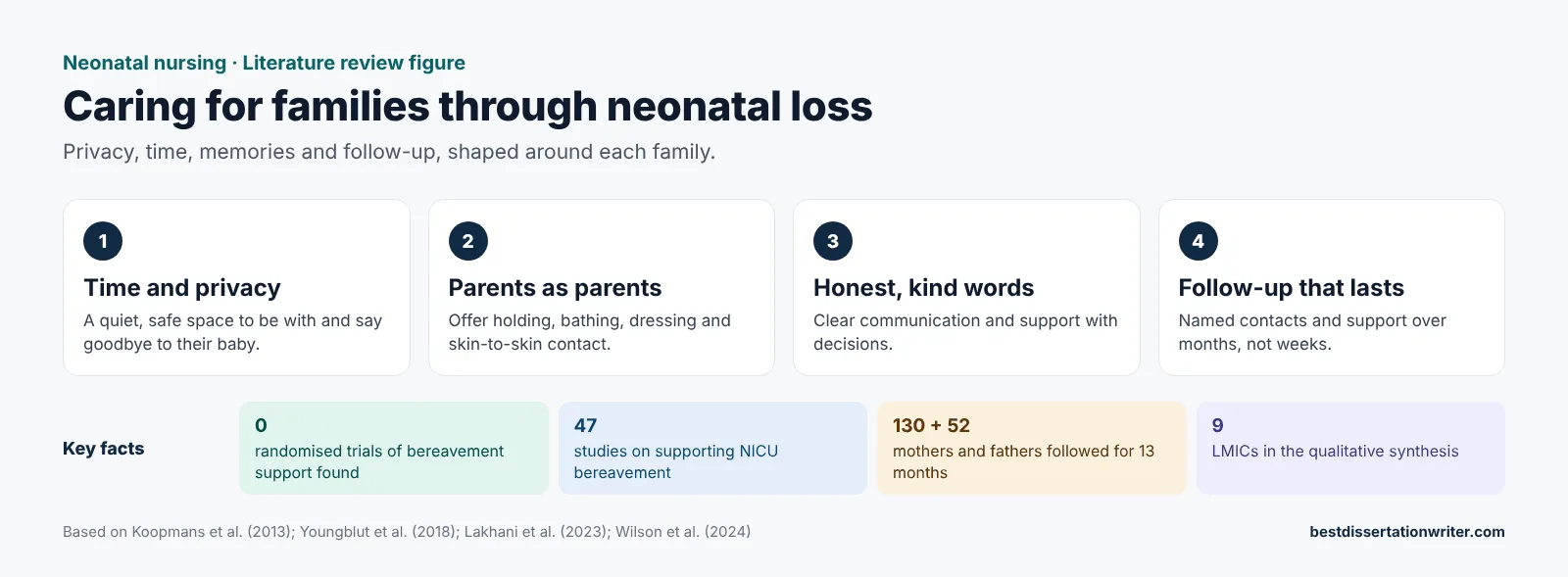
This review found that there is very little trial evidence on bereavement interventions after neonatal loss, but substantial qualitative evidence on what parents need. Parental grief is intense and prolonged, and mothers and fathers may follow different patterns. Parents consistently value privacy, time with their baby, compassionate communication, involvement in care and continuing follow-up, while lack of space, poor communication and early discharge from support add to their distress.
Neonatal nurses are well placed to meet many of the needs that follow neonatal loss. They can create calm, private spaces, offer parents the chance to hold, bathe and dress their baby, help with memory-making, explain what is happening in clear language and stay with families. These actions are simple, but they require time, confidence and support from the wider team. Training in end-of-life communication and bereavement care can help nurses to feel prepared.
Continuity and follow-up after neonatal loss are areas where care often falls short. When families leave the unit, they may lose contact with the staff who knew their baby. Named bereavement nurses or coordinators, follow-up meetings with the consultant, and links with community services and charities can help to bridge this gap. The longitudinal study suggests that follow-up should extend over many months rather than weeks.
Staff wellbeing after neonatal loss is also important. Caring for dying babies and grieving families is emotionally demanding, and nurses may experience their own grief and moral distress, particularly when they disagree with decisions about treatment. Debriefing, clinical supervision and peer support can help nurses to sustain compassionate care without becoming overwhelmed.
This review has limitations. No randomised trials were available, the scoping review included only US studies, the longitudinal study combined neonatal and paediatric deaths, and qualitative findings may not apply to all families. This review relied on openly accessible, English-language sources and did not involve independent double screening. Future research should evaluate bereavement interventions using designs acceptable to families and include fathers, siblings and diverse communities.
Organisational support is essential if nurses are to provide this care consistently. Units need dedicated family rooms, cold cots, memory-making resources, clear guidance and staff with time to stay with families. National standards and bereavement care pathways can help to ensure that every family receives a minimum standard of care, regardless of where or when their baby dies.
Implications of Neonatal Loss Evidence for Practice
Neonatal nurses should offer families privacy, unhurried time and the chance to hold and care for their baby, support skin-to-skin contact at the end of life where wished, building on kangaroo mother care, and offer memory-making that respects culture and religion. Principles from bereavement care following stillbirth can guide practice.
Parents’ distress before the death should be recognised as part of parental stress in the unit, and bereaved families should leave with a clear plan for follow-up, adapting the principles of discharge preparation to ensure that no family leaves without support.
Conclusion
This integrative review examined the evidence on parents’ experiences of neonatal loss and bereavement support. Trial evidence is lacking, but qualitative evidence consistently shows that parents value privacy, time with their baby, compassionate communication, involvement in care and continuing follow-up, and that grief is prolonged and differs between mothers and fathers.
Caring for a family whose baby dies is one of the most important things a neonatal nurse can do. Compassionate, culturally sensitive bereavement care, supported by training and by attention to staff wellbeing, can help parents to carry their grief with fewer regrets.
References
Koopmans, L., Wilson, T., Cacciatore, J., & Flenady, V. (2013). Support for mothers, fathers and families after perinatal death. Cochrane Database of Systematic Reviews, (6), CD000452. https://doi.org/10.1002/14651858.CD000452.pub3
Lakhani, J., Mack, C., Kunyk, D., Kung, J., & van Manen, M. (2023). Considerations for practice in supporting parental bereavement in the neonatal intensive care unit: A systematic review. Journal of Palliative Care. https://doi.org/10.1177/08258597231158328
Paraíso Pueyo, E., González Alonso, A. V., Botigué, T., Masot, O., Escobar Bravo, M. Á., & Lavedán, A. (2021). Nursing interventions for perinatal bereavement care in neonatal intensive care units: A scoping review. International Nursing Review, 68(1), 122–137. https://doi.org/10.1111/inr.12659
Wilson, C., Atkins, B., Molyneux, R., Storey, C., & Blencowe, H. (2024). Parents’, families’, communities’ and healthcare professionals’ experiences of care following neonatal death in healthcare facilities in LMICs: A systematic review and meta-ethnography. BJOG: An International Journal of Obstetrics and Gynaecology. https://doi.org/10.1111/1471-0528.17982
Youngblut, J. M., Brooten, D., Glaze, J., Promise, T., & Yoo, C. (2018). Parent grief 1–13 months after death in neonatal and pediatric intensive care units. Journal of Loss and Trauma. https://digitalcommons.fiu.edu/cnhs_fac/38
Cite this example
Best Dissertation Writers (2026) Bereavement Support for Parents After Neonatal Loss: A Qualitative Evidence Synthesis. Available at: https://bestdissertationwriter.com/neonatal-loss-literature-review/
Best Dissertation Writers
Get expert help with your nursing literature review
Share your topic and deadline with Best Dissertation Writers and get support tailored to your module brief.