Discharge Preparation and Transition to Home for Parents of Premature Infants: A Systematic Review
 By Dr. Robertson Prime, Research Fellow
Updated October 17, 2026
14 min read
About 2,900 words
In this review
Abstract
Background: Discharge preparation helps parents of premature infants to gain the knowledge, skills and confidence they need to care for their baby at home after weeks or months in a neonatal unit. The transition home is a time of excitement but also anxiety, and poor preparation can lead to emergency visits, readmissions and distress.
Aim: This systematic review aimed to examine the evidence on discharge preparation and the transition home for parents of premature infants.
Methods: Evidence was identified through targeted searches of openly accessible bibliographic records, publisher websites and the reference lists of key reviews. Five sources published between 2016 and 2026 were included: a before-and-after study, a cluster randomised trial, a narrative review, a qualitative meta-synthesis and a non-randomised controlled study, synthesised narratively.
Findings: A family-centred discharge package in four UK neonatal units improved parents’ understanding and preparedness, and emergency department visits in the eight weeks after discharge fell from 31 to 20. A family-integrated care model shortened adjusted length of stay by 2.55 days without increasing readmissions. Reviews found that parents need psychological support, practical skills and continuity of care after discharge, and that preparation should begin early in the admission.
Conclusion: Neonatal nurses should begin discharge preparation early, involve parents in daily care, provide individualised teaching and ensure continuity of support after the baby goes home.
Keywords: discharge preparation, premature infants, transition home, parental readiness
Introduction
This systematic review critically examines recent evidence on discharge preparation and its implications for neonatal nursing practice.
For parents of premature infants, taking their baby home is a long-awaited moment. After weeks or months of watching monitors, learning about breathing and feeding, and relying on nurses for their baby’s care, they suddenly become responsible around the clock. Many parents feel excited and relieved, but also anxious and uncertain about whether they will recognise problems, manage feeding and medicines, and cope without staff nearby.
Premature infants often go home with ongoing needs. They may still be learning to breastfeed or bottle-feed, need medicines or supplements, have appointments with several specialists, require oxygen at home or need monitoring for growth and development. Parents also need to understand safe sleep, infection prevention, immunisations and when to seek help. Without good preparation, the transition home can lead to emergency visits, readmissions and parental distress.
Neonatal nurses are central to discharge preparation. They teach parents practical skills, assess readiness, coordinate with other professionals and community services, and provide the information and reassurance that parents need. Increasingly, preparation is seen not as a task in the final days before discharge but as a process that begins on admission and runs throughout the stay.
A systematic review approach was chosen to bring together evidence from intervention studies and reviews of parents’ experiences, and to judge how well current practice prepares families.
Discharge preparation is also a matter of safety. Errors in medicines at home, missed follow-up appointments and late recognition of illness can all lead to harm in the first weeks after discharge. Structured preparation that checks parents’ understanding, provides written and verbal information and confirms follow-up arrangements reduces the chance that important details are lost during the transition from hospital to home.
Review question
What does the evidence show about discharge preparation and the transition home for parents of premature infants?
Background to Discharge Preparation
Discharge readiness has several dimensions. Infant readiness includes stable breathing, temperature control and feeding, with adequate weight gain. Parental readiness includes knowledge, practical skills, confidence and emotional preparedness to care for the baby. Family and community readiness includes home circumstances, support networks and follow-up services. A baby may be medically ready to go home before parents feel ready, and the reverse can also occur.
Traditional discharge preparation often relied on teaching sessions and checklists completed in the days before discharge. Parents could feel rushed and overwhelmed, receiving large amounts of information at once. Newer approaches emphasise involving parents in care from early in the admission, giving them a clear picture of their baby’s expected progress, setting realistic discharge dates and building skills gradually.
Family-centred and family-integrated care models support discharge preparation by making parents the primary caregivers while their baby is still in hospital. Parents who have fed, bathed and comforted their baby throughout the stay, and who have taken part in ward rounds, may be more confident at discharge. Some units also offer rooming-in before discharge, allowing parents to care for their baby overnight with staff nearby.
The transition home continues after discharge. Outreach nursing, telephone follow-up, community neonatal teams and parent support groups can help families through the first weeks. Coordination between hospital and community professionals, and clear communication about who to contact with concerns, are essential parts of the transition home.
Fathers and other caregivers should be included in discharge preparation. In many families, both parents share care at home, and grandparents or other relatives may help. Teaching sessions scheduled only during weekday hours may exclude working parents, so flexible timing, recorded resources and opportunities to practise skills at weekends or in the evening can help to involve the whole family.
Search Strategy and Methods
Evidence for this example was identified through targeted searches of openly accessible bibliographic records, publisher websites and the reference lists of key reviews. Search terms combined keywords for the concept (“discharge preparation”, “discharge planning”, “discharge readiness”, “transition home”) with terms for the population and outcomes (“premature infants”, “preterm”, “neonatal intensive care”, “parents”, “readmission”, “emergency department”, “confidence”), joined with the Boolean operators AND and OR. A full systematic review for assessment would run the same strategy in CINAHL, PubMed/MEDLINE, the Cochrane Library and Embase and report the number of records screened in a PRISMA flow diagram.
Sources were eligible if they evaluated interventions to prepare parents of premature infants for discharge, or synthesised parents’ experiences and needs around discharge, using any design. Intervention studies and reviews were prioritised, and recent qualitative syntheses were included because they describe what parents need from preparation. Studies of term infants only were excluded.
Five sources published between 2016 and 2026 were included: a multicentre before-and-after study, a cluster randomised controlled trial, a narrative review, a qualitative systematic review and meta-synthesis, and a non-randomised controlled study (Table 1). The quality of each source was considered using the Critical Appraisal Skills Programme (CASP) checklists, and findings were synthesised narratively.
Key Findings on Discharge Preparation
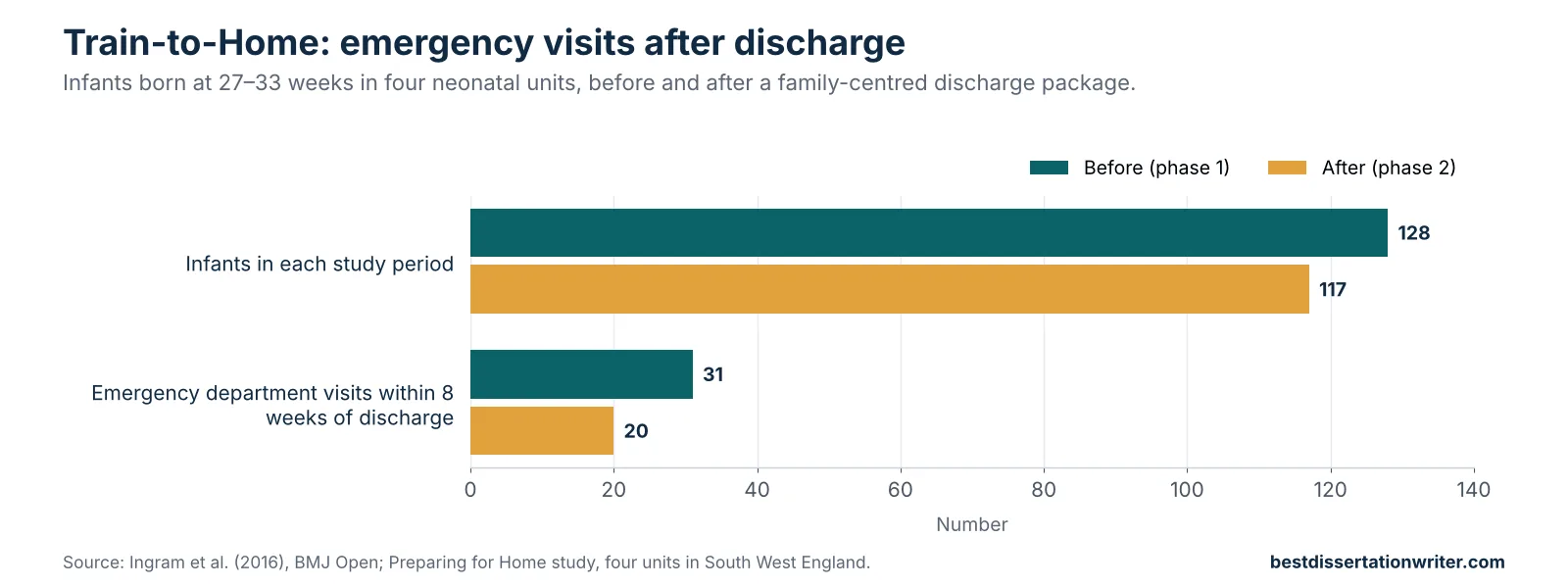
Three themes were identified: structured family-centred discharge programmes, parents’ needs and experiences of the transition home, and the role of parental involvement throughout the stay. Table 1 summarises the included sources, and Figure 1 shows the change in emergency visits after a family-centred discharge package.
| Author, year | Design | Setting and sample | Key finding |
|---|---|---|---|
| Ingram et al. (2016) | Multicentre before-and-after study (Train-to-Home) | Infants 27–33 weeks, 4 neonatal units, South West England | Better understanding and preparedness; ED visits in 8 weeks fell from 31 to 20; self-efficacy unchanged. |
| Benzies et al. (2020) | Pragmatic cluster randomised controlled trial | 10 level II NICUs, Alberta, Canada; infants 32–34 weeks | Adjusted length of stay 2.55 days shorter; no increase in readmissions or ED visits. |
| Taylor and Hambridge (2025) | Narrative review with thematic synthesis | 7 qualitative studies, 2018–2022 | Themes of communication, training, parental mental health and empowerment; preparation should start at birth. |
| Wu et al. (2025) | Qualitative systematic review and meta-synthesis | 12 studies, 204 parents of preterm infants | Needs for psychological support, information and skills, and continuity of services after discharge. |
| Zhu et al. (2026) | Non-randomised controlled study | 84 families of infants 28–34 weeks, China | Family-integrated care improved discharge readiness and reduced parental distress at 3 months. |
Theme 1: Structured Family-Centred Discharge Programmes
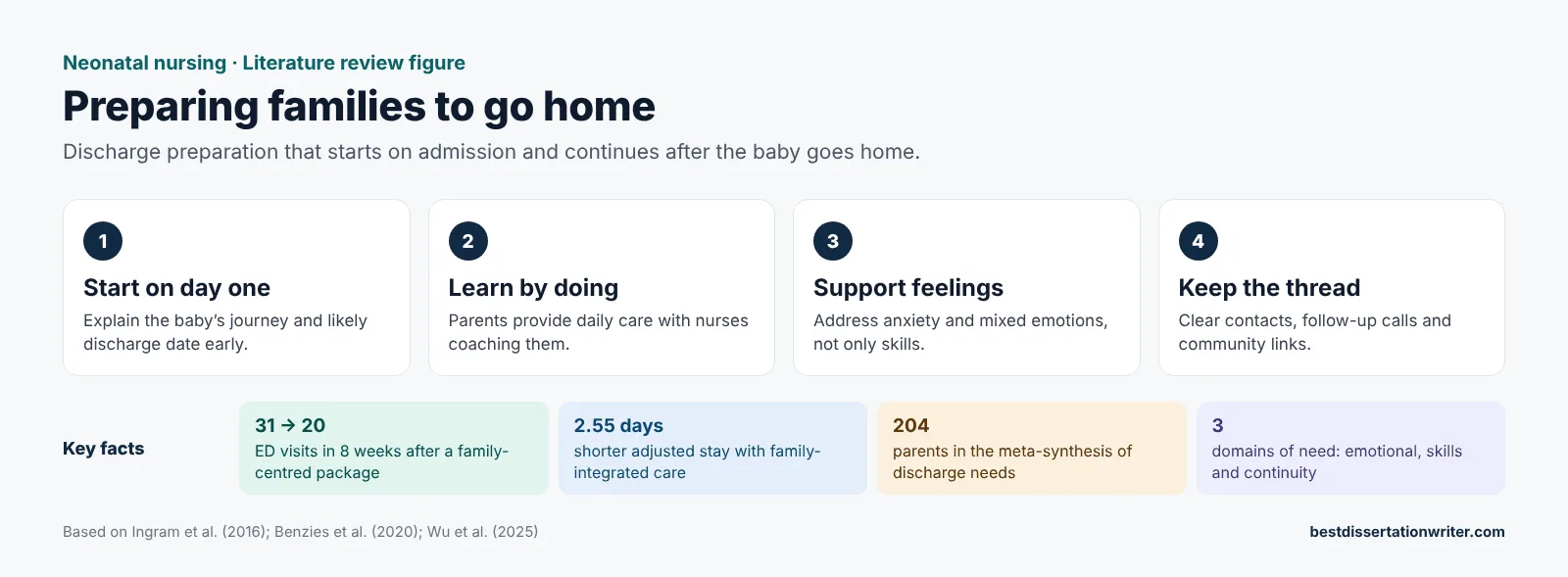
The Train-to-Home study introduced a family-centred discharge package in four local neonatal units in South West England for infants born at 27 to 33 weeks (Ingram et al., 2016). The package used a train graphic and care pathways to explain the baby’s progress and physiological maturation, and gave parents a better estimate of the likely discharge date. Parents reported better understanding of their baby’s progress and greater preparedness for discharge, although scores on a parenting self-efficacy measure did not change.
Emergency department visits in the eight weeks after discharge fell from 31 before the package to 20 after it. Many infants were already discharged more than three weeks before their due date, which limited scope to reduce length of stay further. As a before-and-after study, it cannot exclude other changes over time, but it shows how simple, visual tools can help parents to understand their baby’s journey and feel more prepared.
A cluster randomised trial in ten level II neonatal units in Alberta, Canada, tested a family-integrated care model with relational communication, parent education and parent support for infants born at 32 to 34 weeks (Benzies et al., 2020). After adjustment for site and infant factors, infants in the intervention group went home 2.55 days earlier, without increases in readmissions or emergency visits. Maternal distress and parenting self-efficacy did not differ significantly between groups.
The two intervention studies point to different but complementary benefits. The UK package focused on understanding and expectations, and was linked to fewer emergency visits after discharge, while the Canadian model focused on relationships, education and support during the stay, and was linked to earlier discharge. Both suggest that well-designed discharge preparation can benefit families and services without compromising safety.
Theme 2: Parents’ Needs and the Transition Home
A qualitative systematic review and meta-synthesis of 12 studies with 204 parents of preterm infants identified three areas of discharge planning need (Wu et al., 2025). Parents needed psychological and social support for anxiety, fear and adjustment to their new role; information and skills, including medical knowledge, practical care and specialised feeding support; and continuity of services, including access to specialist resources and integration of family and social support. The authors described parents’ experience as an imbalance between their needs and the preparation they received.
A narrative review of seven qualitative studies examined how prepared parents feel when taking their premature baby home (Taylor and Hambridge, 2025). Four themes emerged: communication, training, parental mental health and empowerment. Many parents felt prepared, but some had mixed feelings and anxiety before and after discharge. The authors recommended family-centred care, strong communication and parent empowerment, and argued that discharge preparation should begin at birth and continue throughout the admission.
These reviews show that parental readiness involves more than practical skills. Parents need emotional support, clear and consistent information, and confidence that help will be available after discharge. Anxiety does not simply disappear when parents learn to feed or give medicines, and preparation must address the psychological dimension of leaving the security of the neonatal unit.
Theme 3: Parental Involvement Throughout the Stay
A non-randomised controlled study in China compared 42 families receiving family-integrated care with 42 receiving standard care for infants born at 28 to 34 weeks (Zhu et al., 2026). Parents in the family-integrated care group had higher discharge readiness and, three months after discharge, fewer positive screens for trauma and post-traumatic stress and lower anxiety, depression and stress. Infants reached full enteral feeding earlier and had higher discharge weights. The small, non-randomised design limits certainty.
Together with the Canadian trial, this study suggests that involving parents in their baby’s care throughout the admission may be one of the most effective forms of discharge preparation. Parents who have practised care with nurses’ support develop skills and confidence gradually, rather than in a rush at the end, and may experience less distress after discharge.
This approach also changes the role of nurses. Instead of delivering teaching at the end of the stay, nurses coach parents from the beginning, assess their growing competence and adjust support to each family’s needs. Discharge preparation becomes woven into everyday care, supported by clear goals, realistic discharge estimates and regular review of parental readiness.
Rooming-in before discharge offers another way to build confidence. Spending one or more nights caring for their baby in a private room on the unit, with nurses nearby, allows parents to experience night-time feeds and settling before they are on their own. Although the included studies did not evaluate rooming-in directly, it is consistent with the parents’ needs identified in the qualitative reviews and with family-integrated approaches to discharge preparation.
Discussion
This review found that family-centred and family-integrated approaches to discharge preparation improve parents’ understanding and readiness, may reduce emergency visits and length of stay, and do not increase readmissions. Reviews of parents’ experiences show that they need psychological support, practical skills, clear communication and continuity of care, and that preparation should begin early in the admission.
The evidence highlights the importance of the emotional side of the transition home. Parents of premature infants have often experienced trauma, separation and uncertainty, and may carry anxiety into the early weeks at home. Discharge preparation that focuses only on tasks may leave these needs unaddressed. Nurses can help by asking parents how they feel about going home, normalising mixed emotions and linking them with emotional support.
Continuity after discharge is a recurring gap. Parents value knowing who to contact, receiving follow-up calls or visits and having access to community neonatal services. Units should ensure that every family leaves with clear information about warning signs, follow-up appointments and contact numbers, and that community teams receive timely information about the baby and family.
Equity also matters. Families with limited English, low health literacy, social disadvantage or long distances to travel may find it harder to take part in care during the stay and to access support after discharge. Interpreters, accessible materials, travel support and tailored follow-up can help to ensure that all families are well prepared.
This review has limitations. The included intervention studies were a before-and-after study, a trial in one region and a small non-randomised study, and the qualitative reviews drew heavily on studies from particular countries. This review relied on openly accessible, English-language sources and did not involve independent double screening. Future research should test structured discharge programmes with outcomes such as readmissions, parental mental health and infant development.
Finally, discharge preparation should be evaluated locally. Units can track readmissions, emergency visits, parents’ reported readiness and feedback from community teams, and use these data to improve their programmes. Listening to parents after discharge, for example through follow-up calls or surveys, can show which parts of discharge preparation helped and where gaps remain.
Implications of Discharge Preparation Evidence for Practice
Neonatal nurses should start discharge preparation on admission, involve parents in daily care, explain the baby’s expected progress with visual tools, give realistic discharge estimates and assess parental readiness regularly. Kangaroo care and parent participation, as described for kangaroo mother care and family-integrated care, build skills and confidence.
Teaching should include safe sleep practices, feeding, medicines and warning signs, and parents should know how to comfort their baby during immunisations and other procedures, drawing on evidence about procedural pain in neonates. Follow-up arrangements should be confirmed and written down for parents before discharge.
Community partners are part of the team. Health visitors, general practitioners, community neonatal nurses and early intervention services all contribute to the weeks and months after a premature baby goes home, and a short, clear handover from the neonatal unit helps them to pick up where hospital care ends and to recognise families who may need extra support in the early weeks at home.
Conclusion
This systematic review examined the evidence on discharge preparation and the transition home for parents of premature infants. Family-centred and family-integrated approaches improve parental readiness, may reduce emergency visits and length of stay, and do not increase readmissions, while parents need psychological support, skills and continuity of care.
Discharge preparation is a process, not a single event at the end of the stay. Neonatal nurses who involve parents from the start, communicate clearly and ensure support continues after discharge can help families to take their baby home with confidence.
References
Benzies, K. M., Aziz, K., Shah, V., Faris, P., Isaranuwatchai, W., Scotland, J., Larocque, J., Mrklas, K. J., Naugler, C., Stelfox, H. T., Chari, R., Soraisham, A. S., Akierman, A. R., Phillipos, E., Amin, H., Hoch, J. S., Zanoni, P., Kurilova, J., Lodha, A., & Alberta FICare Level II NICU Study Team. (2020). Effectiveness of Alberta Family Integrated Care on infant length of stay in level II neonatal intensive care units: A cluster randomized controlled trial. BMC Pediatrics, 20. https://doi.org/10.1186/s12887-020-02438-6
Ingram, J. C., Powell, J. E., Blair, P. S., Pontin, D., Redshaw, M., Manns, S., Beasant, L., Burden, H., Johnson, D., Rose, C., & Fleming, P. J. (2016). Does family-centred neonatal discharge planning reduce healthcare usage? A before and after study in South West England. BMJ Open, 6(3), e010752. https://doi.org/10.1136/bmjopen-2015-010752
Taylor, B., & Hambridge, K. (2025). ‘The transition home with a premature baby’: How prepared are parents for discharge from NICU: A narrative review. Journal of Neonatal Nursing, 31(2), 101601. https://doi.org/10.1016/j.jnn.2024.12.004
Wu, J., Li, L., Guo, X., & Hu, X. (2025). Needs for discharge planning among parents of preterm infants in the NICU: A systematic review and meta-synthesis. Frontiers in Public Health, 13, 1667721. https://doi.org/10.3389/fpubh.2025.1667721
Zhu, Y., Jiang, Y., Hong, F., Song, L., & Yang, X. (2026). Psychological outcomes and discharge readiness of parents of preterm infants in China after family integrated care. Frontiers in Pediatrics, 14, 1653759. https://doi.org/10.3389/fped.2026.1653759
Cite this example
Best Dissertation Writers (2026) Discharge Preparation and Transition to Home for Parents of Premature Infants: A Systematic Review. Available at: https://bestdissertationwriter.com/discharge-preparation-literature-review/
Best Dissertation Writers
Get expert help with your nursing literature review
Share your topic and deadline with Best Dissertation Writers and get support tailored to your module brief.