Thermoregulation and the Prevention of Hypothermia in Newborns: A Literature Review
 By Dr. Robertson Prime, Research Fellow
Updated October 17, 2026
14 min read
About 2,800 words
In this review
Abstract
Background: Thermoregulation is the ability to keep body temperature within a normal range, and newborns, especially preterm and low birthweight babies, lose heat rapidly after birth. Neonatal hypothermia is common worldwide and is associated with higher mortality and complications, so maintaining warmth is a fundamental part of newborn care.
Aim: This narrative review aimed to examine the evidence on hypothermia in newborns and on nursing interventions to support thermoregulation from birth to admission.
Methods: Evidence was identified through targeted searches of openly accessible bibliographic records, publisher websites and the reference lists of key reviews. Five sources published between 2007 and 2018 were included: two large cohort studies, a systematic review of global burden and two Cochrane reviews, synthesised narratively.
Findings: In a European cohort of very preterm infants, 53.4% had an admission temperature below 36.5°C, and temperatures below 35.5°C were linked to higher early mortality (risk ratio 2.41). In a US cohort, each 1°C fall in admission temperature was associated with a 28% increase in mortality. Plastic wraps or bags raised admission temperature by 0.58°C and reduced hypothermia (risk ratio 0.67), and kangaroo mother care reduced hypothermia (risk ratio 0.28).
Conclusion: Nurses and midwives should apply a warm chain from the delivery room onwards, using plastic wraps for very preterm babies, skin-to-skin contact for stable babies and regular temperature monitoring, while avoiding overheating.
Keywords: thermoregulation, neonatal hypothermia, plastic wrap, delivery room
Introduction
This narrative review critically examines recent evidence on thermoregulation and its implications for neonatal nursing practice.
At birth, a baby moves from the warmth of the womb into a much cooler environment while still wet with amniotic fluid. Heat is lost through evaporation, radiation, convection and conduction, and body temperature can fall within minutes. Healthy term babies can generate heat by breaking down brown fat, but this response is limited, and preterm and low birthweight babies have little fat, thin skin, a large surface area relative to their weight and immature control of temperature.
Neonatal hypothermia, usually defined as a temperature below 36.5°C, is therefore common, particularly in very preterm babies and in settings with limited equipment. Cold stress increases oxygen consumption and energy use, and can contribute to low blood sugar, breathing difficulties, acidosis and poor weight gain. Hypothermia on admission to the neonatal unit has been associated with higher mortality and complications in many studies.
Thermoregulation is largely a nursing and midwifery responsibility. Midwives and nurses dry and wrap babies, prepare warm delivery rooms, apply plastic wraps, place babies skin-to-skin, monitor temperature, manage incubators and radiant warmers, and teach parents how to keep their baby warm. Simple measures applied consistently can prevent much of the harm associated with heat loss.
A narrative approach was chosen because the evidence includes cohort studies of outcomes, a systematic review of global burden and Cochrane reviews of interventions, which are best interpreted together.
Thermoregulation in the first hour after birth is particularly important, because this is when heat loss is fastest and when babies may be exposed during assessment, resuscitation and procedures. The temperature recorded on admission to the neonatal unit reflects how well the warm chain worked during this period, which is why it is widely used as a marker of the quality of delivery room care.
Review question
What does the evidence show about hypothermia in newborns, and which interventions support thermoregulation from birth to admission?
Background to Thermoregulation
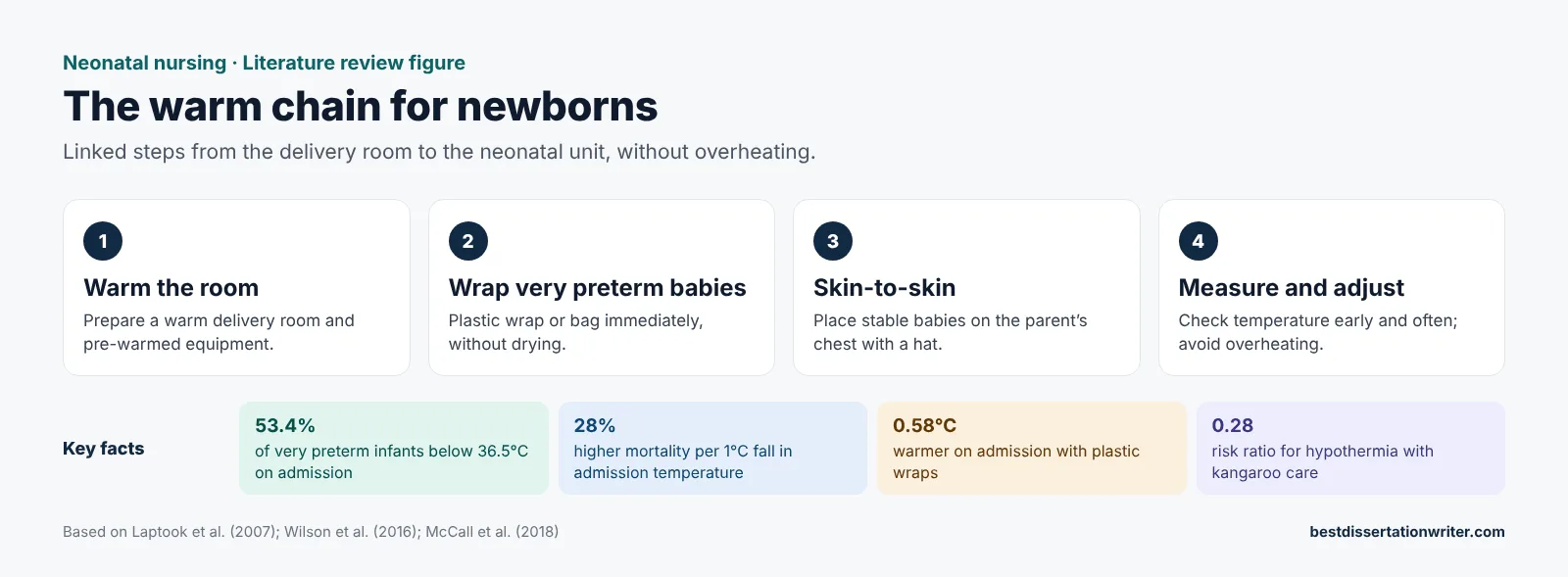
The World Health Organization has described a warm chain, a set of linked steps to keep newborns warm: a warm delivery room, immediate drying, skin-to-skin contact, early breastfeeding, delaying bathing and weighing, appropriate clothing and bedding, keeping mother and baby together, warm transport and warm resuscitation. If any link is broken, the baby may become cold.
For very preterm babies, additional measures are used. Placing the baby, without drying, in a polyethylene plastic wrap or bag immediately after birth reduces evaporative heat loss. Hats, thermal mattresses, radiant warmers, warmed and humidified gases for respiratory support, and raising the temperature of the delivery room can all contribute. Once in the neonatal unit, babies are cared for in incubators or under radiant warmers, with humidity to reduce water and heat loss through immature skin.
Thermoregulation must also avoid hyperthermia. Overheating, especially when several warming measures are combined, can be harmful, increasing oxygen consumption and possibly contributing to brain injury. Regular temperature monitoring, adjusting warming as the baby’s temperature changes and documenting temperatures from birth to admission help to keep babies in the normal range.
In many low- and middle-income countries, babies are born at home or in facilities without reliable heating or equipment. In these settings, skin-to-skin contact and kangaroo mother care are the most practical and effective means of thermal protection. Even in well-equipped hospitals, however, hypothermia on admission remains common, which suggests that the problem lies as much in consistent practice as in technology.
Parents also need to understand thermoregulation. Many are unsure how warmly to dress their baby, how warm the room should be or how to tell whether their baby is too hot or too cold. Teaching parents to feel the baby’s chest or back, to use a hat appropriately and to avoid overwrapping, especially when the baby is asleep, supports safe care in hospital and at home.
Search Strategy and Methods
Evidence for this example was identified through targeted searches of openly accessible bibliographic records, publisher websites and the reference lists of key reviews. Search terms combined keywords for the concept (“thermoregulation”, “hypothermia”, “admission temperature”, “heat loss”, “thermal care”) with terms for the population and interventions (“newborn”, “preterm”, “low birth weight”, “plastic wrap”, “polyethylene”, “skin-to-skin”, “delivery room”), joined with the Boolean operators AND and OR. A full narrative review for assessment would run the same strategy in CINAHL, PubMed/MEDLINE, the Cochrane Library and Embase and report the number of records screened in a PRISMA flow diagram.
Sources were eligible if they examined the prevalence or consequences of neonatal hypothermia, or evaluated interventions to prevent heat loss at or after birth. Large cohort studies were included because they show the association between admission temperature and outcomes, and Cochrane reviews were prioritised for evidence on interventions. Studies of therapeutic cooling for brain injury were excluded.
Five sources published between 2007 and 2018 were included: two large multicentre cohort studies, a systematic review of the global burden of neonatal hypothermia and two Cochrane systematic reviews (Table 1). The quality of each source was considered using the Critical Appraisal Skills Programme (CASP) checklists, drawing on the certainty ratings reported by the reviews, and findings were synthesised narratively.
Key Findings on Thermoregulation
Three themes were identified: the scale of hypothermia in newborns, its association with mortality and morbidity, and interventions that support thermoregulation from the delivery room onwards. Table 1 summarises the included sources, and Figure 1 shows how often very preterm and very low birthweight babies are cold on admission.
| Author, year | Design | Setting and sample | Key finding |
|---|---|---|---|
| Laptook et al. (2007) | Multicentre cohort study | 5,277 infants 401–1,499 g, US Neonatal Research Network | 14.3% below 35°C on admission; each 1°C fall linked to 28% higher mortality. |
| Lunze et al. (2013) | Systematic review | Global studies of neonatal hypothermia | Prevalence 32–85% in hospital births and 11–92% in home births; contributes to many deaths. |
| Conde-Agudelo and Díaz-Rossello (2016) | Cochrane systematic review | 21 trials, 3,042 low birthweight infants | Kangaroo mother care reduced hypothermia (RR 0.28, moderate certainty). |
| Wilson et al. (2016) | Population-based cohort study (EPICE) | 5,697 infants under 32 weeks, 11 European countries | 53.4% below 36.5°C; below 35.5°C linked to higher early mortality (RR 2.41). |
| McCall et al. (2018) | Cochrane systematic review | 25 studies, 2,433 preterm or low birthweight infants | Plastic wraps raised temperature by 0.58°C and reduced hypothermia (RR 0.67); more hyperthermia. |
Theme 1: How Common Is Neonatal Hypothermia?
A systematic review of the global burden of neonatal hypothermia found that it was common in all climates, including tropical settings (Lunze et al., 2013). Prevalence ranged from 32% to 85% among babies born in hospital and from 11% to 92% among those born at home. The authors noted that hypothermia is rarely a direct cause of death but contributes to a substantial proportion of neonatal deaths alongside infection, prematurity and asphyxia, and that thermoprotective practices such as skin-to-skin care had not been scaled up globally.
Hypothermia is also common in high-income countries. A cohort of 5,277 very low birthweight infants admitted to US Neonatal Research Network units found that 14.3% had an admission temperature below 35°C and a further 32.6% were between 35°C and 35.9°C (Laptook et al., 2007). In a European cohort of 5,697 infants born before 32 weeks in 19 regions of 11 countries, 53.4% had an admission temperature below 36.5°C and 12.9% below 35.5°C (Wilson et al., 2016).
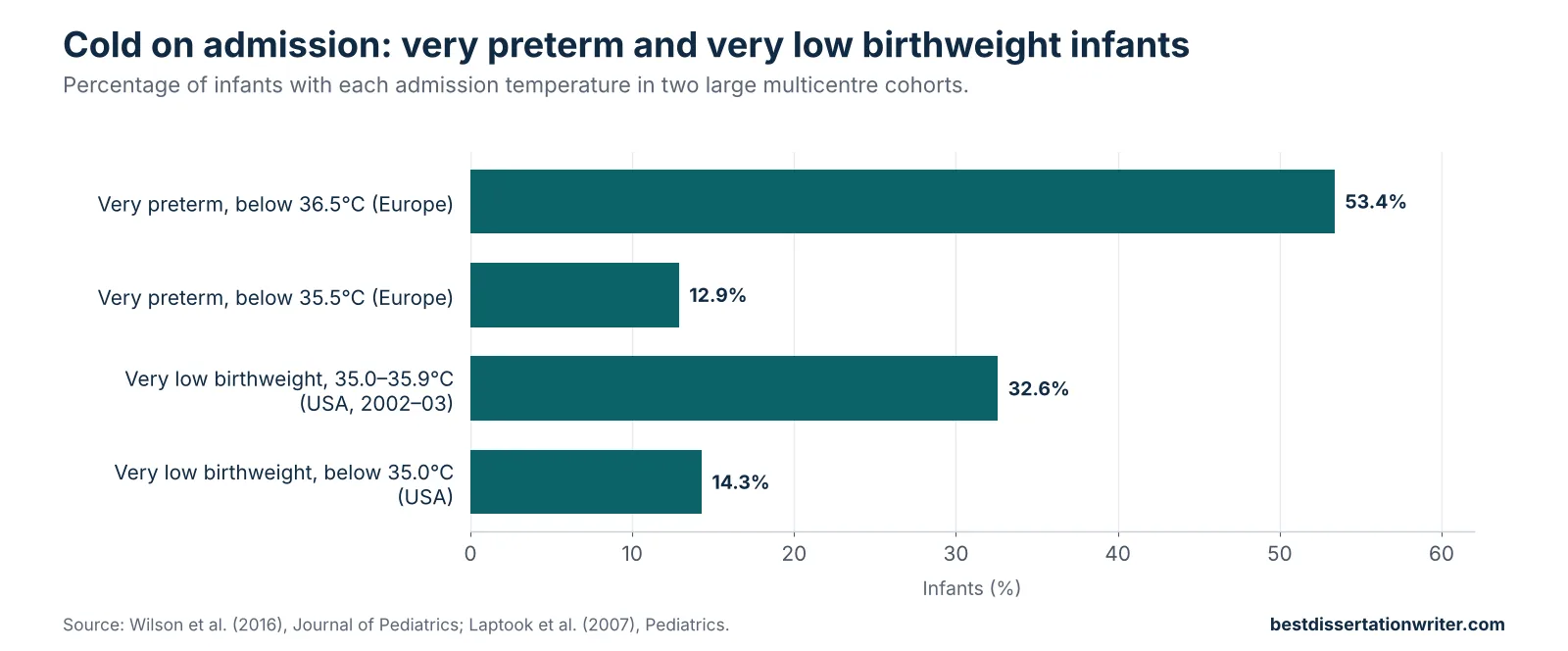
These figures show that more than half of very preterm babies in some settings arrive in the neonatal unit colder than recommended, despite access to warming technology. Variation between centres in both cohorts suggests that practices in the delivery room and during transfer, rather than unavoidable factors, account for much of the difference. This makes thermoregulation an important target for quality improvement.
The variation between centres is an encouraging finding for thermoregulation, because it suggests that improvement is achievable. Units with lower rates of hypothermia are likely to have reliable routines, such as raising the delivery room temperature before a preterm birth, having a plastic wrap ready in the resuscitation area, using pre-warmed transport incubators and measuring temperature soon after birth.
Theme 2: Admission Temperature, Mortality and Morbidity
In the US cohort, each 1°C decrease in admission temperature was associated with a 28% increase in mortality and an 11% increase in late-onset sepsis, after adjustment for other factors (Laptook et al., 2007). No adjusted associations were found with intraventricular haemorrhage, necrotising enterocolitis or duration of ventilation. The authors noted that it was unclear whether low temperature caused harm or was a marker of sicker babies.
In the European cohort, an admission temperature below 35.5°C was associated with a higher risk of death in the first week (risk ratio 2.41) and between 7 and 28 days (risk ratio 1.79), but not after 28 days, and with no association with neonatal morbidity (Wilson et al., 2016). The authors concluded that admission hypothermia after very preterm birth is a significant problem in Europe and is linked to a higher risk of early and late neonatal death.
These cohort studies cannot prove that hypothermia causes death, because sicker babies may be both colder and more likely to die. However, the consistent association across countries, the plausible mechanisms and the simplicity of prevention make maintaining normal temperature a sensible priority. Admission temperature is also widely used as a quality indicator for delivery room care.
The link between low temperature and late-onset sepsis is also notable. Cold stress may affect immune function, or cold babies may be sicker and more likely to need invasive procedures. Either way, good thermoregulation fits within a wider bundle of care aimed at stabilising preterm babies and protecting them from complications in the first days of life.
Theme 3: Supporting Thermoregulation From the Delivery Room
A Cochrane review of 25 studies with 2,433 preterm or low birthweight infants examined interventions to prevent hypothermia at birth (McCall et al., 2018). Plastic wraps or bags raised core temperature on admission by 0.58°C and reduced hypothermia (risk ratio 0.67), with moderate-certainty evidence, meaning that around four babies needed to be wrapped to prevent one case of hypothermia. However, plastic wraps increased hyperthermia (risk ratio 3.91), and no intervention was shown to reduce mortality.
The same review found that skin-to-skin contact reduced hypothermia in a single small trial, and that thermal mattresses raised temperature, but these comparisons were too small for firm conclusions. Combining warming measures, such as plastic bags with thermal mattresses, improved temperature but increased the risk of overheating, highlighting the need for careful monitoring (McCall et al., 2018).
For stable low birthweight babies, kangaroo mother care provides effective thermal protection. A Cochrane review found that it reduced hypothermia at discharge or 40 to 41 weeks’ postmenstrual age compared with conventional care (risk ratio 0.28), with moderate-certainty evidence, alongside reductions in mortality and infection (Conde-Agudelo and Díaz-Rossello, 2016). Skin-to-skin contact uses the parent’s body as a natural, adaptive heat source.
Together, the intervention reviews suggest a layered approach to thermoregulation. For very preterm babies, a plastic wrap or bag applied immediately is the best supported intervention, with additional measures used carefully. For stable babies of any size, skin-to-skin contact is both effective and beneficial in other ways. In all cases, temperature should be measured and the approach adjusted to avoid both cold and overheating.
Discussion
This review found that neonatal hypothermia is common worldwide, including in high-income countries, and that low admission temperature is consistently associated with higher mortality in preterm and low birthweight babies. Plastic wraps and skin-to-skin contact are effective in preventing hypothermia, although no trial has shown that preventing hypothermia reduces deaths. The evidence supports careful thermal care as a fundamental part of newborn care.
The persistence of hypothermia in well-equipped units suggests that the main challenge is reliable practice. Delivery rooms may be too cold, wraps may not be applied immediately, babies may be exposed during resuscitation or transfer, and temperatures may not be measured until admission. Checklists, warm delivery room policies, pre-warmed transport incubators and audit of admission temperatures can help to close these gaps.
The risk of overheating must be balanced against the risk of cold. As more warming measures are used together, temperatures should be monitored frequently, and warming adjusted accordingly. Thermoregulation is not about making babies as warm as possible, but about keeping them within the normal range.
Thermal care also connects with other aspects of neonatal nursing. Skin-to-skin contact supports breastfeeding and bonding as well as warmth, and minimising handling and exposure supports developmental care and reduces stress. Teaching parents how to dress their baby, how to check temperature and how to keep the room at a suitable temperature prepares them for safe care at home.
This review has limitations. The cohort studies show associations rather than causation, the global review relied on varied definitions of hypothermia, and several intervention comparisons were based on small trials. This review relied on openly accessible, English-language sources and did not involve independent double screening. Future research should test whether improved thermal care reduces mortality and evaluate implementation strategies in different settings.
Quality improvement programmes have focused on thermoregulation in many neonatal networks, often using admission temperature as their main measure. Such programmes typically combine staff education, checklists, equipment changes and feedback of data. Nurses and midwives are central to these programmes, because they carry out most of the steps that keep babies warm.
Implications of Thermoregulation Evidence for Practice
Nurses and midwives should ensure a warm delivery room, dry and wrap term babies immediately, place very preterm babies in plastic wraps or bags without drying, use hats and pre-warmed equipment, and measure temperature soon after birth and on admission. Stable babies should be placed skin-to-skin, building on evidence for skin-to-skin contact and kangaroo mother care.
Temperature stability supports developmental care by reducing stress, and babies with neonatal abstinence syndrome may need particular attention because of increased activity and sweating. Units should audit admission temperatures and act on the findings.
Conclusion
This narrative review examined the evidence on hypothermia in newborns and interventions that support thermoregulation. Hypothermia is common worldwide and associated with higher mortality, while plastic wraps and skin-to-skin contact are effective in preventing it, although effects on mortality remain unproven.
Thermoregulation is a simple but essential part of newborn care. Nurses and midwives who maintain a reliable warm chain from the delivery room to the neonatal unit, and who monitor temperature carefully, can protect vulnerable babies from avoidable harm.
References
Conde-Agudelo, A., & Díaz-Rossello, J. L. (2016). Kangaroo mother care to reduce morbidity and mortality in low birthweight infants. Cochrane Database of Systematic Reviews, (8), CD002771. https://doi.org/10.1002/14651858.CD002771.pub4
Laptook, A. R., Salhab, W., Bhaskar, B., & Neonatal Research Network. (2007). Admission temperature of low birth weight infants: Predictors and associated morbidities. Pediatrics, 119(3), e643–e649. https://doi.org/10.1542/peds.2006-0943
Lunze, K., Bloom, D. E., Jamison, D. T., & Hamer, D. H. (2013). The global burden of neonatal hypothermia: Systematic review of a major challenge for newborn survival. BMC Medicine, 11, 24. https://doi.org/10.1186/1741-7015-11-24
McCall, E. M., Alderdice, F., Halliday, H. L., Vohra, S., & Johnston, L. (2018). Interventions to prevent hypothermia at birth in preterm and/or low birth weight infants. Cochrane Database of Systematic Reviews, (2), CD004210. https://doi.org/10.1002/14651858.CD004210.pub5
Wilson, E., Norman, M., Maier, R. F., Misselwitz, B., Howell, E. A., Zeitlin, J., Bonamy, A. K., Van Reempts, P., Martens, E., Martens, G., Pryds, O., Boerch, K., Hasselager, A., Huusom, L., Weber, T., Toome, L., Varendi, H., Truffert, P., Jarreau, P. H., … Fenton, A. (2016). Admission hypothermia in very preterm infants and neonatal mortality and morbidity. Journal of Pediatrics, 175, 61–67.e4. https://doi.org/10.1016/j.jpeds.2016.04.016
Cite this example
Best Dissertation Writers (2026) Thermoregulation and the Prevention of Hypothermia in Newborns: A Literature Review. Available at: https://bestdissertationwriter.com/thermoregulation-literature-review/
Best Dissertation Writers
Get expert help with your nursing literature review
Share your topic and deadline with Best Dissertation Writers and get support tailored to your module brief.