
Quality of Clinical Placements and Student Nurses’ Learning Experiences: An Integrative Review
 By Dr. Robertson Prime, Research Fellow
Updated October 25, 2026
14 min read
About 2,900 words
In this review
Abstract
Background: Clinical placements make up half of pre-registration nursing programmes, and the quality of the learning environment shapes what students learn and whether they stay in nursing. In the United Kingdom, the mentor model has been replaced by practice supervisors and practice assessors, making it timely to ask what makes a placement a good place to learn.
Aim: This integrative review aimed to examine how the quality of placements, and in particular supervision and the learning environment, influences student nurses’ learning experiences.
Methods: Evidence was identified through targeted searches of openly accessible bibliographic records, publisher websites and the reference lists of key reviews. Six sources published between 2010 and 2023 were included: two surveys, three systematic reviews and a regulatory standard, appraised with CASP checklists and synthesised thematically.
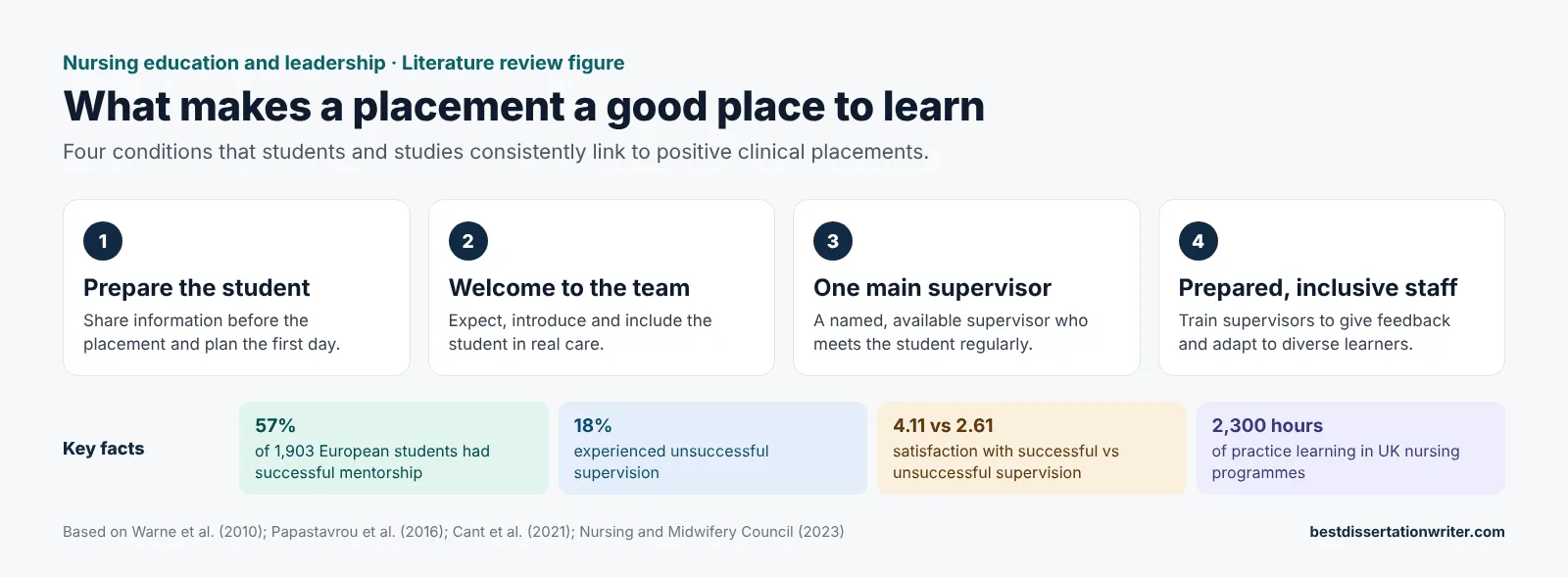
Findings: A survey of 1,903 students in nine European countries found that 57% had a successful mentorship experience and 18% experienced unsuccessful supervision. Students with successful supervision rated their satisfaction at 4.11 on a five-point scale compared with 2.61 for those whose supervision was unsuccessful. Qualitative syntheses showed that preparation, feeling welcomed and wanted, and consistent supervision helped learning, while exclusion, unsupportive staff and unrecognised cultural and language needs hindered it.
Conclusion: The supervisory relationship and a welcoming team are the strongest influences on placement learning. Nurse leaders should protect time for supervision, prepare staff for the role and treat students as members of the team.
Keywords: clinical placements, student experience, learning environment, mentorship
Introduction
This integrative review critically examines recent evidence on clinical placements and its implications for nursing education and leadership.
Practice learning is at the heart of nurse education. In the United Kingdom, students must complete 2,300 hours of practice learning, roughly half of their programme, and similar requirements apply in many other countries. Clinical placements are where students learn to apply theory, develop clinical skills and form a professional identity. They are also where many students decide whether nursing is the right career, so placement quality matters for the future workforce as well as for individual learners.
Yet placement experiences vary widely. Some students describe welcoming teams, attentive supervisors and steadily increasing responsibility, while others report feeling ignored, used as an extra pair of hands or unsure who is supervising them. Workforce shortages, high patient acuity and growing student numbers place pressure on the staff who support learners. The United Kingdom has also changed its supervision model, replacing named mentors with practice supervisors, practice assessors and academic assessors under the Nursing and Midwifery Council’s standards for student supervision and assessment.
An integrative design was chosen because the evidence includes surveys, qualitative studies and systematic reviews of both, and because an integrative approach allows these different forms of evidence to be combined into a single account of what makes clinical placements work.
Review question
How does the quality of clinical placements, especially supervision and the learning environment, influence student nurses’ learning experiences?
Background to Clinical Placements
The clinical learning environment is usually defined as everything that surrounds the student in practice and influences learning: the ward culture, the attitudes of staff, the quality of supervision, the range of patients and the links between the placement and the university. Instruments such as the Clinical Learning Environment, Supervision and Nurse Teacher (CLES+T) scale measure students’ perceptions of the pedagogical atmosphere, leadership style of the ward manager, premises of nursing, supervisory relationship and the role of the nurse teacher.
Supervision has taken different forms over time. Many European systems have used a named mentor who works alongside the student and assesses their progress, while others rely on group supervision by a clinical facilitator or a team approach. The United Kingdom’s 2019 standards separate supervision from assessment: any registered professional can act as a practice supervisor, while a practice assessor confirms achievement. Supporters argue that this widens the pool of supervisors, while critics worry about continuity and the loss of a single relationship.
Placement quality also affects equity. Students from culturally and linguistically diverse backgrounds, students with caring responsibilities and those with disabilities may face additional barriers in practice. Understanding how clinical placements support or hinder learning is therefore important for widening participation, reducing attrition and building a workforce that reflects the population it serves.
Clinical placements are also shaped by organisational pressures that sit outside the control of individual supervisors. Staffing shortages reduce the time registered nurses can spend teaching, while rising student numbers mean that several learners from different programmes may share one ward. Placement providers receive funding to support learners, but how this is used varies. Nurse leaders therefore influence the quality of clinical placements through rostering, allocation of supervisors, protected learning time and the priority given to education within the organisation’s wider workforce strategy.
Search Strategy and Methods
Evidence for this example was identified through targeted searches of openly accessible bibliographic records, publisher websites and the reference lists of key reviews. Search terms combined keywords for the setting (“clinical placements”, “practice learning”, “clinical learning environment”) with terms for the population and outcomes (“nursing student*”, “supervision”, “mentor*”, “student experience”, “satisfaction”), joined with the Boolean operators AND and OR. A full integrative review for assessment would run the same strategy in CINAHL, ERIC, PubMed/MEDLINE and Scopus and report the number of records screened in a PRISMA flow diagram.
Sources were eligible if they examined undergraduate or pre-registration nursing students’ experiences of clinical placements, supervision or the clinical learning environment, using any research design, or if they set regulatory standards for supervision in practice. Studies of postgraduate students, simulation without a practice component and opinion pieces were excluded, as were studies of clinical placements in professions other than nursing unless nursing students formed a distinct group. Systematic reviews and multi-site studies were prioritised to give breadth.
Six sources published between 2010 and 2023 were included: a multinational survey, a national survey, three systematic reviews (one of mentoring, one of culturally and linguistically diverse students and one thematic synthesis of qualitative studies) and the Nursing and Midwifery Council’s standards for supervision (Table 1). The quality of each source was appraised using the Critical Appraisal Skills Programme (CASP) checklist appropriate to its design, and findings were synthesised thematically.
Key Findings on Clinical Placements
Three themes were identified: the supervisory relationship as the core of placement learning, belonging and the welcome students receive on clinical placements, and the needs of diverse learners and the preparation of staff. Table 1 summarises the included sources, and Figure 1 shows how students’ satisfaction differed according to the success of their supervision.
| Author, year | Design | Setting and sample | Key finding |
|---|---|---|---|
| Warne et al. (2010) | Cross-sectional survey | 1,903 nursing students in nine European countries | Students generally satisfied; 57% had successful mentorship, 18% unsuccessful supervision. |
| Jokelainen et al. (2011) | Systematic review | 23 articles on mentoring nursing students (1986–2006) | Mentoring facilitates learning and strengthens professionalism; needs resources and mentor preparation. |
| Mikkonen et al. (2016) | Systematic review of qualitative studies | 12 studies of culturally and linguistically diverse healthcare students | Placements stressful at the start; barriers include unrecognised needs, assumptions and language. |
| Papastavrou et al. (2016) | Descriptive correlational survey (CLES+T) | 463 undergraduate nursing students, three universities, Cyprus | Supervisory relationship most influential; satisfaction 4.11 with successful vs 2.61 with unsuccessful supervision. |
| Cant et al. (2021) | Thematic synthesis of qualitative studies | 27 studies of undergraduate nursing students (2010–2020) | Preparation, being welcomed and wanted, and supervision experiences define a successful placement. |
| Nursing and Midwifery Council (2023) | Regulatory standards | Student supervision and assessment, United Kingdom (in effect since 2019) | Practice supervisors, practice assessors and academic assessors replace the mentor role. |
Theme 1: The Supervisory Relationship in Clinical Placements
In a survey of 1,903 nursing students in nine European countries, including England and Ireland, Warne et al. (2010) found that students were generally satisfied with their clinical placements. However, only 57% reported a successful mentorship experience, and some 18% experienced unsuccessful supervision. The large, multinational sample is a strength, but differences between national systems and the use of self-report mean that the findings describe perceptions rather than learning outcomes.
Papastavrou et al. (2016) surveyed 463 undergraduate nursing students in three universities in Cyprus using the CLES+T scale. Students were highly satisfied overall, with a mean of 4.1 on a five-point scale, and satisfaction was positively related to every dimension of the clinical learning environment. The supervisory relationship was the factor students rated as most influential. Students with successful supervision, meaning a named supervisor and an effective relationship, reported a mean satisfaction of 4.11, compared with 3.86 for group supervision and 2.61 where supervision was unsuccessful.
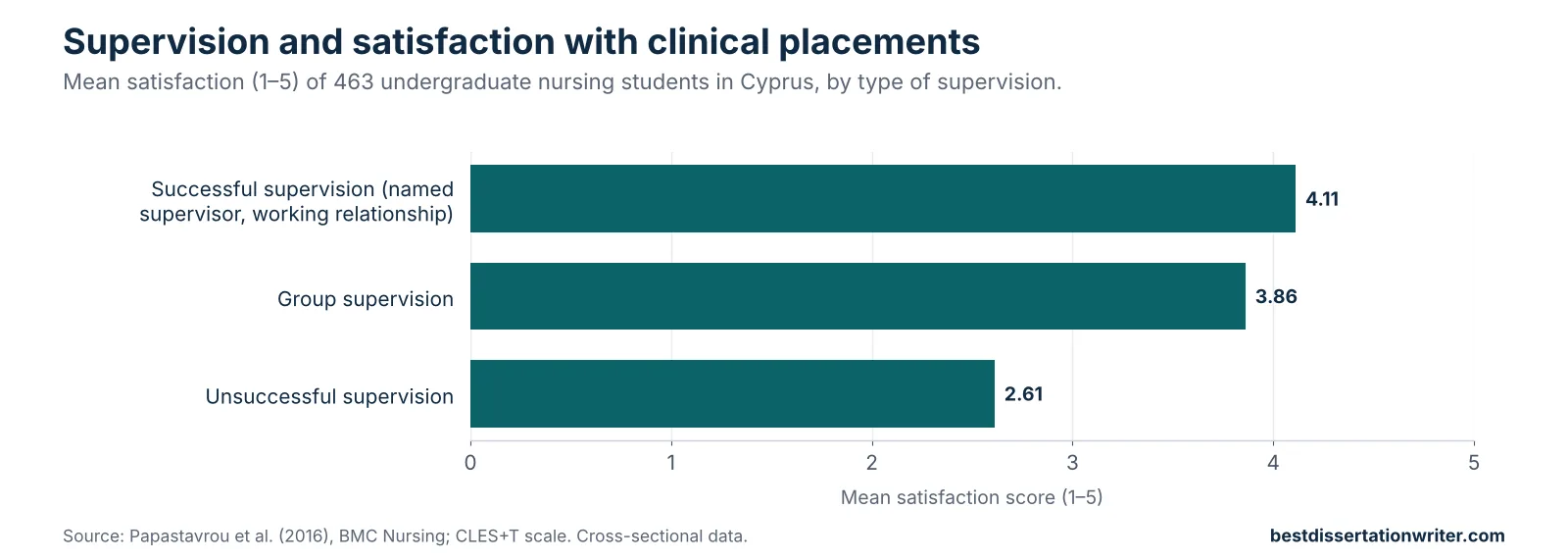
Students who met their supervisors more frequently also reported higher satisfaction. The study was cross-sectional and confined to one country, so it cannot show that better supervision causes better learning. Nevertheless, the size of the gap between successful and unsuccessful supervision is striking and consistent with the European survey: when the relationship fails, the student experience deteriorates sharply.
Jokelainen et al. (2011) reviewed 23 articles published over 20 years to clarify what mentoring involves. They described two main functions: facilitating learning by creating a supportive environment and enabling individual learning processes, and strengthening professionalism by developing professional attributes, identity and competence. The review concluded that an individual, mutual relationship was important and that organisations must provide resources and systematic preparation for mentors. Its sources are now dated, but its account of mentorship still describes what practice supervisors are expected to provide.
Theme 2: Belonging and Being Welcomed
Cant et al. (2021) synthesised 27 qualitative studies published between 2010 and 2020 on what helps and what hinders undergraduate nursing students’ learning on placement. Supportive instructors, close supervision and a sense of belonging within the team helped learning, whereas unsupportive instructors, a lack of supervision and not feeling included hindered it. Three overarching themes described a successful placement: preparation, being welcomed and wanted, and positive supervision experiences.
The emphasis on being welcomed is important for nurse leaders. A student who is expected, introduced to the team and given meaningful work is more likely to ask questions, take part in care and seek feedback. A student who is ignored or treated as a burden may withdraw, limiting their learning and their confidence. Because the welcome depends on the whole team rather than one supervisor, it reflects the culture of the ward and the leadership of the manager, which the CLES+T scale also captures.
Belonging also has consequences beyond a single placement. Students who feel excluded may begin to question whether nursing is right for them, and repeated poor experiences on clinical placements are often cited by students who consider leaving their programmes. Conversely, a placement where a student is trusted with increasing responsibility can confirm their choice of career and even their preferred specialty. Simple actions, such as learning the student’s name, explaining the routine of the ward and inviting the student to handovers, are low-cost ways for every team member to contribute to a positive learning environment.
Theme 3: Diverse Learners and Prepared Staff
Mikkonen et al. (2016) reviewed 12 qualitative studies of culturally and linguistically diverse healthcare students learning in clinical environments. Students often found the start of clinical placements stressful, and learning needed extra time, structured orientation and prior culture and language preparation. Barriers included staff failing to recognise students’ needs, assumptions that students lacked motivation, the strain of feeling different and language difficulties. Staff attitudes shaped students’ experiences and outcomes.
Preparation of staff is a recurring thread. Jokelainen et al. (2011) called for systematic mentor preparation, Mikkonen et al. (2016) recommended culture and language education for staff as well as students, and the United Kingdom’s standards require practice supervisors and assessors to be prepared for their roles (Nursing and Midwifery Council, 2023). The evidence suggests that preparation should cover not only assessment documentation but also how to welcome students, adapt support to individual needs and give constructive feedback.
Discussion
This review suggests that the supervisory relationship is the single most important influence on student nurses’ experience of clinical placements. Surveys in Europe and Cyprus and qualitative syntheses from many countries point in the same direction: students learn best when they have a named, available supervisor who welcomes them, involves them in care and meets with them regularly. When supervision fails, satisfaction falls sharply and learning is likely to suffer.
The evidence also shows that placement learning depends on the whole team and the ward culture, not only on individual supervisors. Feeling welcomed and wanted, being prepared before the placement and being treated as a member of the team were consistently described as conditions for learning. This places responsibility on ward managers and practice education leads, whose leadership shapes the learning environment as much as any individual supervisor.
The findings raise questions about the United Kingdom’s move from mentors to practice supervisors and assessors. The new model may widen the pool of supervisors and separate support from assessment, but the evidence reviewed here highlights the value of a consistent, individual relationship. If students are supervised by many different staff, the continuity that underpins successful mentorship may be lost unless placements allocate a main supervisor and protect time for meetings.
There is also a tension between satisfaction and learning. Students may be most satisfied on clinical placements where they feel comfortable, yet some of the most valuable learning occurs when they are stretched, given feedback on mistakes or exposed to complex care. A good supervisor balances support with challenge, and a good learning environment allows students to take on responsibility safely. Evaluations of clinical placements that rely only on satisfaction scores may therefore miss whether students have actually developed competence, which is why assessment of practice and student feedback need to be considered together.
Equity is a further concern. Students from culturally and linguistically diverse backgrounds faced specific barriers, and similar issues may affect other groups, such as students with disabilities or caring responsibilities. Staff preparation that addresses unconscious assumptions and practical adjustments could reduce these inequalities. Universities and practice partners also need clear routes for students to raise concerns about poor placements without fear of affecting their assessment.
The evidence base has limitations. Most studies relied on self-reported satisfaction and perceptions rather than measures of competence or patient outcomes, and many were cross-sectional. Several sources pre-date the United Kingdom’s current standards, and qualitative studies reflected specific programmes and countries. This review relied on openly accessible, English-language sources and did not involve independent double screening. Future research should evaluate the practice supervisor and assessor model, link placement quality to competence, retention and attrition, and include the voices of diverse students.
Implications of Clinical Placements Evidence for Practice
For nurse leaders, the evidence supports allocating every student a main practice supervisor, protecting time for regular meetings, and preparing staff to welcome, support and give feedback to learners. Ward managers should make sure that students are expected, introduced to the team and given meaningful work. Universities and practice partners should monitor student feedback, act on poor learning environments and provide additional orientation for students from diverse backgrounds.
Placement quality is closely linked to the workforce. Positive experiences may encourage students to join the teams that trained them, supporting nurse retention, and the learning environment reflects the transformational leadership of ward managers. Clinical placements can be complemented by simulation-based learning for situations students rarely see, and good supervision prepares students for preceptorship after qualification.
Conclusion
This integrative review examined how the quality of clinical placements influences student nurses’ learning experiences. The supervisory relationship was the strongest influence on satisfaction, with a large gap between students whose supervision succeeded and those whose supervision failed. Feeling welcomed, being prepared and having staff who understand diverse students’ needs were also central to learning.
For nursing education and leadership, the message is that clinical placements work when supervision is planned, protected and supported by a welcoming team culture. Investing in staff preparation and in the leadership of learning environments is likely to improve the student experience, reduce avoidable attrition and help build a confident, well-prepared future nursing workforce.
References
Cant, R., Ryan, C., Hughes, L., Luders, E., & Cooper, S. (2021). What helps, what hinders? Undergraduate nursing students’ perceptions of clinical placements based on a thematic synthesis of literature. SAGE Open Nursing, 7. https://doi.org/10.1177/23779608211035845
Jokelainen, M., Turunen, H., Tossavainen, K., Jamookeeah, D., & Coco, K. (2011). A systematic review of mentoring nursing students in clinical placements. Journal of Clinical Nursing, 20(19–20), 2854–2867. https://doi.org/10.1111/j.1365-2702.2010.03571.x
Mikkonen, K., Elo, S., Kuivila, H.-M., Tuomikoski, A.-M., & Kääriäinen, M. (2016). Culturally and linguistically diverse healthcare students’ experiences of learning in a clinical environment: A systematic review of qualitative studies. International Journal of Nursing Studies, 54, 173–187. https://doi.org/10.1016/j.ijnurstu.2015.06.004
Nursing and Midwifery Council. (2023). Standards for student supervision and assessment (Part 2 of Realising professionalism: Standards for education and training). https://www.nmc.org.uk/standards-for-education-and-training/standards-for-student-supervision-and-assessment/
Papastavrou, E., Dimitriadou, M., Tsangari, H., & Andreou, C. (2016). Nursing students’ satisfaction of the clinical learning environment: A research study. BMC Nursing, 15, 44. https://doi.org/10.1186/s12912-016-0164-4
Warne, T., Johansson, U.-B., Papastavrou, E., Tichelaar, E., Tomietto, M., Van den Bossche, K., Moreno, M. F. V., & Saarikoski, M. (2010). An exploration of the clinical learning experience of nursing students in nine European countries. Nurse Education Today, 30(8), 809–815. https://doi.org/10.1016/j.nedt.2010.03.003
Cite this example
Best Dissertation Writers (2026) Quality of Clinical Placements and Student Nurses’ Learning Experiences: An Integrative Review. Available at: https://bestdissertationwriter.com/clinical-placements-literature-review/
Best Dissertation Writers
Get expert help with your nursing literature review
Share your topic and deadline with Best Dissertation Writers and get support tailored to your module brief.