

Reflective Practice in Nursing Education: A Narrative Review
 By Dr. Robertson Prime, Research Fellow
Updated October 25, 2026
14 min read
About 2,800 words
In this review
Abstract
Background: Reflective practice is a cornerstone of nursing education in the United Kingdom, where students write structured reflections throughout their programmes and registered nurses must submit written reflective accounts every three years to revalidate. Despite this prominence, the evidence on how reflection should be taught and assessed is often taken for granted.
Aim: This narrative review aimed to examine what is known about the definition, teaching, assessment and value of reflection in nursing education and continuing professional development.
Methods: Evidence was identified through targeted searches of openly accessible bibliographic records, publisher websites and the reference lists of key reviews. Five sources published between 1988 and 2019 were included: a foundational model, a systematic review, an umbrella review, a literature review and the regulator’s revalidation requirements, appraised with CASP checklists where applicable and synthesised narratively.
Findings: Reviews found no common definition of reflection and concluded that evidence for curricular interventions remained largely theoretical. An umbrella review of 19 reviews linked reflective techniques with learning but identified problems with the validity and reliability of assessment. A review of 17 studies of reflective writing found improved clinical reasoning and awareness, although most students reflected at a descriptive level and needed guidance, scaffolding and feedback. Registered nurses must provide five written reflective accounts and a reflective discussion every three years.
Conclusion: Reflection is valuable when it is guided, supported and focused on learning rather than compliance. Educators and leaders should provide structured models, feedback and protected time, and avoid treating written reflections as a box-ticking exercise.
Keywords: reflective practice, nursing education, Gibbs, professional development
Introduction
This narrative review critically examines recent evidence on reflective practice and its implications for nursing education and leadership.
Nurses make complex decisions in uncertain, emotionally charged situations, and much of their expertise is learned from experience rather than textbooks. Reflection, the process of thinking carefully about experiences in order to learn from them, is widely seen as the bridge between experience and improved practice. It helps nurses to make sense of difficult events, recognise the limits of their knowledge, consider the perspectives of patients and colleagues, and plan how to act differently in future.
In the United Kingdom, reflective practice is embedded at every stage of a nursing career. Students write reflections on placement experiences and are assessed on their ability to reflect, while registered nurses must produce written reflective accounts and take part in a reflective discussion with another registrant as part of revalidation with the Nursing and Midwifery Council. Reflection is also central to clinical supervision, debriefing after incidents and learning from complaints.
Yet reflection is not without critics. Some students describe reflective writing as repetitive or artificial, written to satisfy assessors rather than to learn. Others worry about what happens to honest reflections on mistakes, particularly where legal or disciplinary processes may follow. These concerns raise questions about how reflection is defined, taught and assessed, and whether current approaches achieve their aims.
A narrative review was chosen because the literature is conceptually diverse, combining theoretical models, systematic and umbrella reviews and professional requirements, and a narrative approach allows these different types of source to be interpreted together and critically discussed.
Review question
What does the evidence say about the definition, teaching, assessment and value of reflective practice in nursing education and continuing professional development?
Background to Reflective Practice
The modern idea of reflection in professional education draws on several traditions. John Dewey described reflective thinking as active, persistent consideration of beliefs in the light of evidence. Donald Schön distinguished reflection-in-action, which occurs while practising, from reflection-on-action, which occurs afterwards, and argued that professionals learn by reflecting on situations that do not fit textbook rules. Experiential learning theory described learning as a cycle of experience, reflection, conceptualisation and experimentation.
In nursing, structured models help learners to reflect systematically. The most widely used in the United Kingdom is the reflective cycle developed by Gibbs (1988), which guides the learner through six stages: description, feelings, evaluation, analysis, conclusion and action plan. Other models, such as those of Johns, Driscoll and Rolfe, use cue questions such as what, so what and now what. These models make reflection accessible to students, but critics argue that rigid use can encourage formulaic writing.
Reflection can be individual or collective. Individual written reflections are the most common form in education and revalidation, but group reflection in clinical supervision, action learning sets, debriefing and Schwartz rounds allows staff to share experiences and learn from each other. Reflection may also be critical, examining assumptions, power and the wider context of care, rather than focusing only on the individual’s actions and feelings.
Digital tools have widened the forms reflective practice can take. Online journals, e-portfolios and recorded audio or video reflections allow students to capture experiences soon after they happen and to share them selectively with tutors or supervisors. Such tools can make reflection more immediate and allow teachers to respond with feedback, but they also raise questions about confidentiality and about whether reflection becomes another task to complete on a screen. As with written accounts, the value appears to depend on the quality of the dialogue that follows.
Reflective practice is closely linked to professional development. By identifying gaps in knowledge or skill, reflection directs nurses towards further learning, and by examining values and emotions, it supports resilience and professional identity. The Nursing and Midwifery Council requires registrants to link their reflective accounts to the Code, reinforcing the role of reflection in maintaining professional standards throughout a nursing career.
Search Strategy and Methods
Evidence for this example was identified through targeted searches of openly accessible bibliographic records, publisher websites and the reference lists of key reviews. Search terms combined keywords for the concept (“reflective practice”, “reflection”, “reflective writing”, “reflective journal*”, “Gibbs”) with terms for the context (“nursing education”, “nursing student*”, “health professions education”, “revalidation”, “professional development”), joined with the Boolean operators AND and OR. A full narrative review for assessment would run the same strategy in CINAHL, ERIC, PubMed/MEDLINE and Scopus and report the number of records screened in a PRISMA flow diagram.
Sources were eligible if they defined, evaluated or reviewed reflective practice in the education or professional development of nurses or other health professionals, or if they set regulatory requirements for reflection. Reviews were prioritised over single studies because the primary literature on reflective practice is large and heterogeneous. Opinion pieces without an evidence base were excluded, but the foundational model most widely used in United Kingdom nursing was included because of its influence on teaching and assessment.
Five sources published between 1988 and 2019 were included: one foundational model, one systematic review of reflection in health professions education, one umbrella review of 19 reviews, one literature review of 17 studies of reflective writing in nursing and the regulator’s revalidation requirements (Table 1). Reviews were appraised using the Critical Appraisal Skills Programme (CASP) checklist for systematic reviews, and all sources were synthesised narratively.
Key Findings on Reflective Practice
Three themes were identified: the conceptual uncertainty surrounding reflection, how reflective practice is learned and the conditions that support it, and the challenges of assessing reflection in education and revalidation. Table 1 summarises the included sources, and Figure 1 shows the revalidation requirements that make reflection a continuing professional duty for registered nurses.
| Author, year | Design | Setting and sample | Key finding |
|---|---|---|---|
| Gibbs (1988) | Foundational model | Experiential learning in further and higher education | Six-stage reflective cycle: description, feelings, evaluation, analysis, conclusion, action plan. |
| Mann et al. (2009) | Systematic review | 29 papers on reflection in health professions education | No common definition; evidence for curricular interventions largely theoretical. |
| Fragkos (2016) | Umbrella review | 19 reviews of reflection in healthcare education | Reflective techniques linked to learning; assessment raises validity and reliability problems. |
| Bjerkvik & Hilli (2019) | Literature review | 17 studies of reflective writing, undergraduate nursing | Improved clinical reasoning, but mostly descriptive; guidance and feedback essential. |
| Nursing and Midwifery Council (2019) | Regulatory requirements | All registered nurses and midwives, United Kingdom | Every three years: five written reflective accounts and a reflective discussion, plus CPD and feedback. |
Theme 1: What Reflective Practice Means
Mann et al. (2009) systematically reviewed the literature on reflection and reflective practice in health professions education, narrowing more than 600 papers to 29 that explicitly addressed the topic. A key finding was that there was no common definition of reflection, because researchers drew on different theoretical traditions and used varied terminology. The authors concluded that evidence to support curricular interventions remained largely theoretical and that it was unclear which approaches were effective.
Fragkos (2016) conducted an umbrella review of 19 reviews of reflection in healthcare education. Reflection was understood mainly as self-reflection and critical reflection, and the review noted tension between the idea of an epistemology of practice, in which professionals generate knowledge from experience, and evidence-based medicine, which privileges research evidence. This tension is relevant to nursing, where both experiential knowledge and research evidence are expected to inform care.
The lack of a shared definition has practical consequences. If educators, students and assessors hold different ideas of what reflection is, students may be unsure what is expected, and assessments may reward the use of a model’s headings rather than genuine insight. Mann et al. (2009) recommended that educators discuss explicitly what reflection means and encourage reflection on successes as well as failures, rather than assuming a shared understanding.
Theme 2: Learning Through Reflective Writing
Bjerkvik and Hilli (2019) reviewed 17 quantitative and qualitative studies of reflective writing in undergraduate clinical nursing education. Reflective writing improved students’ clinical reasoning and their awareness of clinical situations. However, most students reflected mainly at a descriptive level, with limited development of deeper reflective skills, and they focused on self-assessment and their own emotional reactions rather than on their thinking and learning processes.
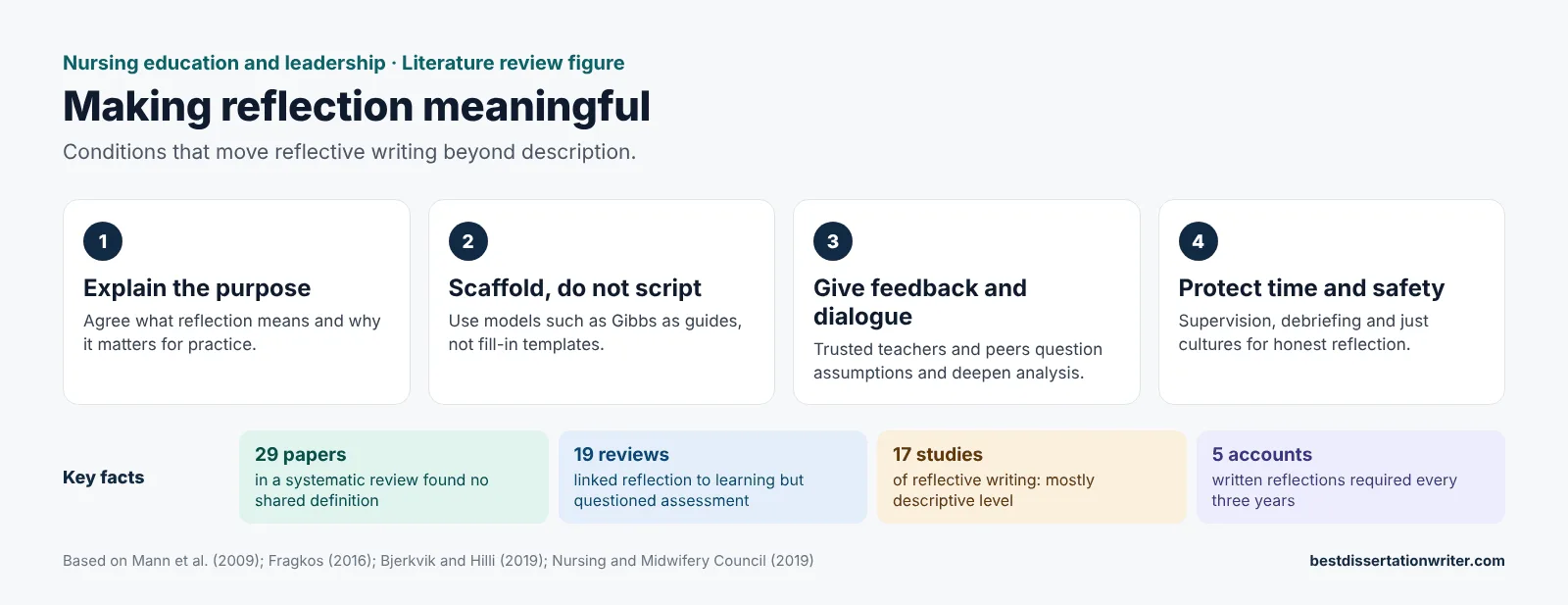
The review identified clear conditions for learning. Clear guidelines, scaffolding and detailed feedback from a trusted, available and qualified teacher supported reflection, as did student maturity, individual cognitive skills, collaboration with peers and the use of mixed learning tools. Time constraints, conflicting values, lack of feedback and support and lack of trust hindered it. The authors concluded that the greatest value of reflective writing lay in students’ personal development as professional nurses.
These findings suggest that models such as the cycle described by Gibbs (1988) are useful starting points but are not sufficient on their own. A student who completes each stage of the cycle without feedback may remain at a descriptive level. Dialogue with a teacher or peer, in which assumptions are questioned and links to evidence are explored, appears necessary for reflective practice to move from description to analysis and change.
Theme 3: Assessing Reflection and Revalidation
Fragkos (2016) found that reflective techniques in summative, formative, group and individual formats had been associated with learning, but that assessment of reflection raised serious issues of validity, reliability and reproducibility. When reflection is graded, students may write what they think assessors want to read, and different assessors may judge the same reflection differently. These problems are particularly acute when reflections contribute to progression decisions.
For registered nurses, the Nursing and Midwifery Council (2019) requires revalidation every three years, including 450 practice hours, 35 hours of continuing professional development of which 20 must be participatory, five pieces of practice-related feedback, five written reflective accounts and a reflective discussion with another registrant. The reflective accounts must link learning to the Code, and the guidance advises nurses not to include information that could identify patients or colleagues.
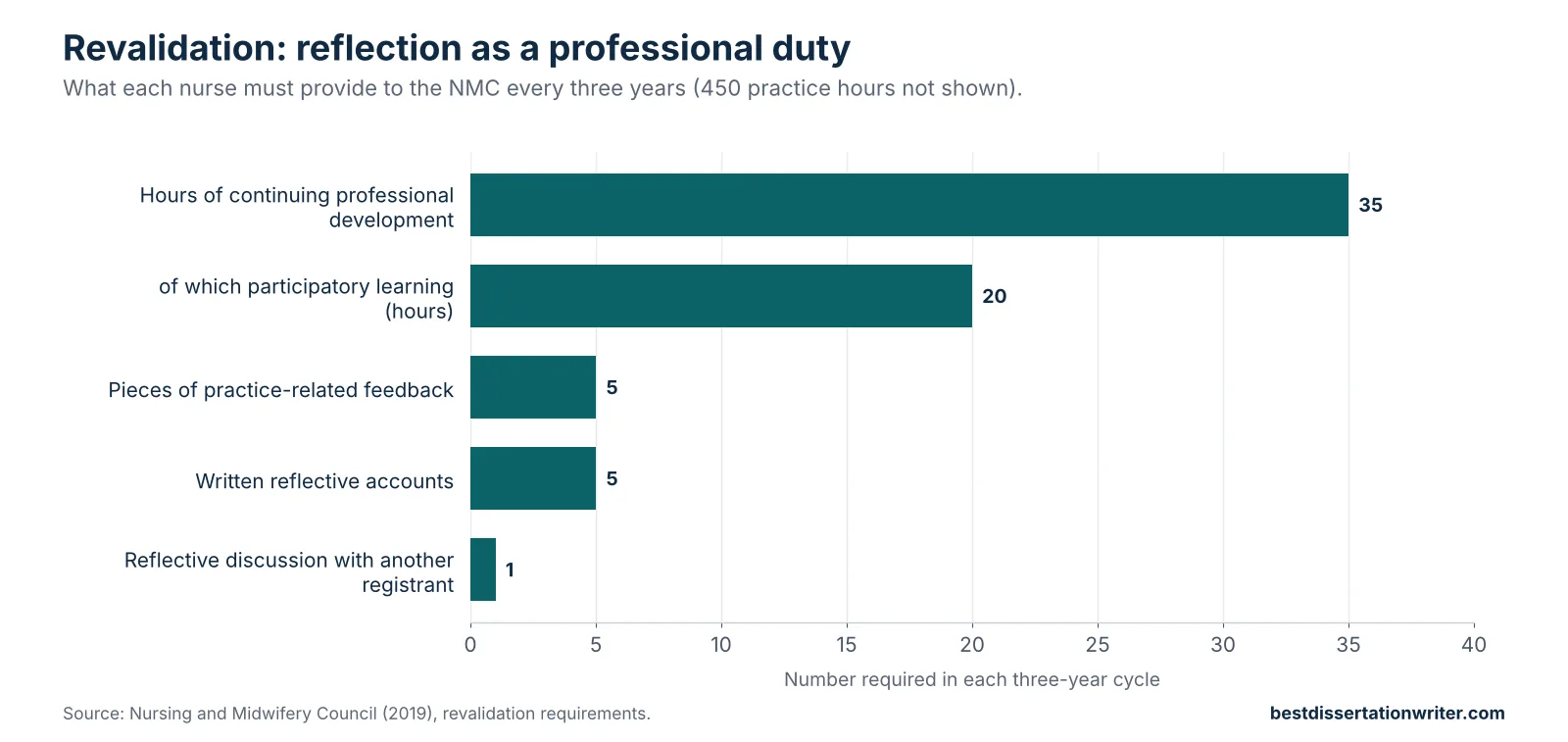
Revalidation has made reflective practice a formal professional duty. This may encourage nurses to reflect regularly and to discuss their learning with colleagues, but it also risks turning reflection into a compliance exercise in which accounts are written quickly to meet a deadline. The reflective discussion is designed to counter this by requiring a conversation about the accounts, which aligns with the evidence that dialogue deepens reflection.
Discussion
This review suggests that reflection is widely valued and associated with learning, particularly in clinical reasoning and personal development, but that the evidence base is conceptually fragmented and largely descriptive. There is no shared definition, assessment is problematic, and many students reflect only at a descriptive level. These findings do not undermine the value of reflective practice, but they challenge the assumption that requiring written reflections automatically produces reflective practitioners.
The most consistent message across the sources is that reflection needs support. Guidance, scaffolding, feedback and dialogue with a trusted teacher or colleague distinguish reflection that leads to learning from reflection that simply describes events. This has resource implications for nursing education, because detailed feedback on reflective writing is time-consuming. It also has implications for practice, where clinical supervision and reflective discussion require protected time that is often hard to secure.
The emotional focus of student reflections is double-edged. Reflecting on feelings can help students process distressing experiences and build resilience, and the cycle described by Gibbs (1988) explicitly includes a feelings stage. However, if reflection remains focused on emotions without moving to analysis and action, its value for improving practice is limited. Educators may need to help students move from how they felt to what they learned and what they will do differently.
Concerns about the legal status of reflections also deserve attention. Nurses may be reluctant to reflect honestly on errors if they fear that written accounts could be used in investigations. Professional guidance encourages anonymised reflection focused on learning, and organisations can support this by fostering just cultures in which learning from mistakes is valued. Without psychological safety, reflective practice may become guarded and superficial.
There is also a question of who benefits. Reflective practice is often presented as an individual responsibility, yet many of the problems nurses reflect on, such as staffing shortages, conflicting priorities and system failures, cannot be solved by individuals alone. Critical forms of reflection that examine organisational and social conditions, and team-based approaches that feed learning back into service improvement, may give reflection greater influence on the quality of care than private written accounts that are never shared beyond a portfolio.
The evidence base has limitations. The included reviews drew on heterogeneous studies, many of them small, qualitative or descriptive, and few measured changes in practice or patient outcomes. This review relied on openly accessible, English-language sources and, as a narrative review, did not use formal systematic screening. Future research should define reflection clearly, use validated measures of reflective ability and examine whether reflective practice changes clinical behaviour and the quality of care.
Implications of Reflective Practice Evidence for Practice
For nurse educators, the evidence supports teaching reflection explicitly, explaining its purpose, using models such as the Gibbs cycle as scaffolds rather than templates, and providing timely, detailed feedback. Formative reflection and group discussion may be more effective than heavily graded individual essays. For nurse leaders, protected time for clinical supervision, debriefing and reflective discussion supports learning and wellbeing. The NMC guidance on revalidation sets out what registrants must provide.
Reflective practice helps nurses examine their decisions against the evidence, supporting evidence-based practice, and it can be delivered flexibly through blended learning and online journals. Reflection on workload and team pressures can inform discussions about safe staffing, while supporting students to reflect on difficult experiences may help to reduce student nurse attrition.
Conclusion
This narrative review examined the definition, teaching, assessment and value of reflective practice in nursing education and professional development. Reflection is associated with improved clinical reasoning and personal development, but it lacks a shared definition, is difficult to assess reliably and often remains descriptive without guidance and feedback.
Reflective practice is most valuable when it is supported by dialogue, feedback and protected time, and when it focuses on learning rather than compliance. Nurse educators and leaders who invest in these conditions are more likely to develop genuinely reflective practitioners who learn from experience throughout their careers.
References
Bjerkvik, L. K., & Hilli, Y. (2019). Reflective writing in undergraduate clinical nursing education: A literature review. Nurse Education in Practice, 35, 32–41. https://doi.org/10.1016/j.nepr.2018.11.013
Fragkos, K. C. (2016). Reflective practice in healthcare education: An umbrella review. Education Sciences, 6(3), 27. https://doi.org/10.3390/educsci6030027
Gibbs, G. (1988). Learning by doing: A guide to teaching and learning methods. Further Education Unit, Oxford Polytechnic.
Mann, K., Gordon, J., & MacLeod, A. (2009). Reflection and reflective practice in health professions education: A systematic review. Advances in Health Sciences Education, 14(4), 595–621. https://doi.org/10.1007/s10459-007-9090-2
Nursing and Midwifery Council. (2019). How to revalidate with the NMC: Requirements for renewing your registration. https://www.nmc.org.uk/revalidation/overview/what-is-revalidation/
Cite this example
Best Dissertation Writers (2026) Reflective Practice in Nursing Education: A Narrative Review. Available at: https://bestdissertationwriter.com/reflective-practice-literature-review/
Best Dissertation Writers
Get expert help with your nursing literature review
Share your topic and deadline with Best Dissertation Writers and get support tailored to your module brief.