E-Learning and Blended Learning in Nursing Curricula: A Systematic Review
 By Dr. Robertson Prime, Research Fellow
Updated October 25, 2026
14 min read
About 2,800 words
In this review
Abstract
Background: Blended learning, which combines online and face-to-face teaching, has become a mainstream approach in nursing curricula, accelerated by the COVID-19 pandemic and by programmes in England that deliver pre-registration nursing degrees largely online. Educators need to know whether it improves learning, for whom and under what conditions.
Aim: This systematic review aimed to examine the effectiveness of combining online and face-to-face teaching in nursing and health professions education, and the factors that influence its success.
Methods: Evidence was identified through targeted searches of openly accessible bibliographic records, publisher websites and the reference lists of key reviews. Six sources published between 2015 and 2023 were included: two meta-analyses, a mixed-methods systematic review, a scoping review, an international mixed-methods study and a national programme description, appraised with CASP checklists and synthesised narratively.
Findings: A meta-analysis of 56 studies found pooled effect sizes of 1.40 compared with no intervention and 0.81 compared with non-blended teaching, and an overview of 11 reviews covering more than 18,000 participants reported a knowledge effect of 0.77, although evidence quality was very low. For clinical skills, online learning was no less effective than face-to-face teaching, but few studies examined combined approaches. Benefits included flexibility and wider access, while technological barriers, staff preparation and the risk of hidden disadvantage were key challenges.
Conclusion: Combining online and face-to-face learning is at least as effective as traditional teaching for knowledge and offers flexibility. Its success depends on purposeful design, support for students and staff and attention to digital inequality.
Keywords: blended learning, e-learning, online education, nursing curriculum
Introduction
This systematic review critically examines recent evidence on blended learning and its implications for nursing education and leadership.
Nursing education has changed rapidly in the past decade. Lectures are increasingly recorded, virtual learning environments host readings and quizzes, and students prepare for skills sessions by watching videos or completing online modules. During the COVID-19 pandemic, many programmes moved almost entirely online at short notice, and some of these changes have remained. In England, Health Education England funded a blended learning nursing degree with seven universities, delivered predominantly through online, remote-access study.
Blended learning is attractive for several reasons. It can make education more flexible for students who work, care for families or live far from campus, and it may widen access to nursing for people who could not attend a traditional full-time programme. It can also allow face-to-face time to be used for practical skills, discussion and simulation, while knowledge-based content is studied online at the student’s own pace. However, nursing is a practical, relational profession, and some educators worry that online study may weaken skills, belonging and professional identity.
A systematic approach was chosen so that meta-analyses of effectiveness, reviews of clinical skills teaching and studies of student and educator experience could be brought together. Combining evidence on outcomes with evidence on implementation helps educators decide not only whether to use blended approaches, but how.
The question is important for curriculum leaders and nurse educators planning programmes, for practice partners who receive students, and for policy-makers seeking to expand the workforce. Decisions about the balance of online and face-to-face teaching affect staffing, estates, technology budgets and the student experience, so they should be informed by the best available evidence rather than by convenience or cost alone.
Review question
How effective is blended learning in nursing and health professions education, and which factors influence its success?
Background to Blended Learning
The term is used in several ways. Most definitions describe a planned combination of online and face-to-face learning, in which each element is designed to complement the other. E-learning refers more broadly to any learning delivered through digital technology, while online education may be entirely remote. The flipped classroom is a specific blended design in which students study content online before class and use contact time for active learning. These distinctions matter because studies labelled as blended learning may evaluate quite different approaches.
Online components can be synchronous, such as live webinars and virtual seminars, or asynchronous, such as recorded lectures, discussion boards, interactive modules and quizzes. Face-to-face components may include tutorials, practical skills sessions, simulation and clinical placements. The proportion of each and the way they are integrated vary widely between programmes, from occasional online resources supporting a traditional course to programmes in which almost all theory is studied online.
Theories of active learning and cognitive load help to explain why blended approaches might work. Allowing students to study at their own pace and revisit material can reduce overload, while interactive online activities can promote active engagement. Face-to-face sessions can then focus on applying knowledge, practising skills and developing professional relationships. However, online learning also demands self-regulation, digital skills and reliable technology, which not all students have.
Regulatory frameworks shape what is possible. In the United Kingdom, nursing programmes must meet the Nursing and Midwifery Council’s standards, including 2,300 hours of practice learning, so blended designs apply mainly to theoretical components. Within these constraints, universities have considerable freedom to redesign the nursing curriculum, and many have expanded online provision since the pandemic. Redesigning a nursing curriculum in this way requires decisions about which outcomes are best achieved online and which require physical presence.
Cost is often part of the argument for blended learning, but the financial picture is complex. Online resources can be reused across cohorts and reduce pressure on teaching rooms, yet high-quality interactive materials are expensive to develop and maintain, and staff need time and training to teach well online. Students may save travel costs but need devices and reliable connectivity. Claims that blended learning saves money should therefore be tested against the full costs of design, support and technology rather than assumed.
Search Strategy and Methods
Evidence for this example was identified through targeted searches of openly accessible bibliographic records, publisher websites and the reference lists of key reviews. Search terms combined keywords for the intervention (“blended learning”, “e-learning”, “online education”, “hybrid learning”, “flipped classroom”) with terms for the population and outcomes (“nursing student*”, “nurse education”, “health professions”, “knowledge”, “clinical skills”, “satisfaction”), joined with the Boolean operators AND and OR. A full systematic review for assessment would run the same strategy in CINAHL, ERIC, PubMed/MEDLINE and Scopus and report the number of records screened in a PRISMA flow diagram.
Sources were eligible if they evaluated blended or online learning in nursing or health professions education, reported learning outcomes or experiences, or described national blended programmes relevant to nursing in the United Kingdom. Meta-analyses and systematic reviews were prioritised because of the large number of primary studies. Studies of continuing education in other professions without a health focus were excluded.
Six sources published between 2015 and 2023 were included: one meta-analysis of health professions education, one overview with an overarching meta-analysis of systematic reviews, one mixed-methods systematic review of clinical skills teaching, one scoping review of blended learning via distance, one international mixed-methods study and one national programme description (Table 1). The quality of each source was appraised using the Critical Appraisal Skills Programme (CASP) checklist appropriate to its design, and findings were synthesised narratively.
Key Findings on Blended Learning
Three themes were identified: the effect of blended learning on knowledge, its effect on clinical skills, and the conditions and challenges that shape implementation. Table 1 summarises the included sources, and Figure 1 presents pooled effect sizes from two meta-analyses of blended learning in health professions education.
| Author, year | Design | Setting and sample | Key finding |
|---|---|---|---|
| McCutcheon et al. (2015) | Mixed-methods systematic review | 19 papers on clinical skills in undergraduate nurse education | Online learning no less effective than face-to-face; only two studies of combined approaches. |
| Liu et al. (2016) | Systematic review and meta-analysis | 56 studies, health professions | Knowledge effect 1.40 vs no intervention and 0.81 vs traditional teaching. |
| Jowsey et al. (2020) | Scoping review | 28 articles on distance study, pre-registration nursing | Purposeful design improves achievement; themes of active learning, technology, support and communication. |
| Health Education England (2021) | National programme description | Largely online nursing degree, seven universities, England | Predominantly online study to widen access to nursing. |
| Lockey et al. (2022) | Overview and overarching meta-analysis | 11 reviews, 160 studies, more than 18,000 participants | Knowledge SMD 0.77 favouring combined teaching; very low quality evidence. |
| Janes et al. (2023) | International mixed-methods study | Survey of 32 nurse education leaders and three case studies | Flexibility and interaction benefits; challenges of design, support and hidden disadvantage. |
Theme 1: Effects of Blended Learning on Knowledge
Liu et al. (2016) conducted a meta-analysis of 56 studies in health professions education. Compared with no intervention, the pooled effect size for knowledge was 1.40 (95% confidence interval 1.04 to 1.77), and compared with non-blended teaching it was 0.81 (0.57 to 1.05). In nursing subgroups compared with non-blended learning, the effect was 0.87 (0.09 to 1.65) for nurses, while the estimate for nursing students, 0.42 (−0.32 to 1.16), was not statistically significant.
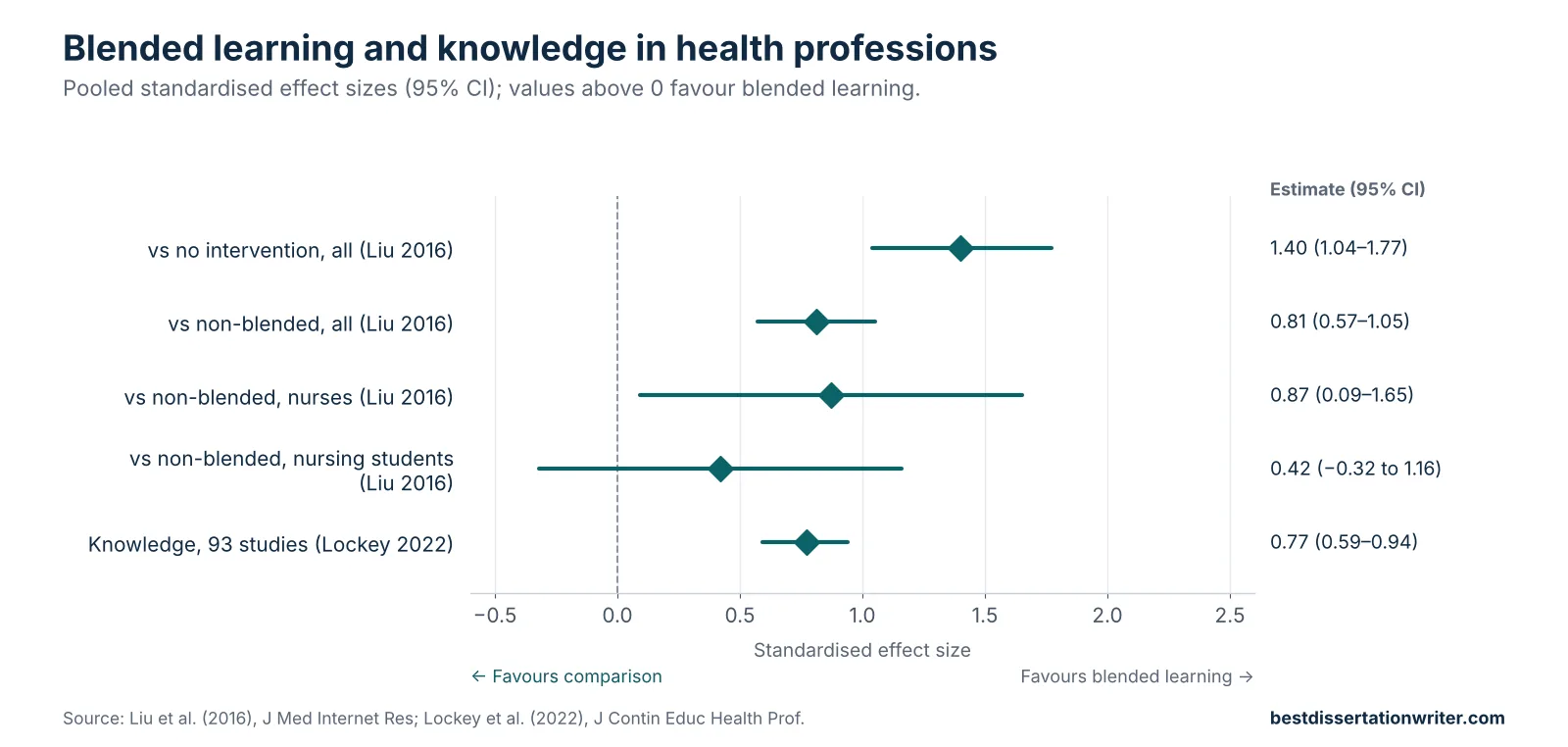
Lockey et al. (2022) combined 11 systematic reviews covering 160 primary studies, 117 of them randomised trials, in 56 countries with more than 18,000 participants. A meta-analysis of 93 studies of knowledge acquisition favoured the blended approach, with a standardised mean difference of 0.77 (0.59 to 0.94). None of the reviews reported adverse effects on other educational outcomes. However, the overall quality of evidence was very low, largely because of heterogeneity in interventions, outcomes and terminology.
Together, these meta-analyses suggest that combining online and face-to-face teaching is at least as effective as traditional teaching for knowledge, and probably more effective. The wide confidence interval for nursing students in Liu et al. (2016) is a reminder that nursing-specific evidence is thinner than the overall picture suggests, and that results from medicine and other professions may not transfer directly to nursing programmes.
Theme 2: Clinical Skills
McCutcheon et al. (2015) systematically reviewed 19 papers comparing online or blended learning with face-to-face learning of clinical skills in undergraduate nurse education. Seventeen evaluated online approaches and only two evaluated blended approaches. Outcomes covered performance, knowledge, self-efficacy and satisfaction. The authors concluded that online learning for teaching clinical skills was no less effective than traditional methods, but that evidence on implementing a blended approach was lacking.
This finding is reassuring for educators who use online videos and modules to prepare students for skills sessions. It does not mean that clinical skills can be learned online alone: hands-on practice, feedback and simulation remain essential. The most promising designs appear to use e-learning to deliver underpinning knowledge and demonstrations, freeing face-to-face time for supervised practice. Combining online preparation with simulation is one example of this approach. Short videos of procedures that students can replay before and after practice sessions are another, and they may be especially helpful for students who need more repetition to feel confident.
Theme 3: Conditions for Successful Blended Learning
Jowsey et al. (2020) reviewed 28 articles on blended learning via distance in pre-registration nursing education. When delivered purposefully, this approach could positively influence student achievement, particularly when used to support distance education. Four themes emerged: active learning, technological barriers, support and communication. The review emphasised that such programmes work when they are designed around active engagement and backed by support, rather than simply moving content online.
Janes et al. (2023) surveyed 32 nurse education leaders across International Council of Nurses regions and conducted three case studies. Benefits included flexibility, cost-effectiveness and improved communication between students and tutors and among students. Challenges included designing interactive resources, preparing and supporting staff and students, the risk of worsening hidden disadvantage and the need for evaluation that includes all stakeholders. Respondents also noted that some students perceive online learning as less valuable than face-to-face teaching, which may reduce engagement unless the purpose of each activity is explained clearly.
The national programme funded by Health Education England (2021) aimed to widen access to nursing for people unable to study in traditional ways, using predominantly online study alongside practice learning. Its rationale reflects the potential of flexible study to support workforce expansion. However, evaluation of such programmes is still emerging, and the challenges identified by Janes et al. (2023), including digital access and student support, are particularly relevant for students who choose remote study because of other commitments.
Discussion
This review suggests that blended learning is at least as effective as traditional teaching for knowledge acquisition in health professions education, with pooled effects favouring blended approaches, and that online learning of clinical skills is no less effective than face-to-face methods. The evidence also highlights that success depends on purposeful design, active learning and support for students and staff.
The quality of the evidence is a significant limitation. Heterogeneity was high, terminology inconsistent and the overall quality of evidence very low in the largest overview. Many studies compared a well-designed new blended course with an unchanged traditional course, so improvements may reflect better design rather than blending itself. Few studies measured long-term retention of knowledge, clinical performance or patient outcomes, so it is unclear whether the short-term gains from blended learning persist into practice.
The role of the teacher changes in blended learning rather than disappearing. Educators must design sequences of online and face-to-face activities, monitor engagement through learning analytics, respond to questions in discussion forums and use contact time for higher-order learning. Staff who lack confidence with technology, or who simply upload lecture slides, are unlikely to achieve the benefits reported in the meta-analyses. Investment in staff development is therefore as important as investment in platforms, and should be built into any plan to expand blended learning within the nursing curriculum.
Nursing-specific evidence is thinner than the general health professions literature. The non-significant estimate for nursing students in one meta-analysis and the scarcity of blended clinical skills studies suggest caution in assuming that results from medical education apply directly. Nursing students are diverse in age, background and digital confidence, and programmes that rely heavily on online education may advantage some students while disadvantaging others.
Digital inequality and belonging deserve particular attention. Students without reliable internet, suitable devices or quiet study space may struggle, and those who study mainly online may feel less connected to peers and staff. Since support and belonging are important influences on whether students complete their programmes, blended learning designs should include deliberate opportunities for interaction, personal tutoring and community building, as well as practical help with technology.
The evidence base has limitations. Most primary studies were short-term, single-site evaluations, and the included reviews overlapped in their primary studies. This review relied on openly accessible, English-language sources and did not involve independent double screening. Future research should compare specific blended designs within nursing programmes, measure clinical performance and progression, examine effects on different student groups and evaluate national blended degree programmes.
Implications of Blended Learning Evidence for Practice
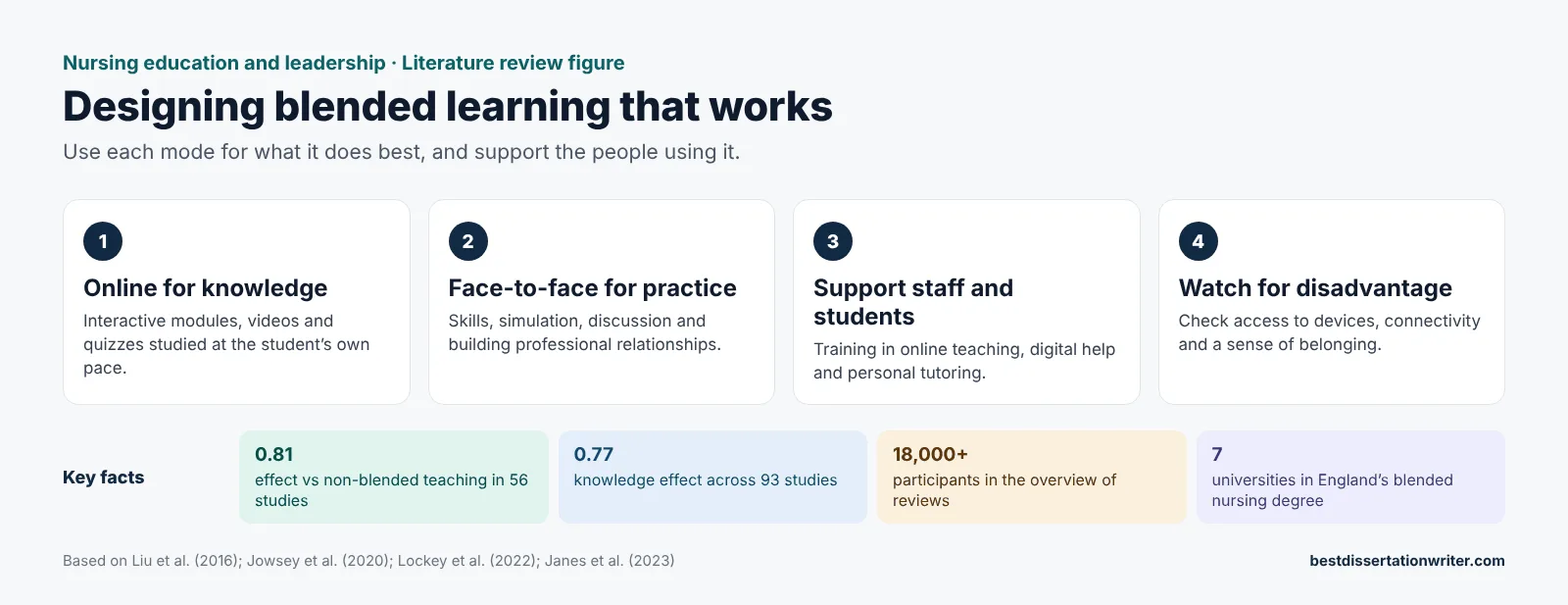
For nurse educators and curriculum leaders, the evidence supports using online components purposefully to deliver knowledge and prepare students for practical sessions, while protecting face-to-face time for skills, simulation, discussion and building relationships. Programmes should train staff in online pedagogy, design interactive rather than passive resources, monitor engagement and offer digital support. Evaluations should include student progression and the experiences of students from disadvantaged backgrounds. The Health Education England blended learning programme provides a national example.
Online preparation can enhance simulation-based learning by freeing contact time for practice, and digital journals support reflective practice. Shared online modules make interprofessional education easier to timetable across professions, while flexible routes into nursing may contribute to long-term safe staffing by widening the pool of future nurses.
Conclusion
This systematic review examined the effectiveness of blended learning in nursing and health professions education. Blended approaches are at least as effective as traditional teaching for knowledge, and online preparation for clinical skills appears no less effective than face-to-face teaching, although evidence quality is low and nursing-specific evidence is limited.
Blended learning offers flexibility and wider access, but its benefits depend on purposeful design, active learning and support for students and staff. Nurse educators and leaders should use it to enhance, rather than replace, the practical and relational learning that nursing requires, and should evaluate its effects on all groups of students.
References
Health Education England. (2021). Blended learning. https://www.hee.nhs.uk/our-work/blended-learning
Janes, G., Ekpenyong, M. S., Mbeah-Bankas, H., & Serrant, L. (2023). An international exploration of blended learning use in pre-registration nursing and midwifery education. Nurse Education in Practice, 66, 103514. https://doi.org/10.1016/j.nepr.2022.103514
Jowsey, T., Foster, G., Cooper-Ioelu, P., & Jacobs, S. (2020). Blended learning via distance in pre-registration nursing education: A scoping review. Nurse Education in Practice, 44, 102775. https://doi.org/10.1016/j.nepr.2020.102775
Liu, Q., Peng, W., Zhang, F., Hu, R., Li, Y., & Yan, W. (2016). The effectiveness of blended learning in health professions: Systematic review and meta-analysis. Journal of Medical Internet Research, 18(1), e2. https://doi.org/10.2196/jmir.4807
Lockey, A., Bland, A., Stephenson, J., Bray, J., & Astin, F. (2022). Blended learning in health care education: An overview and overarching meta-analysis of systematic reviews. Journal of Continuing Education in the Health Professions, 42(4), 256–264. https://doi.org/10.1097/CEH.0000000000000455
McCutcheon, K., Lohan, M., Traynor, M., & Martin, D. (2015). A systematic review evaluating the impact of online or blended learning vs. face-to-face learning of clinical skills in undergraduate nurse education. Journal of Advanced Nursing, 71(2), 255–270. https://doi.org/10.1111/jan.12509
Cite this example
Best Dissertation Writers (2026) E-Learning and Blended Learning in Nursing Curricula: A Systematic Review. Available at: https://bestdissertationwriter.com/blended-learning-literature-review/
Best Dissertation Writers
Get expert help with your nursing literature review
Share your topic and deadline with Best Dissertation Writers and get support tailored to your module brief.