Workplace Bullying and Incivility in Nursing: Prevalence, Impact, and Interventions: A Systematic Review
 By Dr. Robertson Prime, Research Fellow
Updated October 25, 2026
14 min read
About 2,800 words
In this review
Abstract
Background: Workplace bullying and incivility are persistent problems in nursing, where hierarchical cultures, high workloads and stress can allow repeated negative behaviour between colleagues to become normal. Such behaviour harms nurses’ health, damages teamwork and may threaten patient safety.
Aim: This systematic review aimed to examine the prevalence and impact of bullying and incivility among nurses and the effectiveness of interventions to prevent them.
Methods: Evidence was identified through targeted searches of openly accessible bibliographic records, publisher websites and the reference lists of key reviews. Five systematic reviews and meta-analyses published between 2014 and 2024 were included, appraised with CASP checklists and synthesised narratively.
Findings: Across 136 articles covering 151,347 nurses, 39.7% reported exposure to bullying and 66.9% to nonphysical violence, while a separate meta-analysis estimated the prevalence of incivility toward nurses at 55.1%. Among healthcare staff, perceived bullying was associated with psychological distress, depression, burnout, insomnia and more sickness absence. A Cochrane review of workplace interventions found very low-certainty evidence that organisational programmes may increase civility, whereas a meta-analysis of cognitive rehearsal programmes for hospital nurses reported a significant pooled reduction in bullying (effect size −0.40).
Conclusion: Bullying is common and harmful, and the evidence for prevention, though limited, supports organisational approaches combined with skills training. Nurse leaders and educators have a central role in setting expectations of civility and responding to concerns.
Keywords: workplace bullying, incivility, horizontal violence, nursing workplace
Introduction
This systematic review critically examines recent evidence on workplace bullying and its implications for nursing education and leadership.
Nursing is often described as a caring profession, yet many nurses report being treated with hostility, humiliation or exclusion by colleagues. Workplace bullying refers to repeated negative behaviour, such as criticism, belittling, withholding information or unreasonable workloads, directed at someone who finds it difficult to defend themselves. Incivility describes lower-intensity rudeness and disrespect, while horizontal violence or lateral violence refers to hostile behaviour between nurses at the same level. These behaviours can occur between peers, from managers to staff or from staff to students.
Such behaviour matters for several reasons. It harms the health and wellbeing of those targeted, damages teamwork and communication, and may discourage nurses from speaking up about safety concerns. It also affects students and newly qualified nurses, who may be particularly vulnerable because of their position in the hierarchy and their need for support and assessment. The well-known phrase that nurses eat their young reflects long-standing concern that some nursing cultures fail to welcome and support new members.
A systematic approach was chosen because many prevalence studies and several reviews exist, and combining the most comprehensive reviews gives a clearer picture than individual surveys. The review focuses on behaviour between staff rather than violence from patients, while recognising that the two often coexist in the nursing workplace.
Understanding the evidence is particularly important for nurse leaders and educators. Leaders shape the culture in which bullying either thrives or is challenged, and educators prepare students to recognise and respond to negative behaviour. Both groups need to know which interventions have evidence of benefit, so that resources are directed to approaches likely to make a difference rather than to well-intentioned but untested initiatives.
Review question
How common are workplace bullying and incivility among nurses, what are their effects, and which interventions are effective in preventing them?
Background to Workplace Bullying
Definitions of workplace bullying usually include three elements: negative acts, repetition over time and an imbalance of power. Single incidents of rudeness are therefore not normally classed as bullying, although persistent incivility can escalate into it. Behaviour may be overt, such as shouting or public criticism, or covert, such as excluding a colleague from information, setting them up to fail or spreading rumours. Because covert behaviour is hard to prove, targets may doubt their own perceptions or fear that complaints will not be believed.
Several explanations have been proposed for why bullying is common in nursing. Oppressed group theory suggests that nurses, historically subordinate to medicine and management, may direct frustration at each other. Organisational explanations emphasise high workloads, staff shortages, poor leadership and a lack of clear policies. Cultural explanations point to hierarchies based on seniority and the belief that new nurses must prove themselves. These explanations are not mutually exclusive, and they suggest that individual training alone is unlikely to solve the problem.
Measurement varies widely. Some studies use the Negative Acts Questionnaire, which asks about specific behaviours over six months, while others ask nurses whether they have been bullied according to a definition, or use instruments designed for incivility. Time frames, thresholds and definitions differ, so prevalence estimates can range dramatically between studies. This variation must be borne in mind when comparing figures across countries and settings.
In the United Kingdom, professional standards require nurses to treat colleagues with respect and to challenge discrimination and bullying, and national staff surveys track experiences of bullying and harassment. Organisations have adopted policies, freedom to speak up guardians and civility campaigns. Yet reports from nurses and students suggest that workplace bullying remains a significant problem, raising questions about which approaches actually reduce it.
Search Strategy and Methods
Evidence for this example was identified through targeted searches of openly accessible bibliographic records, publisher websites and the reference lists of key reviews. Search terms combined keywords for the behaviour (“workplace bullying”, “incivility”, “horizontal violence”, “lateral violence”, “mobbing”) with terms for the population, outcomes and interventions (“nurse*”, “prevalence”, “health”, “intervention”, “cognitive rehearsal”), joined with the Boolean operators AND and OR. A full systematic review for assessment would run the same strategy in CINAHL, ERIC, PubMed/MEDLINE and Scopus and report the number of records screened in a PRISMA flow diagram.
Sources were eligible if they reported the prevalence, consequences or prevention of bullying or incivility among nurses or healthcare staff. Because many single-site surveys of workplace bullying exist, systematic reviews and meta-analyses were prioritised. Studies focused solely on violence from patients or visitors were excluded, although reviews that reported workplace bullying alongside other forms of workplace violence were included.
Five sources published between 2014 and 2024 were included: two meta-analyses of prevalence, one systematic review of health consequences, one Cochrane review of workplace interventions and one meta-analysis of cognitive rehearsal programmes for nurses (Table 1). The quality of each source was appraised using the Critical Appraisal Skills Programme (CASP) checklist for systematic reviews, and findings were synthesised narratively and grouped into themes.
Key Findings on Workplace Bullying
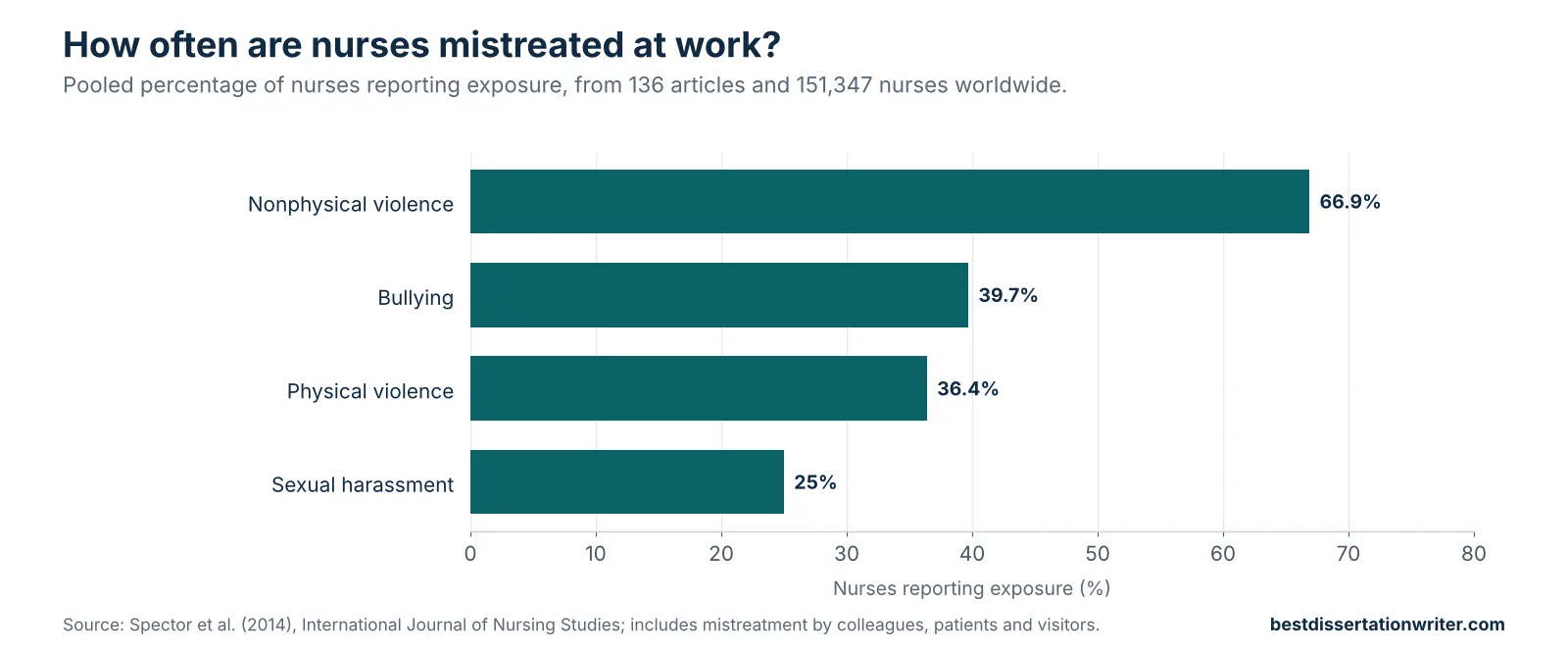
Three themes were identified: the prevalence of workplace bullying and incivility among nurses, the consequences for nurses’ health and work, and the effectiveness of interventions to prevent negative behaviour. Table 1 summarises the included sources, and Figure 1 shows the pooled prevalence of different forms of mistreatment reported by nurses worldwide.
| Author, year | Design | Setting and sample | Key finding |
|---|---|---|---|
| Spector et al. (2014) | Quantitative review (meta-analysis) | 136 articles, 151,347 nurses, 160 samples | Bullying 39.7%; nonphysical violence 66.9%; physical violence 36.4%; sexual harassment 25%. |
| Gillen et al. (2017) | Cochrane systematic review | 5 studies, 4,116 workers across occupations | Civility programme raised civility and cut absence; multilevel programme no effect; very low certainty. |
| Lever et al. (2019) | Systematic review | 45 papers on healthcare staff (2005–2017) | Pooled bullying prevalence 26.3%; linked to distress, depression, burnout, insomnia and absence. |
| Atashzadeh Shoorideh et al. (2021) | Systematic review and meta-analysis | 60 studies, 30,801 participants | Pooled prevalence of incivility toward nurses 55.1%. |
| Jeong et al. (2024) | Systematic review and meta-analysis | 9 studies of cognitive rehearsal for hospital nurses | Pooled effect −0.40 in favour of programmes; only two randomised trials. |
Theme 1: The Prevalence of Workplace Bullying and Incivility
Spector et al. (2014) conducted a quantitative review of 136 articles covering 151,347 nurses in 160 samples. Overall, 39.7% of nurses reported exposure to bullying, 66.9% to nonphysical violence, 36.4% to physical violence and 25% to sexual harassment. Bullying and nonphysical violence were highest in the Middle East, while physical violence and sexual harassment were highest in English-speaking countries. The review combined mistreatment from colleagues, patients and visitors, so not all of the bullying reported came from fellow nurses.
Atashzadeh Shoorideh et al. (2021) pooled 60 studies involving 30,801 participants published between 1997 and 2019 and estimated the prevalence of incivility toward nurses at 55.1% (95% confidence interval 48.05% to 62.06%). Incivility is therefore even more common than bullying, consistent with its lower threshold. The included studies were heterogeneous in measures and settings, but the overall message is that more than half of nurses experience some form of disrespect in their work.
Prevalence figures should be interpreted cautiously. Differences in definitions, time frames and instruments explain much of the variation between studies, and self-report may lead to over- or under-estimation. Nevertheless, even the more conservative estimates suggest that workplace bullying affects a substantial minority of nurses, and that incivility is a common feature of the nursing workplace in many countries.
Theme 2: Consequences for Nurses’ Health and Work
Lever et al. (2019) systematically reviewed 45 papers on the health consequences of bullying among healthcare staff, published between 2005 and 2017. Reported prevalence ranged from 3.9% to 86.5%, with a pooled estimate of 26.3%. Perceived bullying was associated with psychological distress, depression, burnout, insomnia and headaches, and bullied staff took more sickness absence. The authors concluded that bullying occurs frequently among healthcare staff and harms both health and work functioning.
Most included studies were cross-sectional, so it is difficult to know whether bullying causes poor health or whether staff in poor health are more likely to perceive or report bullying. However, longitudinal studies in other occupations suggest that bullying precedes deteriorating mental health, and the consistency of associations across outcomes and settings supports a causal role. For organisations, the link with sickness absence highlights a direct cost of tolerating negative behaviour.
The consequences extend beyond individuals. Targets of bullying may avoid colleagues, hesitate to ask for help or remain silent about errors, which can compromise communication and safety. Witnesses may also feel distress and may consider leaving. Although the included reviews focused mainly on individual outcomes, these team-level effects suggest that bullying is a patient safety issue as well as a matter of staff wellbeing.
Students and newly qualified nurses deserve particular mention. Their reliance on supervisors for assessment and references makes them reluctant to report workplace bullying, and negative experiences early in a career may shape whether they stay in nursing. Being ignored, given only menial tasks or criticised in front of patients can be particularly damaging at this formative stage. Because the included reviews mainly sampled registered staff, the consequences of workplace bullying for learners are likely to be under-represented in the pooled estimates.
Theme 3: Preventing Bullying and Incivility
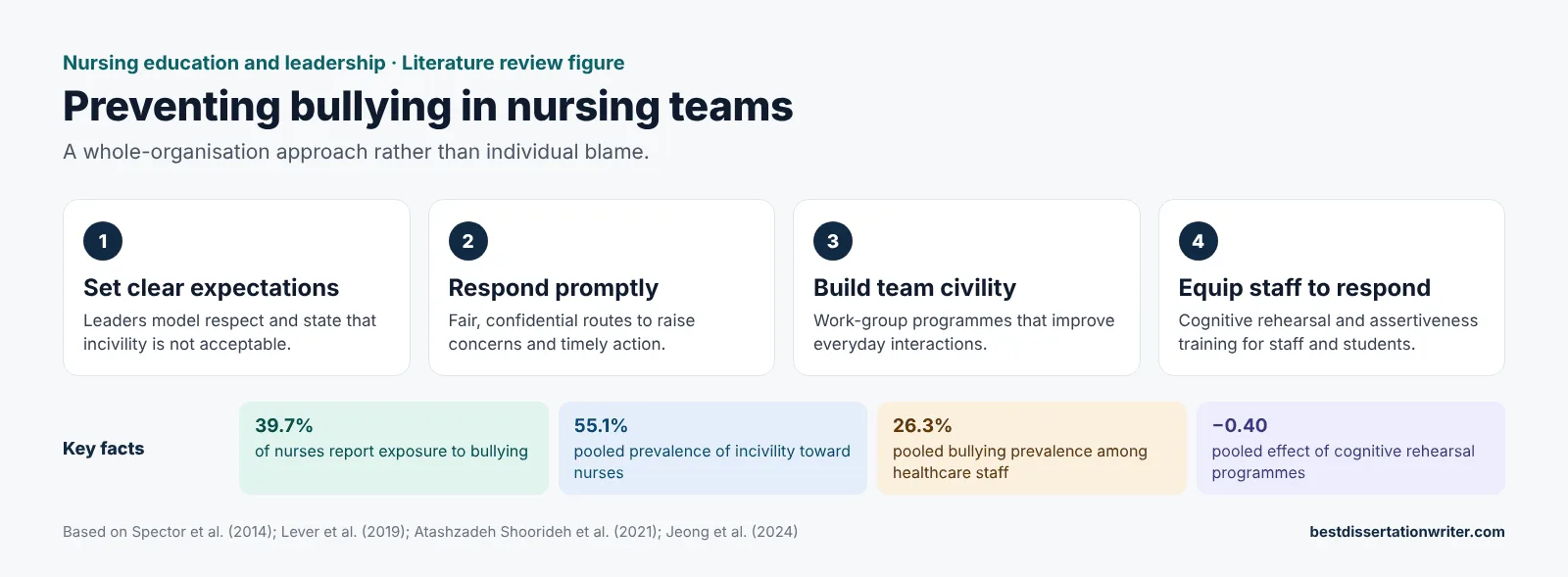
Gillen et al. (2017) conducted a Cochrane review of interventions to prevent bullying in the workplace across occupations, including five studies with 4,116 participants. An organisational programme to improve civility increased civility scores by about 5% and reduced supervisor incivility and days absent, while expressive writing reduced self-reported perpetration of incivility. A multilevel programme involving policy, stress management and awareness training did not reduce victimisation. The certainty of all evidence was very low because of risk of bias and imprecision.
For nurses specifically, Jeong et al. (2024) reviewed nine studies of cognitive rehearsal programmes, which teach staff to recognise negative behaviours and rehearse assertive responses. Five studies were pooled in a meta-analysis, giving a significant overall effect size of −0.40 (95% confidence interval −0.60 to −0.20) in favour of the programmes, with low heterogeneity. Only two included studies were randomised, so the evidence is promising but not definitive. Most programmes were delivered in hospitals in Asia and North America, and follow-up rarely extended beyond a few months, so it is not known whether reductions in workplace bullying are sustained.
Discussion
This review suggests that workplace bullying and incivility are common in nursing worldwide, with roughly two in five nurses reporting bullying and more than half experiencing incivility. Bullying is consistently associated with poorer mental health, burnout and sickness absence. The evidence on prevention is much weaker than the evidence on prevalence and harm, but organisational civility programmes and cognitive rehearsal training show promise.
The imbalance between evidence of harm and evidence of solutions is striking. Many organisations have anti-bullying policies, yet few have evaluated whether these policies reduce negative behaviour. The Cochrane review found that a multilevel programme did not reduce victimisation, which suggests that policies and awareness training alone may be insufficient. Interventions that change everyday team interactions, such as civility programmes that involve whole work groups, may have more potential than one-off training sessions.
Cognitive rehearsal programmes place much of the responsibility on individuals to recognise and respond to negative behaviour. This can empower nurses, particularly students and new staff, but it should not replace organisational action. If workplace bullying arises from high workloads, poor leadership and tolerance of disrespect, then teaching targets to respond assertively addresses symptoms rather than causes. A combined approach, in which leaders set clear expectations and address behaviour promptly while staff learn skills to respond, is likely to be more effective.
Leadership is central to this approach. Managers who model respectful behaviour, intervene when they observe incivility and take complaints seriously send a clear message about what is acceptable. Conversely, managers who ignore negative behaviour or engage in it themselves legitimise it. Leadership development that includes skills in addressing difficult behaviour and creating psychologically safe teams may therefore be one of the most important strategies for reducing workplace bullying in nursing.
Reporting systems also deserve attention. Staff who experience bullying often do not report it because they fear retaliation, doubt that action will follow or worry about being seen as weak. Confidential routes, such as freedom to speak up guardians, and transparent follow-up can increase trust in reporting. Organisations that track trends in complaints and staff survey results, and share what they have done in response, are better placed to identify hotspots and to show staff that concerns are taken seriously.
The evidence base has limitations. Most primary studies were cross-sectional, prevalence measures varied, and intervention studies were few, small and at high risk of bias. Some reviews combined colleague and patient-perpetrated behaviour. This review relied on openly accessible, English-language sources and did not involve independent double screening. Future research should use consistent definitions, longitudinal designs and randomised evaluations of organisational interventions in nursing settings, including their effects on retention and patient safety.
Implications of Workplace Bullying Evidence for Practice
For nurse leaders, the evidence supports clear expectations of respectful behaviour, prompt and fair responses to concerns, and regular monitoring of staff experiences through surveys and exit interviews. Team-based civility programmes and training in assertive responses, such as cognitive rehearsal, can be offered alongside leadership development. Educators should prepare students to recognise horizontal violence, know how to seek support and understand their professional duty to challenge disrespect. The NMC Code provides a professional basis for these expectations.
Bullying of students contributes to student nurse attrition, and its health effects overlap with nurse burnout. Toxic team cultures also undermine nurse retention, while the self-awareness and empathy described in research on emotional intelligence may help leaders recognise and address negative behaviour early.
Conclusion
This systematic review examined the prevalence, consequences and prevention of workplace bullying and incivility in nursing. Bullying affects around two in five nurses, incivility more than half, and both are associated with poorer mental health, burnout and sickness absence. Evidence on prevention is limited, but organisational civility programmes and cognitive rehearsal training show promise.
Tackling workplace bullying requires nurse leaders to treat it as an organisational and safety issue rather than a personal conflict between individuals. Clear expectations, visible leadership, prompt responses and training that equips staff to challenge disrespect together offer the best current approach to creating a respectful nursing workplace.
References
Atashzadeh Shoorideh, F., Moosavi, S., & Balouchi, A. (2021). Incivility toward nurses: A systematic review and meta-analysis. Journal of Medical Ethics and History of Medicine, 14, 15. https://doi.org/10.18502/jmehm.v14i15.7670
Gillen, P. A., Sinclair, M., Kernohan, W. G., Begley, C. M., & Luyben, A. G. (2017). Interventions for prevention of bullying in the workplace. Cochrane Database of Systematic Reviews, (1), CD009778. https://doi.org/10.1002/14651858.CD009778.pub2
Jeong, Y., Jung, H. S., & Baek, E. M. (2024). Effectiveness of cognitive rehearsal programs for the prevention of workplace bullying among hospital nurses: A systematic review and meta-analysis. BMC Public Health, 24, 1568. https://doi.org/10.1186/s12889-024-18969-x
Lever, I., Dyball, D., Greenberg, N., & Stevelink, S. A. M. (2019). Health consequences of bullying in the healthcare workplace: A systematic review. Journal of Advanced Nursing, 75(12), 3195–3209. https://doi.org/10.1111/jan.13986
Spector, P. E., Zhou, Z. E., & Che, X. X. (2014). Nurse exposure to physical and nonphysical violence, bullying, and sexual harassment: A quantitative review. International Journal of Nursing Studies, 51(1), 72–84. https://doi.org/10.1016/j.ijnurstu.2013.01.010
Cite this example
Best Dissertation Writers (2026) Workplace Bullying and Incivility in Nursing: Prevalence, Impact, and Interventions: A Systematic Review. Available at: https://bestdissertationwriter.com/workplace-bullying-literature-review/
Best Dissertation Writers
Get expert help with your nursing literature review
Share your topic and deadline with Best Dissertation Writers and get support tailored to your module brief.