

Factors Influencing Nurse Retention and Turnover: A Systematic Review
 By Dr. Robertson Prime, Research Fellow
Updated October 25, 2026
15 min read
About 2,900 words
In this review
Abstract
Background: Nurse retention has become a central workforce priority, because health systems cannot train enough new nurses to replace those who leave. Large European surveys have found that up to half of hospital nurses in some countries intend to leave their jobs, and turnover is costly for organisations and disruptive for patient care.
Aim: This systematic review aimed to identify the factors that influence nurses’ turnover and intention to leave, and the strategies that support them to stay.
Methods: Evidence was identified through targeted searches of openly accessible bibliographic records, publisher websites and the reference lists of key reviews. Six sources published between 2012 and 2022 were included: two multinational surveys, three systematic reviews and a commissioned policy report, appraised with CASP checklists and synthesised narratively.
Findings: Intention to leave the job ranged from 14% to 49% across 12 countries, and 9% of 23,159 European nurses intended to leave the profession altogether. Burnout roughly doubled the odds of intending to leave (odds ratio 2.02), whereas good leadership and participation in hospital affairs were protective. Reviews identified stress, dissatisfaction, managerial style and supervisory support as key determinants, found turnover to be costly, and showed that transition programmes lasting 27 to 52 weeks were most promising for early career nurses.
Conclusion: Retaining nurses depends on reducing burnout and improving leadership, work environments and early career support. Nurse leaders can influence many of these modifiable factors directly.
Keywords: nurse retention, intention to leave, job satisfaction
Introduction
This systematic review critically examines recent evidence on nurse retention and its implications for nursing education and leadership.
Health systems around the world face shortages of registered nurses. In England, a report published by the King’s Fund noted 43,590 NHS nurse vacancies before the COVID-19 pandemic (West et al., 2020), and similar gaps exist in many countries. Recruiting and training new nurses takes years and is expensive, so keeping experienced nurses in their jobs and in the profession has become a central workforce priority. Every nurse who leaves takes skills, knowledge of the team and continuity of care with them.
Turnover is not always harmful. Some movement between posts brings new ideas and allows nurses to develop their careers. However, high and unplanned turnover increases the workload of those who remain, raises the use of temporary staff and can damage the quality and safety of care. Understanding why nurses leave, and what helps them stay, allows nurse leaders and educators to target the factors they can change rather than relying on recruitment alone to fill gaps.
Nurse retention is also an educational issue. The way students are prepared for practice, the support offered to newly qualified nurses and the opportunities for continuing development all influence whether nurses build long careers. Nurse educators and leaders therefore share responsibility for nurse retention, from the first clinical placement to the final years before retirement, when flexible roles may keep experienced nurses in the workforce for longer.
A systematic approach was chosen so that large multinational surveys, systematic reviews and reviews of reviews could be identified and appraised together. Bringing these sources together helps distinguish factors with consistent evidence from those that are commonly assumed but less well supported.
Review question
What factors influence nurse turnover and intention to leave, and what strategies support nurse retention?
Background to Nurse Retention
Nurse retention is usually studied through two related outcomes. Actual turnover is the proportion of nurses who leave a post, organisation or the profession in a given period. Intention to leave is a nurse’s stated plan to leave, which is easier to measure in surveys and predicts later turnover, although not every nurse who intends to leave actually does so. Studies also distinguish leaving a job, which may mean moving to another hospital, from leaving nursing altogether, which is a loss to the whole health system.
Several theoretical models explain why nurses leave. Job demands–resources models suggest that heavy workloads and emotional demands lead to burnout unless they are balanced by resources such as support, autonomy and good leadership. Models of job satisfaction suggest that nurses stay when their work meets their needs for recognition, development and fair reward. Organisational models highlight the work environment, including staffing, relationships with doctors and the involvement of nurses in decisions.
In the United Kingdom, the NHS has introduced national retention programmes, flexible working policies and support for newly qualified nurses. Professional bodies have also called for action on workload, pay and wellbeing. For nurse leaders, the question is which of these approaches is supported by evidence, and how they can improve nurse retention within their own teams and organisations.
Early career nurses deserve particular attention. The first year after qualification is a period of transition in which newly registered nurses move from supervised student to accountable practitioner, often while working in busy, understaffed settings. Many studies report that turnover is highest in this period, and nurses who leave early may never return to the profession. Effective support at this point therefore has a large potential effect on nurse retention across the whole career.
Search Strategy and Methods
Evidence for this example was identified through targeted searches of openly accessible bibliographic records, publisher websites and the reference lists of key reviews. Search terms combined keywords for the outcome (“nurse retention”, “turnover”, “intention to leave”, “intent to stay”) with terms for possible determinants and interventions (“burnout”, “job satisfaction”, “work environment”, “leadership”, “transition programme”), joined with the Boolean operators AND and OR. A full systematic review for assessment would run the same strategy in CINAHL, ERIC, PubMed/MEDLINE and Scopus and report the number of records screened in a PRISMA flow diagram.
Sources were eligible if they examined registered nurses’ turnover, intention to leave or interventions to improve nurse retention in hospital or community settings, and were published from 2010 onwards. Systematic reviews and large multinational studies were prioritised. Studies limited to nursing assistants, students or a single small organisation were excluded, as were opinion pieces without data. Sources reporting nurse retention outcomes only for mixed staff groups were included if nurses were reported separately.
Six sources published between 2012 and 2022 were included: two multinational cross-sectional surveys, three systematic reviews (one a review of reviews) and one commissioned policy report from the United Kingdom (Table 1). The quality of each source was appraised using the Critical Appraisal Skills Programme (CASP) checklist appropriate to its design, and findings were synthesised narratively and grouped into themes.
Key Findings on Nurse Retention
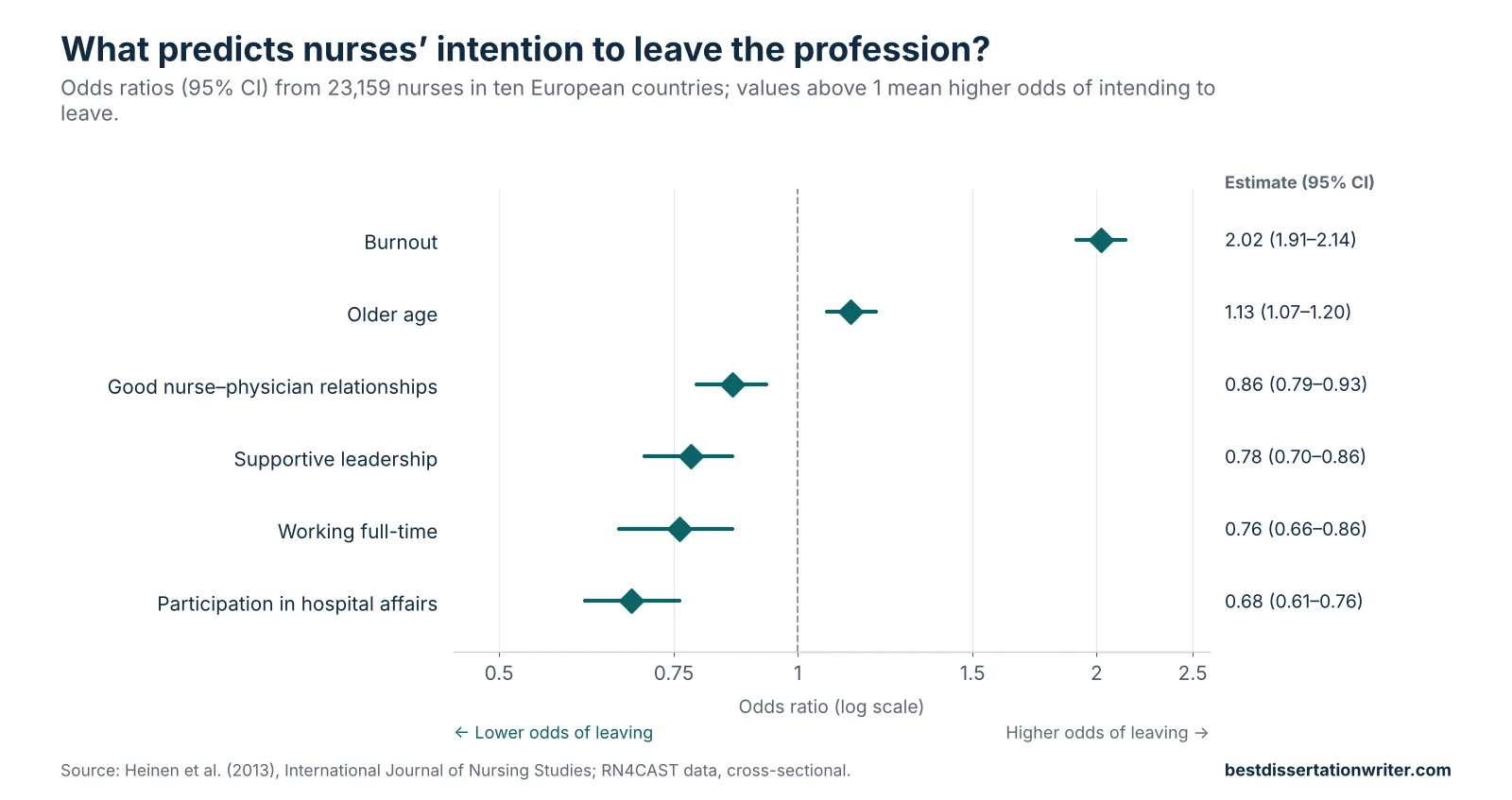
Three themes were identified: the scale of intention to leave across health systems, the individual and organisational determinants of turnover, and the consequences of turnover together with the strategies that support nurse retention. Table 1 summarises the included sources, and Figure 1 shows the factors associated with nurses’ intention to leave the profession in ten European countries.
| Author, year | Design | Setting and sample | Key finding |
|---|---|---|---|
| Aiken et al. (2012) | Cross-sectional surveys (RN4CAST) | 33,659 nurses in 12 European countries; 27,509 nurses in the United States | Intention to leave job 14%–49%; burnout 10%–78%; better work environments linked to better nurse outcomes. |
| Heinen et al. (2013) | Cross-sectional survey | 23,159 nurses, 385 hospitals, ten European countries | 9% intended to leave the profession; burnout OR 2.02; leadership and participation protective. |
| Halter et al. (2017) | Systematic review of systematic reviews | Nine reviews of adult nursing staff turnover | Stress, dissatisfaction, managerial style and supervisory support are key determinants. |
| Brook et al. (2019) | Systematic review | 53 studies of interventions for early career nurses | Residency and transition programmes with preceptor support lasting 27–52 weeks most promising. |
| West et al. (2020) | Commissioned policy report | Nurses and midwives in the United Kingdom | Autonomy, belonging and contribution are core needs; eight recommendations including compassionate leadership. |
| Bae (2022) | Systematic review | 16 studies of actual turnover in acute hospitals | Turnover very costly; negative effects on staffing, nurses and patients partially supported. |
Theme 1: The Scale of Intention to Leave
Aiken et al. (2012) surveyed 33,659 nurses in 488 hospitals in 12 European countries, including England, and 27,509 nurses in 617 hospitals in the United States. Intention to leave the current job ranged from 14% in the United States to 49% in Finland and Greece. Burnout ranged from 10% in the Netherlands to 78% in Greece, and job dissatisfaction from 11% to 56%. Better work environments were associated with better nurse outcomes, and the effect of the work environment was generally stronger than that of staffing levels.
Heinen et al. (2013) used data from 23,159 nurses on 2,025 medical and surgical units in 385 hospitals across ten European countries to examine intention to leave the profession, rather than the job. Overall, 9% of nurses intended to leave nursing, ranging from 5% to 17% between countries. Although this is lower than intention to leave a post, it represents a substantial loss of skilled staff from health systems that are already short of nurses.
Both studies are large and used validated instruments, which strengthens confidence in their findings. However, they are cross-sectional and rely on self-report, and intention to leave does not always translate into actual turnover. The data were collected before the COVID-19 pandemic, which is widely believed to have increased pressures on nurses, so current rates may be higher.
Theme 2: Determinants of Nurse Retention
Heinen et al. (2013) found that burnout was the factor most strongly associated with intention to leave the profession, roughly doubling the odds (odds ratio 2.02, 95% confidence interval 1.91 to 2.14). Older age was also associated with higher intention to leave. Protective factors included good nurse–physician relationships, supportive leadership, working full-time and participation in hospital affairs. At European level, perceived staffing adequacy and patient-to-nurse ratios were not significantly associated with intention to leave the profession, although work environment factors varied between countries.
Halter et al. (2017) reviewed nine systematic reviews of the determinants and consequences of adult nursing staff turnover. At the individual level, nurse stress and dissatisfaction were important factors, while at the organisational level, managerial style and supervisory support carried most weight. The authors described the evidence as incomplete but supported by a body of moderate-quality review evidence. Their emphasis on management and supervision is consistent with the protective effect of leadership found by Heinen et al. (2013).
Together, these findings suggest that job satisfaction, burnout and the quality of leadership are the most consistent determinants of whether nurses stay. Many of these factors are within the influence of nurse managers. Personal factors, such as age and family circumstances, also play a part, but they are harder to change and may be better addressed through flexible working and career options rather than by attempting to alter the individual.
The pattern of protective factors is encouraging for nurse retention, because most of them can be strengthened through management action. Nurses who feel listened to, whose views influence decisions and whose relationships with medical colleagues are respectful report lower intention to leave. These are features of the everyday culture of a ward or unit rather than of national policy, which suggests that local leaders can improve nurse retention even when wider pressures, such as pay and national staffing shortages, lie outside their control.
Theme 3: Consequences of Turnover and Strategies for Nurse Retention
Bae (2022) systematically reviewed 16 studies of actual nurse turnover in acute hospitals. Nine studies found turnover to be very costly, through recruitment, orientation, temporary staffing and lost productivity, while seven studies partially supported negative effects on workgroup processes, staffing, nurse outcomes and patient outcomes. Halter et al. (2017) similarly noted that consequences were mainly described in economic terms. Evidence of direct harm to patients is therefore suggestive rather than conclusive.
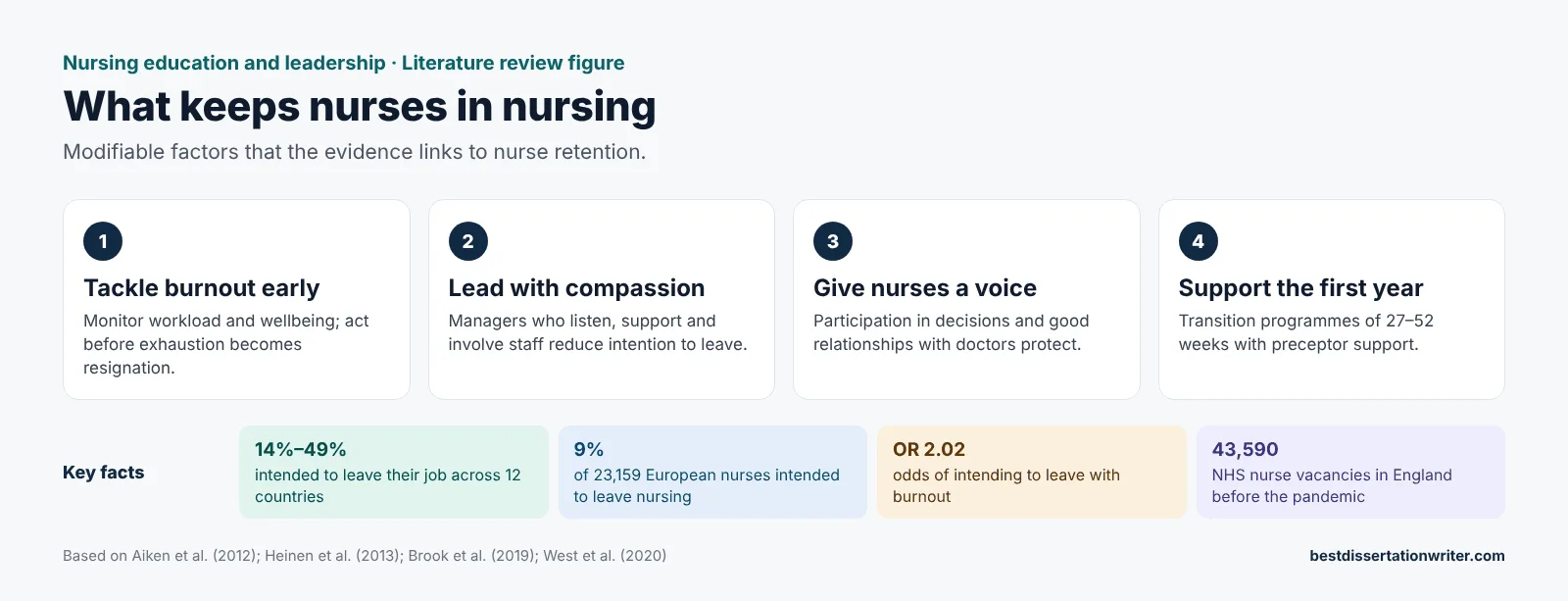
For early career nurses, Brook et al. (2019) reviewed 53 studies of interventions to reduce turnover and improve nurse retention. The most promising were internship or residency programmes and orientation or transition-to-practice programmes that combined a teaching component with preceptor and mentor support. Successful programmes lasted between 27 and 52 weeks. However, methodological weaknesses limited the conclusions, and the authors called for standardised reporting and evaluation of cost-effectiveness.
In the United Kingdom, a report commissioned by the RCN Foundation (West et al., 2020) argued that nurses’ wellbeing and motivation depend on three core needs: autonomy, belonging and contribution. It made eight recommendations covering authority and influence, fairness, working conditions, teamworking, compassionate leadership, workload, supervision and learning. The report drew on a wide range of evidence and consultation rather than a systematic review, but its recommendations align closely with the determinants identified in the research literature.
Discussion
This review suggests that nurse retention depends on a combination of individual wellbeing and organisational conditions. Burnout and dissatisfaction are the strongest individual predictors of intention to leave, and they are themselves shaped by workload, leadership and the work environment. Supportive leadership, good relationships with doctors and participation in decisions protect against intention to leave, while structured transition programmes appear to help early career nurses stay.
A notable finding is that staffing ratios were not directly associated with intention to leave the profession at European level, even though inadequate staffing is a frequent complaint. One interpretation is that staffing affects retention mainly through burnout and job satisfaction rather than independently. Another is that intention to leave the profession differs from intention to leave a job, with staffing more likely to drive moves between employers. Nurse leaders should therefore not assume that improving staffing alone will solve retention problems.
The evidence also highlights the central role of leadership. Managerial style, supervisory support and leadership quality appeared in several sources as factors that either push nurses out or encourage them to stay. This places responsibility on organisations to select and develop ward managers who listen, involve staff in decisions and protect them from excessive demands. Leadership development may be one of the most effective investments in nurse retention, although its effects are rarely evaluated directly.
Most of the evidence reviewed here was collected before the COVID-19 pandemic. The pandemic increased workload, exposure to distress and moral injury for many nurses, and later surveys suggest that intention to leave has risen in several countries. The determinants identified before the pandemic are likely to remain relevant, but their relative importance may have changed, and recovery strategies now need to address accumulated fatigue as well as everyday working conditions.
The evidence base has limitations. Most studies were cross-sectional and measured intention to leave rather than actual turnover, intervention studies often lacked control groups, and few evaluated costs. Much of the evidence came from European and North American hospitals. This review relied on openly accessible, English-language sources and did not involve independent double screening. Future research should use longitudinal designs, measure actual turnover and compare the cost-effectiveness of different strategies for nurse retention in hospital and community settings.
Implications of Nurse Retention Evidence for Practice
For nurse leaders, the evidence supports treating burnout as a warning sign, monitoring job satisfaction and intention to leave through staff surveys and exit interviews, and acting on the factors staff identify. Organisations should invest in leadership development, involve nurses in decisions about their work, offer flexible working and provide structured transition support lasting most of the first year after qualification. The King’s Fund report on the courage of compassion provides a practical framework for these changes.
Nurse retention is closely linked to transformational leadership, which shapes satisfaction and engagement, and to supportive preceptorship for newly qualified nurses. Addressing nurse burnout is central to keeping staff, and giving nurses the time and skills to use evidence-based practice can strengthen their sense of contribution and professional pride.
Conclusion
This systematic review examined the factors that influence nurse turnover and intention to leave. Intention to leave is common across health systems and threatens nurse retention, burnout is the strongest associated factor, and supportive leadership, good professional relationships and involvement in decisions protect against leaving. Turnover is costly, and structured transition programmes show promise for early career nurses.
Improving nurse retention requires sustained, organisation-wide attention to working conditions, leadership and wellbeing rather than one-off initiatives. Nurse leaders and educators can make a direct difference by developing compassionate managers, supporting newly qualified nurses and addressing burnout before it leads to resignation.
References
Aiken, L. H., Sermeus, W., Van den Heede, K., Sloane, D. M., Busse, R., McKee, M., Bruyneel, L., Rafferty, A. M., Griffiths, P., Moreno-Casbas, M. T., Tishelman, C., Scott, A., Brzostek, T., Kinnunen, J., Schwendimann, R., Heinen, M., Zikos, D., Sjetne, I. S., Smith, H. L., & Kutney-Lee, A. (2012). Patient safety, satisfaction, and quality of hospital care: Cross sectional surveys of nurses and patients in 12 countries in Europe and the United States. BMJ, 344, e1717. https://doi.org/10.1136/bmj.e1717
Bae, S. H. (2022). Noneconomic and economic impacts of nurse turnover in hospitals: A systematic review. International Nursing Review, 69(3), 392–404. https://doi.org/10.1111/inr.12769
Brook, J., Aitken, L. M., Webb, R., MacLaren, J., & Salmon, D. (2019). Characteristics of successful interventions to reduce turnover and increase retention of early career nurses: A systematic review. International Journal of Nursing Studies, 91, 47–59. https://doi.org/10.1016/j.ijnurstu.2018.11.003
Halter, M., Boiko, O., Pelone, F., Beighton, C., Harris, R., Gale, J., Gourlay, S., & Drennan, V. (2017). The determinants and consequences of adult nursing staff turnover: A systematic review of systematic reviews. BMC Health Services Research, 17, 824. https://doi.org/10.1186/s12913-017-2707-0
Heinen, M. M., van Achterberg, T., Schwendimann, R., Zander, B., Matthews, A., Kózka, M., Ensio, A., Sjetne, I. S., Moreno Casbas, T., Ball, J., & Schoonhoven, L. (2013). Nurses’ intention to leave their profession: A cross sectional observational study in 10 European countries. International Journal of Nursing Studies, 50(2), 174–184. https://doi.org/10.1016/j.ijnurstu.2012.09.019
West, M., Bailey, S., & Williams, E. (2020). The courage of compassion: Supporting nurses and midwives to deliver high-quality care. The King’s Fund. https://www.kingsfund.org.uk/publications/courage-compassion-supporting-nurses-midwives
Cite this example
Best Dissertation Writers (2026) Factors Influencing Nurse Retention and Turnover: A Systematic Review. Available at: https://bestdissertationwriter.com/nurse-retention-literature-review/
Best Dissertation Writers
Get expert help with your nursing literature review
Share your topic and deadline with Best Dissertation Writers and get support tailored to your module brief.