Workforce Planning and Safe Staffing in Nursing: A Scoping Review
 By Dr. Robertson Prime, Research Fellow
Updated October 25, 2026
15 min read
About 2,900 words
In this review
Abstract
Background: Safe staffing has become a central concern for nurse leaders, regulators and governments, following inquiries into failures of care and growing evidence that registered nurse numbers affect patient survival. Wales has legislated on nurse staffing levels, and national guidance in England sets out how wards should determine the staff they need.
Aim: This scoping review aimed to map the evidence on registered nurse staffing, skill mix and patient outcomes, and the approaches used to plan and govern staffing levels.
Methods: Evidence was identified through targeted searches of openly accessible bibliographic records, publisher websites and the reference lists of key reviews. Six sources published between 2014 and 2022 were included: a nine-country observational study, a longitudinal cohort study, two reviews and two policy instruments, appraised with CASP checklists where applicable and charted descriptively.
Findings: Across 422,730 surgical patients in nine European countries, each additional patient per nurse increased the odds of death within 30 days by about 7% (odds ratio 1.068), while each 10% increase in bachelor-educated nurses reduced them (0.929). In one English hospital, each day of registered nurse staffing below the ward mean increased the hazard of death by 3%, and substituting nursing assistants did not compensate. A review of 27 longitudinal studies concluded that a causal link with mortality is plausible, although measurement varied and endogeneity complicates estimates.
Conclusion: Registered nurse staffing and education levels matter for patient survival. Workforce planning should combine evidence-based tools, professional judgement and governance, and resist substituting less qualified staff for registered nurses.
Keywords: safe staffing, workforce planning, nurse staffing, skill mix
Introduction
This scoping review critically examines recent evidence on safe staffing and its implications for nursing education and leadership.
Few issues matter more to nurses than whether there are enough of them on a shift. When wards are short of registered nurses, care is left undone, observations are missed, patients wait longer for help and nurses go home exhausted and distressed. Inquiries into failures of care in the United Kingdom, including at Mid Staffordshire, identified inadequate staffing as a contributing factor, and since then safe staffing has become a priority for regulators, governments and professional bodies.
Policy responses have differed across the United Kingdom. Wales passed the Nurse Staffing Levels (Wales) Act 2016, requiring health bodies to ensure appropriate nurse staffing levels, and Scotland has since legislated on safe staffing across health and care. In England, the National Institute for Health and Care Excellence (NICE) published guidance in 2014 on safe staffing for adult inpatient wards in acute hospitals, emphasising local judgement supported by evidence-based tools rather than fixed ratios.
A scoping review was chosen because the field combines large observational studies, longitudinal cohort studies, methodological reviews, guidelines and legislation, and a scoping approach allows the breadth and nature of this evidence to be mapped and its gaps identified.
The question matters for nurse leaders who set establishments and manage rotas every day, for educators preparing future ward managers and for policy-makers deciding whether to legislate. Understanding both the strength and the limitations of the evidence helps leaders to argue convincingly for adequate staffing while recognising what the research can and cannot tell them about the right number of nurses for a particular ward.
Review question
What is known about the relationship between registered nurse staffing, skill mix and patient outcomes, and how is safe staffing planned and governed?
Background to Safe Staffing
Nurse staffing can be measured in several ways: patients per registered nurse, registered nurse hours per patient day, the proportion of registered nurses within the nursing team, and the gap between planned and actual staffing on a given shift. Skill mix refers to the balance between registered nurses and other staff such as nursing assistants and nursing associates. Education mix describes the proportion of registered nurses with a bachelor’s degree. Each measure captures a different aspect of staffing and may relate differently to outcomes.
Several mechanisms link staffing to patient outcomes. With fewer registered nurses, each nurse has less time to monitor patients, recognise deterioration, give medicines safely, educate patients and coordinate care. Care left undone, often called missed care, is thought to be a key pathway between low staffing and harm. Higher skill mix may also matter because registered nurses have the education and accountability to make clinical judgements that other staff cannot.
Workforce planning involves deciding how many and what type of staff each ward needs and then ensuring they are available on each shift. Tools such as patient acuity and dependency measures estimate the nursing time required, while professional judgement accounts for factors such as ward layout and patient turnover. Shift-by-shift deployment and escalation processes respond when actual staffing falls short of plans. Mandated ratios are an alternative approach used in some jurisdictions, such as California and parts of Australia.
In the United Kingdom, nurse staffing is also shaped by national shortages, reliance on temporary staff and the introduction of new roles such as nursing associates. These pressures make it tempting to replace registered nurses with less qualified staff, which raises questions about whether such substitutions are safe. Understanding the evidence on skill mix is therefore essential for safe staffing decisions.
Safe staffing also matters to nurses themselves. Working repeatedly on understaffed shifts means skipped breaks, late finishes and the moral distress of knowing that care has been left undone. These experiences help to explain why staffing features so prominently whenever nurses’ wellbeing and working conditions are discussed. For nurse leaders, the case for adequate staffing therefore rests on staff wellbeing and retention as well as on patient outcomes, and both forms of evidence are relevant when arguing for investment in the nursing workforce.
Search Strategy and Methods
Evidence for this example was identified through targeted searches of openly accessible bibliographic records, publisher websites and the reference lists of key reviews. Search terms combined keywords for the exposure (“safe staffing”, “nurse staffing”, “skill mix”, “workforce planning”, “nurse-to-patient ratio”) with terms for outcomes and policy (“mortality”, “patient outcome*”, “missed care”, “guideline”, “legislation”), joined with the Boolean operators AND and OR. A full scoping review for assessment would run the same strategy in CINAHL, ERIC, PubMed/MEDLINE and Scopus and report the number of records screened in a PRISMA flow diagram.
Sources were eligible if they examined the relationship between nurse staffing or skill mix and patient outcomes in acute hospitals, reviewed the methodological quality of this evidence, or set guidance or law on safe staffing in the United Kingdom. Large multi-site studies, longitudinal designs and reviews were prioritised, together with the main policy instruments relevant to United Kingdom practice. Studies of staffing in intensive care, maternity and community services were excluded to keep the focus on general wards, where most safe staffing research has been conducted.
Six sources published between 2014 and 2022 were included: one multinational retrospective observational study, one longitudinal cohort study, one methodological review, one systematic review of longitudinal studies, one national guideline and one Act of the Welsh Parliament (Table 1). Research sources were appraised using the Critical Appraisal Skills Programme (CASP) checklist appropriate to their design, and all sources were charted and summarised descriptively, in keeping with a scoping approach.
Key Findings on Safe Staffing
Three themes were identified: the association between registered nurse staffing, education and mortality; skill mix and the substitution of registered nurses; and the strength and limitations of the evidence for safe staffing policy. Table 1 summarises the included sources, and Figure 1 presents estimates from two major studies of staffing and patient mortality.
| Author, year | Design | Setting and sample | Key finding |
|---|---|---|---|
| Aiken et al. (2014) | Retrospective observational study | 422,730 surgical patients, 300 hospitals, nine European countries | Each extra patient per nurse: OR 1.068 for death; each 10% more bachelor-educated nurses: OR 0.929. |
| NICE (2014) | National guideline | Adult inpatient wards in acute hospitals, England | Organisational strategy, setting establishments, on-the-day assessment and monitoring of nurse staffing. |
| Nurse Staffing Levels (Wales) Act 2016 | Legislation | Health service bodies in Wales | Requires appropriate nurse staffing levels, supported by national workforce tools. |
| Griffiths et al. (2016) | Methodological review | Evidence reviewed for the NICE guideline | Evidence consistent with causation but effect sizes may be biased by endogeneity. |
| Griffiths et al. (2019) | Retrospective longitudinal cohort study | 138,133 admissions, 32 wards, one NHS trust, England | Each day of RN staffing below mean: HR 1.03; assistants did not compensate. |
| Dall’Ora et al. (2022) | Systematic review | 27 longitudinal studies | Beneficial effect of higher RN staffing on mortality; causal link plausible; high risk of bias. |
Theme 1: Registered Nurse Staffing, Education and Mortality
Aiken et al. (2014) analysed discharge data for 422,730 patients aged 50 years or older who underwent common surgical procedures in 300 hospitals in nine European countries, including England, linked to surveys of 26,516 nurses. Each additional patient per nurse was associated with a 7% increase in the odds of death within 30 days of admission (odds ratio 1.068, 95% confidence interval 1.031 to 1.106). Each 10% increase in the proportion of nurses with a bachelor’s degree was associated with a 7% decrease (odds ratio 0.929, 0.886 to 0.973).
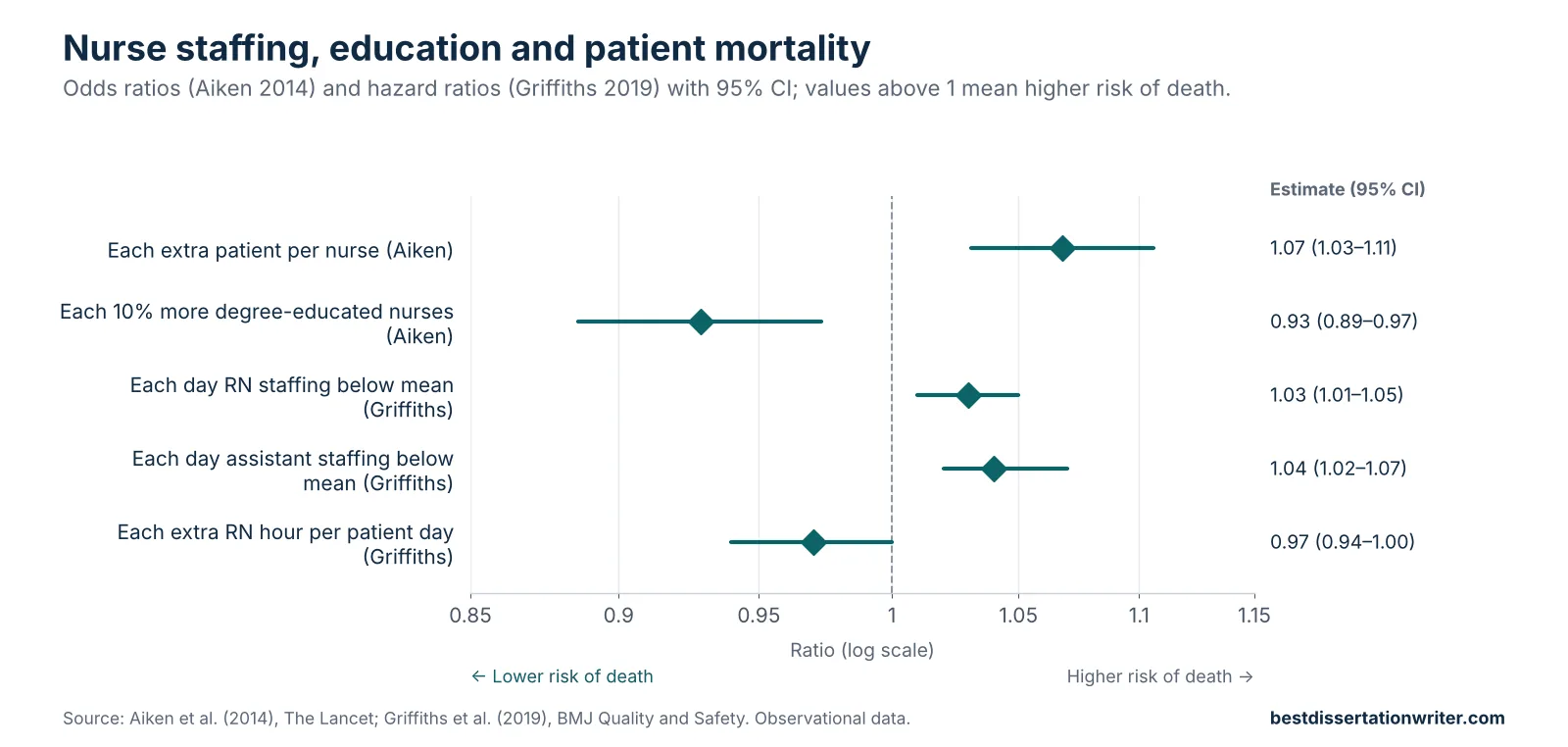
Griffiths et al. (2019) examined 138,133 admissions to 32 general medical and surgical wards in one large NHS trust in the south of England over three years, using daily staffing data. The hazard of death increased by 3% for every day a patient experienced registered nurse staffing below the ward mean (adjusted hazard ratio 1.03, 1.01 to 1.05), and each additional hour of registered nurse care per patient day over the first five days was associated with a lower hazard of death (0.97, 0.94 to 1.00). Using daily rather than average staffing data strengthens the link between exposure and outcome.
Dall’Ora et al. (2022) systematically reviewed 27 longitudinal studies, which are better able than cross-sectional studies to show that low staffing precedes harm. They found an overall picture of a beneficial effect of higher registered nurse staffing on preventing death and judged a causal link between low staffing and mortality to be plausible. Evidence for other outcomes was less clear, most studies were at serious or critical risk of bias, and the authors considered that the most biased studies were likely to underestimate the benefit of higher registered nurse staffing.
Theme 2: Skill Mix and Substitution
The evidence on skill mix suggests that registered nurses cannot simply be replaced by other staff. Griffiths et al. (2019) found that low nursing assistant staffing was also associated with increased mortality, but that additional nursing assistants did not compensate for shortages of registered nurses. Aiken et al. (2014) found that higher proportions of degree-educated nurses were associated with lower mortality, suggesting that the education of the workforce matters as well as its size.
These findings have direct implications for workforce planning. When registered nurse vacancies cannot be filled, adding nursing assistants may maintain the total number of staff on a ward but does not appear to provide equivalent safety. New roles such as nursing associates may contribute valuable care, but the evidence reviewed here suggests that safe staffing decisions should protect the number of registered nurses rather than treating staff groups as interchangeable.
Skill mix decisions are often made under pressure, for example when a registered nurse shift cannot be filled and a nursing assistant is booked instead. The evidence suggests that such decisions should be visible and recorded, so that their cumulative effect on safe staffing can be monitored. Ward managers need clear escalation routes when the registered nurse complement falls below planned levels, and boards need regular reports that distinguish registered nurse hours from total staff hours, rather than a single combined fill rate that can mask dilution of the skill mix.
Theme 3: Evidence, Guidance and Legislation for Safe Staffing
Griffiths et al. (2016) reviewed the evidence considered by NICE when developing its safe staffing guideline. Many studies reported associations between low staffing and adverse outcomes, and the evidence was broadly consistent with a causal relationship. However, endogeneity, arising from omitted variables such as medical staffing, simultaneity between outcomes and staffing, and common-method variance in survey data, meant that effect sizes might be biased. The authors concluded that the evidence supports policy but may not provide operational solutions for deciding exact staffing levels.
The NICE (2014) guideline therefore focused on organisational strategy, principles for determining staff requirements, setting establishments for wards, assessing on the day whether available staff meet patients’ needs and monitoring staffing. The Nurse Staffing Levels (Wales) Act 2016 took a legislative approach, requiring health bodies to ensure appropriate nurse staffing levels, supported by national workforce tools for adult acute and paediatric inpatient areas and other services.
Discussion
This scoping review suggests that the evidence linking registered nurse staffing to patient mortality is consistent and increasingly robust, with large multinational and longitudinal studies pointing in the same direction. Higher registered nurse staffing and a more educated workforce are associated with lower mortality, and substituting nursing assistants for registered nurses does not appear to provide equivalent safety. These findings provide a strong rationale for treating safe staffing as a patient safety priority.
The evidence also has important limitations. Observational designs cannot fully exclude confounding, and endogeneity may bias estimates in either direction. Staffing was measured in many different ways, preventing pooled estimates. Most importantly for practice, the research does not identify a single safe ratio for all wards. As Griffiths et al. (2016) argued, the evidence supports policy but may not tell a ward manager exactly how many nurses are needed on a particular shift.
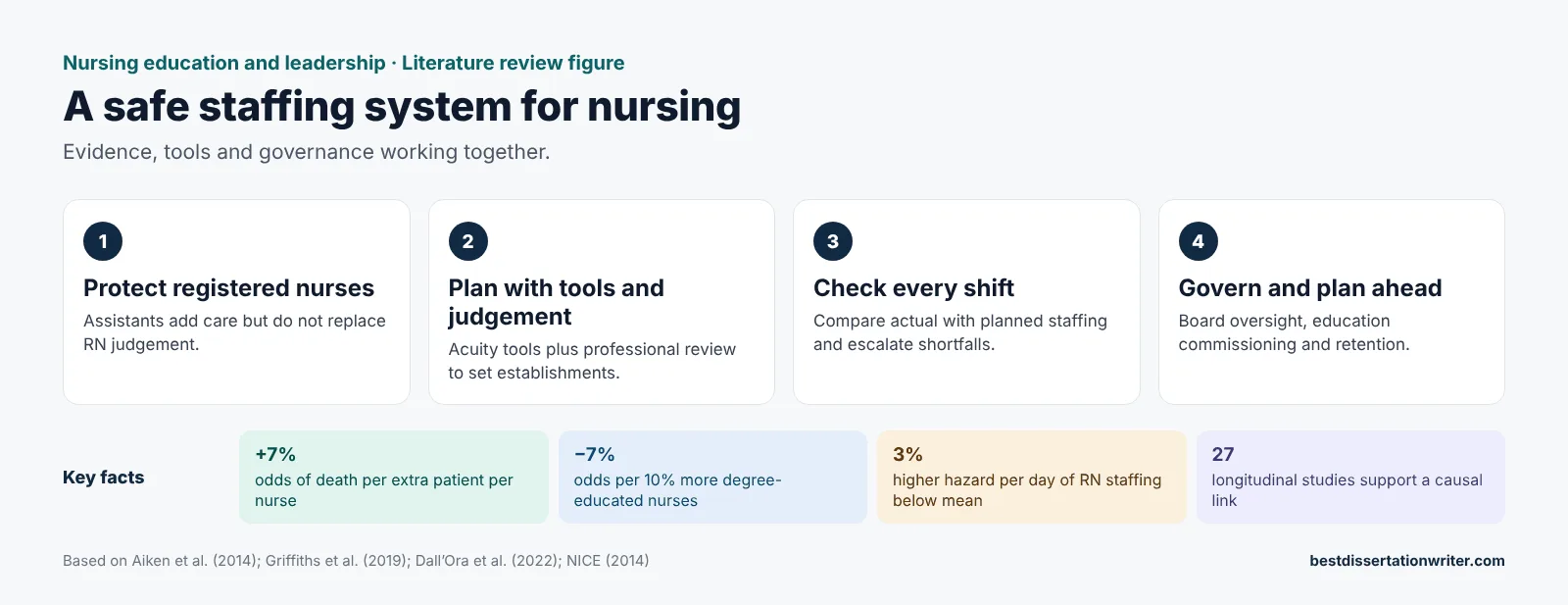
This gap explains why approaches to safe staffing combine evidence-based tools with professional judgement. Acuity and dependency tools estimate need, but they must be applied by nurse leaders who understand their patients and wards, and they must be backed by escalation processes when staffing falls short. Legislation, as in Wales, can strengthen accountability and ensure that staffing is reviewed systematically, while guidance, as in England, leaves more to local decision-making.
Workforce planning cannot be separated from supply. Even the best tools cannot produce nurses who do not exist, and shortages drive reliance on temporary staff and pressure to dilute skill mix. Safe staffing therefore depends on long-term workforce planning, including education commissioning, retention of experienced nurses and attention to working conditions. Low staffing also increases burnout and intention to leave, which can create a cycle in which shortages worsen.
The evidence base has limitations. Most studies were from high-income countries and focused on acute hospital wards, and few examined community, mental health or social care settings. Outcomes beyond mortality were less well studied. This review relied on openly accessible, English-language sources and, as a scoping review, did not formally synthesise effect sizes. Future research should use standardised staffing measures, multi-site longitudinal designs and economic evaluations, and should evaluate the effects of legislation and new roles on safe staffing.
Implications of Safe Staffing Evidence for Practice
For nurse leaders, the evidence supports protecting registered nurse numbers, monitoring staffing against planned levels on every shift, using validated acuity tools alongside professional judgement and escalating shortfalls promptly. Boards should review staffing data alongside patient outcomes and staff wellbeing, and workforce planning should invest in degree-level education and retention. The NICE guideline on safe staffing for adult inpatient wards provides a framework for these processes in England.
Adequate staffing is closely linked to nurse retention and to the prevention of nurse burnout. Organisations with Magnet hospital recognition emphasise staffing and work environments, and effective teamwork developed through interprofessional education can help staff use limited resources safely.
Conclusion
This scoping review mapped the evidence on registered nurse staffing, skill mix and patient outcomes and the approaches used to govern safe staffing. Higher registered nurse staffing and education are consistently associated with lower mortality, and nursing assistants do not substitute for registered nurses, although the evidence cannot specify a single safe ratio.
Safe staffing requires nurse leaders to combine evidence, tools and professional judgement within a supportive governance framework, and it depends on long-term workforce planning that attracts, educates and retains registered nurses. Treating staffing as a core patient safety issue is the clearest message from the evidence.
References
Aiken, L. H., Sloane, D. M., Bruyneel, L., Van den Heede, K., Griffiths, P., Busse, R., Diomidous, M., Kinnunen, J., Kózka, M., Lesaffre, E., McHugh, M. D., Moreno-Casbas, M. T., Rafferty, A. M., Schwendimann, R., Scott, P. A., Tishelman, C., van Achterberg, T., & Sermeus, W. (2014). Nurse staffing and education and hospital mortality in nine European countries: A retrospective observational study. The Lancet, 383(9931), 1824–1830. https://doi.org/10.1016/S0140-6736(13)62631-8
Dall’Ora, C., Saville, C., Rubbo, B., Turner, L., Jones, J., & Griffiths, P. (2022). Nurse staffing levels and patient outcomes: A systematic review of longitudinal studies. International Journal of Nursing Studies, 134, 104311. https://doi.org/10.1016/j.ijnurstu.2022.104311
Griffiths, P., Ball, J., Drennan, J., Dall’Ora, C., Jones, J., Maruotti, A., Pope, C., Recio Saucedo, A., & Simon, M. (2016). Nurse staffing and patient outcomes: Strengths and limitations of the evidence to inform policy and practice. A review and discussion paper based on evidence reviewed for the National Institute for Health and Care Excellence Safe Staffing guideline development. International Journal of Nursing Studies, 63, 213–225. https://doi.org/10.1016/j.ijnurstu.2016.03.012
Griffiths, P., Maruotti, A., Recio Saucedo, A., Redfern, O. C., Ball, J. E., Briggs, J., Dall’Ora, C., Schmidt, P. E., & Smith, G. B. (2019). Nurse staffing, nursing assistants and hospital mortality: Retrospective longitudinal cohort study. BMJ Quality & Safety, 28(8), 609–617. https://doi.org/10.1136/bmjqs-2018-008043
National Institute for Health and Care Excellence. (2014). Safe staffing for nursing in adult inpatient wards in acute hospitals (Safe staffing guideline SG1). https://www.nice.org.uk/guidance/sg1
Nurse Staffing Levels (Wales) Act 2016, anaw 5. https://www.legislation.gov.uk/anaw/2016/5/contents
Cite this example
Best Dissertation Writers (2026) Workforce Planning and Safe Staffing in Nursing: A Scoping Review. Available at: https://bestdissertationwriter.com/safe-staffing-literature-review/
Best Dissertation Writers
Get expert help with your nursing literature review
Share your topic and deadline with Best Dissertation Writers and get support tailored to your module brief.