Nurse Burnout, Resilience, and Wellbeing Among Registered and Student Nurses: A Systematic Review
 By Dr. Robertson Prime, Research Fellow
Updated October 25, 2026
14 min read
About 2,800 words
In this review
Abstract
Background: Nurse burnout, a syndrome of emotional exhaustion, depersonalisation and reduced personal accomplishment, threatens the wellbeing of nurses, the quality of care and the stability of the workforce. Concern has grown since the COVID-19 pandemic, and evidence suggests that burnout begins for many during their pre-registration education.
Aim: This systematic review aimed to examine the prevalence of burnout among registered and student nurses, its associated factors and the effectiveness of interventions to build resilience and wellbeing.
Methods: Evidence was identified through targeted searches of openly accessible bibliographic records, publisher websites and the reference lists of key reviews. Five sources published between 2020 and 2023 were included: three meta-analyses of prevalence, one meta-analysis of resilience interventions and one commissioned policy report, appraised with CASP checklists and synthesised narratively.
Findings: The global pooled prevalence of burnout symptoms among nurses was 11.23% across 45,539 nurses, while during the pandemic 34.1% of nurses reported high emotional exhaustion. Among nursing students, 41% had high emotional exhaustion and 19% high overall burnout. Workload, inadequate resources, low social support and younger age were associated risk factors. Resilience interventions produced moderate improvements in resilience (SMD 0.39) and wellbeing (SMD 0.44), but the certainty of evidence was very low.
Conclusion: Burnout affects a substantial proportion of nurses and students and is driven largely by working and learning conditions. Individual resilience training can help but must be combined with organisational action on workload, staffing and support.
Keywords: nurse burnout, burnout in nursing, nurse resilience
Introduction
This systematic review critically examines recent evidence on nurse burnout and its implications for nursing education and leadership.
Nursing is rewarding but demanding work. Nurses care for people at their most vulnerable, work long shifts with heavy workloads, witness suffering and death and often feel unable to give the care they would wish because of staff shortages. Over time, these pressures can lead to nurse burnout, a state in which nurses feel emotionally drained, become detached from patients and colleagues and lose their sense of achievement. Nurse burnout harms nurses’ health, increases sickness absence and intention to leave and may compromise the safety and quality of care.
Concern about burnout in nursing intensified during the COVID-19 pandemic, when nurses faced high workloads, risks of infection, moral distress and isolation from their families. In England, even before the pandemic, a report for the King’s Fund noted that 44% of nurses and midwives in the 2019 NHS Staff Survey had felt unwell as a result of work-related stress in the previous 12 months. Burnout is therefore a long-standing problem that the pandemic made more visible rather than a new phenomenon.
Burnout does not begin only after registration. Nursing students combine academic study with clinical placements, financial pressures and exposure to distressing situations, often while still developing coping skills. If burnout begins during education, it may affect learning, progression and early careers.
A systematic approach was chosen because the literature includes several large meta-analyses of prevalence in different populations and periods, and reviews of interventions. Bringing these together allows comparison of burnout among registered nurses and students, and assessment of whether the interventions most commonly offered, such as resilience training, are supported by evidence.
Review question
How common is nurse burnout among registered and student nurses, what factors are associated with it, and how effective are interventions to build nurse resilience and wellbeing?
Background to Nurse Burnout
Burnout was first described in the 1970s among human service workers and is most commonly measured using the Maslach Burnout Inventory. This instrument assesses three dimensions: emotional exhaustion, the feeling of being emotionally overextended and depleted; depersonalisation, an impersonal or cynical response to patients; and reduced personal accomplishment, a decline in feelings of competence and achievement. The World Health Organization’s International Classification of Diseases describes burnout as an occupational phenomenon resulting from chronic workplace stress that has not been successfully managed.
Theories of nurse burnout emphasise the balance between job demands and resources. When demands such as workload, emotional labour and time pressure persistently exceed resources such as staffing, support, autonomy and recognition, nurses become exhausted. Mismatches between nurses’ values and what their work allows them to do, for example when staffing shortages force them to leave care undone, can cause moral distress that contributes to nurse burnout.
Resilience is often proposed as a protective factor. Nurse resilience refers to the ability to adapt to adversity, recover from stress and maintain wellbeing. It is shaped by personal characteristics, such as coping strategies and self-efficacy, and by external resources, such as supportive colleagues and leaders. Critics warn that an emphasis on individual resilience may shift responsibility for burnout from organisations to individuals, implying that nurses should simply cope better with unsafe conditions.
For nursing education and leadership, understanding nurse burnout matters at several levels. Educators need to recognise and support students who are struggling, preceptors and managers need to notice early signs in staff, and senior leaders need to address the organisational conditions that drive burnout. Evidence on prevalence, risk factors and interventions can inform each of these responses.
Search Strategy and Methods
Evidence for this example was identified through targeted searches of openly accessible bibliographic records, publisher websites and the reference lists of key reviews. Search terms combined keywords for the outcome (“nurse burnout”, “burnout in nursing”, “emotional exhaustion”, “compassion fatigue”) with terms for the population and interventions (“registered nurse*”, “nursing student*”, “nurse resilience”, “wellbeing”, “mindfulness”, “intervention”), joined with the Boolean operators AND and OR. A full systematic review for assessment would run the same strategy in CINAHL, ERIC, PubMed/MEDLINE and Scopus and report the number of records screened in a PRISMA flow diagram.
Sources were eligible if they reported the prevalence of or factors associated with burnout among registered or student nurses, or evaluated interventions to reduce burnout or build resilience and wellbeing in nurses. Meta-analyses were prioritised because of the very large number of single-site prevalence surveys of nurse burnout. A policy report from the United Kingdom was included to provide national context. Studies limited to other health professions were excluded.
Five sources published between 2020 and 2023 were included: three meta-analyses of burnout prevalence among nurses globally, nurses during the COVID-19 pandemic and nursing students; one meta-analysis of resilience interventions for nurses; and one commissioned policy report from the United Kingdom (Table 1). The quality of each source was appraised using the Critical Appraisal Skills Programme (CASP) checklist appropriate to its design, and findings were synthesised narratively.
Key Findings on Nurse Burnout
Three themes were identified: the prevalence of nurse burnout among registered nurses and students, the factors associated with burnout, and the effectiveness of interventions to build resilience and wellbeing. Table 1 summarises the included sources, and Figure 1 compares the prevalence of burnout dimensions among registered nurses during the pandemic and among nursing students.
| Author, year | Design | Setting and sample | Key finding |
|---|---|---|---|
| Woo et al. (2020) | Systematic review and meta-analysis | 113 studies; 61 meta-analysed; 45,539 nurses in 49 countries | Global pooled prevalence of burnout symptoms 11.23%; varies by region and specialty. |
| West et al. (2020) | Commissioned policy report | Nurses and midwives, United Kingdom | 44% unwell from work-related stress (2019 survey); autonomy, belonging and contribution needed. |
| Galanis et al. (2021) | Systematic review and meta-analysis | 16 studies, 18,935 nurses during COVID-19 | High emotional exhaustion 34.1%; depersonalisation 12.6%; low accomplishment 15.2%. |
| Kunzler et al. (2022) | Systematic review and meta-analysis of RCTs | 24 trials; 17 meta-analysed (1,020 nurses) | Resilience SMD 0.39 and wellbeing SMD 0.44; very low certainty; short-lived. |
| Gómez-Urquiza et al. (2023) | Systematic review and meta-analysis | 34 studies; 15 meta-analysed (2,744 nursing students) | High burnout 19%; high emotional exhaustion 41%. |
Theme 1: The Prevalence of Nurse Burnout
Woo et al. (2020) conducted the first meta-analysis of the global prevalence of burnout symptoms among nurses, including 113 studies in the systematic review and 61 in the meta-analysis, covering 45,539 nurses in 49 countries. The pooled prevalence of burnout symptoms was 11.23%. Prevalence varied significantly by region, specialty and measurement tool, being highest in sub-Saharan Africa and lowest in Europe and Central Asia, and highest among paediatric nurses and lowest in geriatric care.
Galanis et al. (2021) synthesised 16 studies involving 18,935 nurses during the first year of the COVID-19 pandemic. The pooled prevalence of high emotional exhaustion was 34.1%, of high depersonalisation 12.6% and of low personal accomplishment 15.2%. These figures are not directly comparable with the global estimate, because they report individual dimensions rather than a composite measure, but they show that emotional exhaustion affected around a third of nurses during the pandemic.
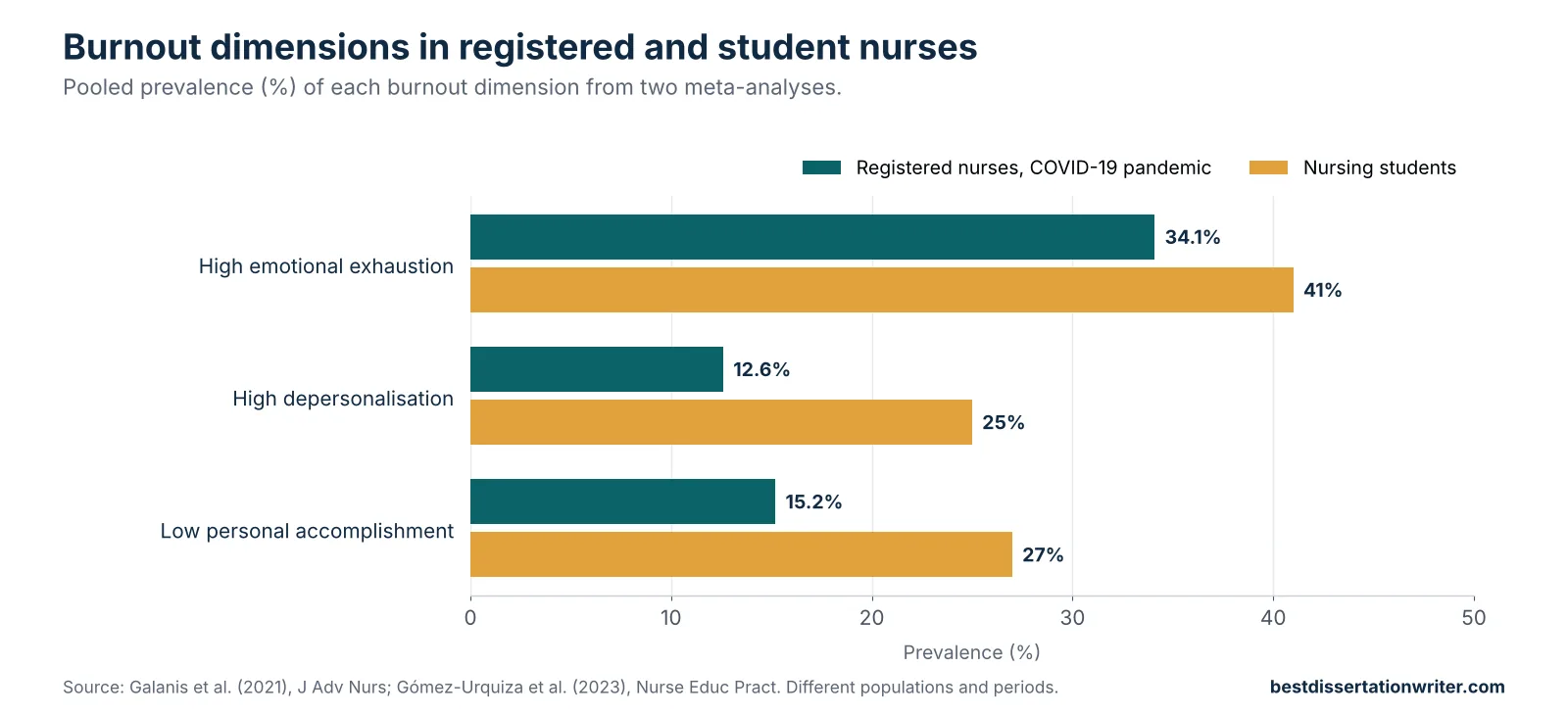
Gómez-Urquiza et al. (2023) reviewed 34 studies of nursing students and meta-analysed 15 studies involving 2,744 students. The pooled prevalence of high burnout was 19%, and emotional exhaustion was the most affected dimension, with 41% of students reporting high levels. High depersonalisation affected 25% and low personal accomplishment 27%. The authors recommended prevention and treatment of burnout at university level.
The finding that students reported higher levels of emotional exhaustion than registered nurses during the pandemic is striking, although the two estimates come from different populations, periods and instruments. It suggests that burnout in nursing may begin before registration, with implications for how nursing education is designed and how students are supported during placements and assessments.
Theme 2: Factors Associated with Burnout
Galanis et al. (2021) identified several risk factors for burnout among nurses during the pandemic: younger age, low social support, greater perceived threat from COVID-19, working in high-risk environments, inadequate material and human resources, increased workload and less specialised training. Most of these factors relate to working conditions and organisational support rather than to individual characteristics.
The pandemic also illustrated how quickly conditions can change. Redeployment to unfamiliar areas, shortages of protective equipment and repeated exposure to death placed nurses under sustained strain, and many continued to work extra shifts to cover absent colleagues. These experiences show that burnout in nursing responds to the immediate environment, which means that it can also be reduced when conditions improve, for example through adequate staffing, rest and recognition after periods of intense pressure.
Woo et al. (2020) found that the prevalence of nurse burnout varied by specialty and region, suggesting that working conditions and health system resources influence burnout. The report by West et al. (2020) for the King’s Fund similarly argued that nurses’ wellbeing depends on three core needs, autonomy, belonging and contribution, and that chronic excessive workload, poor working conditions and lack of compassionate leadership undermine these needs. It recommended action on workload, teamworking, leadership, supervision and working conditions.
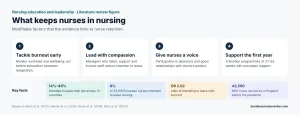
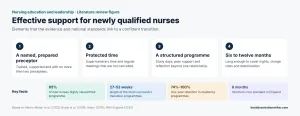
The consistent message is that nurse burnout is largely a product of the work environment. Younger and less experienced nurses appear more vulnerable, which links burnout to the transition from student to registered nurse and to the support offered in the first years of practice. Inadequate staffing and resources, which are organisational responsibilities, feature repeatedly as risk factors.
Theme 3: Building Resilience and Wellbeing
Kunzler et al. (2022) systematically reviewed 24 randomised controlled trials of psychological interventions to foster resilience in nursing staff, conducted before the pandemic, and meta-analysed 17 trials involving 1,020 participants. After the intervention, there was very low-certainty evidence of moderate benefits for resilience (standardised mean difference 0.39, 95% confidence interval 0.12 to 0.66) and wellbeing (0.44, 0.15 to 0.72), but no evidence of effects on anxiety, depression or stress at that point.
Effective programmes included mindfulness and relaxation, psychoeducation, emotion regulation, cognitive strategies, problem-solving and strengthening internal and external resources. Benefits for wellbeing persisted in the short term, but few trials followed participants beyond three months, and no effects were found at later follow-ups. The authors called for larger, longer and higher-quality trials. These findings suggest that resilience training can help individual nurses but is not a complete solution to burnout.
Discussion
This review suggests that nurse burnout affects a substantial proportion of nurses and nursing students worldwide, with emotional exhaustion the most prominent dimension. Nurse burnout is strongly associated with working conditions, including workload, staffing, resources and support, and younger nurses and students appear particularly vulnerable. Individual resilience interventions produce modest, short-term benefits, but the certainty of evidence is very low.
Estimates of nurse burnout vary widely according to definitions, instruments and populations. A pooled global prevalence of around 11% for composite burnout symptoms and a pandemic prevalence of over a third for emotional exhaustion are not contradictory: they measure different things in different contexts. For nurse leaders, the more useful message is that a significant minority of staff are likely to be experiencing burnout at any time, and that the proportion rises when pressures increase.
The evidence on interventions raises important questions about responsibility. Resilience training is relatively cheap and easy to offer, but if nurse burnout is driven by unsafe staffing and excessive workload, teaching nurses to cope better may do little to address the cause and may even imply that burnout is a personal failing. The evidence on risk factors points towards organisational solutions: adequate staffing, manageable workloads, supportive leadership, peer support and opportunities for nurses to influence their work.
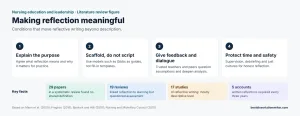
The findings for students are particularly relevant to nursing education. High emotional exhaustion among students suggests that academic workload, placement pressures, financial strain and exposure to distressing experiences take a toll before nurses enter the workforce. Programmes can reduce this through realistic workload planning, supportive placements, personal tutoring and teaching self-care and reflective skills, and by ensuring that students experiencing burnout are identified and supported rather than simply expected to persevere.
The evidence base has limitations. Most prevalence studies were cross-sectional, used different instruments and cut-offs and relied on self-report. Intervention trials were small, short and at high risk of bias, and few examined organisational interventions. This review relied on openly accessible, English-language sources and did not involve independent double screening. Future research should test organisational interventions to prevent burnout, follow students into practice and evaluate combined approaches that address both individual resilience and working conditions.
Monitoring is a practical starting point. Many organisations collect staff survey data, sickness absence figures and turnover rates, but these are rarely combined to identify teams at risk of nurse burnout. Short, validated wellbeing measures used regularly at ward level, together with conversations in supervision and appraisal, could help leaders to notice problems early. Data are only useful, however, if they lead to action, and staff are more likely to report honestly when they see that concerns result in visible changes to rotas, staffing or support.
Implications of Nurse Burnout Evidence for Practice
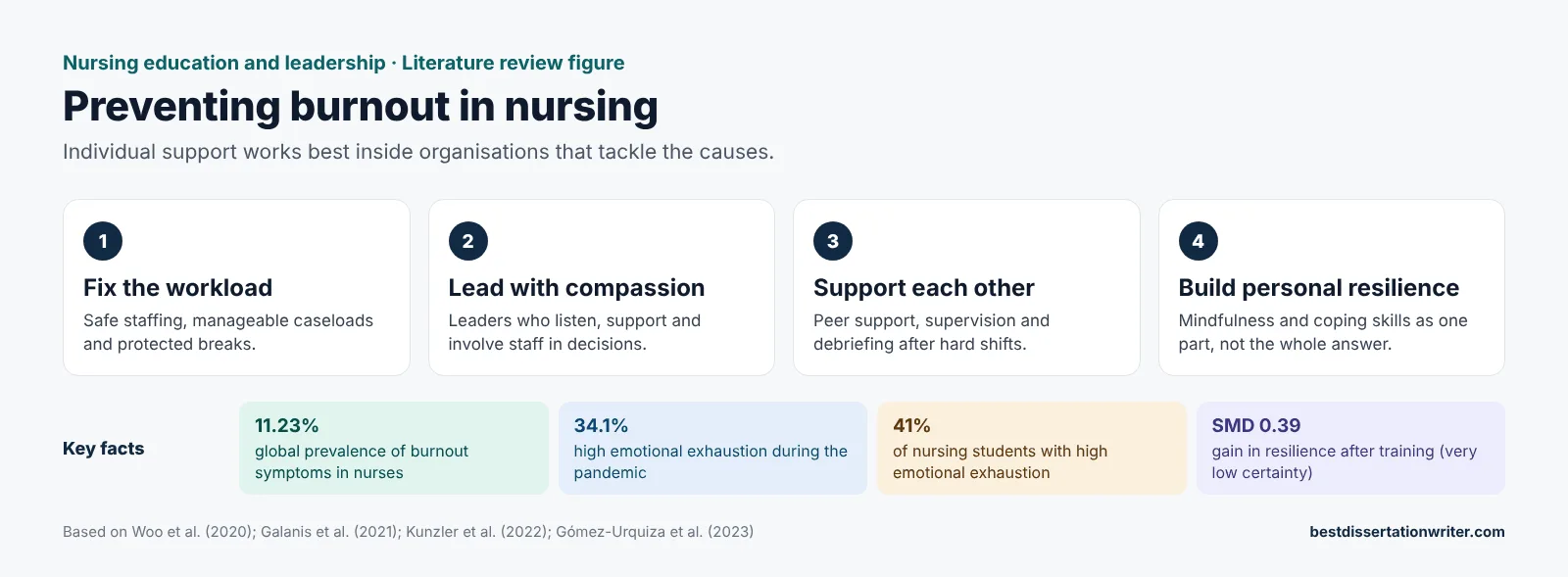
For nurse leaders, the evidence supports monitoring staff wellbeing, addressing workload and staffing, providing protected breaks, peer support and clinical supervision, and developing compassionate leadership. Resilience and mindfulness programmes can be offered as one part of a wider strategy but should not replace organisational action. For educators, the evidence supports attention to student workload, supportive placements and early identification of students showing signs of exhaustion. The King’s Fund report on the courage of compassion offers recommendations for organisations.
Reducing burnout depends on safe staffing and is central to nurse retention. For students, supportive clinical placements reduce stress, and simulation-based learning can prepare students for challenging situations in a safe environment, potentially reducing the shock of first encounters with distressing events in practice.
Conclusion
This systematic review examined nurse burnout, resilience and wellbeing among registered and student nurses. Burnout, especially emotional exhaustion, affects a substantial proportion of both groups, is associated mainly with working and learning conditions and is only partly addressed by individual resilience training, which shows modest benefits supported by very low-certainty evidence.
Preventing nurse burnout requires nurse leaders and educators to combine support for individual nurse resilience with determined action on staffing, workload, leadership and the learning environment. Treating burnout as an organisational responsibility, rather than a personal weakness, is essential for the wellbeing of nurses, the safety of patients and the future of the workforce.
References
Galanis, P., Vraka, I., Fragkou, D., Bilali, A., & Kaitelidou, D. (2021). Nurses’ burnout and associated risk factors during the COVID-19 pandemic: A systematic review and meta-analysis. Journal of Advanced Nursing, 77(8), 3286–3302. https://doi.org/10.1111/jan.14839
Gómez-Urquiza, J. L., Velando-Soriano, A., Membrive-Jiménez, M. J., Ramírez-Baena, L., Aguayo-Estremera, R., Ortega-Campos, E., & Cañadas-De la Fuente, G. A. (2023). Prevalence and levels of burnout in nursing students: A systematic review with meta-analysis. Nurse Education in Practice, 72, 103753. https://doi.org/10.1016/j.nepr.2023.103753
Kunzler, A. M., Chmitorz, A., Röthke, N., Staginnus, M., Schäfer, S. K., Stoffers-Winterling, J., & Lieb, K. (2022). Interventions to foster resilience in nursing staff: A systematic review and meta-analyses of pre-pandemic evidence. International Journal of Nursing Studies, 134, 104312. https://doi.org/10.1016/j.ijnurstu.2022.104312
West, M., Bailey, S., & Williams, E. (2020). The courage of compassion: Supporting nurses and midwives to deliver high-quality care. The King’s Fund. https://www.kingsfund.org.uk/publications/courage-compassion-supporting-nurses-midwives
Woo, T., Ho, R., Tang, A., & Tam, W. (2020). Global prevalence of burnout symptoms among nurses: A systematic review and meta-analysis. Journal of Psychiatric Research, 123, 9–20. https://doi.org/10.1016/j.jpsychires.2019.12.015
Cite this example
Best Dissertation Writers (2026) Nurse Burnout, Resilience, and Wellbeing Among Registered and Student Nurses: A Systematic Review. Available at: https://bestdissertationwriter.com/nurse-burnout-literature-review/
Best Dissertation Writers
Get expert help with your nursing literature review
Share your topic and deadline with Best Dissertation Writers and get support tailored to your module brief.