

Preceptorship and the Transition of Newly Qualified Nurses Into Practice: An Integrative Review
 By Dr. Robertson Prime, Research Fellow
Updated October 25, 2026
14 min read
About 2,800 words
In this review
Abstract
Background: Preceptorship is the period of structured support that helps newly registered nurses move from student to accountable practitioner. The transition is widely described as stressful, early career turnover is high, and regulators and employers in the United Kingdom now set out principles and standards for how this support should be delivered.
Aim: This integrative review aimed to examine how structured support for new registrants influences their confidence, competence and retention during the transition into practice.
Methods: Evidence was identified through targeted searches of openly accessible bibliographic records, publisher websites and the reference lists of key reviews. Six sources published between 2013 and 2022 were included: a mixed-methods evaluation, three systematic or integrative reviews and two national frameworks, appraised with CASP checklists and synthesised thematically.
Findings: In one NHS trust, 85% of new nurses highly valued their programme, which reduced stress and developed clinical and communication skills. A review of 14 papers concluded that one-to-one support influences confidence and competence, with structured programmes having greater impact than the individual preceptor, although direct evidence was weak. Transition programmes lasting 27 to 52 weeks were most promising for retention, and one-year retention in residency programmes ranged from 74% to 100%. National standards now recommend a minimum of six months and protected time for both parties.
Conclusion: Well-structured, adequately resourced support improves the experience of new nurses and may improve retention. Employers should protect time, prepare those who give support and evaluate outcomes.
Keywords: preceptorship, newly qualified nurses, preceptorship programmes
Introduction
This integrative review critically examines recent evidence on preceptorship and its implications for nursing education and leadership.
The first months after registration are a critical time in a nurse’s career. Newly qualified nurses move from supervised learners to accountable professionals, often in busy wards with high patient acuity and limited staffing. Many describe this period as exciting but stressful, marked by uncertainty about their competence, fear of making mistakes and the pressure of managing a full caseload for the first time. Some leave their first post within a year, and a proportion leave nursing altogether.
Preceptorship, the structured support offered during this transition, is intended to help new registrants consolidate their knowledge, develop confidence and integrate into the team. In the United Kingdom, this support has been formalised through national principles from the Nursing and Midwifery Council and a national framework from NHS England. These documents set expectations for the length of support, protected time, preparation of those who provide it and evaluation, and they reflect growing recognition that early career support is a workforce issue as well as an educational one.
An integrative design was chosen because the evidence includes qualitative studies, mixed-methods evaluations, reviews of retention outcomes and national policy, and integrating these different forms of evidence allows both the experience and the effects of transition support to be considered together.
The review also matters for nurse educators and leaders who design and deliver support. Programmes vary widely in length, content and resources, and organisations under pressure may be tempted to shorten or dilute them. Understanding what elements of preceptorship make a difference helps leaders to defend the time and investment needed and to focus resources where they are most likely to help new nurses stay and thrive.
Review question
How does preceptorship influence the confidence, competence and retention of newly qualified nurses during their transition into practice?
Background to Preceptorship
Preceptorship refers to a period of structured support for a newly registered practitioner, during which a more experienced colleague, the preceptor, provides guidance, feedback and role modelling. It was introduced in the United Kingdom in the early 1990s and has since been adopted in many countries, sometimes under different names. In North America, similar support is often provided through nurse residency or internship programmes that combine clinical support with structured education over several months.
Several theories help to explain why new nurses struggle. The idea of transition shock describes the emotional and practical shock of moving from the protected role of a student to full responsibility. Role theory highlights the need to learn the expectations and norms of a new professional role, while theories of socialisation emphasise belonging to a team. Preceptorship aims to soften this shock by providing a safe relationship, time for reflection and gradually increasing responsibility.
Programmes differ considerably. Some consist mainly of a named preceptor and periodic meetings, while others add study days, clinical skills training, action learning sets, rotations and coaching. Their length ranges from a few weeks to more than a year. This variation makes evaluation difficult, because studies may be comparing very different interventions under the same name, and it raises questions about which components are essential.
Funding and organisational context also shape what is possible. Preceptors are usually experienced staff nurses who support new colleagues alongside their own patient workload, and protected time is often the first casualty of staffing shortages. National frameworks in England therefore emphasise board-level oversight and protected time, recognising that support for newly qualified nurses depends on organisational commitment as much as on individual goodwill.
Search Strategy and Methods
Evidence for this example was identified through targeted searches of openly accessible bibliographic records, publisher websites and the reference lists of key reviews. Search terms combined keywords for the intervention (“preceptorship”, “preceptor*”, “residency programme”, “transition programme”, “orientation”) with terms for the population and outcomes (“newly qualified nurse*”, “new graduate nurse*”, “confidence”, “competence”, “retention”), joined with the Boolean operators AND and OR. A full integrative review for assessment would run the same strategy in CINAHL, ERIC, PubMed/MEDLINE and Scopus and report the number of records screened in a PRISMA flow diagram.
Sources were eligible if they evaluated structured support for newly qualified or newly registered nurses during their first year of practice, using any research design, or if they set national standards for such support. Reviews and evaluations reporting confidence, competence, satisfaction or retention were prioritised. Studies focusing only on students, or on experienced nurses changing specialty, were excluded. Because preceptorship and residency programmes overlap in purpose and content, evidence from both was included, with differences in length and structure noted in the synthesis.
Six sources published between 2013 and 2022 were included: one mixed-methods evaluation from an NHS trust, one systematic literature review, one systematic review of retention interventions, one integrative review of residency programmes and two national frameworks from England (Table 1). The quality of each source was appraised using the Critical Appraisal Skills Programme (CASP) checklist appropriate to its design, and findings were synthesised thematically.
Key Findings on Preceptorship
Three themes were identified: the experience and value of preceptorship for newly qualified nurses, the effects on confidence and competence, and the relationship between structured programmes, their length and retention. Table 1 summarises the included sources, and Figure 1 compares the length of support recommended in national guidance in England.
| Author, year | Design | Setting and sample | Key finding |
|---|---|---|---|
| Marks-Maran et al. (2013) | Mixed-methods evaluation | 44 newly qualified nurses, one NHS trust, London | 85% highly valued the programme; reduced stress; improved clinical and communication skills. |
| Irwin et al. (2018) | Systematic literature review | 14 papers (1996–2013) | One-to-one support influences confidence and competence; programmes matter more than the individual preceptor. |
| Asber (2019) | Integrative review | Studies of nurse residency programmes (2010–2016) | One-year retention 74%–100%; national programmes higher than organisation-based ones. |
| Brook et al. (2019) | Systematic review | 53 studies of interventions for early career nurses | Transition programmes with preceptor support lasting 27–52 weeks most promising. |
| Nursing and Midwifery Council (2020) | National principles | Newly registered professionals, United Kingdom | Five principles: culture, oversight, empowerment, preparing preceptors and the programme. |
| NHS England (2022) | National framework | Newly registered nurses, England | Minimum six months (core) and 12 months (gold); protected time; evaluate retention. |
Theme 1: How Newly Qualified Nurses Experience Preceptorship
Marks-Maran et al. (2013) evaluated a programme for newly qualified nurses in an NHS trust in South West London using questionnaires, reflective journals and audio diaries. Of 90 nurses invited, 44 responded. Engagement was high, and 85% of participants highly valued the programme. Preceptors helped to reduce stress, and participants reported development in communication and clinical skills and in their personal and professional roles. Many said they would become preceptors themselves and would recommend the programme to others.
Participants valued the programme despite difficulty finding time to meet their preceptors, a problem that recurs throughout the literature. The study was limited to one trust, and the response rate was below half, so the findings may over-represent nurses who had positive experiences. Nevertheless, its mixed-methods design provides rich insight into what new nurses value: a named person to turn to, reassurance that their uncertainty is normal and structured opportunities to reflect and learn.
The preceptor’s perspective also matters. Preceptorship asks experienced nurses to teach, assess and support a colleague while carrying their own caseload, and preceptors in the same trust reported that time was their main difficulty. When preceptors feel unsupported, the quality of preceptorship suffers, and the relationship may become a formality. Preparing preceptors, recognising their contribution and giving them protected time are therefore as important for newly qualified nurses as the content of any study day.
Theme 2: Confidence and Competence
Irwin et al. (2018) systematically reviewed 14 papers, published between 1996 and 2013, on whether preceptorship improves the confidence and competence of newly qualified nurses. The included papers were mainly qualitative and mixed-methods studies. The authors concluded that one-to-one preceptorship does influence confidence and competence, and that structured preceptorship programmes have greater impact than the individual preceptor. Four themes emerged: measurement, knowledge and experience, support, and structure.
Importantly, Irwin et al. (2018) also found no concrete evidence that this support has a direct impact on confidence and competence, because empirical research was limited and outcomes were rarely measured objectively. Most evidence came from self-report, and confidence is not the same as competence: a nurse may feel confident without being safe, or competent without feeling confident. The finding that programme structure mattered more than the individual preceptor suggests that organisations should not rely solely on the goodwill and skills of one colleague.
The national principles published by the Nursing and Midwifery Council (2020) reflect these findings. They emphasise organisational culture, quality and oversight, preceptee empowerment, preparation of preceptors and a programme agreed with the individual. Preceptors should be properly prepared, supported and able to act as role models, while preceptees should have a named preceptor and a say in the content and length of their support. These principles shift responsibility for preceptorship from individual preceptors to the organisation as a whole, and they apply to nurses, midwives and nursing associates entering practice or joining the register from overseas.
Theme 3: Programme Length and Retention
Brook et al. (2019) reviewed 53 studies of interventions to reduce turnover and increase retention of early career nurses. The most promising were internship or residency programmes and orientation or transition-to-practice programmes that combined a teaching component with preceptor and mentor support. Successful programmes lasted between 27 and 52 weeks. Methodological weaknesses limited the conclusions, and the authors called for standardised reporting of interventions and outcomes.
Asber (2019) reviewed studies published between 2010 and 2016 reporting retention outcomes of nurse residency programmes. One-year retention ranged from 74% to 100%, which the author described as higher than the national average for new graduate nurses, and national programmes showed higher retention than programmes developed by individual organisations. Most studies lacked control groups, so the higher retention cannot be attributed with certainty to the programmes rather than to the organisations that chose to invest in them.
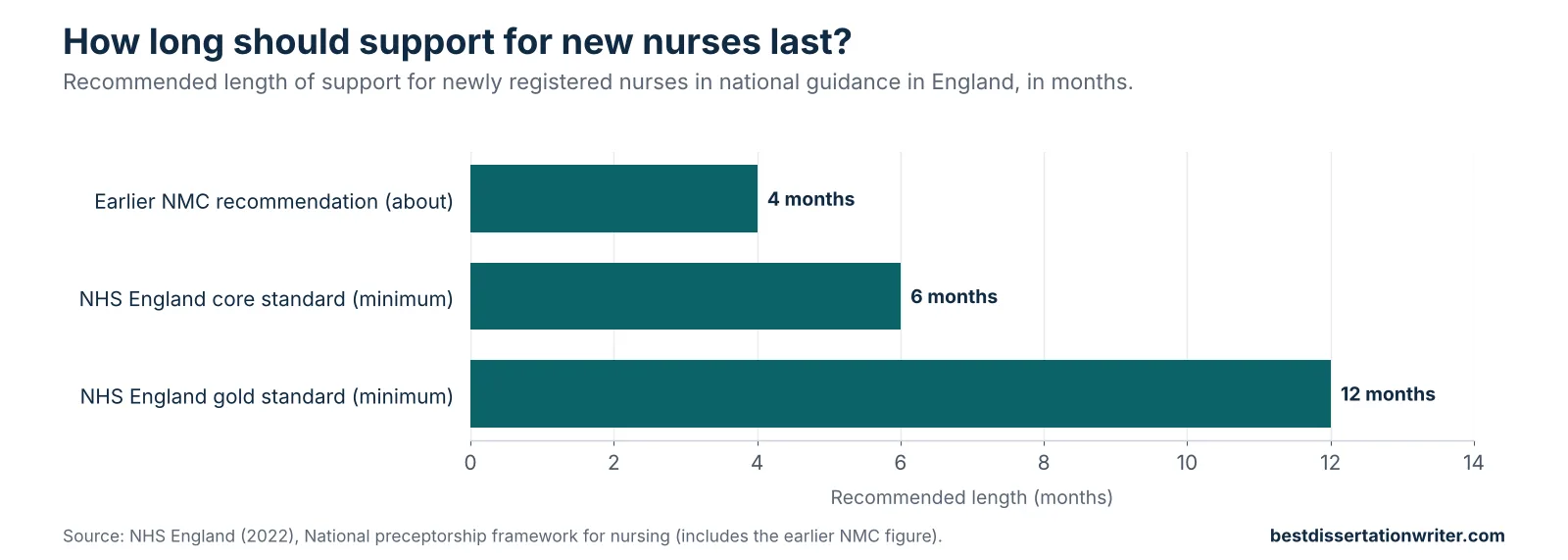
National guidance in England reflects this evidence on length. The NHS England (2022) national framework recommends a minimum of six months as its core standard and 12 months at gold standard, compared with the Nursing and Midwifery Council’s earlier recommendation of about four months. The framework also recommends protected time for preceptors, no more than two preceptees per preceptor, regular meetings and evaluation of retention at 12 and 24 months after registration.
Discussion
This review suggests that structured transition support is highly valued by newly qualified nurses and is associated with greater confidence, reduced stress and, in longer programmes, higher retention. The evidence is consistent in direction across qualitative evaluations, systematic reviews and reviews of retention outcomes, and it has been translated into national principles and standards in the United Kingdom. Preceptorship is therefore well supported as a principle.
The strength of the evidence is more limited. Much of it is qualitative or based on self-report, few studies used control groups and objective measures of competence were rare. Retention outcomes may reflect wider organisational characteristics, since organisations that invest in strong programmes may also offer better working environments. These limitations mean that the size of the benefit is uncertain, even if the direction is clear.
The finding that programme structure matters more than the individual preceptor has important implications. When support depends entirely on one preceptor who has no protected time, it is vulnerable to staffing pressures, sickness and shift patterns. Structured preceptorship programmes that include study days, peer support and clear expectations provide continuity even when the preceptor is unavailable. National standards that require board-level oversight and protected time are therefore a significant step, provided they are implemented in practice rather than only on paper.
Length also matters. The evidence suggests that the most successful programmes last six months to a year, which is considerably longer than the four months once recommended. Shorter programmes may end just as new nurses face their first experiences of night shifts, being in charge or caring for deteriorating patients alone. Extending preceptorship has resource implications, but these may be offset by reduced turnover, given the high costs associated with replacing nurses.
Equity between settings is a further concern. Large acute trusts can run cohort-based preceptorship programmes with dedicated facilitators, whereas small community teams, general practices and care homes may employ only one or two new registrants a year. Regional or shared programmes, in which several employers pool study days and peer support, may help to ensure that nurses in these settings receive comparable support. Internationally educated nurses joining the register also need adapted support that recognises their previous experience while helping them adjust to a new health system and culture.
The evidence base has limitations. Most studies came from single organisations in the United Kingdom, the United States and Australia, and few examined community or mental health settings. This review relied on openly accessible, English-language sources and did not involve independent double screening. Future research should use comparative designs, objective measures of competence and longer follow-up of retention, and should evaluate how preceptorship programmes are implemented under the new national framework.
Implications of Preceptorship Evidence for Practice
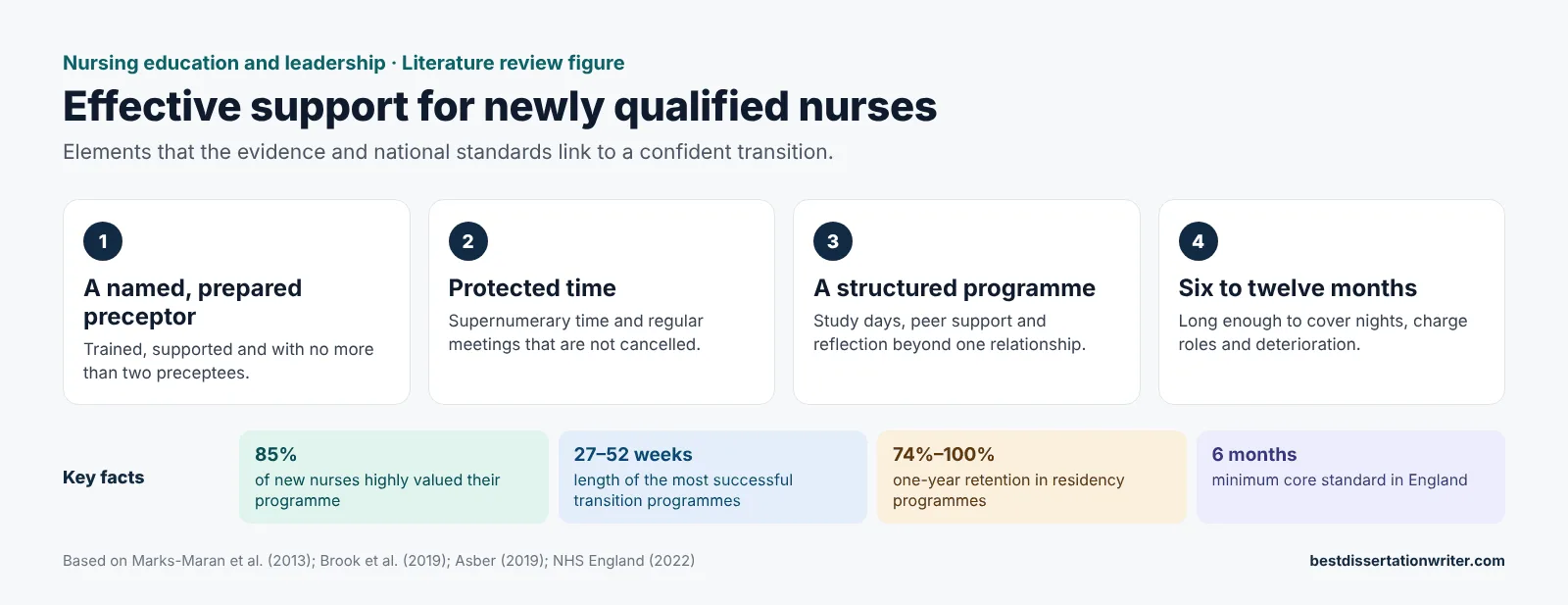
For nurse leaders, the evidence supports offering every newly qualified nurse a structured programme of at least six months, with a named, prepared preceptor and protected time for meetings. Programmes should combine one-to-one support with study days, peer support and opportunities for reflection, and should be evaluated using feedback and retention data. The NMC principles of preceptorship provide a framework that organisations can use to review their provision.
Effective support builds on the learning environment students experience on clinical placements and is a key strategy for nurse retention. Teams where workplace bullying is tolerated undermine new nurses’ confidence, while good transition support addresses the same concerns about support and belonging that drive student nurse attrition.
Conclusion
This integrative review examined how preceptorship influences newly qualified nurses’ confidence, competence and retention. New nurses value structured support highly, it appears to improve confidence and reduce stress, and programmes lasting six months to a year are associated with better retention, although the evidence relies heavily on self-report and uncontrolled studies.
For nursing education and leadership, the message is that preceptorship works best as a structured, adequately resourced programme rather than an informal arrangement. Protecting time, preparing preceptors and evaluating outcomes will help newly qualified nurses make a safe and confident transition into their professional careers.
References
Asber, S. R. (2019). Retention outcomes of new graduate nurse residency programs: An integrative review. Journal of Nursing Administration, 49(9), 430–435. https://doi.org/10.1097/NNA.0000000000000780
Brook, J., Aitken, L. M., Webb, R., MacLaren, J., & Salmon, D. (2019). Characteristics of successful interventions to reduce turnover and increase retention of early career nurses: A systematic review. International Journal of Nursing Studies, 91, 47–59. https://doi.org/10.1016/j.ijnurstu.2018.11.003
Irwin, C., Bliss, J., & Poole, K. (2018). Does preceptorship improve confidence and competence in newly qualified nurses: A systematic literature review. Nurse Education Today, 60, 35–46. https://doi.org/10.1016/j.nedt.2017.09.011
Marks-Maran, D., Ooms, A., Tapping, J., Muir, J., Phillips, S., & Burke, L. (2013). A preceptorship programme for newly qualified nurses: A study of preceptees’ perceptions. Nurse Education Today, 33(11), 1428–1434. https://doi.org/10.1016/j.nedt.2012.11.013
NHS England. (2022). National preceptorship framework for nursing. https://www.england.nhs.uk/long-read/national-preceptorship-framework-for-nursing/
Nursing and Midwifery Council. (2020). Principles of preceptorship. https://www.nmc.org.uk/standards/guidance/preceptorship/
Cite this example
Best Dissertation Writers (2026) Preceptorship and the Transition of Newly Qualified Nurses Into Practice: An Integrative Review. Available at: https://bestdissertationwriter.com/preceptorship-literature-review/
Best Dissertation Writers
Get expert help with your nursing literature review
Share your topic and deadline with Best Dissertation Writers and get support tailored to your module brief.