Oral Health Care and the Prevention of Aspiration Pneumonia in Older Adults: A Systematic Review
 By Dr. Robertson Prime, Research Fellow
Updated October 26, 2026
14 min read
About 2,900 words
In this review
Abstract
Background: Poor oral hygiene is common among older people in nursing homes and hospitals, particularly those who depend on others for daily care. Bacteria from the mouth can be aspirated into the lungs, and aspiration pneumonia is a leading cause of illness and death in frail older adults. Nurses and care staff provide most daily oral health care.
Aim: This systematic review aimed to examine whether oral health care prevents pneumonia in older adults in nursing homes and other care settings, and to identify the barriers and strategies that affect the delivery of oral care.
Methods: Evidence was identified through targeted searches of openly accessible bibliographic records, publisher websites and the reference lists of key reviews. Five sources published between 2002 and 2025 were included: a controlled trial in nursing homes, three systematic reviews and a Cochrane review, appraised using CASP checklists and synthesised narratively.
Findings: In 11 Japanese nursing homes, daily oral care by nurses or caregivers reduced pneumonia from 19% to 11% over two years. A systematic review concluded that tooth brushing after meals, daily denture cleaning and weekly professional care appeared the best approach. A later Cochrane review found that professional oral care may reduce pneumonia-related deaths (risk ratio 0.43) but that its effect on pneumonia incidence remained unclear. Lack of time, residents’ challenging behaviour and inadequate staff training were the most frequent barriers.
Conclusion: Oral health care is a simple, low-risk measure that may reduce pneumonia and death among older residents. Nurses should ensure daily mouth care, denture hygiene and access to dental professionals, supported by training and strategies for residents who resist care.
Keywords: oral health care, oral care, aspiration pneumonia, nursing homes
Introduction
This systematic review critically examines recent evidence on oral health care and its implications for older adult nursing practice.
The mouth is easily overlooked in the care of frail older people. Many residents of nursing homes and older hospital patients have their own teeth for longer than previous generations, often with crowns, bridges and implants, while others wear dentures. When people lose the ability to clean their own mouths because of frailty, stroke or dementia, plaque accumulates quickly, gums become inflamed and the mouth becomes a reservoir for bacteria, including organisms that can cause pneumonia.
Aspiration pneumonia occurs when material from the mouth or stomach is inhaled into the lungs. Older people with swallowing difficulties, reduced cough reflexes, poor mobility and impaired consciousness are particularly at risk, and pneumonia is a major cause of hospital admission and death among nursing home residents. Because the bacteria involved often come from the mouth, reducing the bacterial load through oral health care has been proposed as a simple way to prevent pneumonia.
A systematic review approach was chosen to draw on a controlled trial, systematic reviews and a Cochrane review.
The question matters because daily oral care is usually delivered by care staff and nurses, often under time pressure and with limited training. If oral health care can prevent pneumonia, it deserves the same priority as other fundamental aspects of nursing care, such as nutrition, hydration and pressure area care.
Review question
Does oral health care prevent pneumonia and related deaths in older adults in nursing homes and similar settings, and what barriers and strategies affect the delivery of oral care?
Background to Oral Health Care and Aspiration Pneumonia
Oral health care for dependent older adults typically involves brushing natural teeth at least twice a day with fluoride toothpaste, cleaning the tongue and the inside of the mouth, removing and cleaning dentures daily, leaving dentures out overnight where appropriate and checking the mouth for problems such as sores, infection, broken teeth or poorly fitting dentures. Professional care by dentists, dental hygienists or specially trained staff may add regular cleaning and treatment.
Poor oral hygiene leads to the build-up of dental plaque, a biofilm in which bacteria multiply. Dental plaque and denture plaque can harbour respiratory pathogens, which can then be aspirated, particularly during sleep or when swallowing is impaired. Good oral health care aims to reduce this bacterial load and may also improve swallowing and cough reflexes by stimulating the mouth.
Oral health also affects nutrition, comfort, communication and dignity. Painful teeth or poorly fitting dentures can make eating difficult and contribute to weight loss, and oral infections can cause distress that residents with dementia may be unable to express except through changes in behaviour. Good oral care therefore supports wellbeing in many ways beyond the prevention of pneumonia.
In many nursing homes, oral care is delivered by care aides who receive little formal training, and dental professionals visit rarely. Residents with dementia may resist mouth care, and staff may feel uncomfortable or unsure how to proceed. These challenges mean that oral health care is often inconsistent, even where its importance is recognised.
Search Strategy and Methods
Evidence for this example was identified through targeted searches of openly accessible bibliographic records, publisher websites and the reference lists of key reviews. Search terms combined keywords for the intervention (“oral health care”, “oral care”, “oral hygiene”, “mouth care”, “denture”) with terms for outcomes and settings (“aspiration pneumonia”, “pneumonia”, “nursing homes”, “long-term care”, “barriers”), joined with the Boolean operators AND and OR. A full systematic review for assessment would run the same strategy in CINAHL, PubMed/MEDLINE, the Cochrane Library and Embase and report the number of records screened in a PRISMA flow diagram.
Sources were eligible if they evaluated oral care interventions for older adults in nursing homes or hospitals and reported pneumonia or related outcomes, or if they examined barriers and strategies for delivering oral care in these settings. Trials and systematic reviews were prioritised. Studies of ventilated patients in intensive care were excluded.
Five sources published between 2002 and 2025 were included: a controlled trial of oral care in nursing homes, a systematic review of oral health care and aspiration pneumonia, a systematic review of strategies to motivate residents and manage responsive behaviours, a Cochrane review of oral care for preventing nursing home-acquired pneumonia and a systematic review of barriers reported by health professionals (Table 1). Each source was appraised using the Critical Appraisal Skills Programme (CASP) checklist appropriate to its design, and findings were synthesised narratively and grouped into themes.
Key Findings on Oral Health Care
Three themes were identified: the effect of oral health care on pneumonia, barriers to delivering oral care and strategies to improve it. Table 1 summarises the included sources, and Figure 1 shows the barriers most frequently reported by staff.
| Author, year | Design | Setting and sample | Key finding |
|---|---|---|---|
| Yoneyama et al. (2002) | Controlled trial | 366 residents; 11 nursing homes | Daily staff-delivered oral care reduced pneumonia from 19% to 11% over two years. |
| van der Maarel-Wierink et al. (2013) | Systematic review | 5 publications | Brushing after meals, daily denture cleaning and weekly professional care appear best. |
| Hoben et al. (2017) | Systematic review | 4 research projects | Strategies for responsive behaviours promising but high risk of bias. |
| Cao et al. (2022) | Cochrane systematic review | 6 trials; 6,244 participants | May reduce pneumonia deaths (RR 0.43); effect on incidence unclear. |
| Pombo-Lopes et al. (2025) | Systematic review | 35 studies of health professionals | Lack of time, challenging behaviour and poor training main barriers. |
Theme 1: Oral Health Care and Pneumonia in Nursing Homes
Yoneyama et al. (2002) studied 366 residents in 11 nursing homes in Japan. Residents in the intervention group had their teeth brushed daily by nurses or caregivers, with povidone-iodine applied where brushing was not adequate, while the control group cleaned their own teeth. Over two years, pneumonia occurred in 11% of the oral care group compared with 19% of the control group, and febrile days were less frequent in the oral care group. Residents with pneumonia who had not received oral care were more likely to die from it. Results were similar whether or not residents wore dentures.
van der Maarel-Wierink et al. (2013) systematically reviewed oral health care interventions for frail older people in hospitals and long-term care. Of five included publications, two found that better oral health care reduced the risk of developing and dying from aspiration pneumonia, while three found reductions in respiratory pathogens and improvements in swallowing and cough reflexes. The authors concluded that brushing teeth after each meal, cleaning dentures once a day and professional oral health care once a week seemed the best approach to reducing aspiration pneumonia.
Cao et al. (2022) updated a Cochrane review of oral care for preventing nursing home-acquired pneumonia, including six randomised trials with 6,244 participants. All compared professional oral care with usual care, and all were at high risk of bias. There was insufficient evidence to determine whether professional oral care reduced pneumonia incidence, but two studies with 454 participants suggested a lower risk of pneumonia-related death over 24 months (risk ratio 0.43, 95% CI 0.25 to 0.76; low certainty). No serious adverse events were reported. The authors concluded that the effect remained largely unclear and that the optimal protocol could not be determined.
Taken together, these sources suggest that good mouth care may reduce pneumonia and pneumonia-related deaths among older residents, but that the evidence is not conclusive. Because oral care is inexpensive, low-risk and beneficial for comfort, nutrition and dignity, the uncertainty about its effect on pneumonia is not a reason to neglect it.
Theme 2: Barriers to Oral Health Care
Pombo-Lopes et al. (2025) reviewed 35 studies of health professionals’ perceptions, knowledge and barriers relating to oral health care for dependent people in nursing homes. Most caregivers had inadequate, mostly informal training, and there were gaps between their training and daily practice, although they recognised the importance of oral health. The most frequently reported barriers were lack of time (17 studies), residents’ non-cooperative or challenging behaviour (15), inadequate education or skills (9), insufficient materials (6) and lack of staff (5).
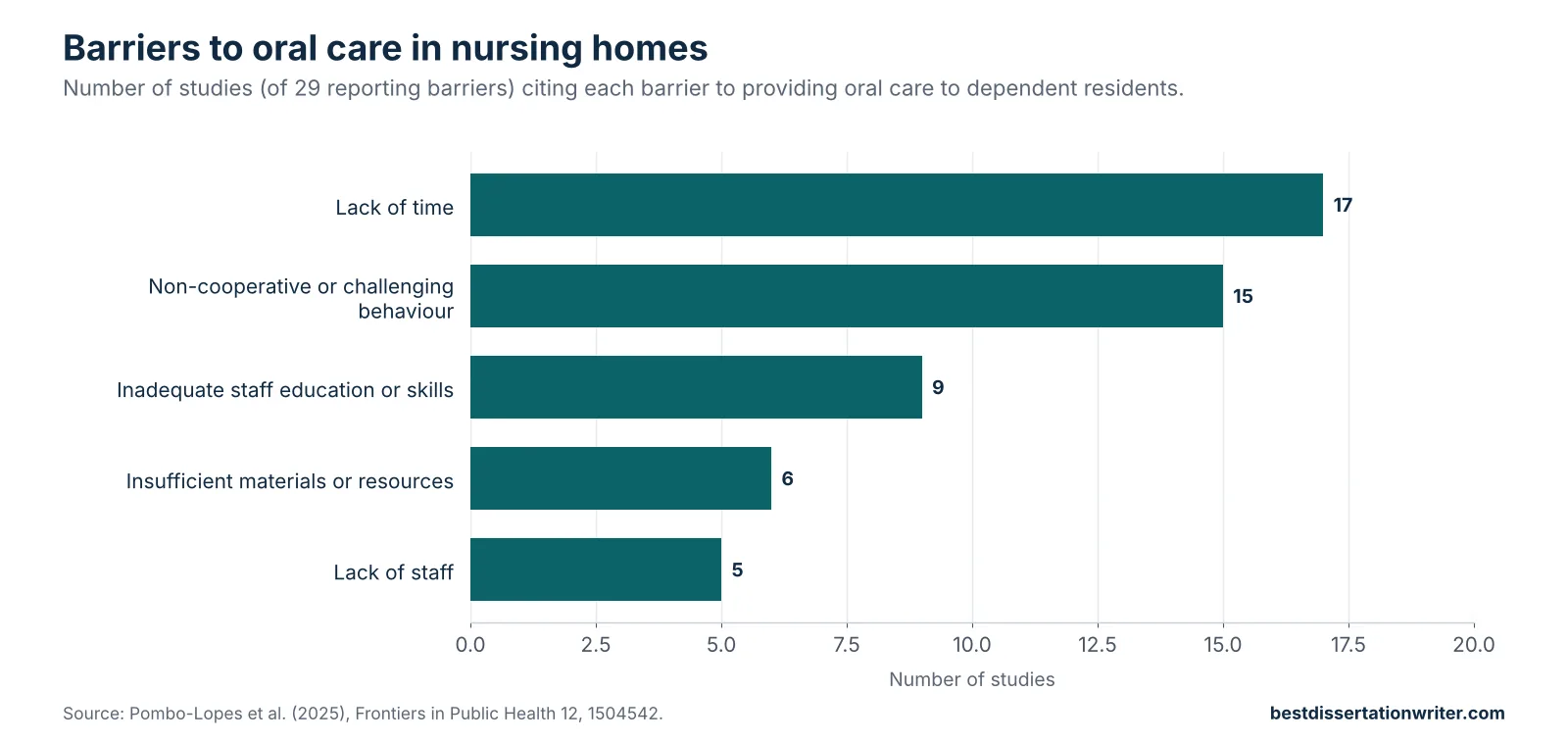
These findings show that barriers to mouth care are largely organisational and educational rather than a matter of staff indifference. Time pressure and staffing levels push oral care down the list of priorities, while lack of training leaves staff unsure how to clean the mouth of a resident who cannot cooperate. Some staff also reported discomfort with the task or fear of causing harm, which suggests that practical, hands-on training and peer support may be as important as information about why mouth care matters.
Theme 3: Strategies for Residents Who Resist Oral Care
Hoben et al. (2017) systematically reviewed strategies to motivate nursing home residents to carry out their own oral care and to prevent or reduce responsive behaviours, such as refusing, turning away or biting, during mouth care. Only four research projects were found, all of low or low-to-moderate quality. All reported improvements in at least some outcomes, such as plaque scores, but methodological problems limited interpretation. The authors concluded that promising strategies exist but that the evidence carries a high risk of bias.
Discussion
This review shows that mouth care may reduce pneumonia and pneumonia-related deaths among older adults in nursing homes, although the evidence is of low certainty and the optimal approach is unclear. Barriers to delivering oral care are common and mainly relate to time, residents’ responsive behaviours and staff training. Strategies to help residents accept care show promise but are poorly evaluated.
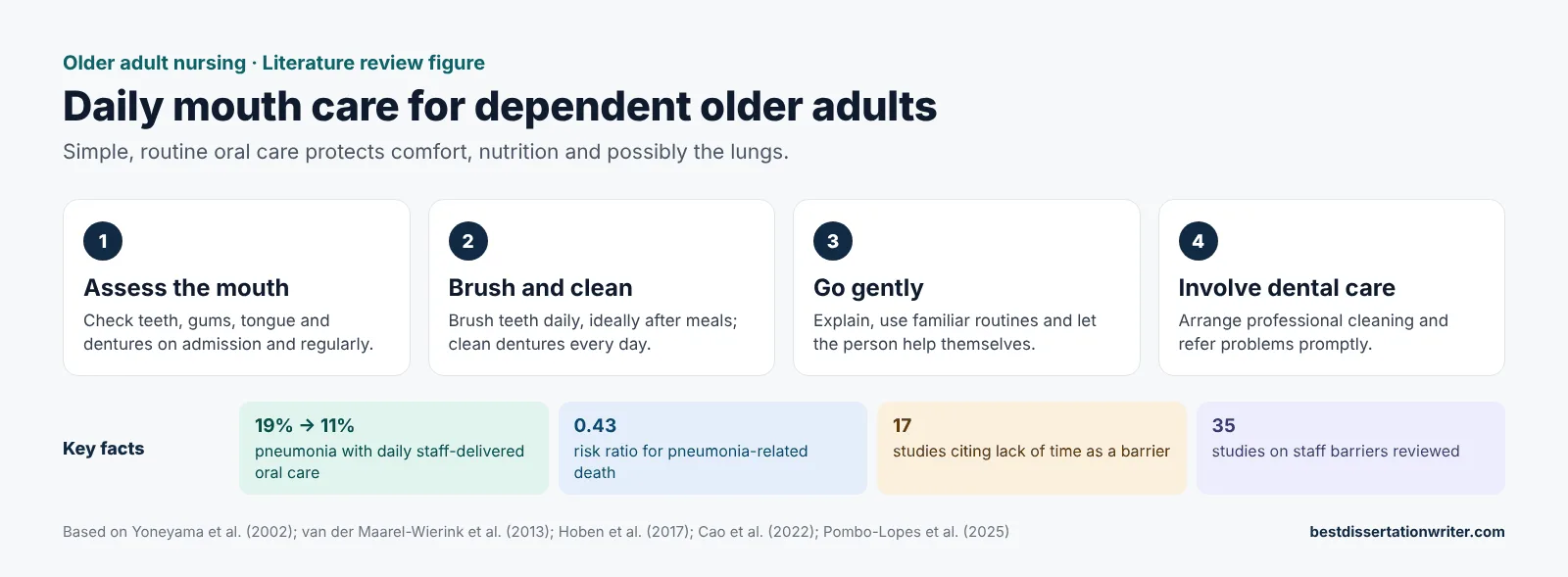
The practical recommendations from the evidence are straightforward: brush natural teeth thoroughly at least daily and ideally after meals, clean dentures daily, inspect the mouth regularly and ensure access to professional dental care. These are fundamental nursing tasks, and making them routine requires that they are planned, recorded and supported in the same way as other aspects of personal care.
Responsive behaviours during oral care are understandable. A person with dementia may not understand why someone is putting a toothbrush in their mouth, may feel threatened or may be experiencing pain. Approaches consistent with person-centred care, such as explaining each step, approaching from the front, using familiar routines, offering the brush so the person can start brushing themselves and choosing a calm time, may help. These approaches are particularly relevant for people with advanced dementia, who may be unable to cooperate and are at high risk of aspiration.
Mouth care also connects with other fundamental care. Residents with painful mouths or ill-fitting dentures may eat and drink less, which increases the risk of weight loss and skin breakdown, so good oral care supports the prevention of pressure ulcers in care homes through better nutrition. In hospital, older patients who are acutely unwell may be at risk of both oral problems and delirium in hospitalised older adults, and attention to comfort, hydration and mouth care forms part of good fundamental nursing.
Training is a key lever. Staff who are confident in how to clean natural teeth, dentures and the soft tissues of the mouth, and who understand the link between oral health and pneumonia, are more likely to prioritise oral care. Training should include practical skills, strategies for residents who resist care and recognition of oral problems that need dental referral.
Documentation helps to make mouth care visible. Recording when teeth were brushed, when dentures were cleaned and any problems observed allows staff to see whether care is being delivered consistently and to notice changes, such as bleeding gums, ulcers or a resident who has started refusing food. Without records, oral care can easily be missed on busy shifts without anyone noticing.
Organisational support is equally important. Assessing oral health on admission, including oral care in care plans, providing suitable toothbrushes, toothpaste and denture equipment, and arranging regular dental visits help to make oral care consistent. Nursing homes may also benefit from oral health champions who promote good practice and support colleagues.
Mouth care is relevant beyond nursing homes. Older people living at home who become dependent may lose the ability to care for their mouths, and community nurses and carers supporting ageing in place should include oral care in their assessments and care plans. In hospitals, older patients who are unwell, nil by mouth or receiving oxygen are also at risk of oral problems and may benefit from structured mouth care.
The evidence base has limitations. The Japanese trial was not blinded and the comparison group received less attention, the Cochrane review found high risk of bias in all trials and could not pool pneumonia outcomes, and the review of strategies for responsive behaviours found only four low-quality projects. The barrier review included studies from varied settings and countries. This review relied on openly accessible, English-language sources and did not involve formal systematic screening. Future research should conduct rigorous trials of nurse-delivered oral care protocols and evaluate strategies for residents with dementia.
Implications of Oral Health Care Evidence for Practice
For nurses and care staff, the evidence supports assessing the mouth on admission and regularly thereafter, brushing natural teeth at least daily and ideally after meals, cleaning dentures daily, recording oral care in care plans, using person-centred approaches for residents who resist care and referring problems to dental professionals. Guidance for care homes is available in the NICE guideline on oral health for adults in care homes.
Managers should provide training in oral health care, ensure that staff have time and equipment, establish links with dental services and audit oral care. Recognising oral care as a core nursing responsibility, rather than an optional extra, is essential to improving the oral health and wellbeing of older adults in care.
Conclusion
This systematic review examined oral health care and the prevention of pneumonia in older adults. Oral care may reduce pneumonia and pneumonia-related deaths among nursing home residents, although the evidence is of low certainty. Lack of time, residents’ responsive behaviours and inadequate training are the main barriers, and strategies to overcome them are promising but poorly evaluated.
Mouth care is a simple, low-risk and dignified part of fundamental care. By making mouth care routine, supporting staff with training and time and responding sensitively to residents who find it difficult, nurses can protect older people’s comfort, nutrition and, potentially, their lives.
References
Cao, Y., Liu, C., Lin, J., Ng, L., Needleman, I., Walsh, T., & Li, C. (2022). Oral care measures for preventing nursing home-acquired pneumonia. Cochrane Database of Systematic Reviews, (11), CD012416. https://doi.org/10.1002/14651858.CD012416.pub3
Hoben, M., Kent, A., Kobagi, N., Huynh, K. T., Clarke, A., & Yoon, M. N. (2017). Effective strategies to motivate nursing home residents in oral care and to prevent or reduce responsive behaviors to oral care: A systematic review. PLOS ONE, 12(6), e0178913. https://doi.org/10.1371/journal.pone.0178913
Pombo-Lopes, J., Rodrigues, I., Costa, J., Gomes, A. C., Fonseca, J., & Grillo-Evangelista, J. (2025). Health professionals’ perceptions, barriers and knowledge towards oral health care of dependent people in nursing homes: A systematic review. Frontiers in Public Health, 12, 1504542. https://doi.org/10.3389/fpubh.2024.1504542
van der Maarel-Wierink, C. D., Vanobbergen, J. N. O., Bronkhorst, E. M., Schols, J. M. G. A., & de Baat, C. (2013). Oral health care and aspiration pneumonia in frail older people: A systematic literature review. Gerodontology, 30(1), 3–9. https://doi.org/10.1111/j.1741-2358.2012.00637.x
Yoneyama, T., Yoshida, M., Ohrui, T., Mukaiyama, H., Okamoto, H., Hoshiba, K., Ihara, S., Yanagisawa, S., Ariumi, S., Morita, T., Mizuno, Y., Ohsawa, T., Akagawa, Y., Hashimoto, K., Sasaki, H., & Oral Care Working Group. (2002). Oral care reduces pneumonia in older patients in nursing homes. Journal of the American Geriatrics Society, 50(3), 430–433. https://doi.org/10.1046/j.1532-5415.2002.50106.x
Cite this example
Best Dissertation Writers (2026) Oral Health Care and the Prevention of Aspiration Pneumonia in Older Adults: A Systematic Review. Available at: https://bestdissertationwriter.com/oral-health-care-literature-review/
Best Dissertation Writers
Get expert help with your nursing literature review
Share your topic and deadline with Best Dissertation Writers and get support tailored to your module brief.