Polypharmacy and Deprescribing in Older Adults: The Role of the Nurse: An Integrative Review
 By Dr. Robertson Prime, Research Fellow
Updated October 26, 2026
14 min read
About 2,900 words
In this review
Abstract
Background: Many older adults take five or more medicines, and some of these may no longer be needed or may cause harm. Polypharmacy and deprescribing have therefore become central concerns in older adult care. Nurses administer medicines, observe their effects and talk with patients and families, so they are well placed to contribute to medication review and medication optimisation.
Aim: This integrative review aimed to examine how polypharmacy is defined, the effects of deprescribing and interventions to improve prescribing, older adults’ attitudes to stopping medicines and the role of nurses in deprescribing.
Methods: Evidence was identified through targeted searches of openly accessible bibliographic records, publisher websites and the reference lists of key reviews. Five sources published between 2016 and 2024 were included: four systematic reviews (including one Cochrane review and one integrative review) and one national survey, appraised using CASP checklists and synthesised using an integrative approach.
Findings: Across 138 definitions, the most common definition of polypharmacy was five or more daily medicines. Patient-specific deprescribing reduced mortality in randomised studies (odds ratio 0.62), whereas generalised education did not. A Cochrane review of 38 trials could not confirm that pharmaceutical care interventions improve appropriateness. In a US survey, 92.0% of older adults were willing to stop a medicine if their doctor said it was possible. Nurses contributed to deprescribing through monitoring, communication and education, but were limited by low confidence and exclusion from team discussions.
Conclusion: Polypharmacy and deprescribing require individualised, team-based medication review in which nurses play an active role. Older adults are generally open to deprescribing, and nurses can help to make it safe.
Keywords: polypharmacy and deprescribing, medication review, medication optimisation
Introduction
This integrative review critically examines recent evidence on polypharmacy and deprescribing and its implications for older adult nursing practice.
As people live longer with several long-term conditions, the number of medicines they take tends to rise. Each medicine may be appropriate on its own, prescribed according to guidelines for a single condition, yet the combination can create a burden of tablets, interactions and side effects. Older adults are particularly vulnerable because ageing changes how the body handles drugs, and conditions such as frailty and dementia increase the risk of harm from medicines that were once safe.
Polypharmacy is associated with falls, confusion, hospital admission and reduced quality of life, although it is not always harmful. Deprescribing, the planned and supervised process of reducing or stopping medicines that may no longer be beneficial or may be causing harm, aims to restore balance. Together, polypharmacy and deprescribing are now recognised as a core part of good care for older people, with medication review and medication optimisation promoted by national policy.
An integrative review was chosen because the evidence includes systematic reviews of definitions and effectiveness, a national survey of attitudes and a review of nursing roles, and an integrative approach allows these diverse sources to be combined.
The question matters because nurses administer and monitor medicines in hospitals, care homes and the community, and they often know more than any other professional about how a person is coping with their medicines day to day. Their observations and conversations can provide crucial information for decisions about polypharmacy and deprescribing.
Review question
How is polypharmacy defined, what are the effects of deprescribing and of interventions to improve prescribing, how do older adults view stopping medicines and what is the role of the nurse?
Background to Polypharmacy and Deprescribing
Polypharmacy is usually defined by a count of medicines, but numerical definitions do not distinguish between appropriate and inappropriate prescribing. A person with several serious conditions may need many medicines, while another may be harmed by only a few. For this reason, the concept of problematic polypharmacy, in which medicines are no longer appropriate or their combined effects cause harm, has become more widely used.
Deprescribing involves reviewing all medicines, identifying those that may be stopped or reduced, agreeing a plan with the person and monitoring the effects of changes. It may involve stopping medicines that no longer have a clear indication, reducing doses, switching to safer alternatives or stopping preventive medicines whose benefits may not be realised within the person’s remaining life expectancy. Tools such as the STOPP/START criteria help clinicians to identify potentially inappropriate medicines and omissions.
Some groups of medicines are particular targets for deprescribing in older adults. These include sedatives and hypnotics, antipsychotics in people with dementia, drugs with anticholinergic effects, some antihypertensives in people at risk of falls and proton pump inhibitors used long term without a clear reason. Stopping these medicines may reduce falls, confusion and other adverse effects.
Medication review is often led by doctors and pharmacists, but nurses contribute in many ways. They may identify side effects, notice that a medicine is not being taken, explain changes to patients and families, monitor the effects of stopping a medicine and, in some cases, prescribe or deprescribe as independent prescribers. Their role in polypharmacy and deprescribing is, however, not always clearly defined.
Transitions of care create particular risks. When older adults move between hospital, care home and home, medicines may be started, stopped or changed without full information reaching the next team. A medicine stopped in hospital may be restarted in the community, or a temporary medicine may continue indefinitely. Accurate medicines reconciliation at each transition is therefore an essential partner to polypharmacy and deprescribing.
Search Strategy and Methods
Evidence for this example was identified through targeted searches of openly accessible bibliographic records, publisher websites and the reference lists of key reviews. Search terms combined keywords for the problem (“polypharmacy and deprescribing”, “polypharmacy”, “inappropriate medication”) with terms for interventions, attitudes and roles (“deprescribing”, “medication review”, “medication optimisation”, “pharmaceutical care”, “attitudes”, “nurse”), joined with the Boolean operators AND and OR. A full integrative review for assessment would run the same strategy in CINAHL, PubMed/MEDLINE, the Cochrane Library and Embase and report the number of records screened in a PRISMA flow diagram.
Sources were eligible if they examined definitions of polypharmacy, the effects of deprescribing or interventions to improve prescribing in older adults, older adults’ attitudes to deprescribing or nurses’ roles in deprescribing. Reviews and large surveys were prioritised, consistent with the integrative approach. Studies of single drugs in isolation were excluded.
Five sources published between 2016 and 2024 were included: a meta-analysis of deprescribing and mortality, a systematic review of definitions of polypharmacy, a national survey of attitudes towards deprescribing, a Cochrane review of interventions to improve polypharmacy and an integrative review of nurses’ involvement in deprescribing (Table 1). Each source was appraised using the Critical Appraisal Skills Programme (CASP) checklist appropriate to its design, and findings were integrated into themes.
Key Findings on Polypharmacy and Deprescribing
Three themes were identified: defining polypharmacy and the effects of deprescribing, interventions to improve prescribing and older adults’ attitudes, and the nurse’s role in polypharmacy and deprescribing. Table 1 summarises the included sources, and Figure 1 shows pooled effects of deprescribing on mortality.
| Author, year | Design | Setting and sample | Key finding |
|---|---|---|---|
| Page et al. (2016) | Systematic review and meta-analysis | 132 studies; 34,143 participants | Patient-specific deprescribing reduced mortality in RCTs (OR 0.62); education did not. |
| Masnoon et al. (2017) | Systematic review of definitions | 110 articles; 138 definitions | Most common definition five or more medicines (46.4%); few distinguished appropriateness. |
| Reeve et al. (2018) | National cross-sectional survey | 1,981 US adults aged 65+ | 92.0% willing to stop a medicine if their doctor agreed. |
| Cole et al. (2023) | Cochrane systematic review | 38 trials; 18,073 participants | Uncertain effects on appropriateness; little or no effect on admissions. |
| Vaismoradi et al. (2024) | Integrative systematic review | 32 studies in long-term care | Nurses monitor, communicate and educate; barriers include confidence and exclusion. |
Theme 1: Polypharmacy and Deprescribing Outcomes
Masnoon et al. (2017) identified 138 definitions of polypharmacy and related terms in 110 articles. Most definitions (80.4%) were purely numerical, and the most common was the use of five or more medicines daily, used in 46.4% of articles. Thresholds ranged from two or more to eleven or more medicines, and only 6.4% of articles distinguished appropriate from inappropriate polypharmacy. The authors concluded that numerical definitions do not account for individual conditions and make it difficult to judge the appropriateness of treatment.
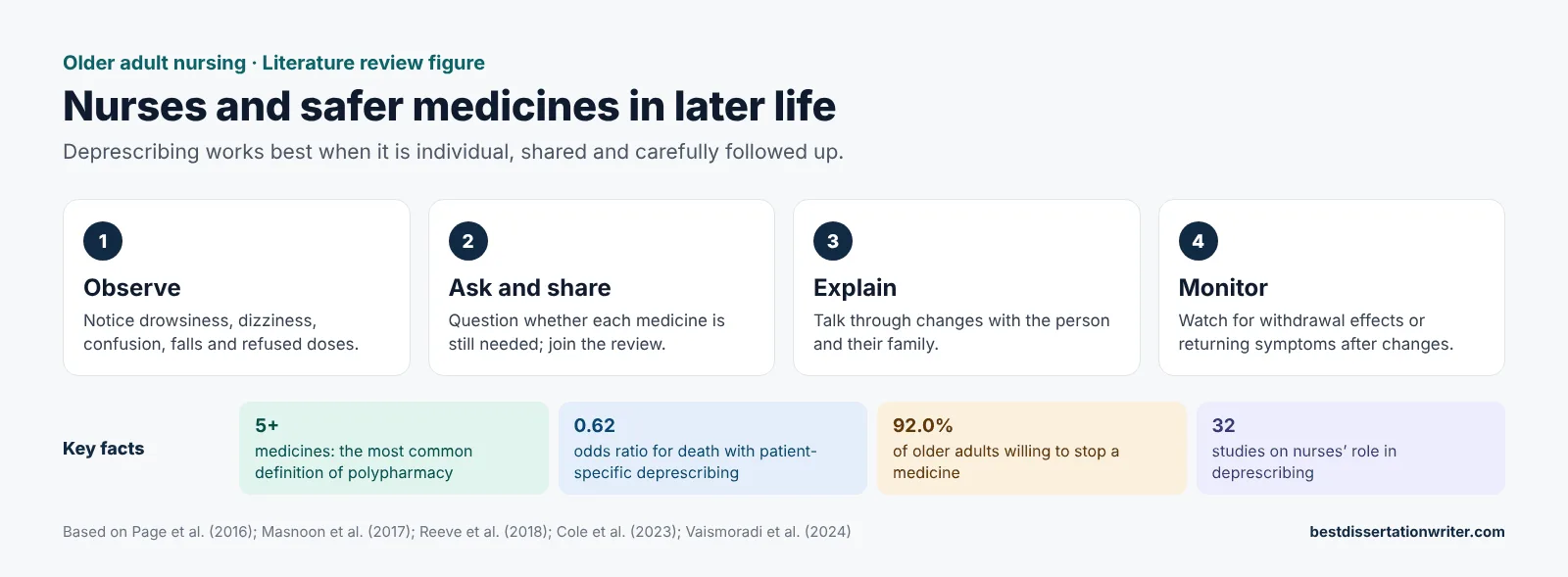
Page et al. (2016) pooled 132 studies with 34,143 older participants to examine the effects of deprescribing. In non-randomised studies, deprescribing was associated with substantially lower mortality (odds ratio 0.32, 95% CI 0.17 to 0.60). In randomised studies overall, the effect was not significant (0.82, 95% CI 0.61 to 1.11). However, patient-specific deprescribing interventions significantly reduced mortality in randomised studies (0.62, 95% CI 0.43 to 0.88), whereas generalised educational programmes did not (1.21, 95% CI 0.86 to 1.69).
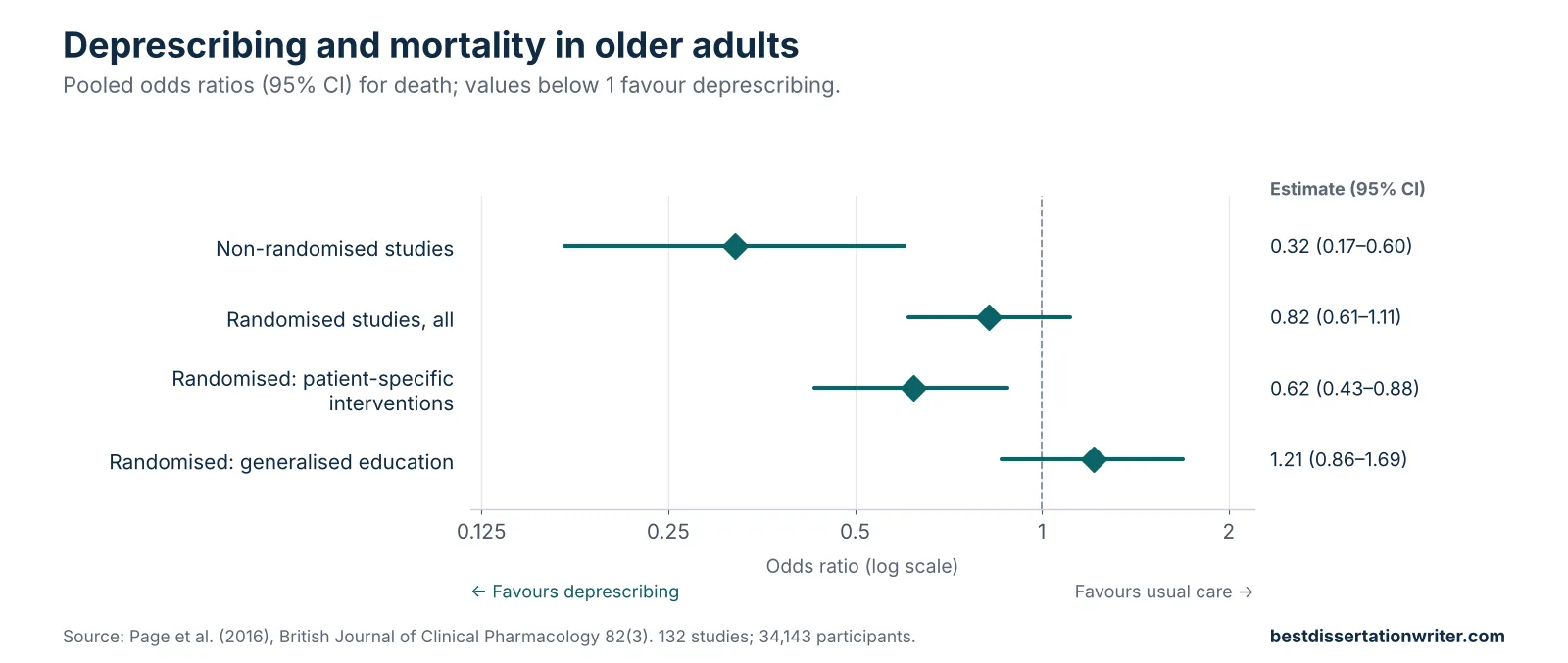
These findings suggest that deprescribing is feasible and can be safe, and that individualised medication review is more effective than general educational approaches. They support a person-centred model of polypharmacy and deprescribing in which decisions are based on the individual’s conditions, goals and responses to treatment rather than on a simple count of medicines.
Theme 2: Interventions for Polypharmacy and Older Adults’ Views
Cole et al. (2023) updated a Cochrane review of interventions to improve the appropriate use of polypharmacy for older people, including 38 randomised trials with 18,073 participants. Most trials tested multifaceted pharmaceutical care. The interventions may have reduced potentially inappropriate medicines and prescribing omissions, but the certainty of evidence was very low, and they may have made little or no difference to hospital admissions or quality of life. The authors could not confirm that these interventions improve medication appropriateness.
Reeve et al. (2018) surveyed 1,981 US Medicare beneficiaries aged 65 or older. Of these, 92.0% said they would be willing to stop one or more regular medicines if their doctor said it was possible, and 66.6% wanted to reduce the number of medicines they took. People taking six or more medicines were more likely to be willing to stop medicines (adjusted odds ratio 2.90) and to want fewer medicines (2.31).
Together, these findings show that while older adults are generally open to deprescribing, structured interventions have not yet been shown to improve clinical outcomes consistently. This suggests that the barriers to effective polypharmacy and deprescribing lie less in patient reluctance and more in how interventions are designed, delivered and followed up.
Theme 3: The Nurse’s Role in Polypharmacy and Deprescribing
Vaismoradi et al. (2024) integrated 32 qualitative and quantitative studies of nurses’ involvement in deprescribing in long-term care for older people. Findings were grouped into five categories: the necessity and benefits of deprescribing, multidisciplinary collaboration, the nurse’s role, challenges and the involvement of older people and families. Nurses supported dose reduction, discontinuation and switching to safer alternatives, and their main contributions were monitoring, communicating and educating. Barriers included insufficient knowledge, low confidence and exclusion from team discussions.
Discussion
This integrative review shows that polypharmacy is most often defined as five or more medicines, that patient-specific deprescribing can reduce mortality, that multifaceted pharmaceutical care interventions have uncertain effects on outcomes, that older adults are largely willing to stop medicines and that nurses contribute to deprescribing through monitoring, communication and education. Integrating these findings suggests that successful polypharmacy and deprescribing depends on individualised, collaborative review that actively involves nurses and patients.
The contrast between individualised and general approaches is important. General education about inappropriate medicines did not reduce mortality, whereas patient-specific review did. This supports structured medication review that considers each medicine in the context of the person’s conditions, priorities and life expectancy, and that involves the person and their family in decisions.
Nurses bring unique information to medication review. They observe side effects such as drowsiness, dizziness, constipation and confusion, notice when medicines are refused or difficult to swallow and hear patients’ concerns. Communicating these observations to prescribers, and raising questions about whether a medicine is still needed, can trigger review. After changes are made, nurses monitor for withdrawal effects or the return of symptoms, which is essential for safe deprescribing.
Polypharmacy and deprescribing are closely linked to other priorities in older adult care. Medicines with sedative or blood pressure-lowering effects increase the risk of falls, connecting deprescribing to falls and fracture prevention. Anticholinergic and sedative drugs contribute to confusion, linking medication review to the prevention of delirium in hospitalised older adults. Frailty may change the balance of benefit and harm for many medicines, so frailty assessment can help to identify people who would benefit most from review.
Documentation supports safe change. Recording why a medicine was stopped, what effects to look for and when the decision will be reviewed helps the whole team, including staff on other shifts and in other settings, to follow the plan. Without this, a medicine may be restarted by someone unaware of the reasons it was stopped.
The barriers identified for nurses suggest clear priorities. Education in pharmacology and deprescribing, inclusion in multidisciplinary medication reviews and clear organisational support for nurses to raise concerns would help nurses to contribute more fully. Nurse prescribers have particular opportunities to lead medication optimisation, but all nurses can play a part through observation and communication.
Care homes offer particular opportunities. Residents often take many medicines, nurses and care staff administer every dose and observe residents closely, and regular multidisciplinary reviews can be built into routine practice. The review of nursing roles focused on long-term care, where monitoring, communication and education by nurses were central to deprescribing. Because care home residents may be less able to report side effects themselves, careful observation by staff who know them well is especially valuable.
Shared decision-making should guide every deprescribing decision. Older adults vary in what matters most to them, whether that is avoiding side effects, preventing future events, reducing the burden of tablets or maintaining independence. Exploring these priorities, and explaining the likely benefits and risks of continuing or stopping a medicine, allows decisions about polypharmacy and deprescribing to reflect the person’s own goals.
Older adults’ willingness to stop medicines is encouraging, but it depends on trust and clear information. Some people fear that stopping a medicine means they are being given up on, or worry that symptoms will return. Nurses can help by explaining the reasons for changes, involving families, agreeing what to watch for and providing reassurance and follow-up.
The evidence base has limitations. The mortality meta-analysis combined heterogeneous studies, and the stronger effect seen in non-randomised studies may reflect bias. The Cochrane review found low to very low certainty evidence with high heterogeneity, the attitudes survey was conducted in the United States and the review of nursing roles focused on long-term care. This review relied on openly accessible, English-language sources and did not involve formal systematic screening. Future research should evaluate nurse-involved deprescribing interventions with clinical outcomes and explore how to integrate nurses into medication review teams.
Implications of Polypharmacy and Deprescribing Evidence for Practice
For nurses, the evidence supports observing and reporting possible adverse effects, asking whether each medicine is still needed, participating in multidisciplinary medication review, explaining changes to older adults and families, monitoring carefully after medicines are stopped and documenting the outcomes. Guidance on medicines optimisation is available from the NICE guideline on medicines optimisation.
Managers should ensure that nurses are included in structured medication review, provide training in pharmacology and deprescribing, support nurse prescribers to undertake medication optimisation and build follow-up into deprescribing plans. Clear communication between hospitals, care homes and primary care is needed so that changes are continued and monitored after transfers of care.
Conclusion
This integrative review examined polypharmacy and deprescribing in older adults and the role of the nurse. Polypharmacy is commonly defined as five or more medicines, patient-specific deprescribing can reduce mortality and most older adults are willing to stop medicines, but structured interventions have not yet consistently improved outcomes. Nurses contribute through monitoring, communication and education, but face barriers of knowledge, confidence and inclusion.
Polypharmacy and deprescribing call for individualised, collaborative care. By sharing their observations, supporting older adults through changes and taking an active part in medication review, nurses can help to ensure that every medicine an older person takes is one that still does them good.
References
Cole, J. A., Gonçalves-Bradley, D. C., Alqahtani, M., Barry, H. E., Cadogan, C., Rankin, A., Patterson, S. M., Kerse, N., Cardwell, C. R., Ryan, C., & Hughes, C. (2023). Interventions to improve the appropriate use of polypharmacy for older people. Cochrane Database of Systematic Reviews, (10), CD008165. https://doi.org/10.1002/14651858.CD008165.pub5
Masnoon, N., Shakib, S., Kalisch-Ellett, L., & Caughey, G. E. (2017). What is polypharmacy? A systematic review of definitions. BMC Geriatrics, 17, 230. https://doi.org/10.1186/s12877-017-0621-2
Page, A. T., Clifford, R. M., Potter, K., Schwartz, D., & Etherton-Beer, C. D. (2016). The feasibility and effect of deprescribing in older adults on mortality and health: A systematic review and meta-analysis. British Journal of Clinical Pharmacology, 82(3), 583–623. https://doi.org/10.1111/bcp.12975
Reeve, E., Wolff, J. L., Skehan, M., Bayliss, E. A., Hilmer, S. N., & Boyd, C. M. (2018). Assessment of attitudes toward deprescribing in older Medicare beneficiaries in the United States. JAMA Internal Medicine, 178(12), 1673–1680. https://doi.org/10.1001/jamainternmed.2018.4720
Vaismoradi, M., Mardani, A., Lillo Crespo, M., Logan, P. A., & Sak-Dankosky, N. (2024). An integrative systematic review of nurses’ involvement in medication deprescription in long-term healthcare settings for older people. Therapeutic Advances in Drug Safety, 15, 20420986241289205. https://doi.org/10.1177/20420986241289205
Cite this example
Best Dissertation Writers (2026) Polypharmacy and Deprescribing in Older Adults: The Role of the Nurse: An Integrative Review. Available at: https://bestdissertationwriter.com/polypharmacy-and-deprescribing-review/
Best Dissertation Writers
Get expert help with your nursing literature review
Share your topic and deadline with Best Dissertation Writers and get support tailored to your module brief.