Person-Centred Dementia Care in Hospital and Care Home Settings: A Systematic Review
 By Dr. Robertson Prime, Research Fellow
Updated October 26, 2026
14 min read
About 2,800 words
In this review
Abstract
Background: Person-centred dementia care is widely promoted as the standard for supporting people living with dementia in care homes and hospitals. It focuses on knowing the person, valuing relationships and seeing the world from the person’s perspective, rather than on tasks and routines. Nurses lead and model much of this care.
Aim: This systematic review aimed to examine the effectiveness of person-centred dementia care on agitation, neuropsychiatric symptoms and quality of life in care home and hospital settings.
Methods: Evidence was identified through targeted searches of openly accessible bibliographic records, publisher websites and the reference lists of key reviews. Five sources published between 2009 and 2021 were included: two cluster-randomised trials, two systematic reviews and one evidence-based practice review, appraised using CASP checklists and synthesised narratively.
Findings: In a trial in 15 Australian care homes, person-centred care reduced agitation compared with usual care, although falls increased. In 69 UK nursing homes, person-centred training and activities improved quality of life and reduced agitation and neuropsychiatric symptoms, with an overall cost saving. A meta-analysis of 19 studies found short-term reductions in agitation and improved quality of life with longer-term staff education and culture change. In acute hospitals, evidence was limited, but family- and person-centred programmes improved some patient outcomes.
Conclusion: Person-centred dementia care can reduce agitation and improve quality of life, particularly in care homes. Nurses should know the person, build relationships and offer meaningful activity, supported by training and organisational commitment.
Keywords: person-centred dementia care, person-centred care, quality of life
Introduction
This systematic review critically examines recent evidence on person-centred dementia care and its implications for older adult nursing practice.
Dementia is one of the most important health and social care challenges of an ageing population. People living with dementia increasingly receive care in care homes and are frequently admitted to acute hospitals, where they may experience distress, confusion and loss of independence. Traditional approaches to care in these settings have often focused on tasks, routines and the management of so-called challenging behaviour, sometimes with antipsychotic medication. Such approaches risk overlooking the person behind the diagnosis.
Person-centred dementia care offers an alternative. Rooted in the work of Tom Kitwood, it views the experience of dementia as shaped not only by changes in the brain but also by the social and psychological environment. It emphasises the person’s identity, history, preferences and relationships, and it interprets behaviour as a form of communication rather than a symptom to be suppressed. Nurses, as leaders of care teams and the professionals with the most contact with patients and residents, are central to putting this approach into practice.
A systematic review approach was chosen to focus on randomised trials and systematic reviews, supported by a review of the fundamental principles that underpin practice.
The question matters because person-centred care is endorsed by policy and professional guidance, yet its effects on outcomes are not always clear, and implementing it requires time, training and changes to organisational culture. Understanding what the evidence shows helps nurses and managers to invest in approaches that make a real difference to people living with dementia and their families.
Review question
How effective is person-centred dementia care in reducing agitation and neuropsychiatric symptoms and improving quality of life for people with dementia in care homes and hospitals?
Background to Person-Centred Dementia Care
Kitwood’s framework placed love at the centre of care, surrounded by five psychological needs: comfort, attachment, inclusion, occupation and identity. He argued that a sense of self can persist despite cognitive impairment and that care practices can either support or undermine it. He described processes that depersonalise people with dementia, such as labelling, infantilising and ignoring them, and he called for care that maintains personhood through relationships.
Brooker later summarised person-centred care in four components: valuing people with dementia and those who care for them, treating people as individuals, seeing the world from the perspective of the person with dementia and creating a positive social environment. These components shifted attention from what is wrong with the person to what helps them to live well, and they emphasised the role of staff relationships and organisational culture.
Several approaches put these principles into practice. Dementia Care Mapping is an observational method in which trained mappers record the experiences and wellbeing of people with dementia and feed back to staff, who then plan improvements. Person-centred training programmes teach staff to understand the person’s life story and needs, to respond to distress and to provide meaningful activity. Culture change initiatives aim to transform care homes into more homelike, resident-directed environments.
In acute hospitals, person-centred dementia care faces particular challenges. Wards are busy, noisy and unfamiliar, staff have limited time and the focus is often on treating the acute illness. Initiatives such as life story documents, family involvement, dementia champions and specialist nurses aim to bring person-centred principles into this environment.
Measuring person-centred dementia care is itself a challenge. Outcomes such as agitation and neuropsychiatric symptoms can be rated by staff using established scales, but quality of life is harder to assess when people have limited ability to report their own experience, and proxy ratings by staff or family may differ from the person’s own view. Observational tools such as Dementia Care Mapping attempt to capture wellbeing directly, but they require trained observers and time.
Search Strategy and Methods
Evidence for this example was identified through targeted searches of openly accessible bibliographic records, publisher websites and the reference lists of key reviews. Search terms combined keywords for the intervention (“person-centred dementia care”, “person-centred care”, “dementia care mapping”, “individualised care”) with terms for settings and outcomes (“care home”, “nursing home”, “acute hospital”, “agitation”, “neuropsychiatric symptoms”, “quality of life”), joined with the Boolean operators AND and OR. A full systematic review for assessment would run the same strategy in CINAHL, PubMed/MEDLINE, the Cochrane Library and PsycINFO and report the number of records screened in a PRISMA flow diagram.
Sources were eligible if they evaluated person-centred interventions for people with dementia in care homes or hospitals and reported outcomes for the person with dementia, or if they synthesised the principles and evidence for person-centred care. Randomised trials and systematic reviews were prioritised. Studies of people without dementia were excluded.
Five sources published between 2009 and 2021 were included: two cluster-randomised trials in care homes, a systematic review and meta-analysis of person-centred interventions, a systematic review of interventions in acute hospitals and an evidence-based review of the fundamentals of person-centred care (Table 1). Each source was appraised using the Critical Appraisal Skills Programme (CASP) checklist appropriate to its design, and findings were synthesised narratively and grouped into themes.
Key Findings on Person-Centred Dementia Care
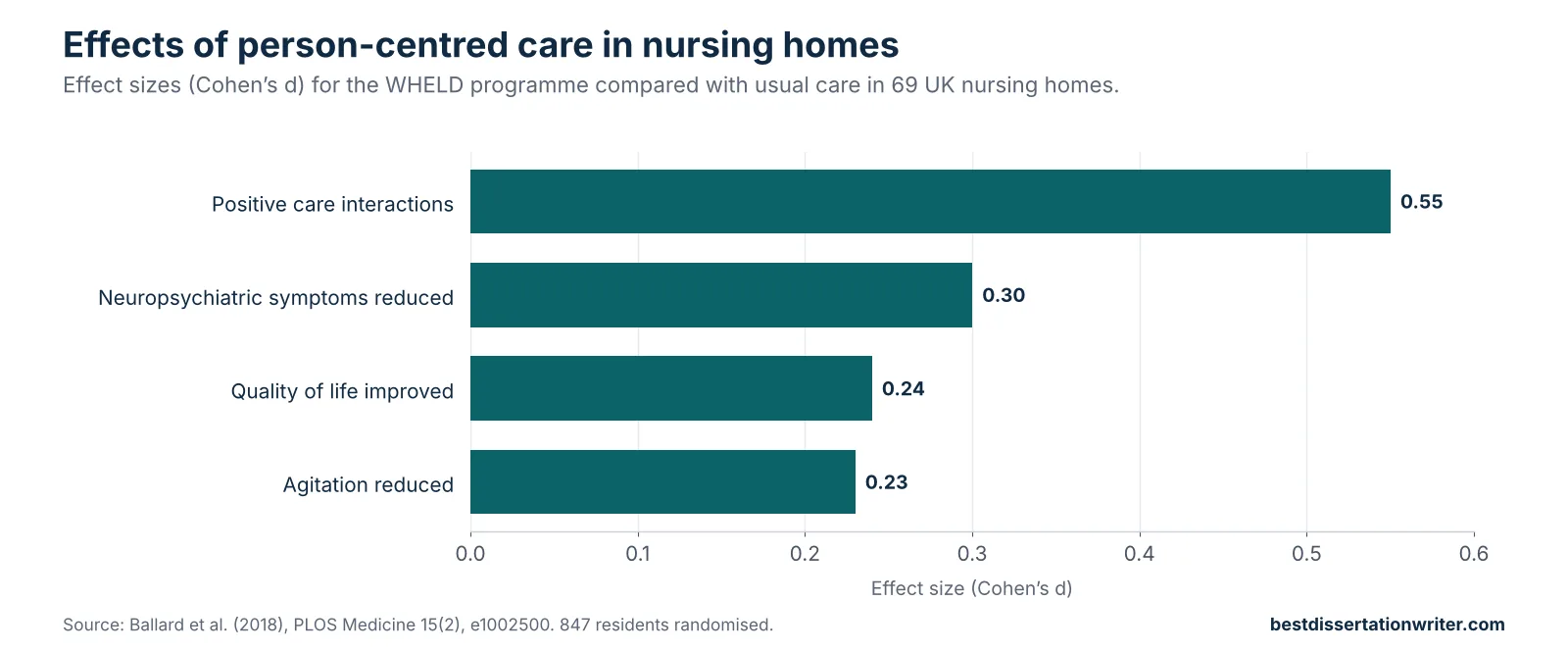
Three themes were identified: effects of person-centred dementia care on agitation and neuropsychiatric symptoms, effects on quality of life and costs, and person-centred care in acute hospitals. Table 1 summarises the included sources, and Figure 1 shows effect sizes from the largest trial.
| Author, year | Design | Setting and sample | Key finding |
|---|---|---|---|
| Chenoweth et al. (2009) | Cluster-randomised trial | 15 care homes; 289 residents | Person-centred care and Dementia Care Mapping reduced agitation; falls rose with person-centred care. |
| Kim & Park (2017) | Systematic review and meta-analysis | 19 studies; 3,985 participants | Short-term interventions reduced agitation (SMD −0.43); longer-term programmes improved quality of life. |
| Ballard et al. (2018) | Cluster-randomised trial (WHELD) | 69 UK nursing homes; 847 residents | Improved quality of life and reduced agitation and neuropsychiatric symptoms; overall cost saving. |
| Fazio et al. (2018) | Evidence-based practice review | Literature on person-centred dementia care | Six practice recommendations; mixed evidence on quality of life and depression. |
| Karrer et al. (2021) | Systematic review | 20 interventional studies in acute hospitals | Education improved staff outcomes; person-centred programmes improved some patient outcomes. |
Theme 1: Person-Centred Dementia Care and Agitation
Chenoweth et al. (2009) randomised 15 residential care sites in Sydney, with 289 residents, to person-centred care, Dementia Care Mapping or usual care. Carers in the intervention sites received training and support. At follow-up, agitation scores on the Cohen-Mansfield Agitation Inventory were lower in both the person-centred care sites (mean difference 13.6) and the Dementia Care Mapping sites (10.9) than in usual care sites. However, residents in person-centred care sites had more falls, while those in mapping sites had fewer.
Kim and Park (2017) pooled 19 intervention studies with 3,985 participants, 17 of them in long-term care facilities. Short-term person-centred interventions reduced agitation (standardised mean difference −0.43), while the effect of longer-term interventions on agitation was small and not clearly significant. The authors also reported benefits for neuropsychiatric symptoms and depression, and they noted that the effects of individualised activities varied between studies.
These findings suggest that person-centred dementia care can reduce agitation, a common and distressing experience for people with dementia and a frequent reason for the use of antipsychotic medication. The increase in falls seen in one trial is a reminder that encouraging freedom of movement and activity needs to be balanced with attention to safety, which links person-centred care to falls and fracture prevention.
Theme 2: Quality of Life, Neuropsychiatric Symptoms and Costs
Ballard et al. (2018) evaluated the WHELD programme, which combined person-centred care training, social interaction and activities, and antipsychotic review, in 69 UK nursing homes with 847 residents. Compared with usual care, WHELD improved quality of life (effect size 0.24), reduced agitation (0.23) and neuropsychiatric symptoms (0.30) and increased positive care interactions (0.55). Antipsychotic use was low at baseline and did not change. The benefits were greatest in people with moderately severe dementia, and lower health and social care costs meant that WHELD produced an overall cost saving.
Kim and Park (2017) found that longer-term interventions, staff education and culture change improved quality of life, with a small pooled effect (standardised mean difference 0.19). Fazio et al. (2018) reviewed the wider literature and noted that person-centred care reduced behavioural symptoms and psychotropic use in some reviews, while evidence on quality of life and depression was inconsistent. They also reported that most staff-focused studies found benefits such as reduced burnout and stress.
These findings indicate that person-centred dementia care can improve quality of life as well as reduce distress, although effects are modest. Importantly, the largest trial found that a structured, well-supported programme could be delivered at scale and could save money overall, which strengthens the case for investment in training and implementation.
Theme 3: Person-Centred Dementia Care in Acute Hospitals
Karrer et al. (2021) systematically reviewed 20 interventional studies aiming to improve acute hospital care for people with dementia, grouping them into eight types. Educational programmes were the most common and improved staff outcomes, such as knowledge and attitudes. Family- or person-centred care programmes, specially trained nurses and delirium management programmes improved some patient outcomes. However, the authors concluded that the evidence was insufficient to determine which interventions effectively improve dementia care in hospitals, and they called for research focusing on patient and family outcomes.
The limited evidence from hospitals reflects the difficulties of implementing and evaluating person-centred care in a fast-moving acute environment. Yet hospital admission is often a crisis point for people with dementia, who are at high risk of delirium in hospitalised older adults, functional decline and prolonged stays. Person-centred approaches, such as involving family carers, using life story information and providing continuity of staff, may help to reduce distress and support recovery.
Discussion
This review shows that person-centred dementia care can reduce agitation and neuropsychiatric symptoms and improve quality of life for people with dementia in care homes, with modest effect sizes. A large UK trial demonstrated that a structured programme could deliver these benefits at scale with an overall cost saving. In hospitals, the evidence is less developed, although family- and person-centred programmes show promise.
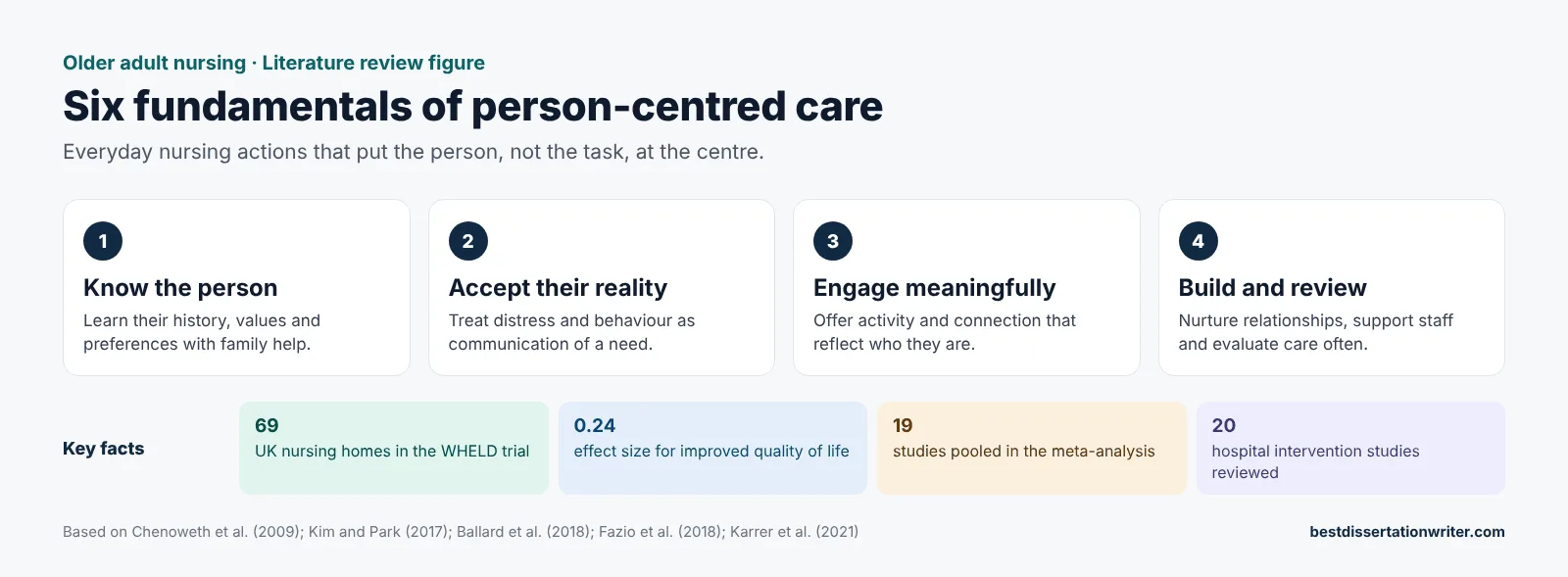
The practical fundamentals of person-centred care provide a useful guide for nurses. Fazio et al. (2018) recommended knowing the person, recognising and accepting the person’s reality, identifying opportunities for meaningful engagement, building authentic relationships, creating a supportive community and regularly evaluating care practices. These recommendations translate abstract principles into everyday actions, such as learning about a resident’s life history, responding to distress by seeking its cause and offering activities that reflect the person’s interests.
Interpreting behaviour as communication is particularly important. Agitation may signal pain, hunger, boredom, fear or unmet needs, and responding to the underlying cause is more effective and more humane than suppressing the behaviour. This approach also supports the reduction of inappropriate antipsychotic prescribing, which carries significant risks for people with dementia and is an important target of polypharmacy and deprescribing initiatives.
Implementation depends on organisational support. Training alone is unlikely to change practice unless it is reinforced through supervision, leadership and adequate staffing. The successful trials provided ongoing support to staff, such as coaching and feedback, rather than one-off education. Managers must also address systemic barriers, such as rigid routines and task-focused workloads, that make it difficult for staff to spend time with residents.
Leadership by registered nurses is central. Nurses set the tone for how colleagues speak to and about people with dementia, decide how care is organised and can champion approaches such as life story work and protected activity time. When senior nurses model person-centred practice consistently, it is more likely to become the norm rather than an occasional extra.
Families are important partners. They hold knowledge about the person’s history, preferences and ways of communicating, and they can help staff to understand and respond to distress. Involving families in care planning and welcoming them as partners, rather than visitors, reflects person-centred principles and may improve outcomes for both the person with dementia and the family carer.
Equality and diversity also matter. People with dementia come from many cultural, religious and linguistic backgrounds, and person-centred care requires staff to understand what is meaningful to each individual, including food, faith, music and language. People whose use of a second language declines as dementia progresses may need staff or families who can communicate in their first language. Knowing the person therefore includes knowing their culture and community.
Staff wellbeing is also relevant. Person-centred care asks staff to invest emotionally in relationships, and evidence suggests that it may reduce staff stress and burnout. Supporting staff through reflective practice, recognition and manageable workloads helps to sustain person-centred care over time.
The evidence base has limitations. Trials were conducted mainly in care homes in high-income countries, interventions varied in content and intensity and outcome measures differed between studies. The meta-analysis reported some inconsistent results for individual activity interventions, and evidence from hospitals was limited. This review relied on openly accessible, English-language sources and did not involve formal systematic screening. Future research should evaluate person-centred interventions in acute hospitals and home care and examine long-term effects on quality of life.
Implications of Person-Centred Dementia Care Evidence for Practice
For nurses, the evidence supports getting to know each person through life story work and conversations with families, interpreting distress as communication, offering meaningful activities and social interaction, building consistent relationships and regularly reviewing care with the team. National guidance on dementia care is available from the NICE guideline on dementia.
Managers should invest in person-centred training with ongoing coaching, protect time for staff to engage with residents and patients, involve families as partners, monitor agitation, quality of life and antipsychotic use and support staff wellbeing. Embedding person-centred dementia care in organisational culture, rather than relying on individual enthusiasm, is key to sustained improvement.
Conclusion
This systematic review examined the effectiveness of person-centred dementia care in care homes and hospitals. Person-centred care can reduce agitation and neuropsychiatric symptoms and improve quality of life, particularly in care homes, and a large UK programme achieved these benefits with an overall cost saving. Evidence from acute hospitals is more limited but promising.
Person-centred dementia care is both an ethical commitment and an evidence-based practice. By knowing the person, building relationships and creating supportive environments, nurses can help people living with dementia to experience care that recognises who they are.
References
Ballard, C., Corbett, A., Orrell, M., Williams, G., Moniz-Cook, E., Romeo, R., Woods, B., Garrod, L., Testad, I., Woodward-Carlton, B., Wenborn, J., Knapp, M., & Fossey, J. (2018). Impact of person-centred care training and person-centred activities on quality of life, agitation, and antipsychotic use in people with dementia living in nursing homes: A cluster-randomised controlled trial. PLOS Medicine, 15(2), e1002500. https://doi.org/10.1371/journal.pmed.1002500
Chenoweth, L., King, M. T., Jeon, Y.-H., Brodaty, H., Stein-Parbury, J., Norman, R., Haas, M., & Luscombe, G. (2009). Caring for Aged Dementia Care Resident Study (CADRES) of person-centred care, dementia-care mapping, and usual care in dementia: A cluster-randomised trial. The Lancet Neurology, 8(4), 317–325. https://doi.org/10.1016/S1474-4422(09)70045-6
Fazio, S., Pace, D., Flinner, J., & Kallmyer, B. (2018). The fundamentals of person-centered care for individuals with dementia. The Gerontologist, 58(Suppl. 1), S10–S19. https://doi.org/10.1093/geront/gnx122
Karrer, M., Schnelli, A., Zeller, A., & Mayer, H. (2021). A systematic review of interventions to improve acute hospital care for people with dementia. Geriatric Nursing, 42(3), 657–673. https://doi.org/10.1016/j.gerinurse.2021.03.006
Kim, S. K., & Park, M. (2017). Effectiveness of person-centered care on people with dementia: A systematic review and meta-analysis. Clinical Interventions in Aging, 12, 381–397. https://doi.org/10.2147/CIA.S117637
Cite this example
Best Dissertation Writers (2026) Person-Centred Dementia Care in Hospital and Care Home Settings: A Systematic Review. Available at: https://bestdissertationwriter.com/person-centred-dementia-care-review/
Best Dissertation Writers
Get expert help with your nursing literature review
Share your topic and deadline with Best Dissertation Writers and get support tailored to your module brief.