Falls and Fracture Prevention in Older Adults in Residential and Hospital Settings: A Systematic Review
 By Dr. Robertson Prime, Research Fellow
Updated October 26, 2026
14 min read
About 2,900 words
In this review
Abstract
Background: Falls are among the most common and harmful adverse events for older adults in hospitals and care homes, and hip fracture is their most serious consequence. Falls and fracture prevention is a core responsibility of nurses, who assess risk, supervise mobility and implement preventive measures.
Aim: This systematic review aimed to examine the consequences of hip fracture and the effectiveness of fall prevention and fracture prevention interventions for older adults in residential and hospital settings.
Methods: Evidence was identified through targeted searches of openly accessible bibliographic records, publisher websites and the reference lists of key reviews. Five sources published between 2010 and 2018 were included: a meta-analysis of mortality after hip fracture, two Cochrane reviews and two cluster-randomised trials in hospitals, appraised using CASP checklists and synthesised narratively.
Findings: In the first three months after hip fracture, the risk of death was five to eight times higher than in people without fracture. In care facilities, vitamin D probably reduced the rate of falls (rate ratio 0.72), and hip protectors probably reduced hip fractures slightly (risk ratio 0.82), although adherence was poor. In hospitals, multifactorial interventions may reduce falls, particularly in subacute settings. Individualised patient education with staff training reduced falls in rehabilitation units (rate ratio 0.60), whereas a nurse-led prevention bundle on acute wards did not reduce falls.
Conclusion: Falls and fracture prevention requires individualised, well-implemented interventions rather than generic checklists. Nurses should combine risk assessment with patient education, supervised mobility, vitamin D where indicated and support for hip protector use.
Keywords: falls and fracture prevention, fall prevention, hip fracture
Introduction
This systematic review critically examines recent evidence on falls and fracture prevention and its implications for older adult nursing practice.
Falls are a major threat to the health and independence of older people. In hospitals and care homes, where residents and patients are often frail, cognitively impaired and taking several medicines, falls are particularly common. Many cause no serious injury, but some result in head injury or fracture, and the fear of falling can lead to reduced activity, loss of confidence and further decline. Hip fracture, in particular, can transform an older person’s life, leading to surgery, prolonged rehabilitation, loss of independence and, for many, death.
Falls and fracture prevention is therefore a central concern for nurses. They assess falls risk, help patients to move safely, respond to call bells, supervise toileting, ensure that walking aids and footwear are appropriate and implement measures such as low beds and sensor alarms. They also educate patients and families and contribute to decisions about medication and vitamin D. Despite this effort, falls remain one of the most frequently reported safety incidents in hospitals.
A systematic review approach was chosen to draw on Cochrane reviews, cluster-randomised trials and a meta-analysis of outcomes after hip fracture.
The question matters because nurses spend considerable time on falls and fracture prevention, and it is important that this time is directed towards interventions that work. Some widely used practices may have little effect, while others are underused.
Review question
What are the consequences of hip fracture, and which interventions for fall prevention and fracture prevention are effective for older adults in residential and hospital settings?
Background to Falls and Fracture Prevention
Falls in older adults usually result from an interaction between individual risk factors and the environment. Individual factors include muscle weakness, poor balance, gait problems, cognitive impairment, delirium, visual impairment, continence problems, postural hypotension and medications such as sedatives and antihypertensives. Environmental factors include unfamiliar surroundings, clutter, poor lighting, slippery floors, inappropriate footwear and equipment that is out of reach.
In hospitals, the risks are heightened by acute illness, new medicines, unfamiliar wards and pressure on staff time. Falls may occur when patients try to walk to the toilet or get out of bed unaided, including at night, which is why the 6-PACK programme included a toileting regimen and bathroom supervision. In care homes, residents are generally frailer and more likely to have dementia, and falls may recur frequently.
Interventions for falls and fracture prevention include multifactorial assessment and individualised interventions, exercise and physiotherapy, medication review, vitamin D supplementation, environmental modifications, patient and staff education, low beds, sensor alarms and hip protectors. Hip protectors are padded garments designed to absorb or divert the force of a fall away from the hip and are used mainly in care homes.
Fracture prevention also involves assessing and treating osteoporosis. Bone-strengthening medication is outside the scope of this review, but nurses contribute by identifying people who have fallen or fractured and ensuring that bone health is considered in their care.
The aftermath of a fall also requires skilled nursing care. Staff must check for injury before moving the person, use safe lifting equipment, monitor for delayed signs of head injury or fracture and review why the fall happened. Post-fall review is an opportunity to identify new risk factors, such as infection or a change in medication, and to update the care plan so that further falls are less likely.
Search Strategy and Methods
Evidence for this example was identified through targeted searches of openly accessible bibliographic records, publisher websites and the reference lists of key reviews. Search terms combined keywords for the problem (“falls and fracture prevention”, “fall prevention”, “hip fracture”, “accidental falls”) with terms for settings and interventions (“care homes”, “nursing homes”, “hospital”, “multifactorial”, “vitamin D”, “hip protectors”, “patient education”), joined with the Boolean operators AND and OR. A full systematic review for assessment would run the same strategy in CINAHL, PubMed/MEDLINE, the Cochrane Library and Embase and report the number of records screened in a PRISMA flow diagram.
Sources were eligible if they evaluated interventions to prevent falls or fractures in older adults in care homes or hospitals, or quantified the consequences of hip fracture. Systematic reviews and randomised trials were prioritised. Studies of community-dwelling older adults only were excluded, except where they formed part of a review that also covered care settings.
Five sources published between 2010 and 2018 were included: a meta-analysis of mortality after hip fracture, a Cochrane review of hip protectors, two cluster-randomised trials of falls prevention in hospitals and a Cochrane review of interventions to prevent falls in care facilities and hospitals (Table 1). Each source was appraised using the Critical Appraisal Skills Programme (CASP) checklist appropriate to its design, and findings were synthesised narratively and grouped into themes.
Key Findings on Falls and Fracture Prevention
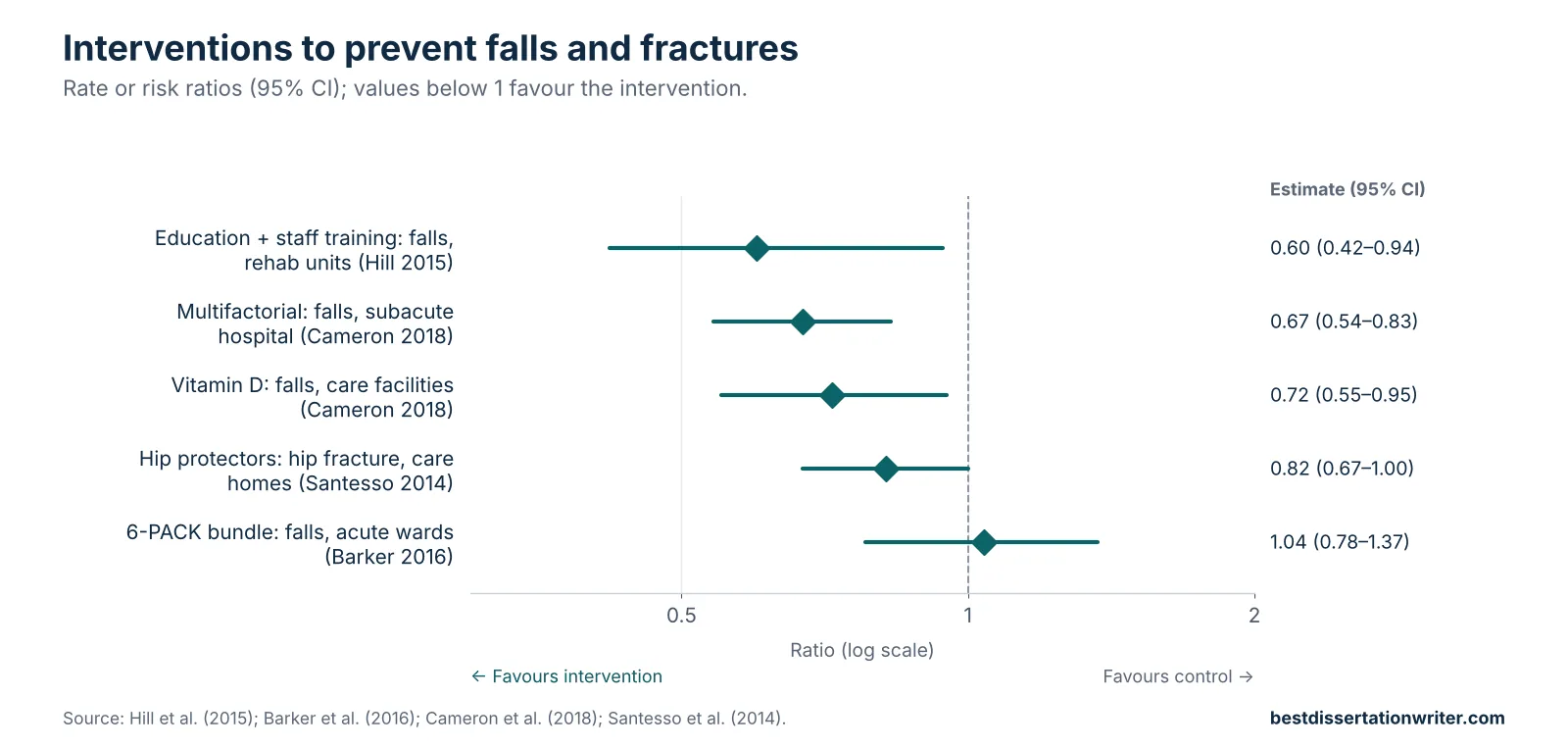
Three themes were identified: the consequences of hip fracture, falls and fracture prevention in care homes and falls prevention in hospitals. Table 1 summarises the included sources, and Figure 1 shows the effects of the main interventions.
| Author, year | Design | Setting and sample | Key finding |
|---|---|---|---|
| Haentjens et al. (2010) | Meta-analysis of cohort studies | 22 cohorts of women; 17 of men | Death risk 5.75 (women) and 7.95 (men) times higher in first 3 months after hip fracture. |
| Santesso et al. (2014) | Cochrane systematic review | 19 trials; about 17,000 people | Hip protectors probably reduce hip fracture in care homes (RR 0.82); poor adherence. |
| Hill et al. (2015) | Stepped-wedge cluster RCT | 8 rehabilitation units; 3,606 patients | Individualised education with staff training reduced falls (RR 0.60). |
| Barker et al. (2016) | Cluster RCT (6-PACK) | 24 acute wards; 31,411 patients | Nurse-led bundle did not reduce falls (RR 1.04) or injuries. |
| Cameron et al. (2018) | Cochrane systematic review | 95 trials; 138,164 participants | Vitamin D reduced fall rate in care facilities (0.72); multifactorial may help in hospitals. |
Theme 1: The Consequences of Hip Fracture
Haentjens et al. (2010) pooled prospective cohort studies of older adults with hip fracture, including 22 cohorts of women and 17 cohorts of men, and compared their survival with that of age- and sex-matched controls. In the first three months after hip fracture, the risk of death from any cause was 5.75 times higher in women and 7.95 times higher in men. Although the excess risk declined over time, it never returned to the level of controls. For women who fractured their hip at age 80, the excess annual mortality was 8% at one year and 22% at ten years.
These findings underline why falls and fracture prevention matters. A hip fracture is not simply an injury to be repaired but a marker and cause of decline, and the period immediately afterwards is particularly dangerous. Preventing falls that lead to hip fracture is therefore one of the most important things nurses can do to protect older people.
Theme 2: Falls and Fracture Prevention in Care Homes
Cameron et al. (2018) reviewed 95 randomised trials of interventions to prevent falls in care facilities and hospitals. In care facilities, vitamin D supplementation probably reduced the rate of falls (rate ratio 0.72, 95% CI 0.55 to 0.95; moderate certainty), although it probably made little difference to the risk of falling, and the populations studied had low vitamin D levels. Evidence for exercise, medication review and multifactorial interventions in care facilities was mostly of low or very low certainty, with no clear effect.
Santesso et al. (2014) reviewed 19 trials of hip protectors with about 17,000 participants. In nursing and residential care, hip protectors probably reduced the risk of hip fracture slightly (risk ratio 0.82, 95% CI 0.67 to 1.00; moderate certainty), equivalent to about 11 fewer hip fractures per 1,000 people, without increasing falls. In the community, they probably made little or no difference. Adherence was poor, particularly over the long term, and some people experienced skin irritation.
Theme 3: Fall Prevention in Hospitals
Barker et al. (2016) randomised 24 acute medical and surgical wards in six Australian hospitals to the nurse-led 6-PACK programme or usual care, covering 31,411 patients. The programme combined a fall risk tool with up to six interventions: a falls alert sign, supervision in the bathroom, walking aids within reach, a toileting regimen, a low-low bed and a bed or chair alarm. Although use of these measures increased threefold, there was no difference in falls (rate ratio 1.04) or fall injuries (0.96) between intervention and control wards.
Hill et al. (2015) evaluated individualised falls prevention education for cognitively intact patients, delivered by a trained health professional, combined with training and feedback for staff, in eight rehabilitation units with 3,606 patients. Falls fell from 13.78 to 7.80 per 1,000 patient-days (adjusted rate ratio 0.60), injurious falls were reduced (0.65) and the proportion of patients who fell decreased from 12.51% to 8.38%.
Cameron et al. (2018) found that multifactorial interventions in hospitals may reduce the rate of falls (rate ratio 0.80), with clearer benefit in subacute and rehabilitation settings (0.67). Evidence for bed and chair alarms and additional physiotherapy was of very low certainty.
Discussion
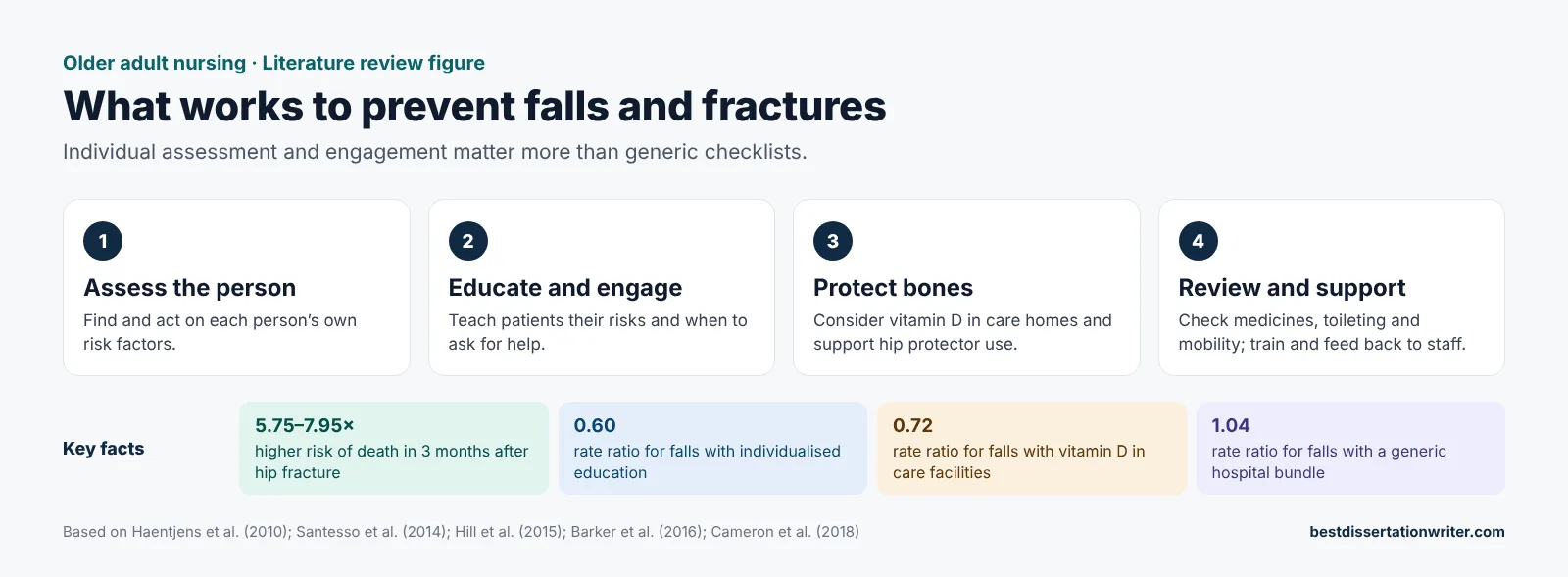
This review shows that hip fracture carries a high risk of death, particularly in the first three months, and that some interventions for falls and fracture prevention are effective while others are not. In care homes, vitamin D for residents with low levels and hip protectors can reduce falls and fractures, although adherence to hip protectors is a challenge. In hospitals, individualised patient education with staff training reduced falls in rehabilitation units, whereas a bundle of commonly used measures on acute wards did not.
The contrast between the two hospital trials is instructive. The 6-PACK programme was well implemented, but it relied largely on environmental measures and alarms applied according to a risk score. The education programme engaged patients directly, helping them to understand their own risk and to ask for help, and it also gave staff feedback. This suggests that fall prevention in hospital depends on changing behaviour, both of patients and staff, rather than simply applying a set of standard measures.
Individualisation runs through the evidence. Multifactorial assessment identifies each person’s specific risk factors, such as postural hypotension, delirium, continence problems or sedative medication, so that targeted actions can be taken. Medication review is part of this, linking falls and fracture prevention to polypharmacy and deprescribing. Generic risk scores alone do not prevent falls; it is the actions that follow assessment that matter.
Hip protectors illustrate the importance of acceptability. They work only if they are worn, and the review found that adherence was poor, particularly over the long term. Residents may find them uncomfortable or difficult to put on, and skin irritation was reported in some trials. Nurses can improve adherence by explaining the purpose, choosing comfortable designs, involving families and helping residents to wear them consistently, especially those at highest risk.
Staff engagement deserves attention. In the successful rehabilitation trial, staff received training and regular feedback on falls, which may have helped them to reinforce the education patients received and to respond consistently. Sharing falls data with ward teams, discussing individual incidents without blame and celebrating improvement can help to sustain attention to falls and fracture prevention over time.
Night-time deserves particular attention. Patients who wake disoriented may try to reach the toilet alone. Offering toileting before sleep, keeping a night light on, placing call bells and walking aids within reach and checking on high-risk patients regularly are simple measures that nurses can build into night routines.
Balancing safety with freedom is a recurring dilemma. Restricting mobility may reduce falls in the short term but leads to deconditioning, loss of independence and distress, and approaches that encourage activity are consistent with person-centred care. Nurses must work with residents and families to agree acceptable levels of risk, ensuring that falls prevention does not become a reason to limit people’s lives.
The consequences of a fall extend beyond fracture. Older people who fall and cannot get up may lie on the floor for long periods, risking dehydration and skin damage, which links fall prevention to the prevention of pressure ulcers in care homes. Unexplained or repeated injuries should also prompt nurses to consider whether a resident may be at risk of elder abuse, as part of a thorough assessment.
Families can also contribute. They can help to bring in well-fitting footwear and familiar walking aids, tell staff about the person’s usual routines and previous falls and reinforce education about asking for help. Involving families in falls and fracture prevention planning, particularly for people with dementia who may not retain information, extends the reach of nursing care.
The evidence base has limitations. Many trials had a high risk of bias, mainly because blinding was not possible, and fracture outcomes were poorly reported. The two hospital trials were conducted in Australia, and the education intervention was limited to patients without cognitive impairment. The hip fracture meta-analysis relied on published survival curves from diverse cohorts. This review relied on openly accessible, English-language sources and did not involve formal systematic screening. Future research should test interventions for patients with cognitive impairment and evaluate how to sustain effective fall prevention in routine practice.
Implications of Falls and Fracture Prevention Evidence for Practice
For nurses, the evidence supports carrying out multifactorial assessment and acting on individual risk factors, providing individualised falls education to patients who can understand it, supporting safe mobility and toileting, reviewing medications, ensuring vitamin D is considered for care home residents and supporting the consistent use of hip protectors where appropriate. National guidance is available in the NICE guideline on falls.
Managers should avoid relying on generic bundles and risk scores alone, invest in staff training and feedback, ensure that patient education is delivered by trained staff and audit falls and injuries. Effective falls and fracture prevention requires an organisational culture that values both safety and the independence of older people.
Conclusion
This systematic review examined falls and fracture prevention for older adults in residential and hospital settings. Hip fracture greatly increases the risk of death. In care homes, vitamin D and hip protectors can reduce falls and fractures, and in hospitals, individualised patient education with staff training is effective, whereas generic bundles may not be.
Falls and fracture prevention is a core part of older adult nursing. By focusing on individualised assessment, education and practical support, and by applying the interventions that work, nurses can protect older people from falls and the serious harm that can follow.
References
Barker, A. L., Morello, R. T., Wolfe, R., Brand, C. A., Haines, T. P., Hill, K. D., Brauer, S. G., Botti, M., Cumming, R. G., Livingston, P. M., Sherrington, C., Zavarsek, S., Lindley, R. I., & Kamar, J. (2016). 6-PACK programme to decrease fall injuries in acute hospitals: Cluster randomised controlled trial. BMJ, 352, h6781. https://doi.org/10.1136/bmj.h6781
Cameron, I. D., Dyer, S. M., Panagoda, C. E., Murray, G. R., Hill, K. D., Cumming, R. G., & Kerse, N. (2018). Interventions for preventing falls in older people in care facilities and hospitals. Cochrane Database of Systematic Reviews, (9), CD005465. https://doi.org/10.1002/14651858.CD005465.pub4
Haentjens, P., Magaziner, J., Colón-Emeric, C. S., Vanderschueren, D., Milisen, K., Velkeniers, B., & Boonen, S. (2010). Meta-analysis: Excess mortality after hip fracture among older women and men. Annals of Internal Medicine, 152(6), 380–390. https://doi.org/10.7326/0003-4819-152-6-201003160-00008
Hill, A.-M., McPhail, S. M., Waldron, N., Etherton-Beer, C., Ingram, K., Flicker, L., Bulsara, M., & Haines, T. P. (2015). Fall rates in hospital rehabilitation units after individualised patient and staff education programmes: A pragmatic, stepped-wedge, cluster-randomised controlled trial. The Lancet, 385(9987), 2592–2599. https://doi.org/10.1016/S0140-6736(14)61945-0
Santesso, N., Carrasco-Labra, A., & Brignardello-Petersen, R. (2014). Hip protectors for preventing hip fractures in older people. Cochrane Database of Systematic Reviews, (3), CD001255. https://doi.org/10.1002/14651858.CD001255.pub5
Cite this example
Best Dissertation Writers (2026) Falls and Fracture Prevention in Older Adults in Residential and Hospital Settings: A Systematic Review. Available at: https://bestdissertationwriter.com/falls-and-fracture-prevention-review/
Best Dissertation Writers
Get expert help with your nursing literature review
Share your topic and deadline with Best Dissertation Writers and get support tailored to your module brief.