Prevention and Management of Pressure Ulcers in Care Homes: A Systematic Review of Evidence for Older Residents
 By Dr. Robertson Prime, Research Fellow
Updated October 26, 2026
14 min read
About 2,800 words
In this review
Abstract
Background: Pressure ulcers in care homes cause pain, infection and distress for older residents, many of whom are frail, immobile, incontinent or living with dementia. Pressure injury prevention depends largely on the daily care provided by nurses and care staff.
Aim: This systematic review aimed to examine the frequency of pressure ulcers among older care home residents and the evidence for risk assessment, repositioning and nutritional interventions for prevention.
Methods: Evidence was identified through targeted searches of openly accessible bibliographic records, publisher websites and the reference lists of key reviews. Five sources published between 2013 and 2026 were included: a systematic review and meta-analysis of prevalence and incidence, a multisite randomised trial in nursing homes and three Cochrane reviews, appraised using CASP checklists and synthesised narratively.
Findings: The pooled point prevalence of pressure injuries among nursing home residents was 11.6%, and 8.5% of residents developed a pressure injury in the home. Heels and sacrum were the most affected sites. In 27 nursing homes, turning residents every two, three or four hours on high-density foam mattresses produced similar, low incidence (2%). Evidence that risk assessment tools reduce pressure ulcers compared with clinical judgement was weak, and nutritional supplements did not clearly prevent pressure ulcers, although they may aid healing.
Conclusion: Care home pressure ulcers remain common but largely preventable. Prevention should combine good support surfaces, individualised repositioning, skin inspection and attention to nutrition, continence and mobility rather than relying on risk scores alone.
Keywords: pressure ulcers in care homes, care home pressure ulcers, pressure injury prevention
Introduction
This systematic review critically examines recent evidence on pressure ulcers in care homes and its implications for older adult nursing practice.
Care home residents are among the people most at risk of pressure ulcers. Many are very old, frail and dependent on others to move, and many live with dementia, incontinence, poor nutrition and multiple long-term conditions. A pressure ulcer can develop within hours if a person lies or sits in one position, and once established it may take weeks or months to heal. For residents, pressure ulcers cause pain, infection, reduced mobility and loss of dignity, and they may contribute to hospital admission and death.
Pressure ulcers in care homes also matter to families, regulators and commissioners. They are often seen as an indicator of the quality of care, and serious pressure ulcers may raise safeguarding concerns. At the same time, care homes often have limited access to specialist tissue viability services and may face staffing pressures, which makes prevention challenging.
A systematic review approach was chosen to draw on a meta-analysis of frequency, a large randomised trial in nursing homes and Cochrane reviews.
The question matters because nurses and care staff in care homes deliver most preventive care, often around the clock, and need to know which measures are supported by evidence. Some routine practices, such as fixed turning schedules and risk scores, are widely used but may not be as effective as assumed.
Review question
How common are pressure ulcers among older care home residents, and what does the evidence show about risk assessment, repositioning and nutritional interventions for pressure injury prevention?
Background to Pressure Ulcers in Care Homes
A pressure ulcer is localised damage to the skin and underlying tissue, usually over a bony prominence, caused by pressure or pressure combined with shear. In older people, thinner skin, reduced fat and muscle, poorer circulation and reduced sensation all increase vulnerability. Moisture from incontinence or sweating weakens the skin further, and poor nutrition and dehydration reduce the tissue’s ability to tolerate pressure and to heal.
Pressure injury prevention traditionally rests on several elements: assessing risk, inspecting the skin regularly, using pressure-redistributing mattresses and cushions, repositioning to relieve pressure, managing moisture and continence, optimising nutrition and hydration and encouraging mobility. In care homes, these elements must be delivered consistently by a team that often includes registered nurses, care assistants and visiting community nurses.
Risk assessment tools such as the Braden and Waterlow scales are widely used to identify residents at risk and to trigger preventive measures. Repositioning schedules, often every two hours, have long been standard practice, although they can disturb sleep and place a heavy workload on staff. Modern high-specification foam mattresses may change the balance, because they reduce the pressure experienced by the skin.
Nutritional support is also widely recommended, because malnutrition is common in care homes and is associated with pressure ulcers. However, it is not clear whether nutritional supplements prevent pressure ulcers in people who are not malnourished, or whether they mainly support healing.
Responsibility for pressure ulcers in care homes is shared. In homes with nursing, registered nurses lead assessment and care planning, while in residential homes without on-site nurses, care staff deliver daily care and community nurses provide clinical input. Clear communication between these groups, and between care homes and hospitals when residents are admitted or discharged, is essential to ensure that preventive care is continuous.
Search Strategy and Methods
Evidence for this example was identified through targeted searches of openly accessible bibliographic records, publisher websites and the reference lists of key reviews. Search terms combined keywords for the problem (“pressure ulcers in care homes”, “care home pressure ulcers”, “pressure injury”, “nursing home”) with terms for prevention (“pressure injury prevention”, “repositioning”, “turning”, “risk assessment”, “nutrition”), joined with the Boolean operators AND and OR. A full systematic review for assessment would run the same strategy in CINAHL, PubMed/MEDLINE, the Cochrane Library and Embase and report the number of records screened in a PRISMA flow diagram.
Sources were eligible if they reported the frequency of pressure ulcers among older care home residents or evaluated preventive interventions relevant to care homes. Systematic reviews and randomised trials were prioritised. Studies focusing only on the treatment of established ulcers with dressings or surgery were excluded.
Five sources published between 2013 and 2026 were included: a meta-analysis of the prevalence and incidence of pressure injuries in nursing homes, a multisite randomised trial of repositioning frequency in nursing homes and Cochrane reviews of risk assessment tools, nutritional interventions and repositioning (Table 1). Each source was appraised using the Critical Appraisal Skills Programme (CASP) checklist appropriate to its design, and findings were synthesised narratively and grouped into themes.
Key Findings on Pressure Ulcers in Care Homes
Three themes were identified in relation to pressure ulcers in care homes: the frequency of care home pressure ulcers, repositioning and support surfaces, and risk assessment and nutrition. Table 1 summarises the included sources, and Figure 1 shows pooled estimates of frequency.
| Author, year | Design | Setting and sample | Key finding |
|---|---|---|---|
| Bergstrom et al. (2013) | Multisite randomised trial | 900+ residents; 27 nursing homes | 2-, 3- and 4-hourly turning on high-density foam equally effective; 2% incidence. |
| Moore & Patton (2019) | Cochrane systematic review | 2 trials; 1,487 participants | No evidence that risk tools reduce ulcers versus clinical judgement. |
| Sugathapala et al. (2023) | Systematic review and meta-analysis | 47 studies of nursing home residents | Point prevalence 11.6%; 8.5% acquired in the home; heels and sacrum most affected. |
| Langer et al. (2024) | Cochrane systematic review | 33 trials; 7,920 participants | Supplements did not clearly prevent ulcers; may aid healing. |
| Latimer et al. (2026) | Cochrane systematic review | Trials of repositioning frequency and tilt | No clear difference between 2- and 4-hourly repositioning (RR 1.06); low certainty. |
Theme 1: How Common Are Pressure Ulcers in Care Homes?
Sugathapala et al. (2023) pooled 47 studies of pressure injuries among nursing home residents aged 60 or older. The pooled point prevalence of pressure injuries of any stage was 11.6% (95% CI 9.6% to 13.7%), falling to 7.2% when stage I injuries were excluded. Cumulative incidence was 14.3%, and 8.5% of residents developed a pressure injury acquired in the nursing home. Stage I and II injuries were most common, and the heel (34.1%), sacrum (27.2%) and foot (18.4%) were the most frequently affected sites. Prevalence appeared to decline over the years of data collection, which may reflect improvements in prevention, although differences in study methods could also contribute.
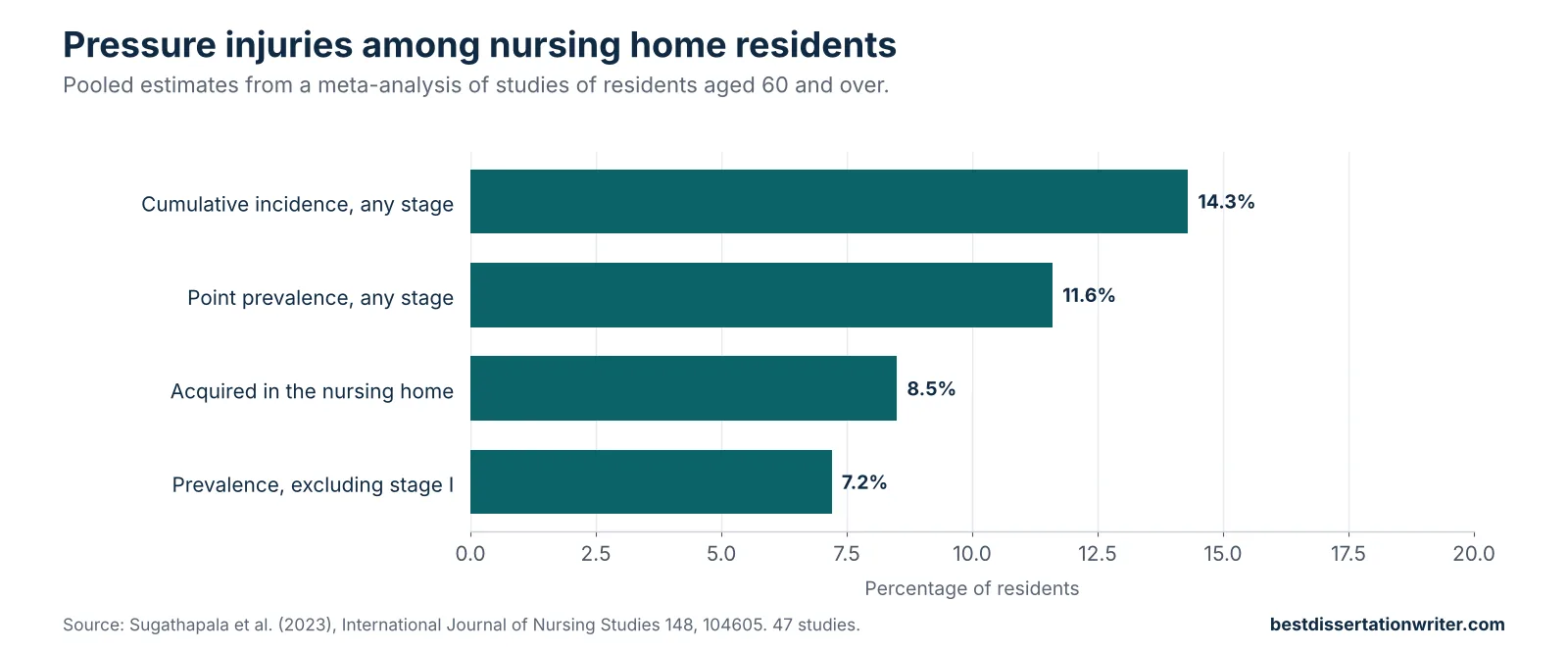
These findings show that pressure ulcers in care homes affect around one in nine residents at any time, and that many are acquired in the home itself. The high proportion affecting the heels and feet is notable, because these sites can be overlooked when attention focuses on the sacrum, and they are particularly vulnerable in residents who spend long periods in bed or in chairs with their feet resting on surfaces.
Theme 2: Repositioning and Support Surfaces for Pressure Injury Prevention
Bergstrom et al. (2013) randomised more than 900 residents at moderate or high risk of pressure ulcers in 27 nursing homes in the United States and Canada to be repositioned every two, three or four hours for three weeks, while lying on high-density foam mattresses. Only 2% of residents developed a pressure ulcer, all of them stage I or II, and there was no significant difference between the repositioning intervals or between risk groups.
Latimer et al. (2026) updated a Cochrane review of repositioning for pressure injury prevention in adults. Pooled data from three trials with 1,074 participants showed no clear difference between two-hourly and four-hourly repositioning (risk ratio 1.06), and evidence for different tilt angles was of very low certainty. One nursing home study found that a 30-degree tilt every three hours cost less than standard care. The authors concluded that the evidence was of low or very low certainty and that the trials were small and at high risk of bias.
Together, these findings suggest that, for pressure ulcers in care homes, when residents are on good-quality pressure-redistributing mattresses, less frequent repositioning may be as effective as two-hourly turning. This could allow residents more undisturbed sleep and free staff time for other aspects of care, although repositioning should still be individualised according to the resident’s skin condition, comfort and risk.
Theme 3: Risk Assessment, Nutrition and Care Home Pressure Ulcers
Moore and Patton (2019) reviewed trials comparing structured risk assessment tools with clinical judgement or other tools. Only two trials with 1,487 participants were found, both in acute care, and neither showed that using a tool reduced pressure ulcer incidence compared with clinical judgement. The authors could not be certain whether risk assessment tools make any difference to outcomes.
Langer et al. (2024) reviewed 33 randomised trials of nutritional interventions. For prevention, supplements providing energy, protein and micronutrients (risk ratio 0.92) or protein alone (0.75) did not clearly reduce pressure ulcer incidence, with low-certainty evidence. For treatment, combined energy, protein and micronutrient supplements may have increased healing (risk ratio 1.45), and collagen supplements probably improved healing in one small trial.
Discussion
This review shows that pressure ulcers in care homes remain common, affecting around 11.6% of residents at any time, with many acquired in the home and a high proportion on the heels and feet. On high-density foam mattresses, repositioning every three or four hours appears as effective as every two hours. Risk assessment tools have not been shown to reduce ulcers compared with clinical judgement, and nutritional supplements have not been shown to prevent ulcers, although they may support healing.
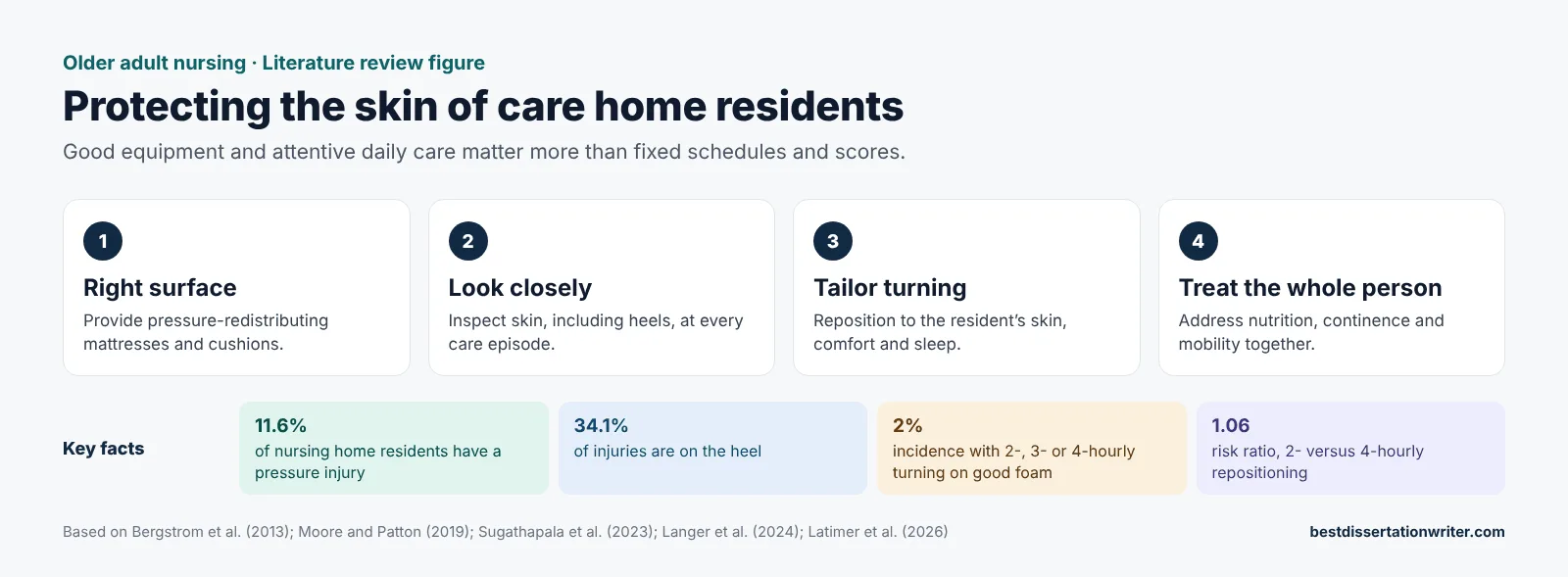
These findings suggest a shift in emphasis. Rather than relying on a risk score and a fixed turning chart, pressure injury prevention should focus on providing high-quality support surfaces for at-risk residents, inspecting the skin regularly, including the heels, and tailoring repositioning to each resident’s skin response, comfort and preferences. Risk assessment tools may still help to structure assessment and communication, but they should prompt clinical judgement and action rather than replace them.
Skin inspection is central to preventing pressure ulcers in care homes. Checking the skin at each repositioning or personal care episode allows early signs of damage, such as persistent redness or changes in skin colour, to be identified and acted upon. In residents with darker skin tones, early damage may not appear as redness, so staff need training to recognise other signs, such as changes in temperature, texture or colour. Heels should be offloaded for residents who spend long periods in bed.
Nutrition and hydration remain important, even though supplements did not clearly prevent ulcers. Malnourished residents have reduced tissue tolerance and heal more slowly, and identifying and treating malnutrition and dehydration supports both prevention and healing. Nurses should screen for malnutrition, encourage eating and drinking and seek dietetic advice when needed.
Moisture and continence are also critical. Incontinence exposes the skin to urine and faeces, which weakens it and makes pressure damage more likely, and moisture-associated skin damage can be confused with pressure ulcers. Effective continence management, prompt cleansing and the use of barrier products help to protect the skin.
Transfers between settings deserve attention. Residents admitted to hospital may return with new pressure damage, and those discharged to care homes may arrive with existing ulcers that need ongoing care. Documenting skin condition on arrival and departure, and sharing information about equipment and repositioning needs, helps to prevent pressure ulcers in care homes from being missed or wrongly attributed.
Staff knowledge and confidence are also important. Care assistants deliver much of the hands-on care that prevents pressure ulcers in care homes, and they need training in skin inspection, positioning, moisture management and when to escalate concerns. Supportive supervision from registered nurses, and access to specialist advice, can help staff to act early when the skin begins to change.
Mobility and activity offer the most natural form of pressure relief. Encouraging residents to move, stand and walk where possible, and avoiding unnecessary bed rest, reduces the time spent under pressure. Mobility must be supported safely, linking pressure injury prevention to falls and fracture prevention, so that efforts to keep residents active do not increase their risk of harm.
The evidence base has limitations. The prevalence meta-analysis combined studies with different definitions and methods, and the repositioning trial lasted only three weeks and used high-specification mattresses that may not be available in all homes. The risk assessment review included only two trials, both in acute care, and the nutrition review included many small studies, some with commercial funding. This review relied on openly accessible, English-language sources and did not involve formal systematic screening. Future research should test pressure injury prevention strategies in care homes over longer periods and include residents with darker skin tones.
Implications of Pressure Ulcers in Care Homes Evidence for Practice
For nurses and care staff, the evidence supports providing pressure-redistributing mattresses and cushions for at-risk residents, inspecting the skin, including heels, at every care episode, tailoring repositioning to each resident rather than applying a fixed schedule, offloading heels, managing moisture and continence, screening for malnutrition and encouraging mobility. National guidance is available in the NICE guideline on pressure ulcers.
Residents and families should be involved in prevention plans. Explaining why repositioning, skin checks and good nutrition matter, and agreeing an approach that respects the resident’s preferences for sleep, comfort and activity, makes care more acceptable and sustainable. Families can also alert staff to changes they notice during visits.
Care home managers should ensure that suitable equipment is available, that staff are trained in skin inspection, including on darker skin tones, that repositioning plans are individualised and that care home pressure ulcers are monitored and reviewed to identify learning. Close working with community nurses and tissue viability services supports both prevention and the management of established ulcers.
Conclusion
This systematic review examined pressure ulcers in care homes and their prevention. Around 11.6% of older residents have a pressure injury at any time, often on the heels or sacrum. On good mattresses, less frequent repositioning appears as effective as two-hourly turning, risk assessment tools have not been shown to improve outcomes and nutritional supplements do not clearly prevent ulcers, though they may aid healing.
Preventing pressure ulcers in care homes depends on attentive, individualised care. By combining good equipment, careful skin inspection, tailored repositioning and attention to nutrition, continence and mobility, nurses and care staff can protect residents from a painful and largely preventable harm.
References
Bergstrom, N., Horn, S. D., Rapp, M. P., Stern, A., Barrett, R., & Watkiss, M. (2013). Turning for Ulcer ReductioN: A multisite randomized clinical trial in nursing homes. Journal of the American Geriatrics Society, 61(10), 1705–1713. https://doi.org/10.1111/jgs.12440
Langer, G., Wan, C. S., Fink, A., Schwingshackl, L., & Schoberer, D. (2024). Nutritional interventions for preventing and treating pressure ulcers. Cochrane Database of Systematic Reviews, (2), CD003216. https://doi.org/10.1002/14651858.CD003216.pub3
Latimer, S. L., Chaboyer, W. P., Probst, S., Thalib, L., Palipana, D., Lapkin, S., McInnes, E., Downes, M. J., & Gillespie, B. M. (2026). Repositioning for pressure injury prevention in adults. Cochrane Database of Systematic Reviews, (6), CD009958. https://doi.org/10.1002/14651858.CD009958.pub4
Moore, Z. E. H., & Patton, D. (2019). Risk assessment tools for the prevention of pressure ulcers. Cochrane Database of Systematic Reviews, (1), CD006471. https://doi.org/10.1002/14651858.CD006471.pub4
Sugathapala, R. D. U. P., Latimer, S., Balasuriya, A., Chaboyer, W., Thalib, L., & Gillespie, B. M. (2023). Prevalence and incidence of pressure injuries among older people living in nursing homes: A systematic review and meta-analysis. International Journal of Nursing Studies, 148, 104605. https://doi.org/10.1016/j.ijnurstu.2023.104605
Cite this example
Best Dissertation Writers (2026) Prevention and Management of Pressure Ulcers in Care Homes: A Systematic Review of Evidence for Older Residents. Available at: https://bestdissertationwriter.com/pressure-ulcers-in-care-homes-review/
Best Dissertation Writers
Get expert help with your nursing literature review
Share your topic and deadline with Best Dissertation Writers and get support tailored to your module brief.