Nurse Practitioner-Led Chronic Disease Management in Primary Care: A Systematic Review
 By Dr. Robertson Prime, Research Fellow
Updated November 2, 2026
15 min read
About 3,000 words
In this review
Abstract
Background: Long-term conditions such as hypertension and diabetes account for a large share of primary care consultations, and many health systems rely on nurse practitioners and other nurses to deliver structured follow-up. Understanding whether nurse-led chronic disease management achieves outcomes comparable to usual care is central to workforce planning.
Aim: This systematic review aimed to examine the evidence on the clinical effectiveness of nurse-led chronic disease management in primary care, including blood pressure, diabetes and cholesterol outcomes, patient satisfaction and safety.
Methods: Evidence was identified through targeted searches of openly accessible bibliographic records, publisher websites and Cochrane evidence pages. Five sources published between 2014 and 2024 were included: three Cochrane or systematic reviews of nurse-led or non-medical care, a systematic review of practice nurse involvement in diabetes care and a meta-analysis of nurse-led interventions for hypertension. The sources were appraised using CASP checklists and synthesised narratively.
Findings: A Cochrane review of 18 trials found probably slightly improved blood pressure, similar other health outcomes and probably higher patient satisfaction with nurse-led primary care. A meta-analysis of 11 trials with 30,247 participants found a systolic blood pressure reduction of 4.27 mmHg with nurse-led care and no significant difference in cholesterol or HbA1c. A Cochrane review of 46 studies found comparable outcomes for diabetes, blood pressure and cholesterol. A review of seven studies found modest improvements for practice nurse management of type 2 diabetes. A meta-analysis of 35 trials found improved long-term blood pressure control.
Conclusion: Nurse-led chronic disease management in primary care achieves outcomes equal to or modestly better than usual care, particularly for blood pressure. Evidence on safety, costs and the most appropriate education is limited, and services should monitor outcomes locally.
Keywords: chronic disease management, hypertension, long-term conditions
Introduction
This systematic review critically examines recent evidence on chronic disease management and its implications for advanced clinical practice.
Most people who use primary care have at least one long-term condition. Hypertension, diabetes, asthma, chronic obstructive pulmonary disease and heart failure require regular review, adjustment of treatment, education and support for self-management, and these tasks are often more suited to continuity of care than to occasional urgent consultations. Meeting the demand with doctors alone is difficult, and many systems have developed nurse-led clinics and roles to share the work.
Nurse practitioners and other advanced practitioners can take on this role in several ways. They may run clinics for a specific condition, manage a caseload of patients with multiple conditions, prescribe and adjust medicines and refer to specialists when needed. In some services they work alongside general practitioners, while in others they lead the care of a defined group of patients.
The central question for patients, employers and commissioners is whether the care is as good as that delivered by doctors.
Review question
What does the evidence show about the effectiveness and safety of nurse-led chronic disease management in primary care, how do outcomes such as blood pressure, diabetes control and cholesterol compare with usual care, and how strong is the evidence?
Background to Chronic Disease Management in Advanced Clinical Practice
Good chronic disease management combines clinical and relational elements. The clinical elements include monitoring, evidence-based treatment, timely adjustment and screening for complications. The relational elements include listening, shared decision-making and support for self-management. Nurses have traditionally emphasised the second set, and advanced practitioners can bring both together.
Outcomes in long-term conditions depend on diagnosis, as well as on follow-up. A practitioner who recognises when a patient’s condition has changed, or who identifies a new problem, protects the patient from delayed care, and this is discussed in the review of diagnostic accuracy. Chronic disease care also involves several professions, and its success depends on the working relationships described in the review of interprofessional collaboration.
The costs of care are also relevant. If nurse-led management gives equivalent outcomes at lower cost, or better outcomes at similar cost, it offers value, as discussed in the review of cost-effectiveness. The studies in the present review mainly report clinical outcomes, and so they provide only part of the picture on value.
Chronic disease management has several components that the sources address in different ways. Some concern clinical targets such as blood pressure or HbA1c, others concern the organisation of care, such as who sees the patient and how often, and others concern the experience of patients. Evidence on chronic disease management is therefore best read across all three, and a service that improves a target but leaves patients dissatisfied has not necessarily succeeded.
The role of the nurse practitioner in chronic disease management also differs between countries. In some, nurse practitioners are autonomous prescribers who manage their own caseloads, while in others they work under protocols or alongside a physician. The studies reviewed here include several arrangements, and the reader should keep this variation in mind when considering how far a finding applies to a particular service.
Search Strategy and Methods
Evidence for this example was identified through targeted searches of openly accessible bibliographic records, publisher websites and Cochrane evidence pages. Search terms combined keywords for the model (“nurse-led”, “nurse practitioner”, “practice nurse”, “non-medical prescribing”, “advanced practice nurse”) with terms for the condition and outcome (“chronic disease management”, “long-term conditions”, “hypertension”, “diabetes”, “blood pressure”, “HbA1c”, “primary care”), joined with the Boolean operators AND and OR. A full review for assessment would run the same strategy in CINAHL, PubMed/MEDLINE, Embase and the Cochrane Library and report how records were screened.
Sources were eligible if they were systematic reviews or meta-analyses of nurse-led or non-medical care of adults with long-term conditions in primary care that reported clinical outcomes. Single trials, opinion pieces and reviews of hospital-based care were excluded.
Five sources published between 2014 and 2024 were included (Table 1). The quality of each source was considered using the Critical Appraisal Skills Programme (CASP) checklists, and findings were synthesised narratively under themes.
The findings are presented from the general to the specific. First the evidence on overall outcomes of nurse-led primary care is considered, then the evidence on specific conditions, and finally the evidence on safety and the limits of the studies. Because the sources use different designs and outcomes, the results are described in each source’s own terms and are not combined statistically.
Key Findings on Chronic Disease Management
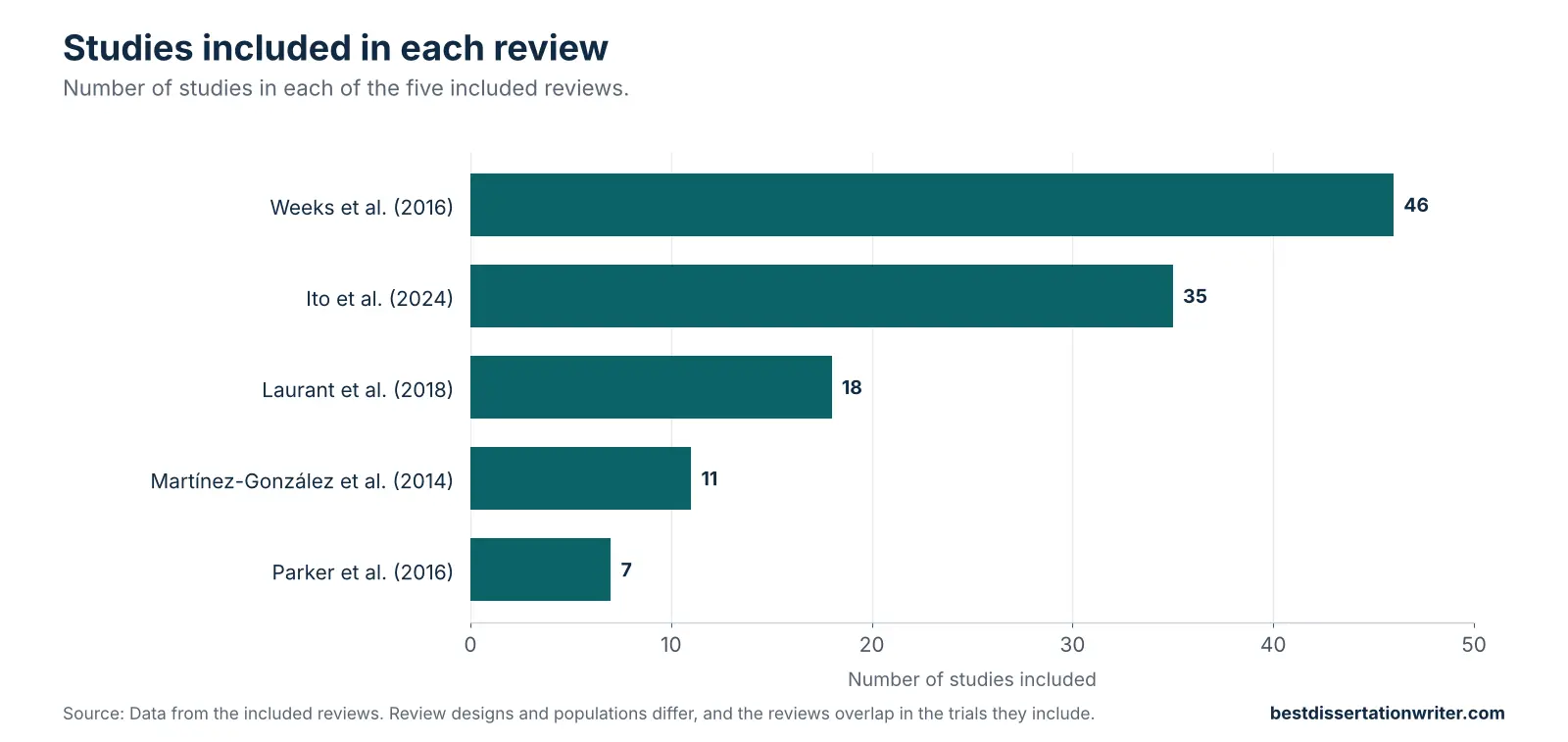
Three themes were identified: overall outcomes of nurse-led care, outcomes for specific conditions, and safety and limits of the evidence. Table 1 summarises the included sources, and Figure 1 shows the number of studies in each review.
| Author, year | Design | Setting and sample | Key finding |
|---|---|---|---|
| Ito et al. (2024) | Systematic review and meta-analysis | 35 trials of nurse-led hypertension interventions | Improved long-term blood pressure control (risk ratio 1.10); no short-term difference. |
| Laurant et al. (2018) | Cochrane review | 18 randomised trials of nurses as substitutes for doctors | Satisfaction and blood pressure probably slightly better; other outcomes similar. |
| Martínez-González et al. (2014) | Systematic review and meta-analysis | 11 trials; 30,247 participants | Systolic blood pressure 4.27 mmHg lower; no difference in HbA1c or cholesterol. |
| Parker et al. (2016) | Systematic review | 7 studies of practice nurse management of type 2 diabetes | Modest improvements in blood pressure and cholesterol; HbA1c improved in poor control. |
| Weeks et al. (2016) | Cochrane review | 46 studies of non-medical prescribing | Comparable outcomes for diabetes, blood pressure and cholesterol. |
Theme 1: Overall Outcomes of Nurse-Led Primary Care
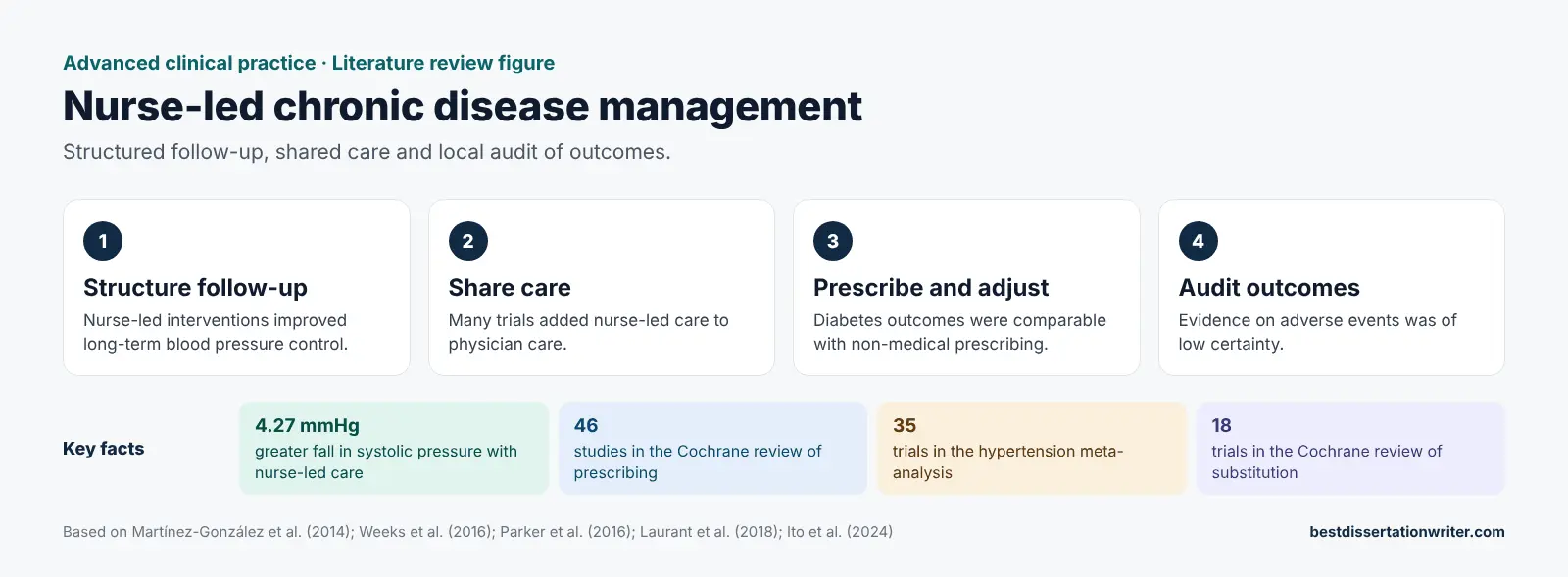
Laurant et al. (2018) carried out a Cochrane review of nurses as substitutes for doctors in primary care. It included 18 randomised trials, mostly from high-income countries. Patient satisfaction was probably slightly higher with nurse-led care (moderate certainty), and blood pressure was probably slightly improved (moderate certainty). Other clinical and health status outcomes were probably similar (moderate certainty), and quality of life may have been slightly higher (low certainty).
The authors concluded that, for some ongoing and urgent physical complaints and chronic conditions, trained nurses probably achieve equal or better health outcomes than primary care doctors. Consultations were probably longer, and attended return visits probably slightly more frequent. The effect on mortality was uncertain, with low-certainty evidence that nurse-led care may lead to slightly fewer deaths in certain groups. The effects on process of care and on costs were uncertain because the evidence was of very low certainty.
Weeks et al. (2016) carried out a Cochrane review of non-medical prescribing versus medical prescribing for acute and chronic disease management in primary and secondary care. They included 46 studies, 42 of them in community settings. Outcomes were comparable for diabetes control (high certainty), blood pressure (moderate certainty), cholesterol (moderate certainty), adherence (moderate certainty), satisfaction (moderate certainty) and quality of life (moderate certainty). Adverse events were comparable, but the evidence was of low certainty.
Taken together, these two Cochrane reviews suggest that nurse-led and non-medical-prescriber-led care achieve outcomes comparable to those of doctors for long-term conditions, with some evidence of slightly better blood pressure control and satisfaction. The authors of both noted that non-medical prescribers often had medical support available, and that results should not be assumed to apply without it.
Theme 2: Outcomes for Specific Conditions
Martínez-González et al. (2014) carried out a systematic review and meta-analysis of randomised trials comparing nurse-led and physician-led primary care on clinical parameters. They searched four databases to August 2012 and included 11 trials with 30,247 participants, mostly from Europe, generally small and at higher risk of bias. Systolic blood pressure fell more with nurse-led care (weighted mean difference −4.27 mmHg, 95% confidence interval −6.31 to −2.23).
Diastolic blood pressure, total cholesterol and HbA1c showed no significant differences between groups. For 32 other clinical parameters, fewer than a fifth favoured nurse-led care and 25 showed no significant difference. The authors concluded that nurses appeared better at lowering systolic blood pressure and similar for the other three measures, and that there was insufficient evidence that nurse-led care produced better outcomes for the other parameters.
Parker et al. (2016) carried out a systematic review, using Joanna Briggs Institute methods, of practice nurse involvement in the management of adults with type 2 diabetes attending general practice. Seven studies met the criteria: three randomised trials, two cluster randomised trials, one cluster non-randomised controlled before-and-after study and one cluster observational cohort study. Nurse management added to standard care produced modest but significant improvements in systolic and diastolic blood pressure and total cholesterol.
Most other outcomes showed no advantage over standard general practitioner care, although two studies found significant HbA1c improvements in patients with poor glycaemic control. The authors recommended a randomised trial of nurse management in patients with poor control, with attention to clinical outcomes and cost-effectiveness. This review concerned practice nurses and not nurse practitioners, so its relevance to advanced practice is indirect.
Ito et al. (2024) carried out a systematic review and meta-analysis of randomised trials of community-based nurse-led interventions added to physician care for adults with hypertension, compared with usual care alone. They included 35 trials, with searches to March 2021 and an update in October 2023. Nurse-led interventions improved long-term blood pressure control (risk ratio 1.10, 95% confidence interval 1.03 to 1.18), whereas there was no significant difference in the short term.
Theme 3: Safety and Limits of the Evidence
Safety is less well studied than effectiveness. Ito et al. (2024) reported that little information on serious adverse events was available and that mortality did not differ between groups at either time point. Weeks et al. (2016) rated the evidence on adverse events as low certainty. Laurant et al. (2018) found low-certainty evidence on mortality. Taken together, the sources show no signal of harm, but they do not provide the large-scale data that would exclude small differences in rare events.
The quality of the trials is a further limit. Martínez-González et al. (2014) noted that trials were small, that attrition was often high and that interventions were disease-specific and came from a small number of health systems. Ito et al. (2024) noted that the appropriate blood pressure target could not be established from the included trials. Nurse-led interventions in these trials were often added to physician care, so they show the value of collaboration as much as of nurse-led care alone.
These points matter for advanced practitioners. The evidence supports an active role in chronic disease management, particularly for blood pressure and for structured follow-up, but it also suggests that care works best as a collaboration with medical colleagues and with access to prescribing, protocols and referral. Practitioners who manage long-term conditions should therefore monitor their own outcomes and maintain links with the wider team.
For patients, the practical meaning of the evidence is reassuring but not complete. A patient with hypertension or diabetes who is followed up by a nurse practitioner can expect outcomes that are at least similar to those from a doctor, and may notice longer consultations and more time for explanation. Patients are entitled to know the practitioner’s role and how to reach a doctor if needed, so that chronic disease management is transparent as well as effective.
For advanced practitioners, the findings suggest a focus on the fundamentals: accurate measurement, timely adjustment of treatment, support for self-management and reliable follow-up. These are the elements that nurse-led clinics in the trials had in common. Auditing the proportion of patients who reach agreed targets, and the time taken to act when they do not, is a straightforward way for a service to check that these fundamentals are in place.
Discussion
This systematic review suggests that nurse-led chronic disease management in primary care achieves outcomes at least comparable to usual care, with modest benefits for blood pressure and probably higher patient satisfaction. For diabetes and cholesterol, outcomes are generally similar, with possible benefits in patients with poor control.
The evidence base has limits. Many of the trials are small, with high attrition and risk of bias, and interventions are often disease-specific. Evidence on adverse events, mortality and costs is of low or very low certainty. The reviews overlap in the trials they include, so their agreement should not be taken as independent confirmation, and most evidence comes from high-income countries.
Other limitations should be noted. Only one of the sources, Parker et al., concerned practice nurses, and the others covered nurses in a variety of roles, so findings may not apply to advanced practitioners with different levels of autonomy. The sources do not test education requirements, and the Cochrane review noted that the level of nursing education that gives the best outcomes could not be determined. This review relied on openly accessible, English-language sources.
Even so, the sources are consistent. Nurses who are trained and supported achieve outcomes equal to or modestly better than doctors in the management of long-term conditions, and benefits are most consistent for blood pressure. Services can use this evidence to design clinics, to define the role of advanced practitioners and to plan for monitoring of outcomes.
Implications of Chronic Disease Management Evidence for Practice
For practice, the evidence supports a structured role for nurses in chronic disease management, with protocols, access to prescribing and referral routes, regular review of outcomes and collaboration with medical colleagues. Guidance is available from the National Institute for Health and Care Excellence, NHS England and the Royal College of Nursing.
Managers should provide protected time for clinics, access to education and supervision, and systems for audit of blood pressure, glycaemic control and other outcomes. They should also consider how care is shared with doctors and pharmacists, since several sources showed benefits when nurse-led care was added to existing care.
Future research should include larger, better-designed trials of nurse practitioner-led care for multimorbidity, measure adverse events and costs, examine the education needed for different levels of autonomy and include patient-reported outcomes. Studies in United Kingdom primary care would be particularly valuable.
A further consideration is workload. Chronic disease management generates a steady flow of review appointments, and a service that adds nurse-led clinics should plan how many patients each practitioner can follow up safely, how results will be acted on and how patients with changing needs will move between practitioners. The sources do not address caseload size, which is a gap for services planning to expand the role.
Conclusion
This systematic review found that nurse-led chronic disease management achieves outcomes equal to or modestly better than usual care, particularly for blood pressure, and that evidence on safety and costs is limited.
Advanced clinical practitioners can contribute by providing structured follow-up, working with colleagues and auditing their own outcomes.
References
Ito, M., Tajika, A., Toyomoto, R., Imai, H., Sakata, M., Honda, Y., Kishimoto, S., Fukuda, M., Horinouchi, N., Sahker, E., & Furukawa, T. A. (2024). The short and long-term efficacy of nurse-led interventions for improving blood pressure control in people with hypertension in primary care settings: A systematic review and meta-analysis. BMC Primary Care, 25, Article 143. https://doi.org/10.1186/s12875-024-02380-x
Laurant, M., van der Biezen, M., Wijers, N., Watananirun, K., Kontopantelis, E., & van Vught, A. J. A. H. (2018). Nurses as substitutes for doctors in primary care. Cochrane Database of Systematic Reviews, (7), Article CD001271. https://doi.org/10.1002/14651858.CD001271.pub3
Martínez-González, N. A., Tandjung, R., Djalali, S., Huber-Geismann, F., Markun, S., & Rosemann, T. (2014). Effects of physician-nurse substitution on clinical parameters: A systematic review and meta-analysis. PLOS ONE, 9(2), Article e89181. https://doi.org/10.1371/journal.pone.0089181
Parker, D., Maresco-Pennisi, D., Clifton, K., Shams, R., & Young, J. (2016). Practice nurse involvement in the management of adults with type 2 diabetes mellitus attending a general practice: Results from a systematic review. International Journal of Evidence-Based Healthcare, 14(2), 41–52. https://doi.org/10.1097/XEB.0000000000000080
Weeks, G., George, J., Maclure, K., & Stewart, D. (2016). Non-medical prescribing versus medical prescribing for acute and chronic disease management in primary and secondary care. Cochrane Database of Systematic Reviews, (11), Article CD011227. https://doi.org/10.1002/14651858.CD011227.pub2
Cite this example
Best Dissertation Writers (2026) Nurse Practitioner-Led Chronic Disease Management in Primary Care: A Systematic Review. Available at: https://bestdissertationwriter.com/chronic-disease-management-review/
Best Dissertation Writers
Get expert help with your nursing literature review
Share your topic and deadline with Best Dissertation Writers and get support tailored to your module brief.