Diagnostic Accuracy and Clinical Decision-Making of Nurse Practitioners: A Narrative Review
 By Dr. Robertson Prime, Research Fellow
Updated November 2, 2026
14 min read
About 2,800 words
In this review
Abstract
Background: Diagnosis is central to the work of advanced practitioners, and errors in diagnosis can cause serious harm. Diagnostic accuracy and the quality of clinical decision-making among nurse practitioners and other advanced nursing roles are therefore important to patient safety and to confidence in the roles.
Aim: This narrative review aimed to examine recent and older evidence on the diagnostic accuracy and clinical decision-making of nurse practitioners and nurses in related roles, and to consider implications for advanced clinical practice.
Methods: Evidence was identified through targeted searches of openly accessible bibliographic records, publisher websites and repositories. Five sources published between 2010 and 2026 were selected: a descriptive cohort study, a retrospective comparison, an observational study of electrocardiogram interpretation, a cross-sectional analysis of emergency care and a systematic review. The relevance and quality of each source was considered critically, and findings were synthesised narratively.
Findings: A cohort study of 1,482 patients found that missed injuries or inappropriate management occurred in 2.7% of emergency nurse practitioner patients and 1.2% of junior doctor patients, a non-significant difference. A study of paediatric abdominal pain reported accuracy of 90.9% for nurse practitioners and physician assistants and 94.9% for physicians. Triage nurses showed an electrocardiogram interpretation error rate of about 11%, and a review of 22 studies found insufficient electrocardiogram competency in safety-critical areas.
Conclusion: Diagnostic accuracy in advanced nursing roles is generally high for defined presentations but depends on education, case complexity and supervision. Evidence is limited, and few studies compare advanced practitioners directly with physicians.
Keywords: diagnostic accuracy, decision-making, clinical judgement
Introduction
This narrative review critically examines recent evidence on diagnostic accuracy and its implications for advanced clinical practice.
Diagnosis is the foundation of treatment. A practitioner who arrives at the wrong diagnosis may order unnecessary tests, give inappropriate treatment or miss a serious condition. As advanced practitioners now assess and diagnose patients who have not been seen by a doctor, the accuracy of their diagnoses is a matter of direct importance for patient safety.
Diagnostic accuracy can be studied in several ways. It may mean how often a diagnosis agrees with that of an expert reference, how often injuries or serious conditions are missed, or how well a practitioner interprets a test such as an electrocardiogram or a radiograph. These are different questions, and the answers depend on the conditions studied and the setting.
Clinical decision-making is broader. It includes the choice of tests, treatments and referral, and the use of resources. This narrative review asks: what does the available evidence say about the diagnostic accuracy and clinical decision-making of nurse practitioners and nurses in related roles, what factors influence them and what does the evidence imply for advanced clinical practice? A narrative approach was chosen because the sources are varied in design and cannot be pooled.
Background to Diagnostic Accuracy in Advanced Clinical Practice
Advanced practitioners reach diagnoses through reasoning that combines knowledge, pattern recognition and deliberate analysis. These processes are the subject of the review of clinical reasoning skills, and they underpin the accuracy considered here. Accuracy is also shaped by the setting, because patients in emergency departments and urgent care may present with undifferentiated symptoms and limited prior information.
Diagnosis is rarely the work of one person. Practitioners consult colleagues, refer patients and rely on laboratory and imaging services. The way teams work together, including how disagreements are handled, is explored in the review of interprofessional collaboration. Studies that compare individual practitioners therefore capture only part of how diagnosis happens in practice.
The patient’s perspective also matters. People who are told their diagnosis want it to be correct, but they also want it explained, and their confidence in the practitioner affects whether they follow advice. This is considered further in the review of patient satisfaction. The present review focuses on accuracy and decision-making and refers to patient experience only where the sources do so.
Errors in diagnosis are not always visible. A diagnosis may be wrong without immediate consequence, and the patient may recover by chance or seek care elsewhere. Studies therefore tend to measure what can be counted, such as missed fractures or disagreements with an expert reviewer. These are valid indicators, but they capture only part of the problem, and the reader should keep in mind that the true extent of diagnostic error is hard to measure.
Search Strategy and Methods
Evidence for this example was identified through targeted searches of openly accessible bibliographic records, publisher websites and repositories. Search terms combined keywords for the practitioners (“nurse practitioner”, “emergency nurse practitioner”, “advanced practice”, “triage nurse”) with terms for the topic (“diagnostic accuracy”, “diagnostic error”, “clinical decision-making”, “missed injuries”, “electrocardiogram interpretation”), joined with the Boolean operators AND and OR. A full narrative review would document searches in CINAHL, MEDLINE and Scopus.
Sources were selected if they reported the accuracy of diagnosis, interpretation of a diagnostic test, or decision-making outcomes of nurses in advanced, extended or triage roles, and if an abstract was accessible. Because studies directly comparing nurse practitioners with physicians are few, sources on closely related nursing roles were also considered, and their relevance was weighed accordingly.
Five sources published between 2010 and 2026 were selected (Table 1). The relevance and quality of each source was considered critically, and findings were synthesised narratively under themes. The sources differ widely in design, so no attempt was made to combine them statistically.
Key Findings on Diagnostic Accuracy
Three themes were identified: diagnostic accuracy compared with physicians, interpretation of diagnostic tests, and decision-making and resource use. Table 1 summarises the sources, and Figure 1 shows the error rates reported in two of the studies.
| Author, year | Design | Setting and sample | Key finding |
|---|---|---|---|
| Alwahsh and Hasanien (2026) | Systematic review | 22 studies of nurse ECG interpretation and computerised analysis | Mean scores 43% to 68%; computerised systems accurate but need oversight. |
| Hoyt et al. (2022) | Retrospective study | Paediatric abdominal pain, four hospital sites | Accuracy 90.9% for NPs/PAs, 94.9% for physicians, 96.5% for combined team. |
| Tseng et al. (2022) | Cross-sectional analysis | Emergency visits, 2009 to 2017 | NPs/PAs alone used less care and less low-value imaging. |
| van der Linden et al. (2010) | Descriptive cohort study | 741 ENP patients and 741 junior doctor patients | Errors 2.7% and 1.2%; not significantly different. |
| Zaboli et al. (2023) | Observational study | 20 triage nurses, 644 patients | About 11% ECG interpretation error; education reduced errors. |
Theme 1: Diagnostic Accuracy Compared with Physicians
van der Linden et al. (2010) carried out a descriptive cohort study of the diagnostic accuracy of emergency nurse practitioners versus physicians in patients with minor illnesses and injuries. They compared 741 patients treated by emergency nurse practitioners with a random sample of 741 patients treated by junior doctors. Overall, 29 patients (1.9%) had a missed injury or inappropriate management.
Junior doctors had nine such errors (1.2%) and emergency nurse practitioners had 20 (2.7%), a difference that was not statistically significant. Misreading radiographs was the most common cause of missed injuries, accounting for 13 of 17. Waiting times were similar, at about 20 minutes for doctors and 19 for nurse practitioners, and average length of stay was shorter for nurse practitioners, at 65 minutes compared with 85. The authors concluded that about 97.3% of patients were correctly diagnosed and managed.
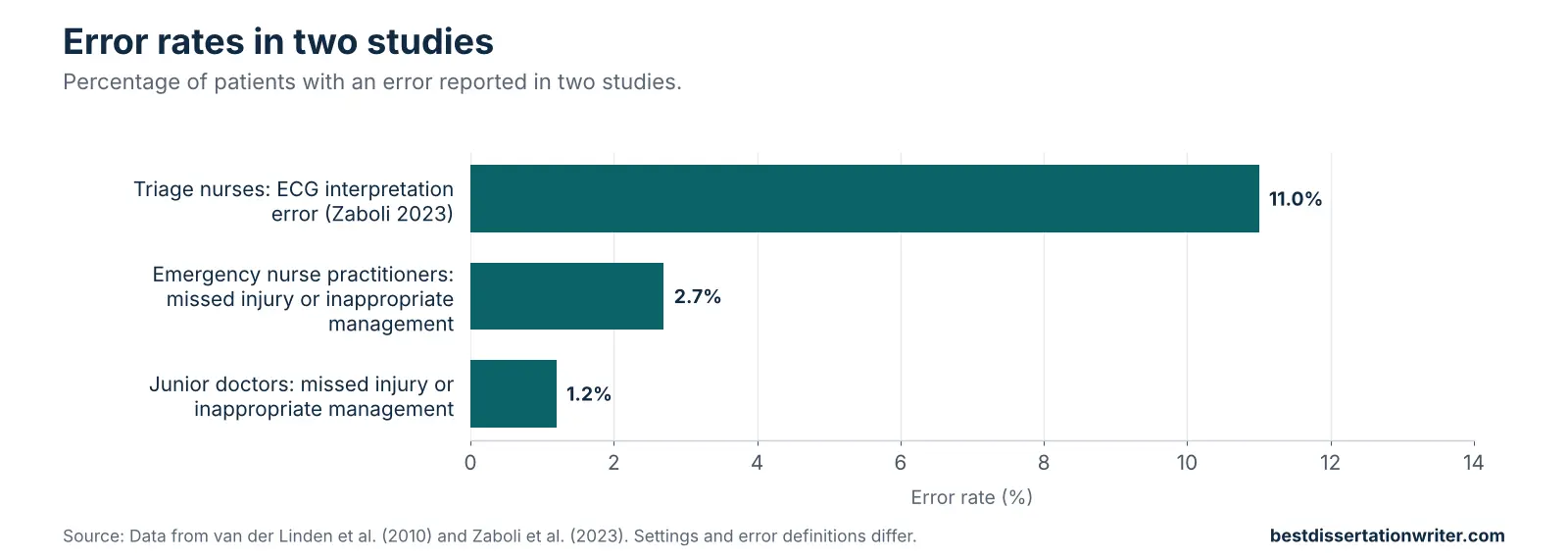
These figures should be read with care. The comparison was a descriptive cohort study and not a randomised trial, and the difference in errors, although not statistically significant, was in the direction of more errors among nurse practitioners. The finding that radiograph interpretation was the main cause of error is important, because it points to a specific area for education.
Hoyt et al. (2022) carried out a retrospective study comparing nurse practitioners and physician assistants with physicians in diagnosing paediatric abdominal pain in children triaged as Emergency Severity Index level 3 in four hospital sites. Diagnostic accuracy was reported as 94.9% for physicians, 90.9% for nurse practitioners and physician assistants, and 96.5% for a combined team, a statistically significant difference. In a subset of 43 cases used for the provider comparison, no significant difference was found.
The authors reported that the disparity in accuracy appeared only for pelvic and genitourinary pain. The study grouped nurse practitioners with physician assistants and was limited to one presentation, so it cannot be taken as a general measure of nurse practitioner diagnostic accuracy. It does show, however, that accuracy can vary by type of presentation and that combined teams performed best.
Theme 2: Interpretation of Diagnostic Tests
Zaboli et al. (2023) carried out a prospective, single-centre observational study of the ability of triage nurses to interpret electrocardiograms in practice. Twenty triage nurses and 644 patients evaluated for cardiovascular symptoms were included. According to the emergency physician, 21.6% of electrocardiograms were pathological. Agreement between nurses and physicians gave a Cohen’s kappa of 0.666, and about 11% of patients had an interpretation error.
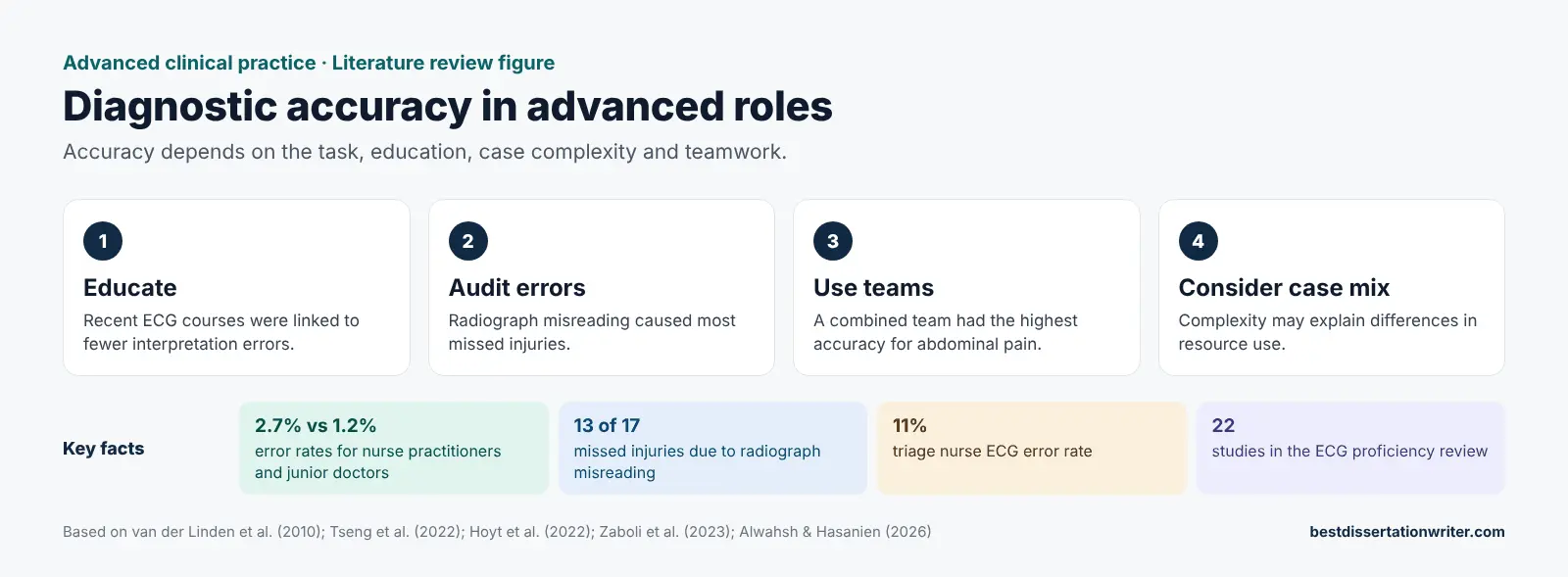
Nurses who had completed an electrocardiogram course within the past year and who studied interpretation independently had lower error rates, and older patients and those with more prior cardiovascular disease were more likely to have an interpretation error. The authors concluded that triage nurses have a fair ability to interpret the electrocardiogram and suggested that specific education could improve it. These were triage nurses and not advanced practitioners, so the findings are indirect, but they show how education and case complexity relate to accuracy.
Alwahsh and Hasanien (2026) carried out a systematic review of the proficiency of emergency and critical care nurses in electrocardiogram interpretation and of computerised interpretation. They searched for studies published from January 2020 to October 2025 and included 22, of which 16 examined nurse interpretation. Mean interpretation scores ranged from 43% to 68%, and fewer than 40% of participants met predefined competency thresholds. Nurses performed best at recognising asystole and worst at tachyarrhythmias, myocardial ischaemia and conduction abnormalities.
The review also found that computerised and artificial intelligence-based systems showed high diagnostic accuracy, and concluded that they may be useful complementary tools only alongside ongoing nurse education and clinical oversight. In the version read for this review, some counts did not fully reconcile, so the headline figures should be treated with caution until checked against the full text.
Theme 3: Decision-Making and Resource Use
Tseng et al. (2022) carried out a cross-sectional analysis of United States emergency care using national survey data from 2009 to 2017. The sample included 12,410 visits with nurse practitioners or physician assistants alone, 21,560 with a nurse practitioner or physician assistant together with a physician and 143,687 with physicians alone, before weighting.
After weighting, nurse practitioners and physician assistants working alone used less care than physicians alone, including fewer medications, diagnostic tests, procedures, hospitalisations and low-value computed tomography or magnetic resonance imaging. The combined team used more of each. The authors suggested that practitioners who see more complex patients may use more services, and that the pattern could reverse for simpler cases.
This is a different kind of evidence from the studies of accuracy. It shows that decision-making patterns differ, but it cannot show whether using fewer services was more or less appropriate, since the study did not measure outcomes. It does, however, suggest that case mix is an important influence on comparisons between professions.
Taken together, the three themes show that accuracy, test interpretation and decision-making are linked. A practitioner who misreads a radiograph may also make an inappropriate decision about treatment, and one who is uncertain about an electrocardiogram may order further tests. The studies measured these outcomes separately, and an integrated view, in which decisions are followed from the first assessment to the final outcome, is largely missing from the evidence.
Critical Discussion
The sources suggest that diagnostic accuracy in advanced nursing roles is high for defined presentations such as minor injuries, but that it varies with the type of presentation, the interpretation of tests and the education of the practitioner. Where differences between nurses and physicians were reported, they were small or not statistically significant, although in the study of minor injuries the numerically higher error rate was among nurse practitioners.
Before turning to patterns across the sources, it is worth reflecting on what comparison with physicians means. Junior doctors, senior house officers and consultants differ widely in experience, and a nurse practitioner may be compared with a trainee who is still learning. In the cohort study of minor injuries, the comparison was with junior doctors, so the results say something about how nurse practitioners perform relative to a particular group, and not relative to all doctors.
Several patterns recur. Radiograph and electrocardiogram interpretation were the main sources of error in the studies that examined them. Education improved performance in the electrocardiogram study. Combined teams performed best in the paediatric abdominal pain study. Together, these patterns suggest that accuracy is not simply a property of the profession, but of training, task and team.
The studies also raise a question about learning from error. In the cohort of minor injuries, missed injuries were mostly caused by misreading radiographs, and in the study of electrocardiograms, performance improved with recent training. These findings suggest that errors are often predictable and therefore preventable. A service that reviews its own errors, shares them with practitioners and offers targeted teaching is more likely to reduce them than one that relies on the experience of practitioners alone.
Limitations should be noted. This review relied on openly accessible, English-language sources and included only five. Several concern nurses or practitioner groups other than advanced practitioners in United Kingdom services, and only one study compares emergency nurse practitioners directly with junior doctors, in a paper published more than a decade ago. The studies were observational, mostly single-centre, and did not measure long-term patient outcomes, so a lower or higher error rate cannot be linked directly to harm.
A further difficulty is that diagnostic accuracy is hard to define for the conditions that nurse practitioners most often see. Many minor illnesses do not have a confirmed diagnosis, and the reference standard used in studies, often a senior clinician’s opinion, is itself imperfect. This means that studies of diagnostic accuracy should be interpreted as measures of agreement with an expert, and not as measures of truth.
Implications of Diagnostic Accuracy Evidence for Practice
For practice, the evidence supports focused education in the interpretation of radiographs and electrocardiograms, audit of missed injuries and diagnostic errors, access to senior review and the use of teams for complex presentations. Services should monitor accuracy locally and should encourage a culture in which errors are discussed and learned from. Guidance is available from the NHS England Centre for Advancing Practice, the Nursing and Midwifery Council and the Royal College of Nursing.
Educators can use the evidence to plan practical teaching in diagnostic skills. Case-based sessions using real radiographs and electrocardiograms, with feedback on errors, would address the areas of weakness reported in the sources. Assessment should include the interpretation of tests as well as history taking, and should be repeated through a practitioner’s career, since the electrocardiogram study suggests that recent training matters.
Managers can use the findings to design safety systems. Examples include double-reading of radiographs, a system for recalling patients when a report differs from the original interpretation, and agreed criteria for seeking senior review. Services should also record the outcomes of patients seen by advanced practitioners, so that accuracy and decision-making can be monitored over time in their own population.
Future research should include studies of nurse practitioner diagnostic accuracy in current services, including in primary care, evaluation of education in test interpretation, studies of how artificial intelligence tools can support interpretation, and linkage of diagnostic accuracy to patient outcomes.
Conclusion
This narrative review found that diagnostic accuracy in advanced nursing roles is generally high for defined presentations, but that it depends on education, case complexity and supervision, and that direct comparative evidence for advanced practitioners is limited.
Advanced clinical practitioners can maintain and demonstrate accuracy through education in test interpretation, audit and access to senior review.
References
Alwahsh, A. H., & Hasanien, A. A. (2026). Assessing the proficiency of emergency and critical care nurses in electrocardiogram interpretation and the integration of computerized electrocardiogram analysis: Benefits and limitations: A systematic review. Korean Journal of Adult Nursing, 38(2), 139–154. https://doi.org/10.7475/kjan.2025.1125
Hoyt, K. S., Agan, D. L., Jordan, K. S., Ramirez, E., Nichols, S., & Topp, R. (2022). Comparing nurse practitioners/physician assistants and physicians in diagnosing pediatric abdominal pain for ESI level 3 patients seen in the emergency department. Journal of the American Association of Nurse Practitioners, 34(2), 270–274. https://doi.org/10.1097/jxx.0000000000000609
Tseng, C.-H., Ladapo, J. A., Smulowitz, P., Landon, B. E., Guo, R., Mafi, J. N., Chen, A., & Choi, K. (2022). US emergency care patterns among nurse practitioners and physician assistants compared with physicians: A cross-sectional analysis. BMJ Open, 12(4). https://doi.org/10.1136/bmjopen-2021-055138
van der Linden, C., Reijnen, R., & De Vos, R. (2010). Diagnostic accuracy of emergency nurse practitioners versus physicians related to minor illnesses and injuries. Journal of Emergency Nursing, 36(4), 311–316. https://doi.org/10.1016/j.jen.2009.08.012
Zaboli, A., Sibilio, S., Brigo, F., Magnarelli, G., Fanni Canelles, M., Paulmichl, R., Pfeifer, N., & Turcato, G. (2023). The triage nurse’s ability in electrocardiogram interpretation in real clinical practice. Journal of Clinical Nursing, 32(15–16), 4904–4914. https://doi.org/10.1111/jocn.16624
Cite this example
Best Dissertation Writers (2026) Diagnostic Accuracy and Clinical Decision-Making of Nurse Practitioners: A Narrative Review. Available at: https://bestdissertationwriter.com/diagnostic-accuracy-literature-review/
Best Dissertation Writers
Get expert help with your nursing literature review
Share your topic and deadline with Best Dissertation Writers and get support tailored to your module brief.