Advanced Physical Assessment and Clinical Reasoning Skills in Nurse Practitioner Practice: An Integrative Review
 By Dr. Robertson Prime, Research Fellow
Updated November 2, 2026
14 min read
About 2,800 words
In this review
Abstract
Background: Advanced practitioners assess patients, form differential diagnoses and decide on investigations and treatment, often without a doctor’s review. Clinical reasoning skills underpin each step, and weaknesses in them are linked to diagnostic error, so how these skills are defined, taught and developed is central to the safety of advanced clinical practice.
Aim: This integrative review aimed to examine the evidence on clinical reasoning skills in nurse practitioner and advanced practice, including how reasoning is conceptualised, how it differs from medical reasoning and what is known about teaching it.
Methods: Evidence was identified through targeted searches of openly accessible bibliographic records, publisher websites and repositories. Five sources published between 2018 and 2024 were included: two systematic or scoping reviews of the literature, two integrative or literature reviews of teaching, and a literature review proposing a model of diagnostic reasoning. The sources were appraised using CASP checklists and integrated narratively.
Findings: A systematic search of 873 articles, reduced to 27, found three theories of clinical reasoning but no clear, consistent definition. An integrative review of 18 studies identified five educational themes for teaching diagnostic reasoning: testing strategies, cognitive biases, simulation, course formats and instructional approaches. A scoping review retrieved 1,115 articles and included 41, of which ten referred directly to the science of diagnostic reasoning. A systematic integrative review of 69 articles found that nursing and medical reasoning differ mainly in philosophy and intent. A literature review of 41 sources proposed a metacognitive model for advanced practice nurses.
Conclusion: Clinical reasoning skills are central to advanced practice, but the literature lacks shared definitions and robust evidence on teaching. Educators and services should adopt explicit reasoning frameworks, use simulation and reflection and evaluate their effect on diagnostic accuracy.
Keywords: clinical reasoning skills, advanced assessment, physical examination
Introduction
This integrative review critically examines recent evidence on clinical reasoning skills and its implications for advanced clinical practice.
When a patient with chest discomfort, abdominal pain or a new rash sits in front of an advanced practitioner, a sequence of mental steps begins. The practitioner gathers a history, decides what to examine, interprets the findings, weighs possible diagnoses, chooses tests and plans treatment, adjusting the plan as new information arrives. This process is usually described as clinical reasoning, and it is one of the defining abilities of advanced practice.
Clinical reasoning is difficult to see, because much of it takes place in the practitioner’s mind. It draws on knowledge, experience, pattern recognition and deliberate analysis, and it is influenced by context, time pressure and patients’ own accounts. Errors in reasoning, such as settling too early on a diagnosis or failing to consider alternatives, are recognised contributors to diagnostic error, so the skill is closely linked to patient safety.
Advanced physical assessment, the structured examination of body systems that informs reasoning, is a related skill. A practitioner who examines carefully but reasons poorly, or who reasons well from poor data, is likely to reach the wrong conclusion. This integrative review asks: how is clinical reasoning defined and described in nursing, how does it compare with medical reasoning, and what is known about teaching and developing clinical reasoning skills in advanced practice?
Background to Clinical Reasoning Skills in Advanced Clinical Practice
Theories of reasoning describe both fast and slow thinking. Intuitive, pattern-based processing allows experienced clinicians to recognise familiar problems quickly, while analytical processing allows them to consider alternatives when a case is unusual or the stakes are high. Skilled practitioners are thought to move between the two, and to monitor their own thinking, an ability known as metacognition.
Advanced practice roles extend the range of decisions that nurses make. Practitioners may see undifferentiated patients, order and interpret investigations, diagnose and prescribe, and for that reason they need robust clinical reasoning skills. The development of these skills is a core aim of education for nurse practitioners and for advanced clinical practitioners, and it is likely to influence the quality of diagnosis, as discussed in the review of diagnostic accuracy.
The effect of advanced practice on costs and outcomes is explored in the review of cost-effectiveness. If advanced practitioners reason well and make sound decisions, they are more likely to deliver safe and efficient care. If they do not, errors and unnecessary tests may offset the benefits of the role, so it is important to understand how clinical reasoning skills are acquired and supported.
The importance of clinical reasoning skills is also practical. Practitioners who work in primary care, urgent care and emergency settings often see patients with several problems at once, and they must decide which is most urgent, which can wait and which needs referral. Clinical reasoning skills allow them to prioritise, to recognise when a presentation does not fit the expected pattern and to seek help before harm occurs.
Search Strategy and Methods
Evidence for this example was identified through targeted searches of openly accessible bibliographic records, publisher websites and repositories. Search terms combined keywords for the skill (“clinical reasoning”, “diagnostic reasoning”, “clinical decision-making”, “advanced assessment”, “physical examination”) with terms for the population and approach (“nurse practitioner”, “advanced practice”, “education”, “teaching”, “integrative review”), joined with the Boolean operators AND and OR. A full review for assessment would run the same strategy in CINAHL, PubMed/MEDLINE, Embase and ERIC and report how records were screened.
Sources were eligible if they were systematic, scoping, integrative or literature reviews that addressed the conceptualisation, teaching or evaluation of clinical or diagnostic reasoning in nursing, including advanced practice. Single primary studies, opinion pieces and protocols were excluded, and a published protocol for one review was set aside in favour of the completed review.
Five sources published between 2018 and 2024 were included (Table 1). The quality of each source was considered using the Critical Appraisal Skills Programme (CASP) checklists, and findings were integrated narratively under themes.
The findings are presented from the general to the specific. First the evidence on how reasoning is defined and conceptualised is considered, then the evidence on how it compares with medical reasoning, and finally the evidence on teaching and developing it. Because the sources use different designs, the results are described in each source’s own terms and are not combined statistically.
Key Findings on Clinical Reasoning Skills
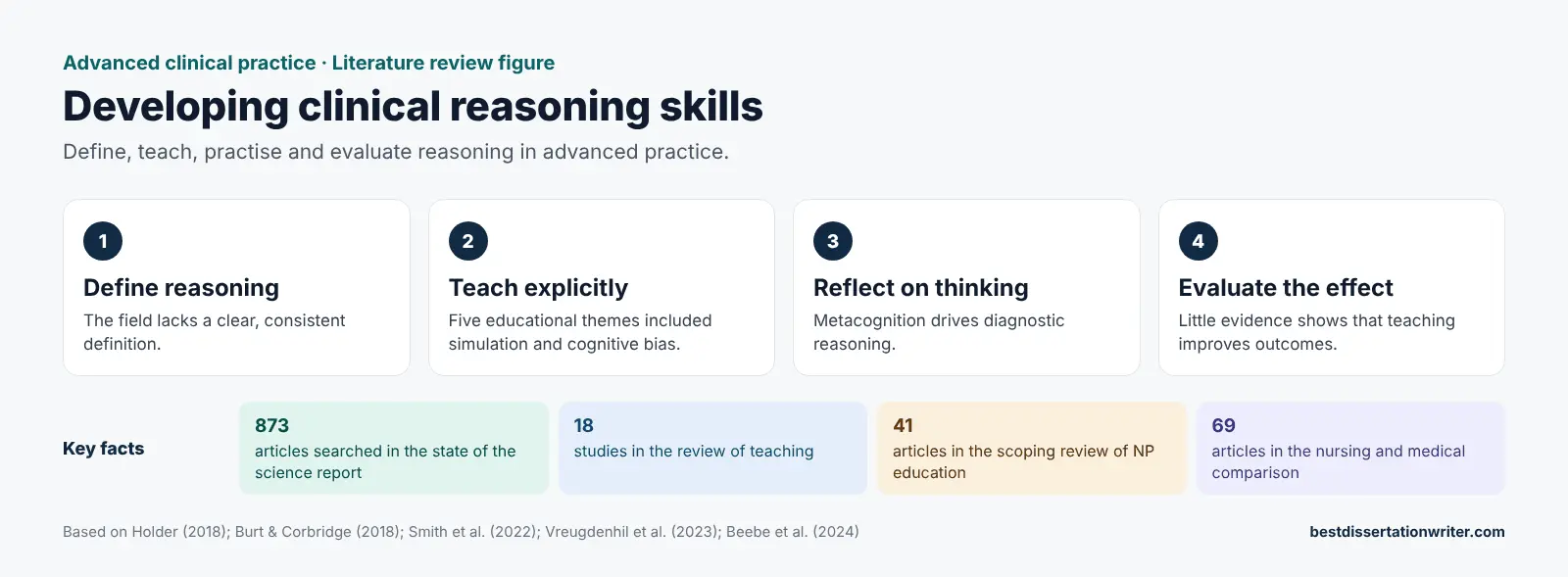
Three themes were identified: defining and modelling clinical reasoning, nursing and medical reasoning compared, and teaching clinical reasoning skills. Table 1 summarises the included sources, and Figure 1 shows the composition of the articles in a systematic integrative review of nursing and medical reasoning.
| Author, year | Design | Setting and sample | Key finding |
|---|---|---|---|
| Beebe et al. (2024) | Literature review | 41 sources on diagnostic reasoning in advanced practice nurses | Metacognitive Diagnostic Reasoning model with three concepts. |
| Burt & Corbridge (2018) | Integrative review | 18 primary sources on teaching diagnostic reasoning | Five educational themes; interventions simple to implement. |
| Holder (2018) | Systematic review | 27 articles from 873 | Three theories; no clear, consistent definition. |
| Smith et al. (2022) | Scoping review | 41 articles from 1,115 on nurse practitioner education | Literature limited; shared conceptualisations lacking. |
| Vreugdenhil et al. (2023) | Systematic integrative review | 69 articles; 27 nursing, 37 medical, 5 both | Differences mainly in philosophy and intent. |
Theme 1: Defining and Modelling Clinical Reasoning
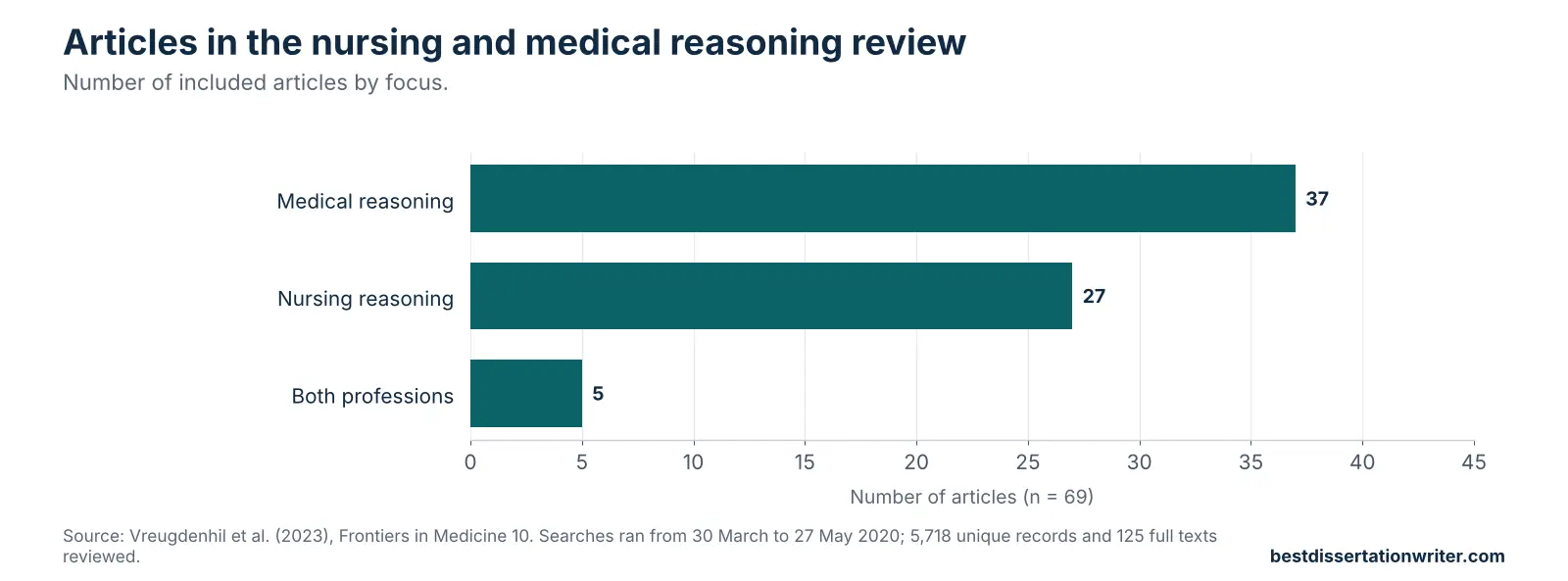
Holder (2018) carried out a systematic review of the literature on clinical reasoning and produced a state of the science report. The author searched five databases, identified 873 articles and, after quality appraisal, retained 27. The report noted that clinical reasoning is a cognitive process in which nurses gather information and combine it with existing knowledge to guide therapeutic action, and that poor use of the process can lead to weak decisions, inappropriate actions or inaction.
The review found that three theories currently describe how to use the clinical reasoning process most effectively, but that the field lacks a clear, consistent definition. The author recommended that future research should define and explain the process, link it to non-clinical reasoning processes and develop measures to develop and assess clinical reasoning. This is a significant finding for advanced practice: educators and employers cannot easily assess a skill that has no agreed definition.
Beebe et al. (2024) carried out a literature review to present a model of diagnostic reasoning factors in advanced practice registered nurses. Systematic database searches, supplemented by historical articles, texts and documents from inception to August 2023, yielded 41 sources. The resulting Metacognitive Diagnostic Reasoning model has three concepts: metacognition drives diagnostic reasoning, dual cognitive processing and knowledge representations are used, and after diagnosis, treatment and evaluation practitioners use metacognition to improve the process for the next encounter.
The authors presented the model as a framework that researchers can develop and test and that faculty can use to teach and evaluate learners. It is a conceptual contribution and has not been tested in the review, so its value rests on future validation. It does, however, address the gap that Holder identified by offering a structured account of reasoning that is specific to advanced practice nurses and that places reflection on the practitioner’s own thinking at its centre.
Theme 2: Nursing and Medical Reasoning Compared
Vreugdenhil et al. (2023) carried out a systematic integrative review of the documented features of clinical reasoning in physicians and nurses. They searched four databases from 30 March to 27 May 2020, identified 5,718 unique records, reviewed 125 full texts and included 69 articles, of which 27 concerned nursing, 37 medicine and five combined both. Data were organised in three layers: philosophy, principles and techniques.
The main differences lay in the philosophy layer, which was positioned on continua between care and cure and between subjective and objective approaches. Four contrasts emerged in principles: breadth of focus, whether the patient is considered alone or together with relatives, hypotheses for explanation compared with understanding, and causal compared with associative argumentation. At the technical level the professions used different concepts of diagnosis and involved patients to different degrees.
The authors concluded that differences between nursing and medical reasoning originate mainly in professional paradigms and intentions, and they presented the review as a first step towards better collaboration, education and research across both professions. For advanced practitioners, who work in the space between the two, the finding suggests that they may bring a broader, person-centred perspective to reasoning, while also needing the hypothesis-driven diagnostic skills that medicine has traditionally emphasised.
This is a conceptual rather than an empirical finding, and it describes the literature and not individual practitioners. It also draws on studies from different countries and periods. Even so, it supports the view that advanced practitioners should not simply copy medical reasoning, but should combine the strengths of each tradition, and it provides language for discussing how they do so with medical colleagues.
Theme 3: Teaching Clinical Reasoning Skills
Burt and Corbridge (2018) carried out an integrative literature review of evidence-based interventions for teaching diagnostic reasoning. Eighteen primary sources met the inclusion criteria, and the interventions fell into five educational themes: testing strategies, cognitive biases, simulation programmes, course formats and instructional approaches. The authors concluded that the interventions were simple and could be implemented in multiple educational settings.
They recommended future research in nurse practitioner student populations, together with the development of validated, easy-to-use measurement tools and more precise concepts of diagnostic reasoning. The review shows that practical methods exist for teaching reasoning, such as raising awareness of cognitive bias and using simulation, but it also confirms that the evidence for their effect on practice is limited.
Smith et al. (2022) carried out a scoping review of diagnostic reasoning as a component of clinical reasoning in United States primary care nurse practitioner education. They retrieved 1,115 articles from four databases for 2005 to 2021, and 41 met the criteria. Most described approaches for teaching clinical or diagnostic reasoning, and ten directly referenced the science and theory of diagnostic reasoning.
The authors identified concepts with global relevance: focused, hypothesis-directed histories and examinations, generating a problem statement, forming a differential diagnosis, appropriate diagnostic testing, determining a working diagnosis and developing evidence-based, patient-centred management plans. They concluded that the literature on diagnostic reasoning in nurse practitioner education is limited, lacks shared conceptualisations and shows little evidence that teaching improves educational outcomes.
Taken together, the sources on teaching suggest that advanced practice education is beginning to address reasoning explicitly, but that the evidence for particular methods is thin. They point to practical steps: teaching the stages of reasoning explicitly, using cases and simulation, drawing attention to cognitive bias and encouraging reflection on the process. Each is plausible, but each needs testing, ideally with measures of diagnostic accuracy and patient outcomes.
A practical consequence of the findings is that clinical reasoning skills should be treated as a competence to be developed throughout a career, and not as something completed at graduation. Early in a role, practitioners may rely on checklists and structured histories; later, they may use pattern recognition more fluently while still needing to pause when a case is unusual. Supervision and feedback help to make this transition safe.
Employers and educators can also help by making reasoning visible. Case-based discussion, audit of diagnostic decisions and review of cases where the diagnosis changed all offer opportunities to examine how conclusions were reached. These approaches are consistent with the metacognitive emphasis in the literature and with the call for better measures, although the included sources do not test them directly.
Discussion
This integrative review suggests that clinical reasoning skills are central to advanced practice, that the field lacks an agreed definition, that nursing and medical reasoning differ in philosophy and emphasis and that teaching is developing but under-evaluated. Several sources call for shared concepts and validated measures.
The evidence base has important limits. The sources are reviews of the literature, and several are conceptual or educational in focus, so none directly measures whether better reasoning leads to better diagnosis or outcomes. Studies are mostly from the United States and other high-income countries, and the review of nurse practitioner education is limited to United States primary care programmes. Evidence on advanced physical examination as a separate skill is limited.
Further limitations should be noted. The sources overlap in the literature they review and differ in the rigour of their methods, and the model proposed by Beebe et al. has not been tested. The number of included studies in the reviews of teaching is small, and the reviews found few controlled evaluations. This review relied on openly accessible, English-language sources, and it did not include primary studies published after the reviews’ search dates.
Even so, the sources are consistent about the need for a shared understanding of reasoning and for evidence on how to develop it. For advanced practitioners, practical steps include reflecting on difficult cases, seeking feedback from supervisors, discussing differential diagnoses with colleagues and using structured frameworks when a case is unclear.
Implications of Clinical Reasoning Skills Evidence for Practice
For practice, the evidence supports explicit teaching of clinical reasoning skills, the use of simulation and case discussion, attention to cognitive bias and regular supervised practice with feedback. Guidance on advanced practice is available from NHS England, the Nursing and Midwifery Council and the Royal College of Nursing.
Educators should use shared language for reasoning, assess it in a structured way and evaluate whether their programmes improve diagnostic accuracy. Services should provide supervision, reflective practice and peer review, so that practitioners can examine their reasoning in complex cases and learn from near misses.
Future research should develop and validate measures of clinical reasoning skills in advanced practice, test teaching interventions in controlled designs, examine the link between reasoning and diagnostic accuracy and compare the reasoning of nurse practitioners, advanced clinical practitioners and doctors in practice. Studies in the United Kingdom would be particularly valuable.
Conclusion
This integrative review found that clinical reasoning skills are central to advanced practice, that definitions and measures are lacking and that evidence on teaching is limited.
Advanced practitioners and educators can strengthen these skills through explicit frameworks, reflection, simulation and supervised practice, and by evaluating the effect on diagnosis.
References
Beebe, S. L., McNelis, A. M., El-Banna, M., & Dreifuerst, K. T. (2024). Reflecting on diagnosis: The Metacognitive Diagnostic Reasoning Model©. Journal of the American Association of Nurse Practitioners, 36(12), 711–718. https://doi.org/10.1097/JXX.0000000000001018
Burt, L., & Corbridge, S. (2018). Teaching diagnostic reasoning: A review of evidence-based interventions. International Journal of Nursing Education Scholarship, 15(1), Article 20180003. https://doi.org/10.1515/ijnes-2018-0003
Holder, A. G. (2018). Clinical reasoning: A state of the science report. International Journal of Nursing Education Scholarship, 15(1), Article 20160024. https://doi.org/10.1515/ijnes-2016-0024
Smith, S. K., Benbenek, M. M., Bakker, C. J., & Bockwoldt, D. (2022). Scoping review: Diagnostic reasoning as a component of clinical reasoning in the U.S. primary care nurse practitioner education. Journal of Advanced Nursing, 78(12), 3869–3896. https://doi.org/10.1111/jan.15414
Vreugdenhil, J., Somra, S., Ket, H., Custers, E. J. F. M., Reinders, M. E., Dobber, J., & Kusurkar, R. A. (2023). Reasoning like a doctor or like a nurse? A systematic integrative review. Frontiers in Medicine, 10, Article 1017783. https://doi.org/10.3389/fmed.2023.1017783
Cite this example
Best Dissertation Writers (2026) Advanced Physical Assessment and Clinical Reasoning Skills in Nurse Practitioner Practice: An Integrative Review. Available at: https://bestdissertationwriter.com/clinical-reasoning-skills-review-review/
Best Dissertation Writers
Get expert help with your nursing literature review
Share your topic and deadline with Best Dissertation Writers and get support tailored to your module brief.