
Antimicrobial Stewardship and the Role of Advanced Practice Nurses: A Scoping Review
 By Dr. Robertson Prime, Research Fellow
Updated November 2, 2026
15 min read
About 3,000 words
In this review
Abstract
Background: Antimicrobial resistance is a major global health threat, and antibiotics are among the most commonly prescribed medicines in primary care and urgent care. Advanced practice nurses prescribe, assess infections and educate patients, so they have a direct influence on antibiotic use and a clear role in antimicrobial stewardship.
Aim: This scoping review aimed to map the evidence on antimicrobial stewardship and the role of nurses, including advanced practice nurses, with attention to prescribing, competencies, education and the settings in which antibiotics are prescribed.
Methods: Evidence was identified through targeted searches of openly accessible bibliographic records, publisher websites and repositories. Five sources published between 2021 and 2025 were included: three scoping reviews and an integrative review of nurses’ roles, and a mixed-methods study of nurse practitioners. Findings were charted and summarised descriptively under themes.
Findings: An integrative review of 52 papers found that formally including nurses in stewardship was associated with better knowledge and confidence and, in some studies, better patient outcomes. A scoping review of 43 sources found little research on best practice for intravenous antibiotics. A scoping review of 41 studies mapped eight competency domains for bedside nurses. A mixed-methods study found that nurse practitioner antibiotic prescribing for upper respiratory illnesses declined over three years in one facility. A scoping review of 28 studies of out-of-hours prescribing found that variation in service models made comparison difficult.
Conclusion: Nurses have a significant but under-recognised influence on antibiotic use, and advanced practice nurses can contribute through prescribing decisions and patient education. Evidence on advanced practice is limited, so roles, education and governance should be defined and evaluated.
Keywords: antimicrobial stewardship, antibiotic prescribing, antimicrobial resistance
Introduction
This scoping review critically examines recent evidence on antimicrobial stewardship and its implications for advanced clinical practice.
Antibiotics have transformed medicine, but their value is being eroded by bacteria that no longer respond to them. Every course of antibiotics contributes to the selective pressure that produces resistant organisms, so unnecessary or poorly chosen prescriptions carry a cost for the whole community. Antimicrobial stewardship is the term used for coordinated efforts to ensure that antibiotics are used only when needed, in the right dose, by the right route and for the right length of time.
Stewardship is often described as the work of doctors, pharmacists and infection specialists. Yet nurses are present at nearly every point in the antibiotic pathway. They assess patients, recognise signs of infection, take cultures, prepare and administer intravenous antibiotics, monitor response and advise patients about taking medicines correctly. Advanced practice nurses go further, diagnosing infections and prescribing antibiotics in primary care, urgent care and other settings.
This makes advanced practitioners important stewards. A decision to prescribe or to withhold an antibiotic, a conversation that explains why antibiotics will not help a viral illness and a plan for safety-netting all influence how antibiotics are used. This scoping review asks: what is known about the role of nurses, including advanced practice nurses, in antimicrobial stewardship, what competencies and education are described and where are the gaps in the evidence?
Background to Antimicrobial Stewardship in Advanced Clinical Practice
Stewardship programmes typically combine guidelines, education, audit and feedback, restrictions on certain antibiotics and review of treatment after a few days. They are most successful when everyone involved in prescribing and administering antibiotics understands and supports them. Nurses’ involvement has historically been informal, and one of the questions this review explores is how far their role has been defined and recognised.
Prescribing authority matters. As described in the review of non-medical prescribing, nurses in many countries can prescribe independently, and the quality of their prescribing is a stewardship issue. The governance that surrounds prescribing, including guidelines, audit and clinical supervision, is discussed in the review of clinical governance, and the frameworks that define the competencies of advanced practice are the subject of the review of competency frameworks.
Settings also matter. Antibiotics are prescribed in hospitals, in general practice, in urgent care and in out-of-hours services, and the pressures differ. In an out-of-hours service, for example, practitioners may see patients they do not know, have limited access to results and face expectations from patients who are unwell and anxious. These conditions make stewardship particularly challenging.
For advanced clinical practice, antimicrobial stewardship raises questions that differ from those in a hospital ward. The practitioner often works alone with a patient, makes a diagnosis on the basis of history and examination, and decides whether an antibiotic is justified. Good antimicrobial stewardship in this setting depends on diagnostic reasoning, knowledge of local guidance and the ability to explain a decision not to prescribe in a way that the patient finds acceptable.
The case for strengthening antimicrobial stewardship in nursing is also a case about workforce. Nurses form the largest part of the health workforce in most countries, and they spend more time with patients than any other group. If antimicrobial stewardship is to reach every setting in which antibiotics are used, it cannot rely only on a small number of specialist teams, and the contribution of nurses and advanced practitioners needs to be understood.
Search Strategy and Methods
Evidence for this example was identified through targeted searches of openly accessible bibliographic records, publisher websites and repositories. Search terms combined keywords for the topic (“antimicrobial stewardship”, “antibiotic stewardship”, “antibiotic prescribing”, “antimicrobial resistance”) with terms for the practitioners and setting (“nurses”, “nurse practitioners”, “advanced practice”, “primary care”, “out-of-hours”, “competencies”), joined with the Boolean operators AND and OR. A full scoping review would run the same strategy in CINAHL, PubMed/MEDLINE, Embase and Scopus and report how records were screened.
Sources were eligible if they reported the role, competencies, education or prescribing practice of nurses or advanced practice nurses in relation to antibiotics, or the context in which antibiotics are prescribed in primary care. In keeping with scoping review methods, studies were not excluded on the basis of design.
Five sources published between 2021 and 2025 were included (Table 1). Findings were charted and summarised descriptively under themes. As is usual in a scoping review, the quality of the sources was noted but not used to exclude them.
The findings are presented from the general to the specific. First the evidence on the role of nurses in stewardship is considered, then the evidence on competencies and education, and finally the evidence on prescribing by advanced practitioners and on the settings in which they work. Because the sources use different designs, the results are described in each source’s own terms and are not combined statistically.
Key Findings on Antimicrobial Stewardship
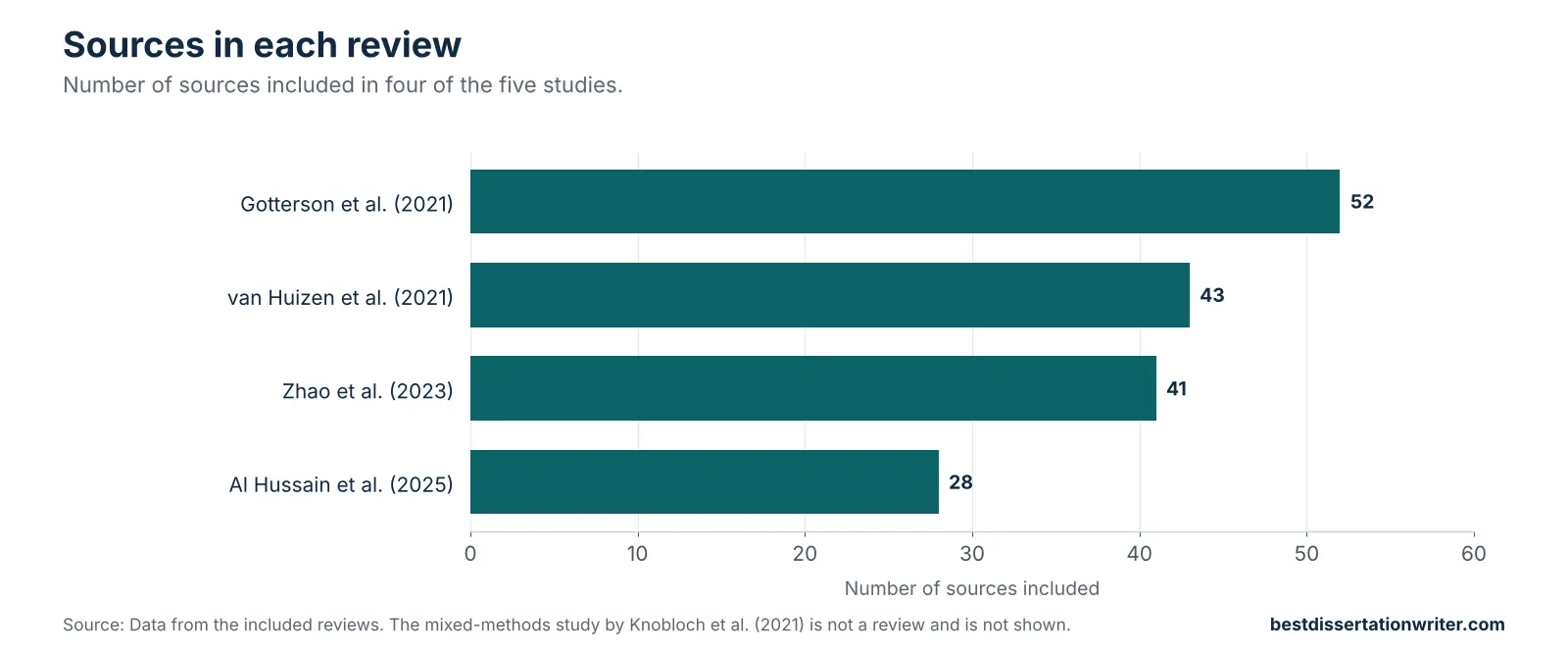
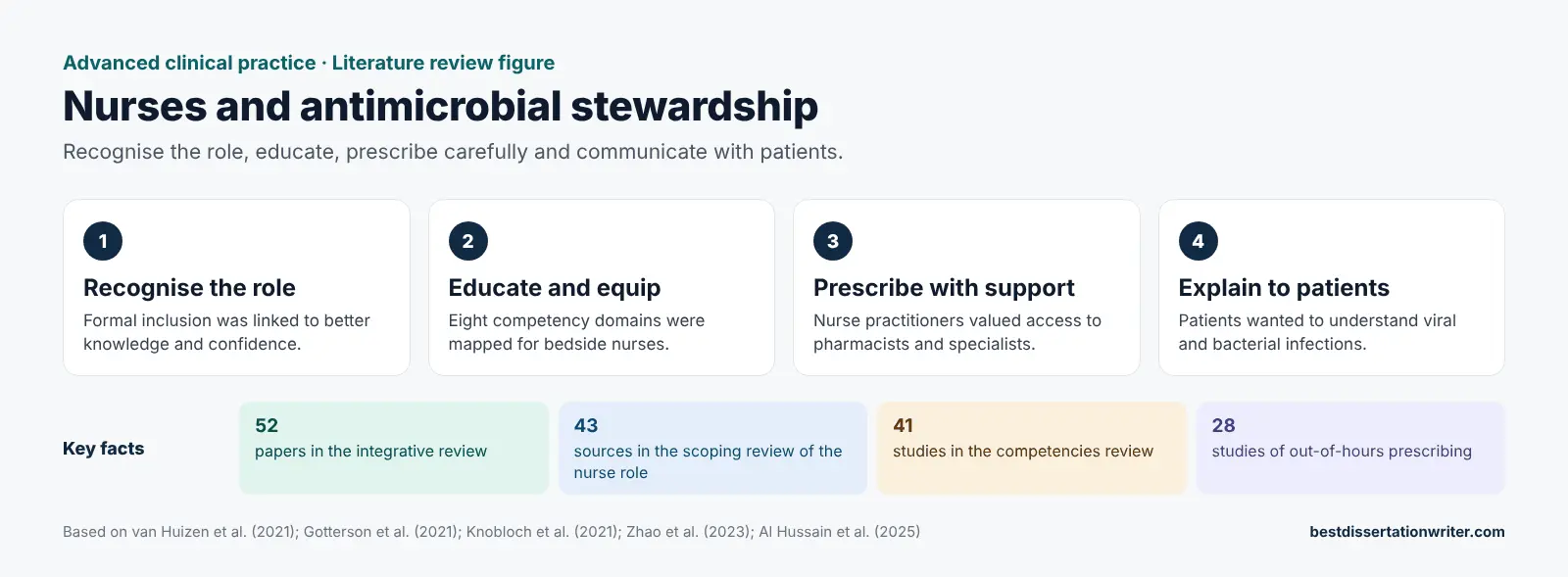
Three themes were identified: the role of nurses in stewardship, competencies and education, and prescribing by advanced practitioners and its settings. Table 1 summarises the included sources, and Figure 1 shows the number of sources in four of the reviews.
| Author, year | Design | Setting and sample | Key finding |
|---|---|---|---|
| Al Hussain et al. (2025) | Scoping review | 28 studies of out-of-hours oral antibacterial prescribing | Variation in service models made comparison difficult. |
| Gotterson et al. (2021) | Integrative review | 52 papers on nurse role in stewardship | Formal inclusion linked to better knowledge and confidence. |
| Knobloch et al. (2021) | Mixed-methods study | Nurse practitioners at one Veterans Affairs facility | Prescribing for upper respiratory illnesses declined over three years. |
| van Huizen et al. (2021) | Scoping review | 43 sources on the nurses’ role | Little research on best practice for intravenous antibiotics. |
| Zhao et al. (2023) | Scoping review | 41 studies on bedside nurses’ competencies | Eight competency domains; framework with basic and advanced levels. |
Theme 1: The Role of Nurses in Stewardship
Gotterson et al. (2021) carried out an integrative review of nurse role and contribution to antimicrobial stewardship, using Whittemore and Knafl’s method. They searched electronic databases from inception to November 2019 and included 52 research papers that involved nurses or had implications for nursing practice across acute, aged and primary care. Papers focused solely on nurse prescribers or nurse practitioners were excluded.
Findings were grouped into five themes: nursing knowledge, learning needs and education; nurses’ perceptions of their role and what motivates their involvement; nurses’ brokering role and their influence on information flow to and from patients; workflow, workload and workarounds; and nurse leadership. Formal inclusion of nurses in stewardship was associated with better nurse knowledge and confidence and, in some studies, improved patient clinical outcomes.
The authors concluded that nursing values motivate nursing actions and that nurses have a complex but significant influence on antimicrobial prescribing. They suggested formally recognising the role, educating nurses about how they can contribute, involving nurses in planning local stewardship activities and engaging nurse leaders. They noted that evidence was still limited and that methodological quality varied, which limits the transferability of some findings.
van Huizen et al. (2021) carried out a scoping review of the nurses’ role in antimicrobial stewardship, searching seven databases and including 43 sources. Monitoring judicious antibiotic prescribing was part of the nurse’s role. Apart from literature on medication errors, little research described best practice for preparing, administering and disposing of intravenous antibiotics, and evidence of consistent policy, guidelines and education for nurses was limited.
Theme 2: Competencies and Education
Zhao et al. (2023) carried out a scoping review of bedside nurses’ antimicrobial stewardship practice scope and competencies in acute hospitals, following Arksey and O’Malley’s framework. They searched eight databases from inception to November 2022, with an update in March 2023, retrieved 1,422 records and included 41 studies. Beyond six recommended practices, bedside nurses contributed to five additional fields.
Competencies were grouped into eight domains: specialised knowledge, safe medication administration, leadership, education, diagnostic stewardship, infection prevention and control, professional development and professional quality. The authors concluded that nurses’ stewardship scope overlaps greatly with routine nursing practice, supporting their role as ideal partners in stewardship. They developed a competency framework with basic and advanced levels to inform training, assessment and staffing.
Both Gotterson et al. and van Huizen et al. identified education as a gap. Nurses’ knowledge, learning needs and access to guidelines were limited, and the evidence for consistent education was thin. For advanced practitioners, who make prescribing decisions, education in stewardship needs to include diagnostic reasoning, knowledge of local resistance patterns and communication skills for discussing antibiotics with patients.
These sources focus mainly on bedside nurses in hospitals, so their direct relevance to advanced practitioners in primary care is partial. Even so, the competency domains, such as diagnostic stewardship, leadership and education, apply equally to advanced practice, and the framework offers a starting point for defining the stewardship competencies of those who prescribe.
Theme 3: Prescribing by Advanced Practitioners and Its Settings
Knobloch et al. (2021) carried out a mixed-methods study of nurse practitioners as antibiotic stewards at one Veterans Affairs facility, combining interviews, focus groups and analysis of prescribing data. Antibiotic prescribing by nurse practitioners for upper respiratory illnesses declined over the three years from 2017 to 2019. Nurse practitioners were satisfied with available resources, especially quick access to pharmacists and infectious disease specialists.
The nurse practitioners saw building patient trust as central to their confidence in prescribing decisions, and veterans said they wanted a better understanding of the difference between viral and bacterial infections. The authors concluded that outpatient nurse practitioners focus on patient education while managing access challenges and called for research on how to include both nurse practitioners and patients in stewardship. This is a single-site study, so findings cannot be generalised.
Al Hussain et al. (2025) carried out a scoping review of oral antibacterial prescribing in primary care out-of-hours services. They searched seven databases for studies from 2017 to May 2022 and included 28 studies from nine high-income countries, six from the United Kingdom and five from Belgium; 23 were quantitative. The review mapped common prescriptions, trends, predictors of prescribing, appropriateness, the effects of interventions, prescribing during COVID-19, patient expectations and challenges such as safety-netting and communication.
Variation in out-of-hours service models made comparison difficult, and the authors called for more research to understand practice in these settings. This review is not specific to nurses, but it describes the context in which many advanced practitioners prescribe, and it highlights the importance of safety-netting and communication in stewardship.
Taken together, the sources suggest that advanced practitioners can contribute to stewardship through prescribing decisions, patient education and use of specialist support, but that the evidence on their contribution is limited and comes largely from single sites. They also show how much of the literature on nursing and stewardship concerns hospital nurses, so evidence specific to advanced practice remains to be built.
One implication of these sources is that antimicrobial stewardship for advanced practitioners should be treated as part of ordinary clinical reasoning and not as a separate programme. The competencies mapped by Zhao et al. include diagnostic stewardship and communication, which are exercised in every consultation, and the nurse practitioners in the Knobloch study described patient education as central to their work. Seen in this way, antimicrobial stewardship is a professional habit that education and supervision can develop.
Discussion
This scoping review suggests that nurses have a significant influence on antibiotic use, that formal inclusion in stewardship is associated with better knowledge and confidence and that competencies and education need to be defined. Advanced practice nurses can contribute through prescribing and communication, although evidence specific to them is limited.
Considered across the sources, antimicrobial stewardship was most often framed in terms of knowledge, communication and organisational support. These are all modifiable. A service that provides education, access to specialist advice and feedback on prescribing creates the conditions in which careful prescribing is easier, whereas a service that leaves practitioners isolated, or that rewards speed over judgement, makes it harder. The sources do not test these explanations directly, so they are offered as interpretations.
The evidence base has limits. The reviews are scoping or integrative and do not pool results, and the quality of included studies varied. Only one source focused on nurse practitioners, and it was a single-site study in the United States. The out-of-hours review was not specific to nurses, and none of the sources measured the effect of advanced practice stewardship on resistance or patient outcomes.
Other limitations should be noted. Most evidence is from high-income countries and from hospitals, and the sources define stewardship roles in different ways. The decline in antibiotic prescribing in the nurse practitioner study may have had several causes that were not separated. This review relied on openly accessible, English-language sources, and it did not include primary studies published after the reviews’ search dates.
Even so, the sources point in a consistent direction. Nurses should be formally recognised as part of stewardship, educated for the role and involved in planning, and advanced practitioners should be supported with guidelines, audit and access to specialist advice. These are practical steps that services can take now while the evidence develops.
Implications of Antimicrobial Stewardship Evidence for Practice
For practice, the evidence supports education in stewardship for nurses and advanced practitioners, access to pharmacists and infection specialists, clear local guidelines, audit and feedback on prescribing and good communication with patients about when antibiotics are not needed. Guidance is available from the National Institute for Health and Care Excellence, NHS England and the Royal College of Nursing.
Educators can use these sources to design teaching on antimicrobial stewardship for pre-registration and advanced practice programmes. Case-based learning on common infections, discussion of how to talk with patients who expect antibiotics, and instruction on interpreting local resistance data would address the gaps identified in the integrative and scoping reviews. Teaching should be assessed, so that the competencies in the framework are demonstrated in practice and not only described.
Managers should include nurses in stewardship teams, recognise the role formally, provide time for education and audit and engage nurse leaders. They should also ensure that out-of-hours and urgent care services have clear guidance and that advanced practitioners can discuss complex cases with specialists.
Future research should examine the effect of advanced practice stewardship on prescribing and outcomes, evaluate education and competency frameworks, include primary care and out-of-hours settings and explore patients’ expectations. Studies in United Kingdom services where advanced practitioners prescribe independently would be particularly valuable.
Taken as a whole, the evidence reviewed here supports a view of antimicrobial stewardship as shared work. Pharmacists, doctors, infection specialists, nurses and advanced practitioners each hold part of the picture, and good antibiotic use depends on their working together. For students, the topic offers a clear example of how a population-level problem such as resistance is addressed through individual clinical decisions.
Conclusion
This scoping review found that nurses have a significant but under-recognised influence on antibiotic use, that competencies and education are being defined and that evidence specific to advanced practice is limited.
Advanced clinical practitioners can contribute to stewardship through careful prescribing, patient education and participation in audit and governance.
References
Al Hussain, S. K., Deslandes, R., Edwards, D., & Hodson, K. L. (2025). Oral antibacterial drug prescribing in primary care out-of-hours services: A scoping review. Antibiotics, 14(1), Article 100. https://doi.org/10.3390/antibiotics14010100
Gotterson, F., Buising, K., & Manias, E. (2021). Nurse role and contribution to antimicrobial stewardship: An integrative review. International Journal of Nursing Studies, 117, Article 103787. https://doi.org/10.1016/j.ijnurstu.2020.103787
Knobloch, M. J., Musuuza, J., Baubie, K., Saban, K. L., Suda, K. J., & Safdar, N. (2021). Nurse practitioners as antibiotic stewards: Examining prescribing patterns and perceptions. American Journal of Infection Control, 49(8), 1052–1057. https://doi.org/10.1016/j.ajic.2021.01.018
van Huizen, P., Kuhn, L., Russo, P. L., & Connell, C. J. (2021). The nurses’ role in antimicrobial stewardship: A scoping review. International Journal of Nursing Studies, 113, Article 103772. https://doi.org/10.1016/j.ijnurstu.2020.103772
Zhao, W., Guo, W., Sun, P., Yang, Y., Ning, Y., Liu, R., Xu, Y., Li, S., & Shang, L. (2023). Bedside nurses’ antimicrobial stewardship practice scope and competencies in acute hospital settings: A scoping review. Journal of Clinical Nursing, 32(17–18), 6061–6088. https://doi.org/10.1111/jocn.16731
Cite this example
Best Dissertation Writers (2026) Antimicrobial Stewardship and the Role of Advanced Practice Nurses: A Scoping Review. Available at: https://bestdissertationwriter.com/antimicrobial-stewardship-review-review/
Best Dissertation Writers
Get expert help with your nursing literature review
Share your topic and deadline with Best Dissertation Writers and get support tailored to your module brief.