Clinical Governance, Accountability, and Scope of Practice in Advanced Nursing Roles: A Narrative Review
 By Dr. Robertson Prime, Research Fellow
Updated November 2, 2026
14 min read
About 2,800 words
In this review
Abstract
Background: Advanced practice roles have expanded in many countries, often faster than the structures that regulate them. Clinical governance, the framework through which organisations are accountable for the quality of care, is central to how advanced practitioners are supervised, held accountable and supported to work within a defined scope of practice.
Aim: This narrative review aimed to examine how recent literature describes clinical governance, accountability and scope of practice in advanced nursing roles, and to identify the implications for advanced clinical practice.
Methods: Evidence was identified through targeted searches of openly accessible bibliographic records, publisher websites and repositories. Five sources published between 2017 and 2026 were selected: a scoping review, an international narrative review, a discussion article on regulation, a mixed-methods study of clinical supervision and a qualitative focus group study. The relevance and quality of each source was considered critically, and findings were synthesised narratively.
Findings: Sources described inconsistent role definition, scope and regulation, with regulation in the United Kingdom depending largely on local employer procedures. Clinical supervision lacked a consistent approach, and in a survey of advanced practice students barriers outnumbered facilitators. Trainee and qualified advanced clinical practitioners reported unstructured training and a role poorly understood by the wider profession. A scoping review of 25 articles identified regulation, governance and professional credibility as supporting autonomy.
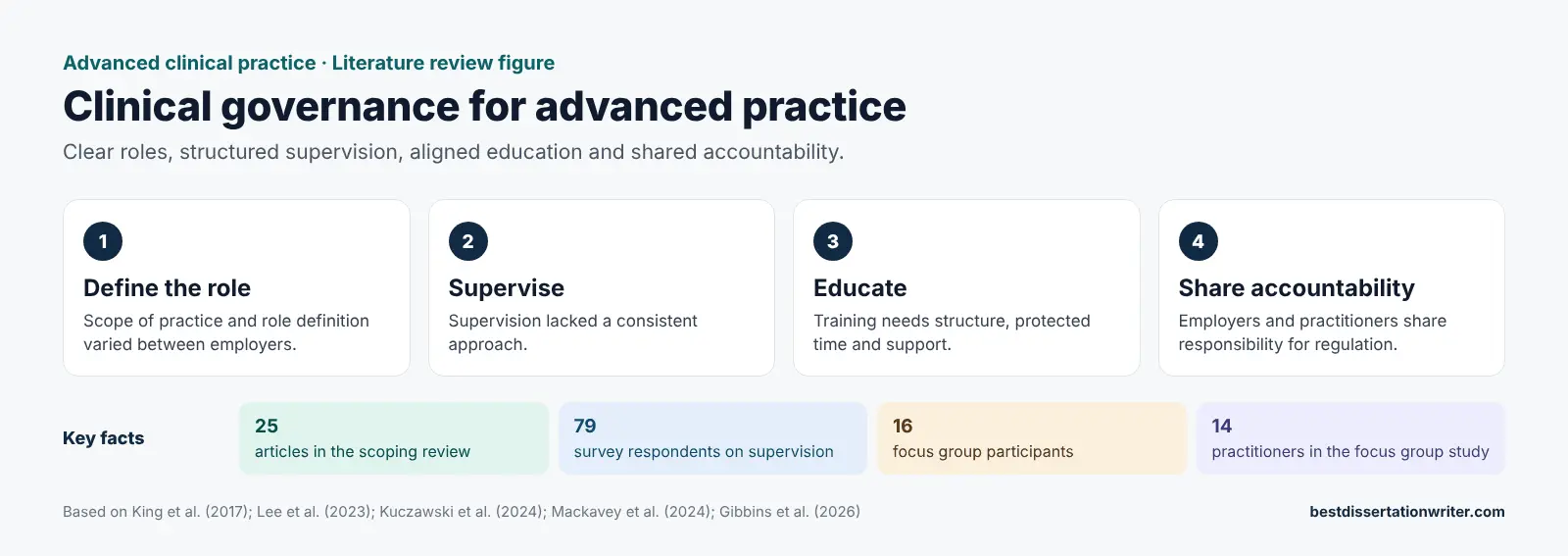
Conclusion: Clinical governance for advanced practice remains uneven. Clear role definition, structured supervision, aligned education and shared responsibility between employers and practitioners are the most consistent recommendations, although evidence of their effect is limited.
Keywords: clinical governance, accountability, scope of practice
Introduction
This narrative review critically examines recent evidence on clinical governance and its implications for advanced clinical practice.
When a nurse, physiotherapist or paramedic moves into an advanced role, the work changes in ways that existing structures do not always anticipate. Advanced practitioners assess undiagnosed patients, make decisions with a degree of autonomy and may prescribe, request investigations and discharge patients. These responsibilities raise questions about who is accountable, who supervises, what the practitioner is permitted to do and how the quality of that work is assured.
Clinical governance is the name given to the systems through which health organisations are accountable for continuously improving the quality of their services and safeguarding high standards of care. In practice it includes policies, audit, risk management, clinical supervision, education and the processes by which a practitioner’s competence is confirmed. For advanced roles, clinical governance has a particular importance because the roles are new, vary between employers and are not always protected by a single regulatory definition.
This narrative review asks: how does recent literature describe clinical governance, accountability and scope of practice in advanced nursing roles, what barriers and enablers are reported and what do these findings imply for advanced clinical practice? A narrative approach was chosen because the literature is varied in design, and the aim was to interpret it critically and not to pool results.
Background to Clinical Governance in Advanced Clinical Practice
Advanced practice has developed in response to workforce shortages, ageing populations and growing complexity of care. Nurses in particular have taken on roles once held by doctors, and the evidence for their effectiveness is considered in the review of nurse-led versus physician-led care. The expansion, however, has often been driven by local need, and local solutions tend to produce local variation.
In the United Kingdom, the title advanced clinical practitioner is not protected in law, and responsibility for ensuring that individuals in such roles are competent has rested largely with employers. National frameworks have set out expectations for the level of practice, education and capabilities. The review of competency frameworks examines how such frameworks are used, and this review concentrates on the governance arrangements that put them into effect.
Accountability in advanced practice has several layers. Practitioners are accountable to their professional regulator for their own conduct, to the law for the care they provide and to their employer for working within agreed policies. Employers are in turn accountable for the systems that allow safe practice. These layers are easy to describe but harder to maintain when roles cross professional boundaries, as in the case of prescribing, discussed in the review of non-medical prescribing.
Governance is also a matter of context. A practitioner working in a large teaching hospital has colleagues, specialists and formal committees close at hand, whereas one working in a small community team or a remote area may have far less immediate support. These contrasts are explored further in the review of rural and remote healthcare.
It is useful to separate three terms that are often used loosely. Accountability is the obligation to explain and justify one’s actions. Scope of practice is the range of activities that a practitioner is educated, competent and authorised to perform. Clinical governance is the organisational framework that makes both possible, by providing supervision, policy and assurance. A weakness in any one of these puts pressure on the others, which is why they are considered together in this review of clinical governance.
Search Strategy and Methods
Evidence for this example was identified through targeted searches of openly accessible bibliographic records, publisher websites and repositories. Search terms combined keywords for the topic (“clinical governance”, “accountability”, “scope of practice”, “regulation”, “clinical supervision”) with terms for the practitioners (“advanced practice”, “advanced clinical practitioner”, “advanced nurse practitioner”), joined with the Boolean operators AND and OR. A full narrative review would document searches in CINAHL, MEDLINE and Scopus and state the dates on which they were run.
Sources were selected if they discussed the governance, regulation, supervision, accountability or role definition of advanced nursing or advanced clinical practice roles, and if they were published in English with an accessible abstract. Opinion pieces and discussion articles were allowed, since governance is often debated in that form, but the type of each source was noted and its weight in the argument adjusted accordingly.
Five sources published between 2017 and 2026 were selected (Table 1). The relevance and quality of each source was considered critically, and findings were synthesised narratively under themes. Because the sources differ in design, ranging from a discussion article to a scoping review and two empirical studies, no attempt was made to combine them statistically.
Key Findings on Clinical Governance
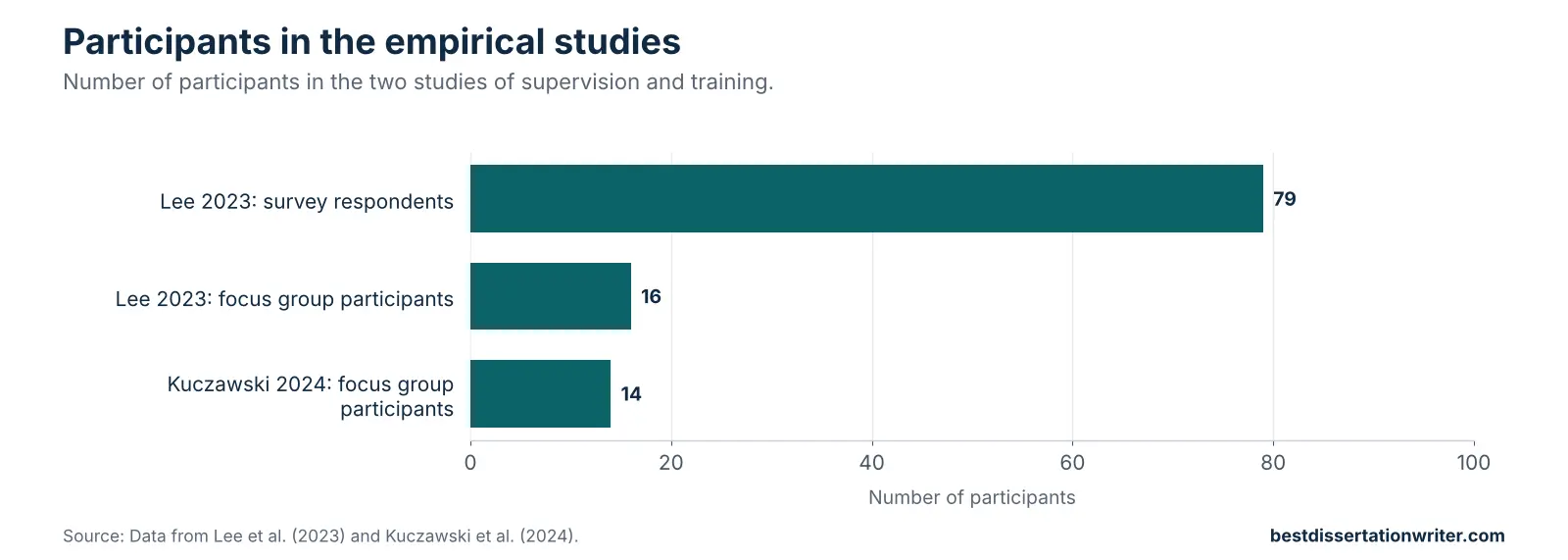
Three themes were identified: role definition, scope of practice and regulation; clinical supervision and support; and training, identity and sustainability. Table 1 summarises the sources, and Figure 1 shows the number of participants in the empirical studies.
| Author, year | Design | Setting and sample | Key finding |
|---|---|---|---|
| Gibbins et al. (2026) | Scoping review | 25 articles on advanced practitioner roles | Regulation, governance and credibility support autonomy. |
| King et al. (2017) | Discussion article | Development and regulation of advanced nurse practitioners | Regulation in the UK depends on local employer procedures. |
| Kuczawski et al. (2024) | Qualitative study | 14 trainee and qualified advanced clinical practitioners | Training lacked structure; the role was poorly understood. |
| Lee et al. (2023) | Mixed-methods study | 79 survey respondents and 16 focus group participants | Supervision lacked a consistent approach; barriers outnumbered facilitators. |
| Mackavey et al. (2024) | Narrative review | International literature on advanced practice nurses | Unclear role definition and weak regulation in many countries. |
Theme 1: Role Definition, Scope of Practice and Regulation
King et al. (2017) discussed the development and regulation of advanced nurse practitioners in the United Kingdom and internationally. They noted that the role had spread widely in primary and secondary care, but that scope of practice, training and regulation remained inconsistent. Globally, advanced nurse practitioners were regulated by national government, a professional body or local employers, whereas in the United Kingdom regulation depended on local employer procedures.
The authors identified variation in scope, organisational constraints and lack of support as challenges, made worse by unclear role definition. They described credentialing introduced by the Royal College of Nursing, a system for recording qualifications, skills and experience, but noted that its uptake had not been evaluated. They concluded that employers and advanced nurse practitioners share responsibility for appropriate regulation of the role.
This is a discussion article and not an empirical study, so its claims rest on the authors’ reading of the literature and policy at the time. It is also nearly a decade old, and national frameworks have developed since. Even so, its central point, that regulation by local employer procedure produces variation, is echoed in later sources and remains a useful starting point.
Mackavey et al. (2024) reviewed the development and identity of the advanced practice nurse role internationally. The review found that the role has expanded worldwide, driven partly by physician shortages, ageing populations and growing complexity of care. Many countries faced similar obstacles, notably unclear role definition and weak regulation, but advanced practice nurses continued to advance the role despite these barriers.
Gibbins et al. (2026) carried out a scoping review of the development of advanced practitioner roles across healthcare professions, using Joanna Briggs Institute methods. They searched five databases in April 2025 and included 25 articles, most concerning advanced practice nursing. Four themes emerged: the need for clear, consistent role definition; education matched to intended scope; regulation, governance and professional credibility that support autonomy; and contribution to patient outcomes and service efficiency.
The authors concluded that successful implementation depends on a coherent professional identity, robust competency frameworks and supportive organisational and regulatory environments. Their review is the most recent in this set, and it links governance directly to autonomy: a practitioner who works within clear regulatory and organisational boundaries is better placed to exercise independent judgement.
Theme 2: Clinical Supervision and Support
Lee et al. (2023) used a mixed-methods design to explore clinical supervision of advanced practice master’s students. An online survey was completed by 79 of 145 students, a 55% response rate, and two focus groups included 16 participants. Most respondents were nurses, and most held a formal trainee advanced practice role. Respondents generally felt that their supervisors understood the advanced practice role.
The focus groups produced five themes: support from supervisors, supervisor skill, physicians’ views on supervising advanced practitioners, supervisor preparation and the transition from trainee to qualified practitioner. The authors concluded that supervision lacked a consistent approach and called for a formally evaluated implementation framework. They also found that barriers currently outnumbered facilitators, and that COVID-19 had added to the barriers.
The study is valuable because it gives the perspective of those being supervised. Its limits are that the sample came from a single type of programme, the response rate was modest and the data were self-reported. It does not show whether better supervision leads to safer care, which is the question that governance ultimately needs to answer.
Theme 3: Training, Identity and Sustainability
Kuczawski et al. (2024) carried out a qualitative study using five online focus groups with 14 trainee and qualified advanced clinical practitioners in the North of England, held between March and May 2021. Thematic analysis was informed by grounded theory principles. Four themes were reported: clinical training lacked structure and support; prior knowledge and experience both helped and hindered; the role was poorly understood by practitioners themselves and by the wider medical profession; and practitioners valued the role but wanted changes to provide security and sustainability.
The authors concluded that structure and support throughout training are crucial for a smooth transition and for building confidence and competence. They called for structural change and knowledge brokering, especially around role clarity, protected time for learning and practice, role accreditation and continuous supervision. These recommendations map directly onto the elements of clinical governance, which suggests that governance gaps are felt by practitioners as gaps in training and support.
The sample was small and drawn from one region, so the findings cannot be assumed to apply elsewhere. The focus groups were held during the pandemic, which may have shaped experiences of training and supervision. Nevertheless, the themes are consistent with those of Lee et al. and with the broader concerns about role definition raised by King et al. and Mackavey et al.
Taken together, the three themes show how closely the elements of clinical governance are linked. A role that is poorly defined is hard to supervise, supervision that is inconsistent cannot reliably confirm competence, and training without structure leaves practitioners unsure of their limits. The participants in the empirical studies experienced these gaps as practical problems, such as uncertainty about who would supervise them and how others in the team understood their role.
Critical Discussion
Read together, the sources describe a consistent problem. Advanced practice roles have grown quickly, and the structures of clinical governance that should surround them have been less consistent. Role definition, scope of practice, regulation, supervision and training all vary, and practitioners themselves report that their role is poorly understood.
An important question for students is whose responsibility clinical governance is. King et al. placed shared responsibility on employers and practitioners, and the later sources are consistent with this view. Employers are responsible for the systems of clinical governance, such as supervision and role definition, while practitioners are responsible for working within their competence and seeking support. Neither can compensate fully for the other’s absence.
The sources agree on the direction of travel. Each calls, in different terms, for clearer role definition, structured supervision, education that matches scope and shared responsibility between employers and practitioners. These are recommendations rather than demonstrated solutions, and none of the sources evaluated whether introducing them improves patient safety or outcomes.
There are also tensions. Greater regulation may protect patients and give practitioners security, but it may also reduce the flexibility that allows services to respond to local need. Credentialing and accreditation offer assurance, but they take time and resources. Clinical governance is therefore a balance between standardisation and local adaptation, and the literature does not yet say where the balance should lie.
Limitations should be noted. The review relied on openly accessible, English-language sources, and the number of sources is small. One source is a discussion article, one is a scoping review whose included articles were mostly about nursing, and the empirical studies are small and mainly from the United Kingdom. The review does not draw on legal or regulatory documents, which would be needed in a full analysis of accountability.
Implications of Clinical Governance Evidence for Practice
For practice, the sources suggest that employers should define the scope of each advanced role clearly, provide structured clinical supervision from supervisors who understand the role, offer protected time for learning, and confirm competence through recognised frameworks. Practitioners should seek out supervision, keep records of their qualifications and experience and work within the limits of their competence. Guidance is available from the NHS England Centre for Advancing Practice, the Nursing and Midwifery Council and the Royal College of Nursing.
Audit and feedback also belong within clinical governance for advanced practice. Reviewing the cases an advanced practitioner manages, including referrals, discharges and prescribing decisions, gives both the practitioner and the organisation information about the quality of care and about the boundaries of scope of practice. None of the sources evaluated this directly, but it is a routine component of clinical governance elsewhere and a reasonable expectation for advanced roles.
Managers and educators should treat clinical governance as part of the design of advanced roles and not as an afterthought. Preparing supervisors, explaining the role to the wider team and creating routes for progression from trainee to qualified practitioner would address the barriers reported in the sources.
Future research should evaluate whether structured supervision, credentialing and clearer scope of practice improve patient safety, practitioner retention and service outcomes. Studies that include patients, supervisors and managers as well as practitioners, and that examine settings beyond hospitals, would strengthen the evidence.
Conclusion
This narrative review found that clinical governance for advanced practice is uneven, that role definition, supervision and training are the most consistently reported concerns, and that evidence of the effect of governance on patient outcomes is limited.
Advanced clinical practice depends on governance that is clear, supportive and shared between employers and practitioners.
References
Gibbins, S., Masterson Algar, P., & Lord, E. (2026). Exploring the development of advanced practitioner roles in healthcare professions: A scoping review. World of Health, 9(1), 57–72. https://doi.org/10.65241/wh.9.1.8
King, R., Tod, A., & Sanders, T. (2017). Development and regulation of advanced nurse practitioners in the UK and internationally. Nursing Standard, 32(14), 43–50. https://doi.org/10.7748/ns.2017.e10858
Kuczawski, M., Ablard, S., Sampson, F., Croft, S., Sutton-Klein, J., & Mason, S. (2024). Exploring advanced clinical practitioner perspectives on training, role identity and competence: A qualitative study. BMC Nursing, 23, Article 185. https://doi.org/10.1186/s12912-024-01843-x
Lee, G. A., Baker, E. E., Stewart, C., & Raleigh, M. (2023). Advanced practice and clinical supervision: An exploration of perceived facilitators and barriers in practice. Journal of Clinical Nursing, 32(5–6), 780–788. https://doi.org/10.1111/jocn.16341
Mackavey, C., Henderson, C., de Zwart van Leeuwen, E., Maas, L., & Ladd, A. (2024). The advanced practice nurse role’s development and identity: An international review. International Journal for Advancing Practice, 2(1), 36–44. https://doi.org/10.12968/ijap.2024.2.1.36
Cite this example
Best Dissertation Writers (2026) Clinical Governance, Accountability, and Scope of Practice in Advanced Nursing Roles: A Narrative Review. Available at: https://bestdissertationwriter.com/clinical-governance-literature-review/
Best Dissertation Writers
Get expert help with your nursing literature review
Share your topic and deadline with Best Dissertation Writers and get support tailored to your module brief.