

Patient Outcomes of Nurse-Led Versus Physician-Led Care: A Systematic Review
 By Dr. Robertson Prime, Research Fellow
Updated November 2, 2026
14 min read
About 2,800 words
In this review
Abstract
Background: Health services face shortages of doctors and rising demand, and nurses in advanced roles increasingly deliver care that was once provided by physicians. Whether nurse-led versus physician-led care produces similar patient outcomes is central to decisions about workforce design and to the credibility of advanced clinical practice.
Aim: This systematic review aimed to synthesise recent review-level evidence comparing patient, process and service outcomes of nurse-led versus physician-led care across primary care, hospital and emergency settings.
Methods: Evidence was identified through targeted searches of openly accessible bibliographic records, publisher websites and the Cochrane Library. Five systematic reviews published between 2018 and 2026 were included. Each was appraised using CASP questions for systematic reviews, and findings were synthesised narratively.
Findings: A Cochrane review of 82 studies and 28,041 participants found that substituting nurses for physicians in hospital probably made little to no difference to death or quality of life. A Cochrane review of 18 primary care trials found that satisfaction was probably slightly higher with nurse-led care. Reviews of 13 and 15 studies reported similar or better outcomes, and a review of 17 emergency care studies reported mixed results. Evidence on costs was limited or unclear.
Conclusion: Nurse-led care generally achieves outcomes similar to physician-led care, with some advantages in satisfaction and waiting times. Certainty is moderate to low, and evidence on costs and the nursing workforce is limited.
Keywords: nurse-led versus physician-led care, nurse-led care, physician-led care
Introduction
This systematic review critically examines recent evidence on nurse-led versus physician-led care and its implications for advanced clinical practice.
For many years, health systems have asked whether care delivered by nurses can safely replace some of the work of doctors. The question has become more pressing as populations age, as chronic conditions multiply and as the supply of doctors fails to keep pace with demand. Nurses in advanced roles now assess, diagnose, treat and follow up patients in primary care, hospital wards, outpatient clinics and emergency departments.
The comparison of nurse-led versus physician-led care is not simply academic. If nurse-led care were less safe or less effective, expanding advanced practice would put patients at risk. If it were equivalent, it could widen access and make better use of scarce skills. If it were better in some respects, such as communication, it might change how services are designed. Evidence from controlled studies and systematic reviews therefore matters to patients, practitioners and planners alike.
Because many primary studies have been published, the most useful evidence is often found in systematic reviews.
Review question
What does recent review-level evidence show about patient, process and service outcomes of nurse-led versus physician-led care, how certain is that evidence and what does it imply for advanced clinical practice?
Background to Nurse-Led versus Physician-Led Care in Advanced Clinical Practice
Nurse-led versus physician-led care is not a single comparison, because nurse-led care takes several forms. In some models a nurse takes over a defined group of patients or tasks, which is described as substitution. In others, nurses add to the care that doctors provide, for example by offering structured follow-up for people with long-term conditions. The distinction matters, because evidence about substitution cannot be assumed to apply to complementary roles.
The conditions under which nurses practise also differ. Some nurses prescribe independently, as discussed in the review of non-medical prescribing, while others work to protocols. The quality of their decisions depends partly on diagnostic reasoning, which is the subject of the review of clinical reasoning skills, and on the education and supervision they receive.
Cost is a further dimension of nurse-led versus physician-led care. Even where outcomes are similar, services want to know whether nurse-led models save money or simply move costs elsewhere. This is considered in the review of cost-effectiveness, and the present review notes cost findings only where the included reviews reported them.
The way the question is framed shapes the answer. A comparison of nurse-led versus physician-led care that asks only whether outcomes are equal may miss differences in how care is experienced, such as the time given to explanation or the way a plan is agreed. Equally, a comparison that looks only at satisfaction may miss differences in clinical safety. The reviews included here address both types of outcome, which makes them more useful for decision-makers than studies of a single measure.
Trust in the evidence also depends on who produced it. Cochrane reviews follow strict methods and are updated periodically, whereas other systematic reviews vary in rigour. For students, an important skill is to look at how each review judged the quality of the studies it included, and to ask whether conclusions about nurse-led versus physician-led care follow from the certainty of the evidence.
Search Strategy and Methods
Evidence for this example was identified through targeted searches of openly accessible bibliographic records, publisher websites and the Cochrane Library. Search terms combined keywords for the practitioners (“nurse practitioner”, “advanced practice nurse”, “nurse-led”) with terms for the comparison and outcomes (“physician-led”, “substitution”, “patient outcomes”, “usual care”, “systematic review”), joined with the Boolean operators AND and OR. A full systematic review would search CINAHL, MEDLINE, Embase and the Cochrane Library, register a protocol and report the selection process in a PRISMA flow diagram.
Systematic reviews were eligible if they compared care delivered by nurses, including nurse practitioners and advanced practice nurses, with care delivered by physicians or with usual care, and reported patient, process or service outcomes. Reviews were required to describe their search methods, and primary studies were not analysed separately.
Five systematic reviews published between 2018 and 2026 were included (Table 1). Each was appraised using CASP questions for systematic reviews, which consider the clarity of the question, the search, the assessment of included studies and the precision of results. Findings were synthesised narratively, because the reviews differ in settings, populations and outcomes and overlap in the trials they include.
Key Findings on Nurse-Led versus Physician-Led Care
Three themes were identified: patient outcomes and safety, patient experience and service outcomes, and costs and certainty. Table 1 summarises the reviews, and Figure 1 shows the number of studies in each.
| Author, year | Design | Setting and sample | Key finding |
|---|---|---|---|
| Butler et al. (2026) | Cochrane review | 82 studies, 28,041 participants, hospital | Little to no difference in death or quality of life; cost effect unclear. |
| Fox et al. (2026) | Systematic review | 17 studies of nurse practitioners in emergency care | Mixed results; positive impact on wait times and satisfaction. |
| Htay and Whitehead (2021) | Systematic review | 13 randomised trials | Better satisfaction, waiting times and some clinical outcomes. |
| Laurant et al. (2018) | Cochrane review | 18 randomised trials, primary care | Satisfaction probably slightly higher; outcomes equal or better. |
| McMenamin et al. (2023) | Systematic review | 15 studies, multiple chronic conditions | Equal or better quality; no study found worse outcomes. |
Theme 1: Patient Outcomes and Safety
Butler et al. (2026) updated a Cochrane review of the substitution of nurses for physicians in the hospital setting. It included 82 studies with 28,041 participants, of which 32 were from the United Kingdom, and compared nurse-delivered care with doctor-delivered care in inpatient units and outpatient clinics. Evidence was current to June 2024.
Substituting nurses probably made little to no difference to death or quality of life, and may have made little to no difference to patient safety events. Some clinical outcomes may have improved slightly, including physical and psychological function and the management of diabetes and eczema. Confidence in the evidence was moderate to low, because of differences in participants, interventions and measurement, and few studies came from low- and middle-income countries.

Laurant et al. (2018) reviewed nurses as substitutes for doctors in primary care. They included 18 randomised trials and concluded that, for some ongoing and urgent physical complaints and chronic conditions, trained nurses probably achieve equal or better health outcomes than doctors. Htay and Whitehead (2021) reviewed 13 randomised trials of advanced nurse practitioners compared with physician-led or usual care, five of them high quality and eight low to moderate, and reported improved symptom control, physical function, health status and blood pressure control.
McMenamin et al. (2023) reviewed 15 studies published between 2003 and 2021 of nurse practitioner-delivered primary care for patients with multiple chronic conditions. Most studies reported equal or better quality and similar or lower rates of emergency department use and hospitalisation, and no study found worse outcomes. These findings concern a particular group of patients, so they add to the evidence for primary care rather than repeating it.
Theme 2: Patient Experience and Service Outcomes
Laurant et al. found that patient satisfaction was probably slightly higher with nurse-led care, with moderate certainty, while consultations were probably longer and attended return visits probably slightly more frequent. Htay and Whitehead likewise reported better patient satisfaction and shorter waiting times in advanced nurse practitioner care. Butler et al. found that some practitioner performance measures, such as patient assessment, following practice recommendations and medication management, may have improved slightly with nurse-delivered care.
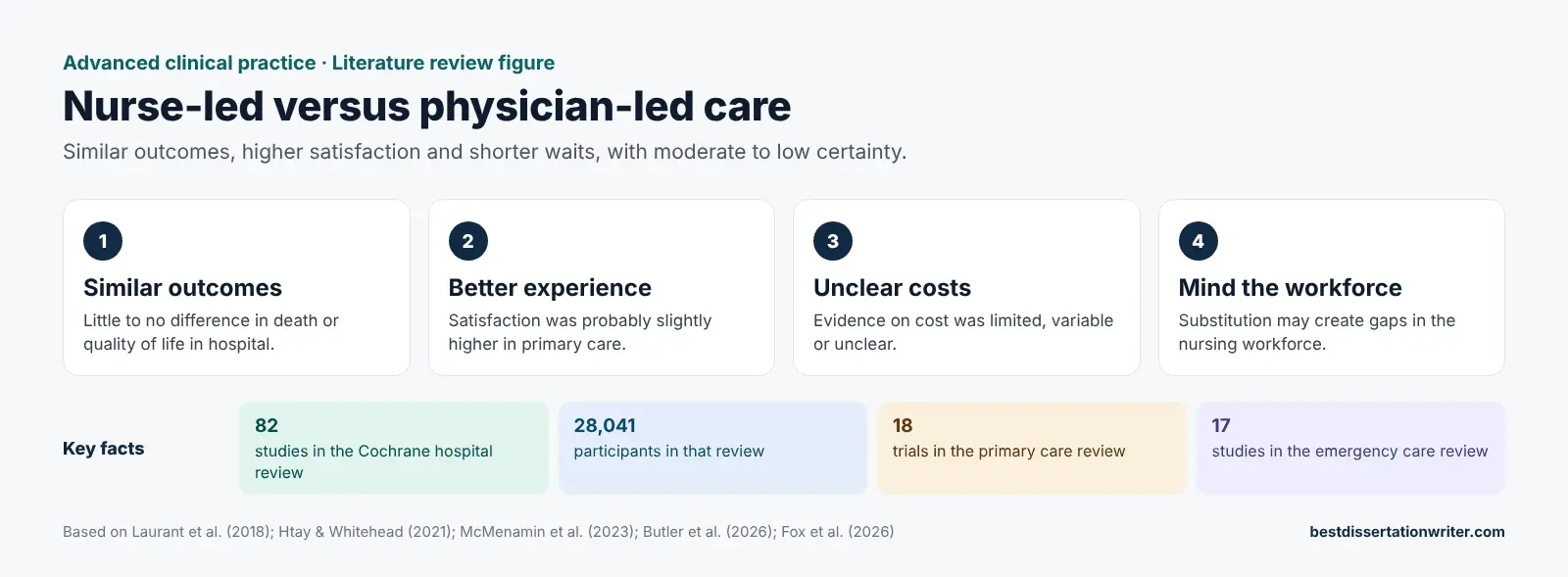
Fox et al. (2026) updated a systematic review of nurse practitioner services in emergency care. From 2,329 records screened, 236 full texts were reviewed and 17 studies underwent critical appraisal. Results were mixed, with both favourable and unfavourable findings. The authors reported a positive impact on patient wait times and satisfaction, and described the evidence on health care costs and outcomes as limited and variable.
Fox et al. also called for consistent professional benchmarks and evaluation frameworks, because global evaluation of nurse practitioner services in emergency care remains inconsistent. This is an important qualification. Where services are evaluated in different ways, comparison between nurse-led and physician-led care becomes difficult, and results from one setting may not transfer to another.
Theme 3: Costs and Certainty of Evidence
Evidence on cost was less secure than evidence on outcomes. Butler et al. concluded that it was unclear whether nurse substitution affects direct costs. Htay and Whitehead reported lower costs, and McMenamin et al. reported lower or similar costs in most studies. Fox et al. described cost evidence as limited and variable. Taken together, the reviews suggest that nurse-led care is unlikely to be more expensive in these studies, but they do not provide a firm basis for claiming savings.
The certainty of the evidence is also limited. Butler et al. rated confidence as moderate to low, Htay and Whitehead found that eight of 13 trials were of low to moderate quality and noted methodological flaws, and Fox et al. found mixed results. Butler et al. added that the effect of substitution on the nursing workforce should be considered when it is used to respond to physician shortages, because moving nurses into substitute roles may create gaps elsewhere.
Taken together, the three themes show a consistent but cautious pattern. Outcomes were mostly similar, experience was often better and cost evidence was weak. The reviews also share a common message about quality: the more rigorous the study, the more modest the claims. Students should therefore treat the favourable findings as encouraging rather than conclusive, and should look for evidence from long-term follow-up and from settings that differ from those of the existing trials.
Discussion
Before the main findings are discussed, it is worth noting what the evidence for nurse-led versus physician-led care can and cannot show. It can show that, in the settings studied, patients under nurse-led care did not fare worse on the outcomes measured. It cannot show that every service would obtain the same results, because the trials took place in organisations that had chosen to introduce nurse-led models and that supported them with training and supervision.
The reviews agree on the main finding. Across primary care, hospital and emergency settings, nurse-led versus physician-led care generally shows similar patient outcomes, with small advantages in satisfaction, waiting times and some process measures. No review found that nurse-led care was clearly worse, although Fox et al. reported mixed results in emergency care.
The finding that satisfaction was higher with nurses needs careful interpretation. Longer consultations, as reported by Laurant et al., may explain part of the difference, because patients often value time and explanation. If satisfaction depends on time, then the advantage in nurse-led versus physician-led care may reflect how services allocate time and not the profession of the practitioner. The reviews do not allow this to be tested directly.
This does not mean that any nurse can safely do any physician task. The trials and studies were conducted in services where nurses were trained, supported and given a defined role. The reviews describe nurse-led care under these conditions, and their findings should be read in that light. The education, supervision and governance of advanced practitioners are therefore as important as the comparison itself.
Limitations should be noted. This review relied on openly accessible, English-language sources and included five reviews, so some relevant reviews will be missing. The reviews overlap in the trials they include, particularly the primary care trials, so the apparent agreement among them is not fully independent. Most evidence is from high-income countries, and the reviews differ in how they define nurse-led care, the outcomes they measure and the quality of included studies.
A further limitation is that the comparison is rarely a pure one. In many studies nurses and doctors worked in teams, and patients were not randomised to a single professional for all their care. Outcomes may therefore reflect the system of care as much as the individual practitioner, which is relevant to how results are applied in practice.
Implications of Nurse-Led versus Physician-Led Care Evidence for Practice
For practice, the evidence on nurse-led versus physician-led care supports the use of nurse-led models where nurses are educated for the role, work within clear governance and have access to medical advice. Services should monitor patient outcomes and experience, and they should consider workforce effects when roles are substituted. Guidance is available from the NHS England Centre for Advancing Practice, the Nursing and Midwifery Council and the Royal College of Nursing.
Managers designing services should treat the evidence on nurse-led versus physician-led care as one input among several. Local needs, the availability of trained nurses, the support of medical colleagues and the views of patients all affect whether a model will work. Piloting a model, evaluating it with agreed measures and sharing the results would add to the evidence and would help other services to decide.
Educators can use the evidence to show students how advanced practice has been evaluated and where uncertainty remains. Discussion of nurse-led versus physician-led care provides a good example of how to read systematic reviews critically, including how to consider certainty, overlap among reviews and the transferability of results. It also shows why evaluation should be built into new roles from the start.
Future research should include more studies from low- and middle-income countries, longer follow-up, rigorous economic evaluation and studies of the nursing workforce, and it should compare models that add to physician care with those that replace it. Better reporting of the training and supervision of nurses would help services to judge whether results can be reproduced.
In short, the evidence suggests that the question is not whether nurses or doctors should deliver care, but how care is organised so that each contributes safely and effectively. Reviews of nurse-led versus physician-led care provide reassurance about outcomes, and they also remind services to attend to costs, workforce and the quality of evidence.
Conclusion
This systematic review found that nurse-led versus physician-led care generally shows similar patient outcomes, with advantages in satisfaction and waiting times in several reviews, but that certainty is moderate to low and evidence on costs is limited.
The evidence on nurse-led versus physician-led care can support advanced clinical practitioners, provided that education, supervision and evaluation accompany the role.
References
Butler, M., Kirwan, M., Mc Carthy, V. J. C., Cole, J. A., & Schultz, T. J. (2026). Substitution of nurses for physicians in the hospital setting for patient, process of care, and economic outcomes. Cochrane Database of Systematic Reviews, (2), Article CD013616.pub2. https://doi.org/10.1002/14651858.CD013616.pub2
Fox, A., Williams, S., Jennings, N., Tomkins, E. M., Glynn, R., Dunningham, C., & Tori, K. (2026). Ten-year update of nurse practitioner service impact on patient and health service outcomes in emergency care settings: A systematic review. Journal of Advanced Nursing. https://doi.org/10.1111/jan.70569
Htay, M., & Whitehead, D. (2021). The effectiveness of the role of advanced nurse practitioners compared to physician-led or usual care: A systematic review. International Journal of Nursing Studies Advances, 3, Article 100034. https://doi.org/10.1016/j.ijnsa.2021.100034
Laurant, M., van der Biezen, M., Wijers, N., Watananirun, K., Kontopantelis, E., & van Vught, A. J. A. H. (2018). Nurses as substitutes for doctors in primary care. Cochrane Database of Systematic Reviews, (7), Article CD001271. https://doi.org/10.1002/14651858.CD001271.pub3
McMenamin, A., Turi, E., Schlak, A., & Poghosyan, L. (2023). A systematic review of outcomes related to nurse practitioner-delivered primary care for multiple chronic conditions. Medical Care Research and Review, 80(6), 563–581. https://doi.org/10.1177/10775587231186720
Cite this example
Best Dissertation Writers (2026) Patient Outcomes of Nurse-Led Versus Physician-Led Care: A Systematic Review. Available at: https://bestdissertationwriter.com/nurse-led-versus-physician-led-care/
Best Dissertation Writers
Get expert help with your nursing literature review
Share your topic and deadline with Best Dissertation Writers and get support tailored to your module brief.