Loneliness and Depression in Later Life and Nursing Interventions: An Integrative Review
 By Dr. Robertson Prime, Research Fellow
Updated October 28, 2026
14 min read
About 2,800 words
In this review
Abstract
Background: Depression in later life is common but often unrecognised, being mistaken for normal ageing or masked by physical illness. Loneliness and social isolation are closely linked to low mood and to poorer health and survival. Nurses in community, hospital and care home settings are well placed to notice signs of depression and loneliness and to support older people to access help.
Aim: This integrative review aimed to examine the prevalence of depression in later life, the relationship between loneliness, depression and mortality and the evidence for psychological and social interventions.
Methods: Evidence was identified through targeted searches of openly accessible bibliographic records, publisher websites and the reference lists of key reviews. Five sources published between 2008 and 2018 were included: a prevalence meta-analysis, two meta-analyses of loneliness, a Cochrane review of psychotherapy and an integrative review of social interventions, appraised using CASP checklists and synthesised using an integrative approach.
Findings: Among people aged 75 and over, major depression affected 7.2% and depressive disorders 17.1%. Loneliness had a moderate effect on depression across 88 studies, and social isolation, loneliness and living alone increased the likelihood of death by 29%, 26% and 32%. Cognitive behavioural therapy was more effective than waiting-list control for depressed older people. Interventions to reduce loneliness were varied, and the most effective shared adaptability, a community development approach and productive engagement.
Conclusion: Depression in later life and loneliness are common and serious, but treatable. Nurses should ask about mood and social contact, recognise depression, support access to psychological therapy and connect older people with meaningful social activity.
Keywords: depression in later life, loneliness, social interventions
Introduction
This integrative review critically examines recent evidence on depression in later life and its implications for older adult nursing practice.
Later life brings many changes that can affect mood. Older people may experience bereavement, retirement, loss of physical health and independence, chronic pain, sensory impairment and moves into care. Friends and family may live far away or have died, and reduced mobility can make it harder to stay connected. While many older people remain content and resilient, a substantial minority experience depression, and many more feel lonely or socially isolated.
Depression in later life is often missed. Older people may describe physical symptoms such as tiredness, poor sleep or loss of appetite rather than low mood, and these may be attributed to physical illness or simply to ageing. Some older people grew up at a time when mental illness carried considerable stigma and may be reluctant to talk about their feelings. Professionals may assume that sadness is understandable given the person’s circumstances and fail to offer treatment.
An integrative review was chosen because the evidence includes prevalence studies, meta-analyses of associations and reviews of diverse interventions, and an integrative approach allows these to be combined.
The question matters because nurses have frequent contact with older people in many settings. District nurses, practice nurses, ward nurses and care home staff may be the first to notice that someone has become withdrawn, has stopped eating or has no visitors. Recognising these signs and responding appropriately can make a substantial difference to older people’s wellbeing.
Review question
How common is depression in later life, how are loneliness, depression and mortality related and what is the evidence for psychological treatment and social interventions?
Background to Depression in Later Life
Depression is characterised by persistent low mood or loss of interest and pleasure, together with symptoms such as changes in sleep and appetite, fatigue, poor concentration, feelings of worthlessness and thoughts of death. In older adults, depression may present differently, with more physical complaints, anxiety, irritability or memory problems. Depression in later life is associated with poorer physical health, greater disability, longer hospital stays and higher mortality, including suicide.
Loneliness and social isolation are related but distinct. Social isolation refers to an objective lack of social contacts, while loneliness is the subjective, distressing feeling that one’s relationships are inadequate. A person may live alone and feel content, or be surrounded by others and feel lonely. Both have been linked to depression, cognitive decline and poorer physical health.
Screening tools such as the Geriatric Depression Scale help to identify depression in older adults. Treatment options include psychological therapies, such as cognitive behavioural therapy, antidepressant medication, increased physical and social activity and support for practical problems. Social interventions to reduce loneliness include befriending, group activities, community programmes, intergenerational projects and the use of technology to stay connected.
In care homes, depression is particularly common and may be overlooked amid physical and cognitive needs. Residents may have lost their home, their independence and many of their social roles, and the routine of institutional life may offer few opportunities for meaningful activity. Staff who know residents well can play an important role in recognising changes in mood.
Physical illness and depression often occur together. Conditions such as stroke, heart disease, diabetes, chronic pain and sensory loss increase the risk of depression, and depression in turn can make it harder to manage physical conditions, adhere to treatment and engage in rehabilitation. For nurses caring for older people with long-term conditions, attention to mood is therefore part of good physical care as well as good mental health care.
Search Strategy and Methods
Evidence for this example was identified through targeted searches of openly accessible bibliographic records, publisher websites and the reference lists of key reviews. Search terms combined keywords for the problem (“depression in later life”, “late-life depression”, “loneliness”, “social isolation”) with terms for outcomes and interventions (“prevalence”, “mortality”, “cognitive behavioural therapy”, “social interventions”, “older adults”), joined with the Boolean operators AND and OR. A full integrative review for assessment would run the same strategy in CINAHL, PubMed/MEDLINE, PsycINFO and the Cochrane Library and report the number of records screened in a PRISMA flow diagram.
Sources were eligible if they reported the prevalence of depression among older adults, examined associations between loneliness, social isolation, depression and mortality, or evaluated psychological or social interventions for depression or loneliness in older people. Meta-analyses and reviews were prioritised, consistent with the integrative approach. Studies of younger adults only were excluded.
Five sources published between 2008 and 2018 were included: a Cochrane review of psychotherapy for depressed older people, a meta-analysis of depression prevalence in people aged 75 and over, a meta-analysis of loneliness, social isolation and mortality, a meta-analysis of loneliness and depression and an integrative review of interventions to reduce social isolation and loneliness (Table 1). Each source was appraised using the Critical Appraisal Skills Programme (CASP) checklist appropriate to its design, and findings were integrated into themes.
Key Findings on Depression in Later Life
Three themes were identified: the prevalence of depression in later life, loneliness, depression and mortality, and psychological and social interventions. Table 1 summarises the included sources, and Figure 1 shows the increased likelihood of death associated with social isolation, loneliness and living alone.
| Author, year | Design | Setting and sample | Key finding |
|---|---|---|---|
| Wilson et al. (2008) | Cochrane systematic review | 7 small trials | CBT more effective than waiting list for depressed older people. |
| Luppa et al. (2012) | Systematic review and meta-analysis | 24 studies of people aged 75+ | Major depression 7.2%; depressive disorders 17.1%. |
| Holt-Lunstad et al. (2015) | Meta-analysis | Studies of isolation, loneliness and mortality | Isolation, loneliness and living alone raised likelihood of death by 29%, 26% and 32%. |
| Erzen & Çikrikci (2018) | Meta-analysis | 88 studies; 40,068 participants | Loneliness had a moderate effect on depression. |
| Gardiner et al. (2018) | Integrative review | 38 studies of interventions | Adaptable, community-based, productive engagement most effective. |
Theme 1: How Common Is Depression in Later Life?
Luppa et al. (2012) pooled 24 studies of depression among people aged 75 and over. Using diagnostic criteria, the pooled prevalence of major depression was 7.2% (95% CI 4.4% to 10.6%). Using symptom scales, the pooled prevalence of depressive disorders was 17.1% (95% CI 9.7% to 26.1%), with individual studies ranging from 4.5% to 37.4%. About half of the included studies were of poor methodological quality.
These findings show that depression in later life is common, affecting around one in six people aged 75 and over when depressive symptoms are included. The wide range between studies reflects differences in measures and populations, but even the lower estimates suggest that many older people are living with depression that may not have been recognised or treated. Because the review focused on people aged 75 and over, it also highlights that depression remains common in the oldest age groups, who are most likely to be receiving nursing care.
Theme 2: Loneliness, Depression and Mortality
Erzen and Çikrikci (2018) pooled 88 studies with 40,068 participants and found that loneliness had a moderate, significant effect on depression. The effect did not differ significantly by sample group, publication type or year of publication, suggesting a consistent relationship across populations.
Holt-Lunstad et al. (2015) pooled studies of loneliness, social isolation and mortality. After controlling for confounders, social isolation increased the likelihood of death by 29%, loneliness by 26% and living alone by 32%. There was no meaningful difference between objective isolation and subjective loneliness, and the authors concluded that the effects were comparable to those of well-established risk factors for mortality.
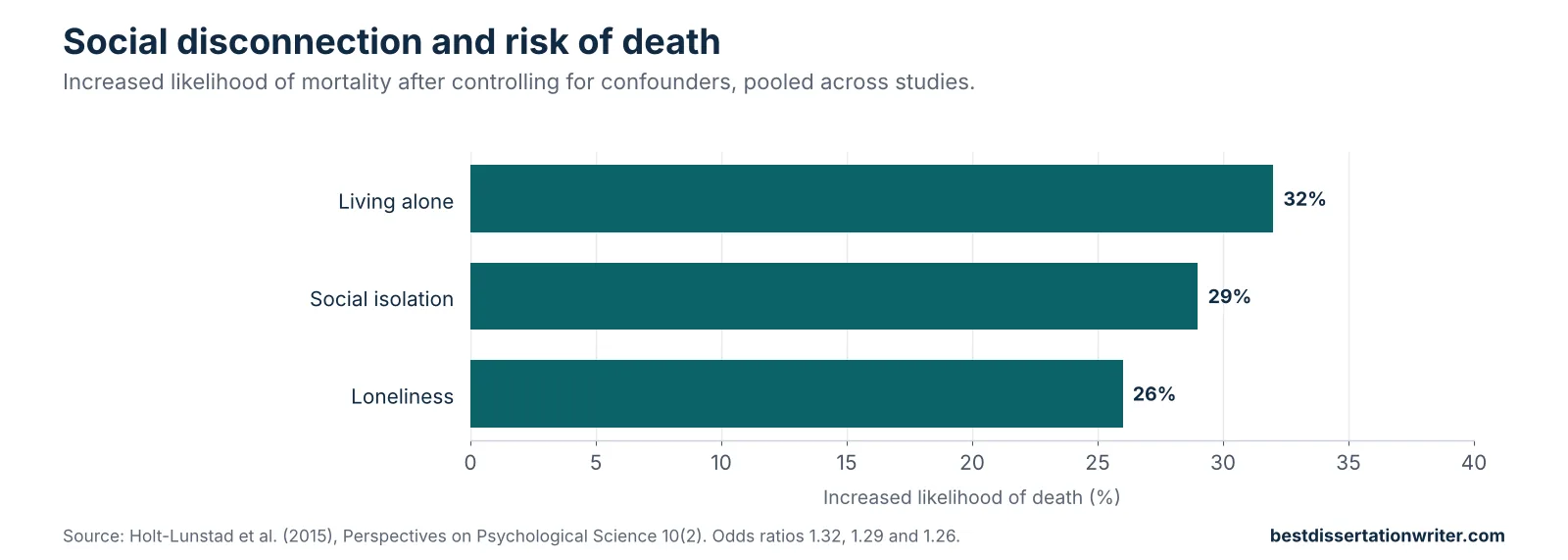
Together, these findings show that loneliness is not simply an unpleasant feeling but a significant risk to mental and physical health. Loneliness contributes to depression, and both are associated with earlier death. This makes loneliness a legitimate concern for nurses and other health professionals, not only for social services or voluntary organisations, and it supports including questions about social contact in routine nursing assessment of older people.
Theme 3: Psychological and Social Interventions
Wilson et al. (2008) reviewed seven small randomised trials of psychotherapy for depressed older people. Cognitive behavioural therapy was more effective than waiting-list control (weighted mean difference −9.85 on depression scales), and more effective than active control on one depression scale, though not on another. There was no significant difference between cognitive behavioural therapy and psychodynamic therapy. The authors noted that the evidence base was small but consistent with larger analyses suggesting that cognitive behavioural therapy may help.
Gardiner et al. (2018) integrated 38 studies of interventions to reduce social isolation and loneliness among older people. The interventions were diverse, including group activities, befriending, community development, technology and therapeutic approaches. Most reported some success, but evidence quality was generally weak. The most effective social interventions shared three features: adaptability to local contexts and individual needs, a community development approach that involved older people in shaping the intervention and productive engagement in meaningful activity.
Discussion
This integrative review shows that depression in later life affects a substantial proportion of older people, that loneliness contributes to depression and that both are associated with increased mortality. Cognitive behavioural therapy is effective for depressed older people, and social interventions that are adaptable, community-based and involve meaningful activity show the most promise for reducing loneliness, although evidence quality is often weak.
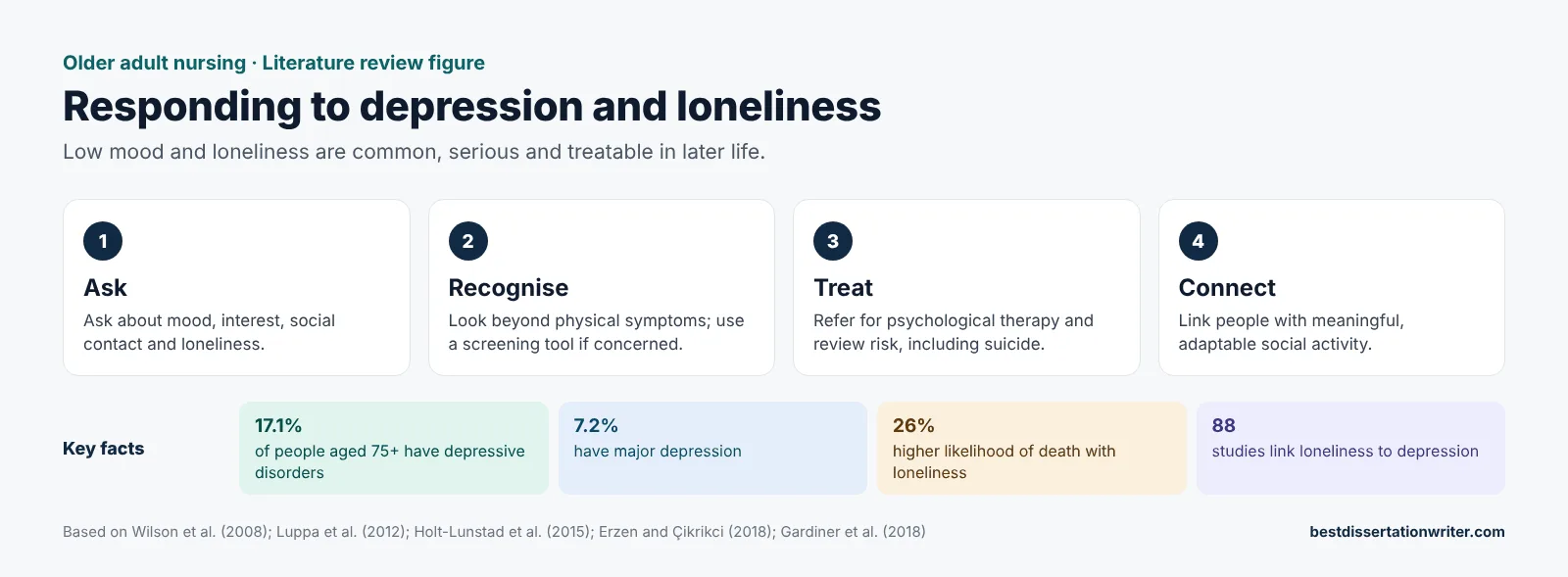
Recognition is the first step. Nurses can ask simple questions about mood and interest, such as whether the person has felt down or lost interest in things they used to enjoy, and they can use validated screening tools when concerns arise. They can also ask about social contact, such as how often the person sees or speaks to others and whether they feel lonely. These questions can be built into routine assessments in the community, on admission to hospital and in care homes.
Responding to depression in later life involves ensuring that older people have access to the same treatments as younger adults. Older people may be less likely to be offered psychological therapy if professionals assume that they will not benefit. The evidence that cognitive behavioural therapy is effective in older adults supports referral, and nurses can encourage and support older people to take up therapy, including adapting arrangements for those with hearing or mobility problems.
Technology can help some older people stay connected, through video calls, online groups and messaging, but it is not a solution for everyone. Some older people lack access, skills or confidence with digital devices, and remote contact may not meet the need for physical presence and touch. Offering support to use technology, alongside face-to-face contact, may extend social connection for those who want it.
Social interventions offer nurses practical ways to help. Connecting older people with befriending services, community groups, day centres, faith communities or volunteering opportunities can reduce loneliness. The finding that the most effective interventions involve productive engagement suggests that older people value activities with purpose, where they contribute as well as receive. In care homes, meaningful activity and relationships are central to person-centred dementia care and to the wellbeing of all residents.
Depression and loneliness interact with many other aspects of older adult care. Low mood can reduce appetite, mobility and engagement with care, and may make people less willing to take part in decisions about their future, such as advance care planning. In care homes, practices that restrict residents’ freedom, such as physical restraint, may increase distress and isolation. Even everyday care, such as good oral health care, affects people’s comfort, appearance and willingness to eat and socialise.
Transitions are moments of particular vulnerability. Bereavement, discharge from hospital, moving into a care home and losing the ability to drive can all increase isolation and low mood. Nurses involved at these points can check how the person is coping, ensure that follow-up is in place and connect them with support. A brief conversation at the right time may prevent a slide into depression.
Carers also matter. Family members who care for an older person may themselves be older, isolated and at risk of depression. Supporting carers, recognising their own needs and linking them with respite and support groups benefits both carers and the people they care for.
Risk of suicide must not be overlooked. Older people may be at risk of suicide, and depression is an important contributor. Nurses should be alert to expressions of hopelessness or thoughts of death, ask directly about suicidal thoughts when concerned and ensure urgent assessment where needed. Asking about suicidal thoughts sensitively and directly is part of good assessment and can be an important step towards help.
The evidence base has limitations. The prevalence meta-analysis included many poor-quality studies, the loneliness meta-analyses included people of all ages and the psychotherapy review included only seven small trials. The integrative review of social interventions found generally weak evidence. This review relied on openly accessible, English-language sources and did not involve formal systematic screening. Future research should evaluate nurse-led approaches to recognising depression and reducing loneliness among older people in different settings.
Implications of Depression in Later Life Evidence for Practice
For nurses, the evidence supports asking older people about mood, interest and social contact, using validated screening tools, recognising atypical presentations of depression, referring for psychological therapy, connecting people with social interventions that offer meaningful engagement, monitoring for suicide risk and involving families. National guidance is available in the NICE guideline on depression in adults.
Managers should ensure that staff are trained to recognise depression in later life, that pathways to psychological therapy are accessible to older people and that care homes provide meaningful activity and opportunities for connection. Partnerships with voluntary and community organisations can extend the range of social interventions available.
Conclusion
This integrative review examined depression in later life, loneliness and the interventions that help. Depression affects around one in six people aged 75 and over when symptoms are included, loneliness contributes to depression and both are linked to earlier death. Cognitive behavioural therapy is effective, and adaptable, community-based social interventions show promise.
Depression in later life and loneliness are not inevitable parts of ageing. By asking, listening, recognising depression and helping older people to find connection and purpose, nurses can make a meaningful difference to their mental health, quality of life and survival.
References
Erzen, E., & Çikrikci, Ö. (2018). The effect of loneliness on depression: A meta-analysis. International Journal of Social Psychiatry, 64(5), 427–435. https://doi.org/10.1177/0020764018776349
Gardiner, C., Geldenhuys, G., & Gott, M. (2018). Interventions to reduce social isolation and loneliness among older people: An integrative review. Health & Social Care in the Community, 26(2), 147–157. https://doi.org/10.1111/hsc.12367
Holt-Lunstad, J., Smith, T. B., Baker, M., Harris, T., & Stephenson, D. (2015). Loneliness and social isolation as risk factors for mortality: A meta-analytic review. Perspectives on Psychological Science, 10(2), 227–237. https://doi.org/10.1177/1745691614568352
Luppa, M., Sikorski, C., Luck, T., Ehreke, L., Konnopka, A., Wiese, B., Weyerer, S., König, H.-H., & Riedel-Heller, S. G. (2012). Age- and gender-specific prevalence of depression in latest-life: Systematic review and meta-analysis. Journal of Affective Disorders, 136(3), 212–221. https://doi.org/10.1016/j.jad.2010.11.033
Wilson, K., Mottram, P. G., & Vassilas, C. (2008). Psychotherapeutic treatments for older depressed people. Cochrane Database of Systematic Reviews, (1), CD004853. https://doi.org/10.1002/14651858.CD004853.pub2
Cite this example
Best Dissertation Writers (2026) Loneliness and Depression in Later Life and Nursing Interventions: An Integrative Review. Available at: https://bestdissertationwriter.com/depression-in-later-life-review-review/
Best Dissertation Writers
Get expert help with your nursing literature review
Share your topic and deadline with Best Dissertation Writers and get support tailored to your module brief.