Never Events in Surgery: Causes, Prevention, and Learning for Nursing Practice: A Narrative Review
 By Dr. Robertson Prime, Research Fellow
Updated October 26, 2026
14 min read
About 2,800 words
In this review
Abstract
Background: Never events are serious, largely preventable patient safety incidents that should not occur if national guidance and safety barriers are in place. In surgery, they include wrong-site surgery, retained foreign objects and wrong implants, and they continue to be reported despite checklists and national standards.
Aim: This narrative review aimed to examine how often surgical never events occur, what causes them, how they affect patients and what evidence supports prevention, with a focus on learning for nursing practice.
Methods: Evidence was identified through targeted searches of openly accessible bibliographic records, publisher websites and the reference lists of key reviews. Five sources published between 2013 and 2025 were included: an analysis of malpractice claims, a systematic review, a national survey of English hospitals, national safety standards and national incident data, appraised using CASP checklists where applicable and synthesised narratively.
Findings: In England, 401 incidents met the never event definition in one year, including 178 cases of wrong site surgery and 100 retained foreign objects. A national survey estimated a risk of about 1 surgical never event in 16,423 operations and found no link with other safety indicators. Among 9,744 paid claims in the United States, 6.6% of patients died and 32.9% suffered permanent injury. A systematic review of 138 studies identified inadequate communication as a frequent root cause and found only limited evidence for preventive interventions.
Conclusion: Never events are rare for each patient but frequent across health systems, and they often stem from communication and system failures. Nurses contribute to prevention through standardised safety checks, speaking up and learning from incidents.
Keywords: never events, wrong-site surgery, surgical errors
Introduction
This narrative review critically examines recent evidence on never events and its implications for perioperative nursing practice.
Some surgical errors are so serious, and so clearly preventable, that health systems have decided they should never happen. Operating on the wrong side of the body, leaving a swab inside a patient or implanting the wrong prosthesis are examples. In England, these incidents are classed as Never Events, defined as serious incidents that are entirely preventable because guidance or safety recommendations providing strong systemic protective barriers are available at a national level and should have been implemented by all healthcare providers. Similar lists of serious reportable events exist in other countries.
Despite this status, these incidents continue to occur. Each one represents a failure of multiple safeguards and can cause serious and lasting harm to patients, as well as distress to the staff involved. These incidents also attract considerable public and regulatory attention, and they are used by commissioners and regulators as indicators of safety. Understanding why they happen, and what can be done to prevent them, is therefore an important concern for all members of the surgical team.
A narrative review was chosen because the evidence includes national incident data, claims analysis, a national survey, a systematic review and national standards, and a narrative approach allows these diverse sources to be interpreted together.
The topic is important for perioperative nurses because they are involved in nearly every safety check designed to prevent these incidents, from verifying the patient’s identity and the procedure on admission to counting swabs and instruments and confirming implants in theatre. Nurses are also often the people best placed to notice when something is wrong and to stop the process.
Review question
How often do surgical never events occur, what causes them, what are their consequences for patients, and what evidence supports prevention?
Background to Never Events in Surgery
The list of never events in England has changed over time, but the surgical categories have remained central. Wrong site surgery includes operating on the wrong side, the wrong level of the spine, the wrong digit or the wrong patient. Retained foreign objects include swabs, needles, instruments and guidewires left inside a patient unintentionally. Wrong implant or prosthesis events involve the insertion of an implant other than the one intended. Other categories outside the operating theatre include the misplacement of nasogastric tubes and certain medication errors.
The principal safeguards against these surgical incidents are well established. They include marking the operative site, verifying the patient’s identity and consent, completing the WHO surgical safety checklist, performing swab and instrument counts and checking implants against the plan. In England, national safety standards for invasive procedures set out how these checks should be organised and harmonised across all settings in which procedures take place.
Investigations of such incidents have traditionally used root cause analysis, which aims to identify the underlying causes of an incident and the actions needed to prevent recurrence. More recent approaches to incident response emphasise learning, systems thinking and the involvement of patients and staff. These approaches recognise that such incidents are rarely caused by a single individual and that blaming individuals may discourage reporting and learning.
There is ongoing debate about the label itself. Critics argue that describing events as never events implies that they are always preventable and that any occurrence reflects individual failure, whereas safety science suggests that even well-designed systems occasionally fail. Supporters argue that the label signals the seriousness of these events and drives attention to prevention. Both perspectives are relevant to how nurses and organisations respond when a never event occurs.
Search Strategy and Methods
Evidence for this example was identified through targeted searches of openly accessible bibliographic records, publisher websites and the reference lists of key reviews. Search terms combined keywords for the event (“never events”, “wrong-site surgery”, “retained foreign object”, “wrong implant”, “surgical errors”) with terms for causes and prevention (“root cause”, “communication”, “universal protocol”, “safety standards”, “nursing”), joined with the Boolean operators AND and OR. A full narrative review for assessment would run the same strategy in CINAHL, PubMed/MEDLINE, the Cochrane Library and Embase and report the number of records screened in a PRISMA flow diagram.
Sources were eligible if they reported the frequency, consequences, causes or prevention of these surgical incidents, or set out national standards relevant to their prevention. Large-scale data sources and reviews were prioritised. Individual case reports were excluded.
Five sources published between 2013 and 2025 were included: an analysis of paid malpractice claims in the United States, a systematic review of wrong-site surgery and related events, a survey of all acute NHS trusts in England, national safety standards for invasive procedures and national incident data for England (Table 1). Research sources were appraised using the Critical Appraisal Skills Programme (CASP) checklist appropriate to their design, and findings were synthesised narratively and grouped into themes.
Key Findings on Never Events
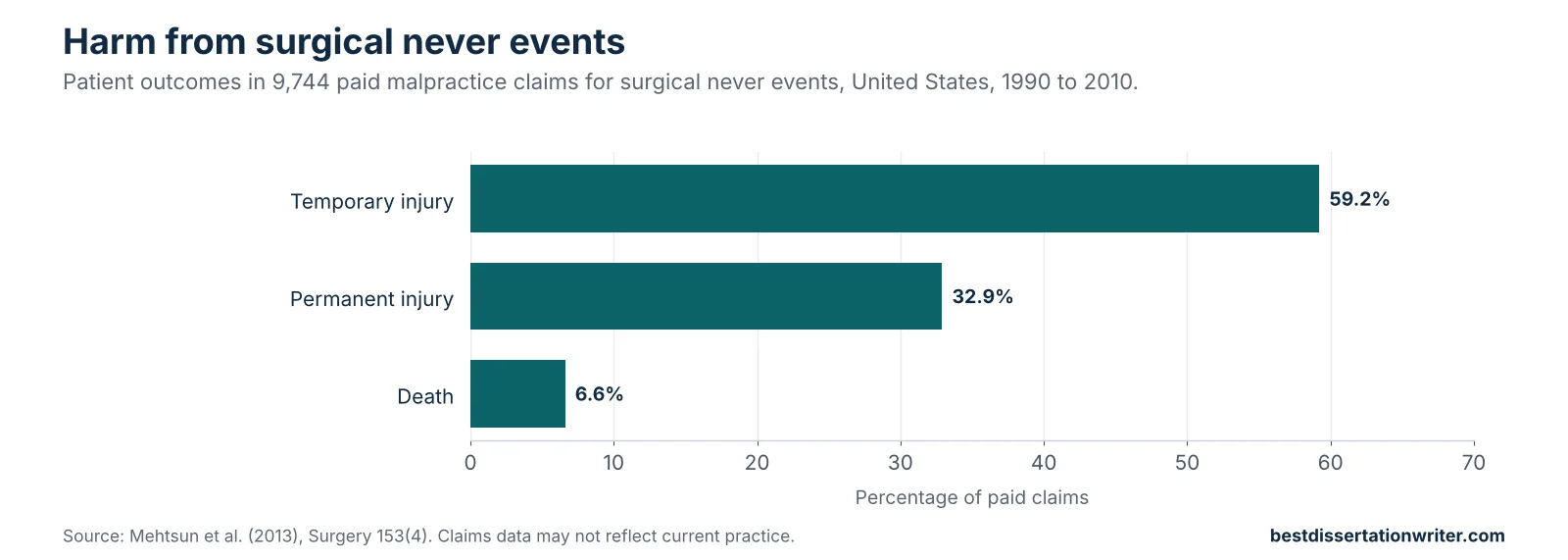
Three themes were identified: the frequency and consequences of these events, their causes and contributing factors, and the evidence for prevention. Table 1 summarises the included sources, and Figure 1 shows patient outcomes in paid claims for surgical never events.
| Author, year | Design | Setting and sample | Key finding |
|---|---|---|---|
| Mehtsun et al. (2013) | Analysis of paid malpractice claims | 9,744 claims, United States, 1990–2010 | 6.6% died and 32.9% had permanent injury; over 4,000 claimable events a year estimated. |
| Hempel et al. (2015) | Systematic review | 138 studies | Wrong-site surgery about 1 in 100,000; retained items about 1 in 10,000; communication a common root cause. |
| Moppett & Moppett (2016) | National survey of NHS trusts | 742 surgical never events over three years | Risk about 1 in 16,423 operations; not linked to other safety indicators. |
| Centre for Perioperative Care (2023) | National safety standards (NatSSIPs 2) | All invasive procedures | Stop moments, harmonised checks and proportionate counts. |
| NHS England (2025) | National incident data | Never events in England, 2022/23 | 401 never events; 178 wrong site surgery; 100 retained foreign objects. |
Theme 1: Frequency and Consequences of Never Events
NHS England (2025) reported that 401 incidents meeting the never event definition occurred in England between April 2022 and March 2023. Wrong site surgery was the most frequent category (178), followed by retained foreign objects after a procedure (100), wrong implant or prosthesis (43) and misplaced nasogastric or orogastric tubes (32). Surgical categories therefore accounted for the large majority of reported incidents.
Moppett and Moppett (2016) surveyed all English acute NHS trusts about these incidents and surgical activity over three years. They recorded 742 surgical incidents, with no change between years, equating to a risk of about 1 in 16,423 operations, or one never event per 12.9 operating theatres per year. The risk of severe harm was about 1 in 238,939 operations. The number of incidents was not meaningfully associated with other safety indicators, and the authors concluded that never events matter greatly to individual patients but are not a useful measure of the overall quality of care.
Mehtsun et al. (2013) analysed 9,744 paid malpractice claims for wrong-site surgery, retained foreign bodies and related events in the United States between 1990 and 2010, with total payments of $1.3 billion. Of the patients involved, 6.6% died, 32.9% suffered permanent injury and 59.2% suffered temporary injury. The authors estimated that over 4,000 such events leading to claims occur each year in the United States, and that 12.4% of surgeons named in one claim were later named in another.
Theme 2: Causes of Never Events and Surgical Errors
Hempel et al. (2015) systematically reviewed 138 empirical studies of wrong-site surgery, retained surgical items and surgical fires. The median incidence of wrong-site surgery in US settings was 0.09 per 10,000 procedures, or about 1 in 100,000, and that of retained surgical items was 1.32 per 10,000, or about 1 in 10,000. A frequently reported root cause was inadequate communication, and the authors suggested that improving communication was a key target for prevention.
These findings indicate that surgical errors of this kind rarely reflect a single mistake. Wrong-site surgery may arise from errors in consent forms, imaging labelled incorrectly, site marking that is absent or obscured, changes to the list order or failures to pause and confirm details during the checklist. Retained items may follow incomplete counts, distraction or changes of staff. In each case, several opportunities to detect the error were missed, often because information was not shared or concerns were not voiced.
Theme 3: Prevention of Never Events
Hempel et al. (2015) found limited evidence supporting the Universal Protocol, education and team training for preventing wrong-site surgery, and limited evidence for data-matrix-coded sponge counting systems for preventing retained items. Evidence for preventing surgical fires was insufficient. The authors noted that studying changes in rare events is methodologically difficult, which limits the conclusions that can be drawn from evaluations.
The Centre for Perioperative Care (2023) published the second version of the National Safety Standards for Invasive Procedures (NatSSIPs 2), intended to reduce misunderstandings and errors and to improve team cohesion. The standards apply to all invasive procedures, including those outside the operating department, and emphasise standardisation, harmonisation and education. They relaunch the WHO checklist with mandated stop moments to confirm the standard pathway and patient-specific details, and they introduce proportionate counts for more minor procedures.
Discussion
This review shows that surgical never events are rare for individual patients but occur regularly across health systems, that they can cause death or permanent harm and that inadequate communication is a common underlying cause. Evidence for specific preventive interventions is limited, partly because rare events are difficult to study. National standards in England aim to strengthen and harmonise safety checks across all settings.
The finding that these incidents were not associated with other safety indicators has important implications. It suggests that these incidents may occur in any organisation, including those that perform well on other measures, and that their occurrence reflects the inherent vulnerability of complex processes as much as poor overall care. This supports an approach to them that focuses on learning and system improvement rather than blame or league tables.
The importance of communication links never events to human factors and teamwork. Safety checks such as the WHO surgical safety checklist only work if team members engage with them, share information and feel able to raise concerns. When a nurse notices that the site marking does not match the consent form, or that the count is incorrect, the outcome depends on whether that concern is voiced and acted upon.
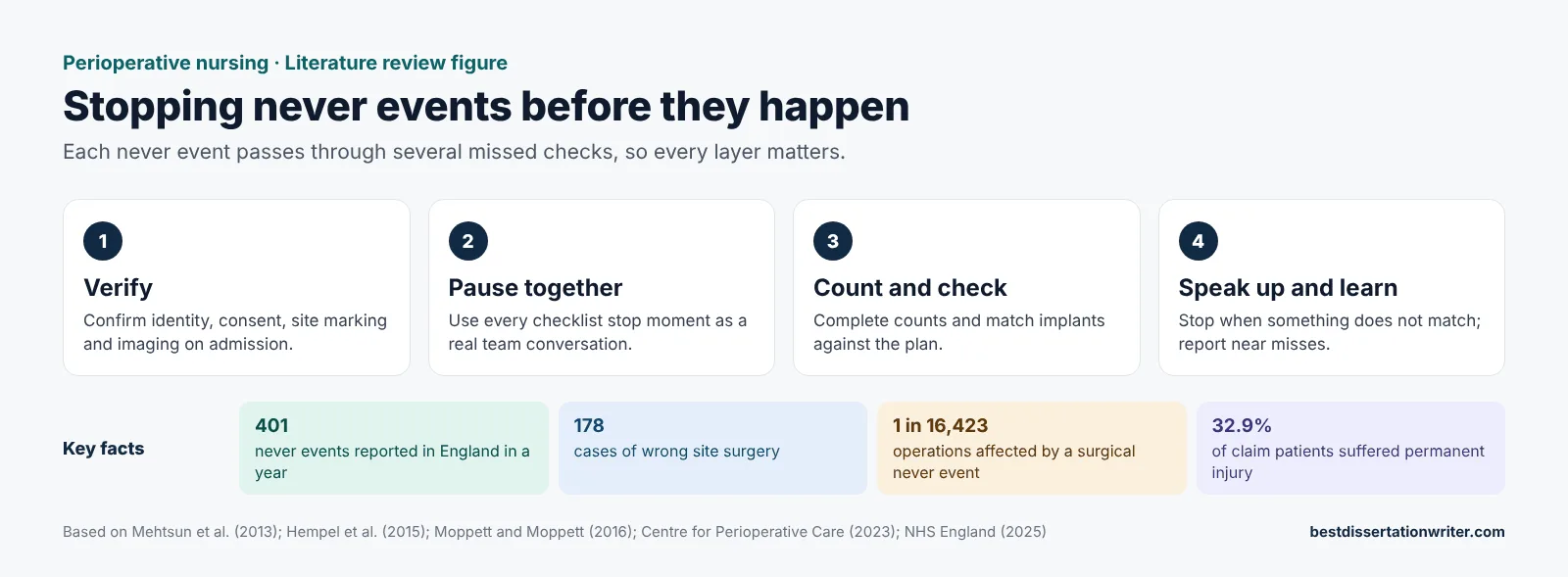
Nurses have specific responsibilities at each stage. On admission, they verify identity, consent and site marking. In the anaesthetic room and theatre, they participate in sign in, time out and sign out, check implants against the plan and perform counts. Throughout, they can act as a final barrier by stopping the process if something does not match. Preventing retained surgical items is one example of a nursing-led safeguard that directly targets a common never event.
Learning from never events requires a just culture. Staff involved in a never event may experience considerable distress, and investigations that focus on individual blame may discourage reporting and honest discussion. Approaches that examine the conditions in which the error occurred, involve staff in identifying solutions and share learning across organisations are more likely to prevent recurrence. Patients and families should also be involved and informed openly in line with the duty of candour.
Technology may offer additional safeguards. Electronic consent and listing systems can reduce transcription errors, barcode scanning can confirm that the correct implant has been selected, and counting technologies may support manual counts. However, technology can also introduce new risks if it is poorly integrated with workflows or if staff come to rely on it uncritically. The systematic review found only limited evidence for such technologies, so they should complement rather than replace established checks.
Supporting staff after an incident is part of a safety culture. Nurses involved in a serious error may feel guilt, anxiety and fear of blame, and some may consider leaving their role. Access to peer support, clear information about the investigation process and an emphasis on learning can help staff to recover and to contribute constructively to improvement.
Proportionate safety checks are a further consideration. Procedures outside the main theatre, such as those in endoscopy, radiology and outpatient settings, may not have the same culture of checking, yet the same errors can occur there too. National standards that harmonise checks across settings, and that adapt counts and checklists to the scale of the procedure, aim to extend protection without creating unnecessary burden.
The evidence base has limitations. Malpractice claims capture only events that led to payment and may not reflect current practice, national incident data depend on reporting and the survey of NHS trusts relied on self-reported data. The systematic review found few robust intervention studies. National standards are based largely on consensus. This review relied on openly accessible, English-language sources and did not involve formal systematic screening. Future research should evaluate the implementation of national standards and use methods suited to studying rare events, such as analysis of near misses.
Implications of Never Events Evidence for Practice
For perioperative nurses, the evidence supports active participation in every stage of safety checking, including identity, consent and site verification, the WHO checklist stop moments, counts and implant checks, and a willingness to stop the process when something does not match. Nurses should report near misses as well as incidents, contribute to learning reviews and support colleagues involved in such incidents. Information on national safety standards is available from NHS England’s NatSSIPs pages.
Managers should ensure that local standards reflect national guidance, that safety checks are harmonised across all procedural settings, that staff receive training in human factors and communication and that learning from incidents is shared widely. Patient safety extends into recovery, where complications such as postoperative nausea and vomiting also benefit from standardised, evidence-based care.
Conclusion
This narrative review examined the frequency, consequences, causes and prevention of surgical never events. They are rare for each patient but frequent across health systems, they can cause death or permanent harm and they are commonly linked to communication failures. Evidence for specific interventions is limited, and national standards aim to strengthen and harmonise safety checks.
Never events are a reminder that safety depends on every member of the team. Through careful checking, clear communication, a willingness to speak up and a commitment to learning rather than blame, perioperative nurses can help to make never events rarer still.
References
Centre for Perioperative Care. (2023). National safety standards for invasive procedures 2 (NatSSIPs 2). Centre for Perioperative Care.
Hempel, S., Maggard-Gibbons, M., Nguyen, D. K., Dawes, A. J., Miake-Lye, I., Beroes, J. M., Booth, M. J., Miles, J. N. V., Shanman, R., & Shekelle, P. G. (2015). Wrong-site surgery, retained surgical items, and surgical fires: A systematic review of surgical never events. JAMA Surgery, 150(8), 796–805. https://doi.org/10.1001/jamasurg.2015.0301
Mehtsun, W. T., Ibrahim, A. M., Diener-West, M., Pronovost, P. J., & Makary, M. A. (2013). Surgical never events in the United States. Surgery, 153(4), 465–472. https://doi.org/10.1016/j.surg.2012.10.005
Moppett, I. K., & Moppett, S. H. (2016). Surgical caseload and the risk of surgical Never Events in England. Anaesthesia, 71(1), 17–30. https://doi.org/10.1111/anae.13290
NHS England. (2025). Never Events reported as occurring between April 2022 and March 2023: Final update. https://www.england.nhs.uk/long-read/never-events-reported-as-occurring-between-april-2022-and-march-2023-final-update/
Cite this example
Best Dissertation Writers (2026) Never Events in Surgery: Causes, Prevention, and Learning for Nursing Practice: A Narrative Review. Available at: https://bestdissertationwriter.com/never-events-literature-review/
Best Dissertation Writers
Get expert help with your nursing literature review
Share your topic and deadline with Best Dissertation Writers and get support tailored to your module brief.