
Prevention of Inadvertent Perioperative Hypothermia: A Systematic Review of Nursing Interventions
 By Dr. Robertson Prime, Research Fellow
Updated October 26, 2026
14 min read
About 2,800 words
In this review
Abstract
Background: Inadvertent perioperative hypothermia, a core temperature below 36°C, is a common and preventable complication of anaesthesia and surgery. It is associated with wound infection, cardiac events, bleeding, shivering and discomfort, and its prevention depends largely on nursing care before, during and after surgery.
Aim: This systematic review aimed to examine the consequences of perioperative hypothermia and the effectiveness of nursing interventions for prevention and treatment, including active warming, warmed fluids and thermal insulation.
Methods: Evidence was identified through targeted searches of openly accessible bibliographic records, publisher websites and the reference lists of key reviews. Five sources published between 1996 and 2016 were included: one randomised controlled trial and four Cochrane reviews, appraised using CASP checklists and synthesised narratively.
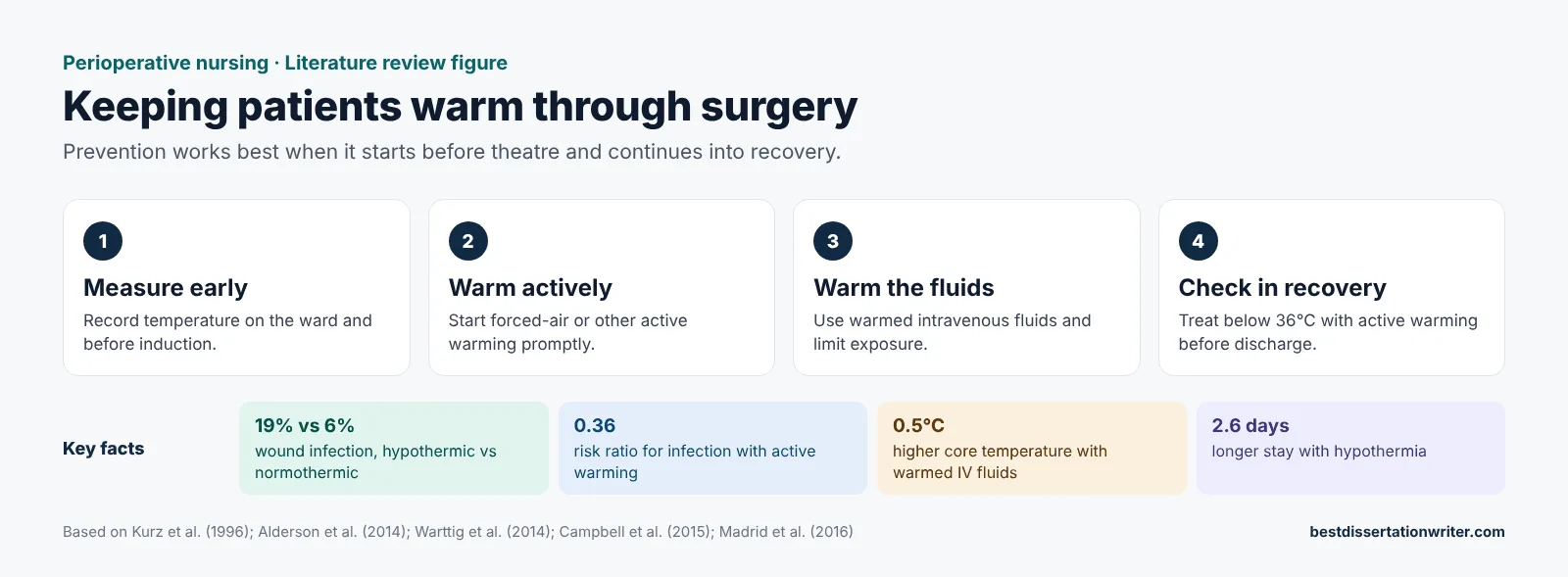
Findings: In colorectal surgery, maintaining normothermia reduced wound infection from 19% to 6% and shortened hospital stay by 2.6 days. Active body surface warming reduced surgical site infection (risk ratio 0.36) and shivering (0.39). Warmed intravenous fluids kept core temperature about 0.5°C higher, while extra thermal insulation offered no clear benefit over standard care. After surgery, active warming returned patients to normal temperature faster than blankets.
Conclusion: Preventing perioperative hypothermia requires temperature monitoring throughout the pathway, active patient warming for those at risk and warmed intravenous fluids. Nurses play a central role in ensuring these measures are applied consistently.
Keywords: perioperative hypothermia, temperature monitoring, patient warming
Introduction
This systematic review critically examines recent evidence on perioperative hypothermia and its implications for perioperative nursing practice.
Most patients lose heat during surgery. General and regional anaesthesia impair the body’s ability to regulate temperature, causing heat to move from the core to the periphery and reducing the normal responses, such as vasoconstriction and shivering, that conserve and generate heat. At the same time, patients are exposed in a cool operating theatre, their skin is cleaned with cold solutions and they may receive cold intravenous and irrigation fluids. Without active prevention, a large proportion of surgical patients become hypothermic.
Inadvertent perioperative hypothermia is usually defined as a core temperature below 36°C. Even mild hypothermia can have important consequences. It impairs immune function and reduces blood flow to the skin, which may increase the risk of wound infection. It affects blood clotting, increasing bleeding, and it places additional strain on the heart. Patients who are cold after surgery often shiver and feel uncomfortable, and recovery may take longer.
A systematic review approach was chosen to focus on randomised trials and Cochrane reviews, which provide the strongest evidence on the effectiveness of warming interventions.
The question matters for perioperative nurses because they are responsible for much of the care that determines a patient’s temperature: measuring temperature before surgery, applying warming devices, warming fluids, keeping patients covered and monitoring and treating hypothermia in recovery. Understanding the evidence helps nurses to prioritise the interventions most likely to work.
Review question
What are the consequences of perioperative hypothermia, and how effective are nursing interventions to prevent and treat it?
Background to Perioperative Hypothermia
The fall in core temperature during anaesthesia typically follows a recognised pattern. In the first hour, heat is redistributed from the core to the cooler peripheral tissues, causing a rapid drop in core temperature. This is followed by a slower decline as heat loss to the environment exceeds heat production. Eventually, temperature may plateau as vasoconstriction returns. Because the first phase is rapid, warming the patient before anaesthesia, sometimes called prewarming, can reduce the initial drop by increasing the heat content of peripheral tissues.
Risk factors for perioperative hypothermia include older age, low body weight, a low preoperative temperature, higher ASA grade, combined general and regional anaesthesia, major or long surgery and large volumes of cold fluids. Patients undergoing major abdominal surgery, in which large areas of the body cavity are exposed, are particularly vulnerable.
Interventions to prevent hypothermia can be passive or active. Passive measures, such as blankets, reflective covers and keeping the patient covered, reduce heat loss but do not add heat. Active measures add heat to the body: forced-air warming blows warm air through a blanket over the patient, while resistive heating mattresses and blankets and circulating water devices transfer heat by conduction. Warming intravenous and irrigation fluids prevents the cooling effect of cold fluids.
Temperature monitoring is essential to detect hypothermia and guide treatment. Core temperature can be measured at several sites, and the choice depends on the type of surgery and anaesthesia. Guidelines typically recommend measuring temperature before induction, regularly during surgery and on arrival in and before discharge from recovery, with patients not leaving recovery until their temperature is at least 36°C.
The theatre environment itself influences heat loss. Theatres are often kept cool for the comfort of gowned staff, and high rates of air exchange increase convective heat loss from exposed skin. Raising the ambient temperature while the patient is exposed, for example during induction and skin preparation, can reduce heat loss, but it must be balanced against staff comfort. Coordinating these decisions is part of the team’s shared responsibility for preventing perioperative hypothermia.
Search Strategy and Methods
Evidence for this example was identified through targeted searches of openly accessible bibliographic records, publisher websites and the reference lists of key reviews. Search terms combined keywords for the problem (“perioperative hypothermia”, “inadvertent hypothermia”, “normothermia”, “core temperature”) with terms for interventions (“patient warming”, “forced-air warming”, “warmed fluids”, “thermal insulation”, “temperature monitoring”), joined with the Boolean operators AND and OR. A full systematic review for assessment would run the same strategy in CINAHL, PubMed/MEDLINE, the Cochrane Library and Embase and report the number of records screened in a PRISMA flow diagram.
Sources were eligible if they were randomised trials or systematic reviews of adults undergoing surgery that examined the consequences of hypothermia or the effectiveness of interventions to prevent or treat it. Pharmacological interventions to prevent shivering and studies of children were excluded.
Five sources published between 1996 and 2016 were included: one randomised trial of maintaining normothermia during colorectal surgery and four Cochrane reviews of thermal insulation, treatment of postoperative hypothermia, warmed intravenous and irrigation fluids and active body surface warming (Table 1). Each source was appraised using the Critical Appraisal Skills Programme (CASP) checklist appropriate to its design, and findings were synthesised narratively and grouped into themes.
Key Findings on Perioperative Hypothermia
Three themes were identified: the consequences of perioperative hypothermia, the effectiveness of active patient warming during surgery and the contribution of fluid warming, insulation and treatment after surgery. Table 1 summarises the included sources, and Figure 1 shows pooled effects of active warming on key outcomes.
| Author, year | Design | Setting and sample | Key finding |
|---|---|---|---|
| Kurz et al. (1996) | Randomised controlled trial | 200 colorectal surgery patients | Normothermia reduced wound infection (6% vs 19%) and shortened stay by 2.6 days. |
| Alderson et al. (2014) | Cochrane systematic review | 22 trials of thermal insulation | No clear benefit of extra insulation; forced-air warming kept patients warmer. |
| Warttig et al. (2014) | Cochrane systematic review | 11 trials; 699 adults | Active warming restored normal temperature faster and reduced shivering. |
| Campbell et al. (2015) | Cochrane systematic review | 24 studies; 1,250 adults | Warmed IV fluids kept core temperature about 0.5°C higher; irrigation warming no clear effect. |
| Madrid et al. (2016) | Cochrane systematic review | 67 trials; 5,438 participants | Active warming reduced infection (RR 0.36) and shivering (RR 0.39). |
Theme 1: Consequences of Perioperative Hypothermia
Kurz et al. (1996) randomised 200 patients undergoing colorectal surgery to routine thermal care or additional warming to maintain normothermia. At the end of surgery, mean core temperature was 34.7°C in the routine care group and 36.6°C in the warmed group. Wound infection occurred in 19% of the hypothermic patients and 6% of the normothermic patients. Sutures were removed a day later in the hypothermic group, and hospital stay was 2.6 days longer, an increase of about 20%.
This landmark trial showed that mild hypothermia, a fall of only around 2°C, can have significant clinical consequences. It provided an early rationale for routine warming during major surgery and remains one of the most widely cited studies in the field. Because it was conducted in colorectal surgery, which carries a relatively high risk of infection, the size of the effect may differ in other types of surgery.
Theme 2: Active Patient Warming and Perioperative Hypothermia
Madrid et al. (2016) reviewed 67 randomised trials with 5,438 participants of active body surface warming, most often forced-air warming. Compared with control, active warming reduced surgical site infection (risk ratio 0.36, 95% CI 0.20 to 0.66; three trials, 589 participants, low certainty) and shivering (risk ratio 0.39, 95% CI 0.28 to 0.54; 29 studies). In high-risk patients, one trial suggested fewer major cardiovascular complications with forced-air warming (risk ratio 0.22, 95% CI 0.05 to 1.00), although this was based on few events. Active warming also reduced blood loss slightly and improved thermal comfort, but did not reduce mortality or the need for transfusion.
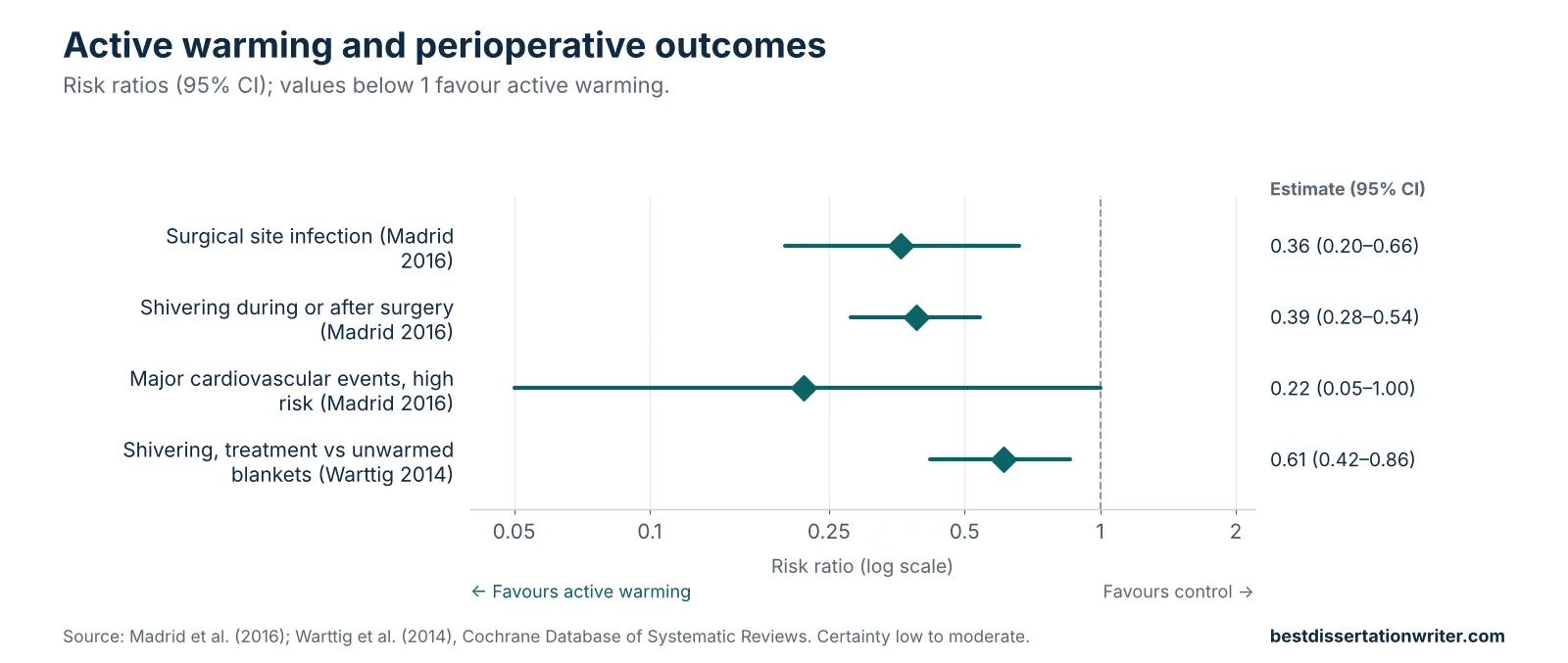
These findings support active warming as the main intervention to prevent perioperative hypothermia and its complications. The certainty of evidence for important outcomes such as infection and cardiovascular events was low, largely because few trials reported them, but the consistency of benefit across outcomes and the low risk of harm support its routine use for patients at risk.
Theme 3: Fluid Warming, Insulation and Treatment of Perioperative Hypothermia
Campbell et al. (2015) reviewed 24 studies with 1,250 adults of warmed intravenous and irrigation fluids. Warmed intravenous fluids kept core temperature about 0.5°C higher than room-temperature fluids throughout surgery and reduced shivering, with moderate-quality evidence. Warmed irrigation fluids made no significant difference. No trials reported rates of hypothermia or clinical complications.
Alderson et al. (2014) reviewed 22 trials of thermal insulation, such as reflective blankets and extra layers. Extra insulation made no significant difference to core temperature compared with standard care (mean difference 0.12°C), and forced-air warming kept patients warmer than insulation by roughly 0.5 to 1°C. The authors found no clear benefit of extra insulation over standard care.
Warttig et al. (2014) reviewed 11 trials with 699 adults of treatments for hypothermia after surgery. Active warming returned patients to normal temperature about 30 minutes faster than warmed cotton blankets and about 89 minutes faster than unwarmed blankets, and reduced shivering compared with unwarmed blankets (risk ratio 0.61, 95% CI 0.42 to 0.86). Forced-air warming restored normal temperature about 54 minutes sooner than circulating water devices.
Discussion
This review shows that perioperative hypothermia has significant clinical consequences, including wound infection and longer hospital stay, and that active patient warming is the most effective preventive intervention. Warmed intravenous fluids provide a modest additional benefit, while extra passive insulation adds little to standard care. After surgery, active warming restores normal temperature more quickly than blankets.
The evidence supports a pathway approach in which prevention begins before the patient reaches the operating theatre. Measuring temperature on the ward, keeping patients warm while they wait and prewarming those at higher risk can reduce the initial fall in temperature after induction. In theatre, active warming should be started promptly, intravenous fluids above a modest volume should be warmed and exposure of the patient should be minimised. In recovery, temperature should be checked on arrival and active warming used for patients who are hypothermic.
Temperature monitoring is the foundation of this approach. Without accurate and regular measurement, hypothermia may go undetected, particularly in short procedures or under regional anaesthesia, where patients may not feel cold until their temperature has already fallen. Nurses should ensure that temperature is recorded at each stage of the pathway and that abnormal values lead to action rather than simply being documented.
The modest effect of warmed fluids should be interpreted in context. A difference of 0.5°C may seem small, but it may be enough to keep a patient above the 36°C threshold, and fluid warming is easy to combine with surface warming. For patients receiving large volumes of fluid or blood products, warming is particularly important because cold fluids can cause a rapid fall in core temperature.
Compliance with warming guidance is often incomplete. Warming devices may not be available in every theatre, may be started late or may be removed during positioning and not replaced. A human factors perspective suggests that making warming the default, for example by having devices set up before the patient arrives and including temperature in the team briefing, is more effective than relying on individual memory.
Perioperative hypothermia is linked to other complications that nurses work to prevent. Reduced skin perfusion may contribute to pressure damage, and impaired immunity may increase infection risk, linking warming to the prevention of perioperative pressure injuries and surgical site infection. In day surgery, where patients may be discharged within hours, ensuring normothermia before discharge is also an important part of day surgery nursing.
Particular groups need closer attention. Older and frail patients, those with low body weight and those undergoing emergency surgery may already be cold when they arrive in theatre and may have less capacity to generate heat. Emergency patients may also have little time for prewarming. Identifying these patients early and starting active warming as soon as possible, including in the anaesthetic room, can help to limit the fall in temperature.
Patient comfort is a further reason to prioritise warming. Feeling cold and shivering after surgery are distressing experiences that patients often remember. Active warming improves thermal comfort, and simple measures such as offering warm blankets and asking patients whether they feel cold show attention to their experience as well as their physiology.
The evidence base has limitations. The landmark trial was conducted in one type of surgery in the 1990s, before many current practices were established. The Cochrane reviews included many small trials with unclear risk of bias, and important outcomes such as infection and cardiovascular events were reported in few studies. This review relied on openly accessible, English-language sources and did not involve formal systematic screening. Future research should report clinical outcomes consistently and evaluate implementation strategies to improve compliance with warming guidance.
Implications of Perioperative Hypothermia Evidence for Practice
For perioperative nurses, the evidence supports measuring temperature before surgery and at regular intervals throughout the perioperative pathway, keeping patients warm and covered, using forced-air or other active patient warming for those at risk, warming intravenous fluids, minimising exposure during skin preparation and positioning, and using active warming in recovery for patients who are hypothermic. National guidance on prevention is set out in the NICE guideline on hypothermia in adults having surgery.
Education should cover not only how to use warming equipment but why it matters. Staff who understand the link between a small fall in temperature and outcomes such as infection and prolonged stay are more likely to prioritise warming when time is short. Sharing local audit data on patient temperatures can reinforce this understanding and highlight where practice needs to improve.
Theatre managers should ensure that warming devices and fluid warmers are available for every theatre and recovery area, that staff are trained in their use and that temperature data are audited. Including temperature in team briefings and the sign-out, and making normothermia a quality indicator, can help to embed prevention of perioperative hypothermia in routine practice.
Conclusion
This systematic review examined the consequences and prevention of perioperative hypothermia. Hypothermia increases wound infection and prolongs hospital stay, active patient warming reduces infection and shivering, warmed intravenous fluids provide a modest additional benefit and active warming treats postoperative hypothermia more quickly than blankets. Extra passive insulation offers little added value.
Perioperative hypothermia is common but largely preventable. Through consistent temperature monitoring, prompt active warming and attention to patient comfort across the whole surgical pathway, perioperative nurses can protect patients from a complication with real clinical consequences.
References
Alderson, P., Campbell, G., Smith, A. F., Warttig, S., Nicholson, A., & Lewis, S. R. (2014). Thermal insulation for preventing inadvertent perioperative hypothermia. Cochrane Database of Systematic Reviews, (6), CD009908. https://doi.org/10.1002/14651858.CD009908.pub2
Campbell, G., Alderson, P., Smith, A. F., & Warttig, S. (2015). Warming of intravenous and irrigation fluids for preventing inadvertent perioperative hypothermia. Cochrane Database of Systematic Reviews, (4), CD009891. https://doi.org/10.1002/14651858.CD009891.pub2
Kurz, A., Sessler, D. I., & Lenhardt, R. (1996). Perioperative normothermia to reduce the incidence of surgical-wound infection and shorten hospitalization. New England Journal of Medicine, 334(19), 1209–1216. https://doi.org/10.1056/NEJM199605093341901
Madrid, E., Urrútia, G., Roqué i Figuls, M., Pardo-Hernandez, H., Campos, J. M., Paniagua, P., Maestre, L., & Alonso-Coello, P. (2016). Active body surface warming systems for preventing complications caused by inadvertent perioperative hypothermia in adults. Cochrane Database of Systematic Reviews, (4), CD009016. https://doi.org/10.1002/14651858.CD009016.pub2
Warttig, S., Alderson, P., Campbell, G., & Smith, A. F. (2014). Interventions for treating inadvertent postoperative hypothermia. Cochrane Database of Systematic Reviews, (11), CD009892. https://doi.org/10.1002/14651858.CD009892.pub2
Cite this example
Best Dissertation Writers (2026) Prevention of Inadvertent Perioperative Hypothermia: A Systematic Review of Nursing Interventions. Available at: https://bestdissertationwriter.com/perioperative-hypothermia-review-review/
Best Dissertation Writers
Get expert help with your nursing literature review
Share your topic and deadline with Best Dissertation Writers and get support tailored to your module brief.