Preoperative Anxiety and the Effectiveness of Patient Education Delivered by Nurses: A Systematic Review
 By Dr. Robertson Prime, Research Fellow
Updated October 26, 2026
14 min read
About 2,900 words
In this review
Abstract
Background: Preoperative anxiety is common among adults awaiting surgery and is associated with greater anaesthetic and analgesic requirements and a higher risk of postoperative delirium. Nurses are well placed to identify anxious patients and to deliver preparation, information and simple interventions before surgery.
Aim: This systematic review aimed to examine the prevalence and consequences of preoperative anxiety in adults and the effectiveness of nurse-deliverable interventions, including patient education, psychological preparation and music.
Methods: Evidence was identified through targeted searches of openly accessible bibliographic records, publisher websites and the reference lists of key reviews. Five sources published between 2013 and 2025 were included: three systematic reviews of interventions, one meta-analysis of outcomes and one cross-sectional study, appraised using CASP checklists and synthesised narratively.
Findings: Half of patients in one multi-hospital study had high state anxiety, and female sex and surgery within 24 hours were associated with higher odds of anxiety. Anxiety was associated with higher anaesthetic and analgesic requirements and greater odds of delirium in adults. Psychological preparation reduced negative affect, pain and length of stay, music listening reduced anxiety scores, and the format and timing of information made little difference.
Conclusion: Preoperative anxiety is common and clinically important. Nurses should assess anxiety routinely and offer psychological preparation and music alongside clear preoperative education, while recognising that much of the evidence is of low certainty.
Keywords: preoperative anxiety, patient education, preoperative education
Introduction
This systematic review critically examines recent evidence on preoperative anxiety and its implications for perioperative nursing practice.
Waiting for surgery is stressful. Patients may worry about anaesthesia, pain, the outcome of the operation, loss of control, time away from work or family and the possibility of complications or death. For many people, this worry is a normal and proportionate response, but for some it becomes severe enough to cause distress, disturb sleep and affect how they experience their care. Anxiety before surgery is therefore a concern for patient wellbeing in its own right, as well as a possible influence on recovery.
Nurses meet patients at several points before surgery: in preoperative assessment clinics, on admission wards and in the anaesthetic room. They are therefore well placed to recognise anxiety, to provide preoperative education and reassurance and to offer simple interventions that may reduce distress. However, time before surgery is often limited, and nurses need to know which approaches are supported by evidence and which make little difference.
A systematic review approach was chosen to focus on high-level evidence, including Cochrane reviews and meta-analyses, supplemented by a primary study of prevalence and associated factors.
The question is important because preoperative anxiety is common, because it may affect clinical outcomes such as anaesthetic requirements and delirium, and because many interventions to reduce it are simple, low-cost and within the scope of nursing practice. Understanding the evidence helps nurses to prioritise their limited time with patients before surgery.
Review question
How common is preoperative anxiety in adults, what are its consequences, and which nurse-deliverable interventions reduce it?
Background to Preoperative Anxiety
Preoperative anxiety is generally understood as a state of unease, apprehension or tension related to an impending operation. It is distinct from trait anxiety, which describes a person’s general tendency to feel anxious, although people with high trait anxiety may be more likely to experience high anxiety before surgery. Commonly used measures include the State-Trait Anxiety Inventory (STAI) and the Amsterdam Preoperative Anxiety and Information Scale (APAIS), which also assesses how much information a patient wants.
Several mechanisms may explain why anxiety affects outcomes. Anxiety activates the stress response, which may increase heart rate and blood pressure, alter pain perception and increase the amount of anaesthetic needed to achieve sedation. Anxious patients may also find it harder to understand and remember information, to engage in recovery activities such as mobilising and deep breathing, and to cope with pain after surgery.
Interventions to reduce preoperative anxiety fall into several groups. Patient education provides procedural information about what will happen, sensory information about what the patient will feel and behavioural instruction about what they should do to aid recovery. Psychological approaches include cognitive interventions, relaxation, hypnosis and emotion-focused support. Music listening is a further option that can be offered easily on wards and in anaesthetic rooms. Pharmacological premedication, such as benzodiazepines, is also used, but it carries risks such as sedation and is outside the scope of this review.
Preoperative education may be delivered verbally, in writing, by video or through multimedia resources, and at different times, from the assessment clinic to the day of surgery. Health services increasingly use digital resources to provide information before surgery, which raises questions about which formats and timings are most effective in reducing preoperative anxiety and improving knowledge.
Search Strategy and Methods
Evidence for this example was identified through targeted searches of openly accessible bibliographic records, publisher websites and the reference lists of key reviews. Search terms combined keywords for the problem (“preoperative anxiety”, “anxiety before surgery”, “surgical patients”) with terms for interventions and outcomes (“patient education”, “preoperative education”, “psychological preparation”, “music”, “anaesthetic requirements”, “delirium”), joined with the Boolean operators AND and OR. A full systematic review for assessment would run the same strategy in CINAHL, PubMed/MEDLINE, the Cochrane Library and PsycINFO and report the number of records screened in a PRISMA flow diagram.
Sources were eligible if they examined the prevalence, associated factors or consequences of anxiety in adults awaiting surgery, or evaluated interventions that nurses could deliver to reduce it. Systematic reviews and meta-analyses were prioritised. Studies of children, studies of pharmacological premedication alone and reports without anxiety or outcome data were excluded.
Five sources published between 2013 and 2025 were included: two Cochrane reviews of interventions, one systematic review of information format and timing, one systematic review and meta-analysis of the consequences of preoperative anxiety and one cross-sectional study of prevalence across 14 hospitals (Table 1). Each source was appraised using the Critical Appraisal Skills Programme (CASP) checklist appropriate to its design, and findings were synthesised narratively and grouped into themes.
Key Findings on Preoperative Anxiety
Three themes were identified: the prevalence and consequences of preoperative anxiety, the effects of psychological preparation and music, and the role of the format and timing of preoperative education. Table 1 summarises the included sources, and Figure 1 shows pooled effects from the intervention reviews.
| Author, year | Design | Setting and sample | Key finding |
|---|---|---|---|
| Bradt et al. (2013) | Cochrane systematic review | 26 trials; 2,051 participants | Music reduced anxiety (STAI-S −5.72 points; SMD −0.60) with no adverse effects. |
| Powell et al. (2016) | Cochrane systematic review | 105 studies; 10,302 adults | Psychological preparation reduced pain, negative affect and length of stay; low-certainty evidence. |
| Hounsome et al. (2017) | Systematic review | 34 trials; 3,742 participants | Format affected knowledge more than anxiety; timing made no difference. |
| Shawahna et al. (2023) | Cross-sectional study | 280 adults, 14 hospitals | 50.0% high state anxiety; higher odds in women and surgery within 24 hours. |
| Shebl et al. (2025) | Systematic review and meta-analysis | Observational studies of surgical patients | Anxiety linked to higher anaesthetic and analgesic needs and adult delirium. |
Theme 1: Prevalence and Consequences of Preoperative Anxiety
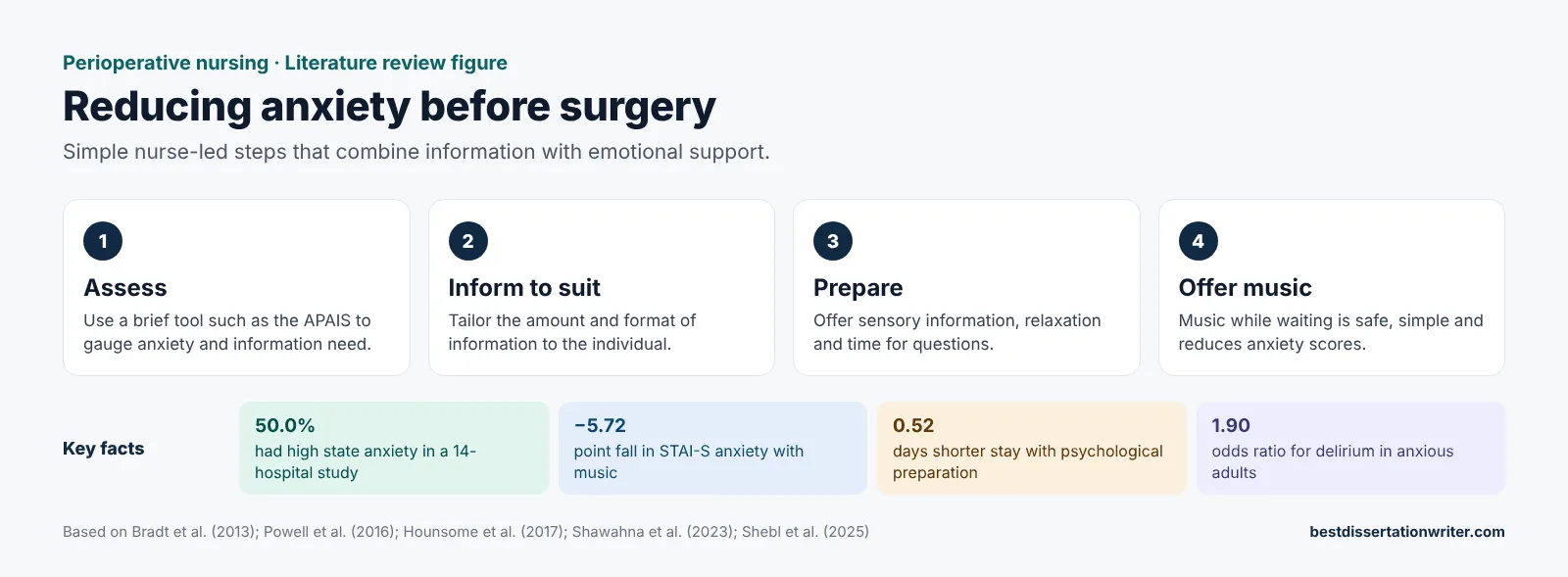
Shawahna et al. (2023) surveyed 280 adults scheduled for elective surgery in 14 hospitals in Palestine. Using a short state anxiety scale, 50.0% of patients had high anxiety, and 27.1% had high anxiety on the APAIS. A high need for information was reported by 57.1% of patients. Female patients had almost three times the odds of high anxiety (odds ratio 2.89, 95% CI 1.44 to 5.81), and surgery scheduled within 24 hours was associated with roughly twice the odds (odds ratio 2.04, 95% CI 1.15 to 3.60). Chronic disease and previous surgical complications were also associated with higher anxiety.
Shebl et al. (2025) conducted a systematic review and meta-analysis of the impact of preoperative anxiety on surgical outcomes. Anxiety was associated with higher anaesthetic requirements (standardised mean difference 0.67, 95% CI 0.32 to 1.01) and analgesic requirements (0.89, 95% CI 0.65 to 1.12), and with increased odds of postoperative delirium in adults (odds ratio 1.90, 95% CI 1.11 to 3.26). No significant association with postoperative pain was found. The authors’ results section reported some figures that differ from the abstract, so the abstract values are used here and should be interpreted with caution.
Taken together, these sources suggest that preoperative anxiety affects a substantial proportion of surgical patients and is associated with outcomes that matter clinically. Because the prevalence study was conducted in one country and the meta-analysis combined observational studies, the findings show association rather than causation, but they support routine assessment of anxiety before surgery.
Theme 2: Psychological Preparation and Music for Preoperative Anxiety
Powell et al. (2016) reviewed 105 studies with 10,302 adults undergoing surgery under general anaesthesia. Psychological preparation, including procedural information, sensory information, behavioural instruction, cognitive interventions, relaxation, hypnosis and emotion-focused interventions, was associated with less postoperative pain (standardised mean difference −0.20, 95% CI −0.35 to −0.06), a shorter hospital stay (mean difference −0.52 days, 95% CI −0.82 to −0.22) and less negative affect (−0.35, 95% CI −0.54 to −0.16). The certainty of evidence was low, and the review measured negative affect rather than anxiety specifically.
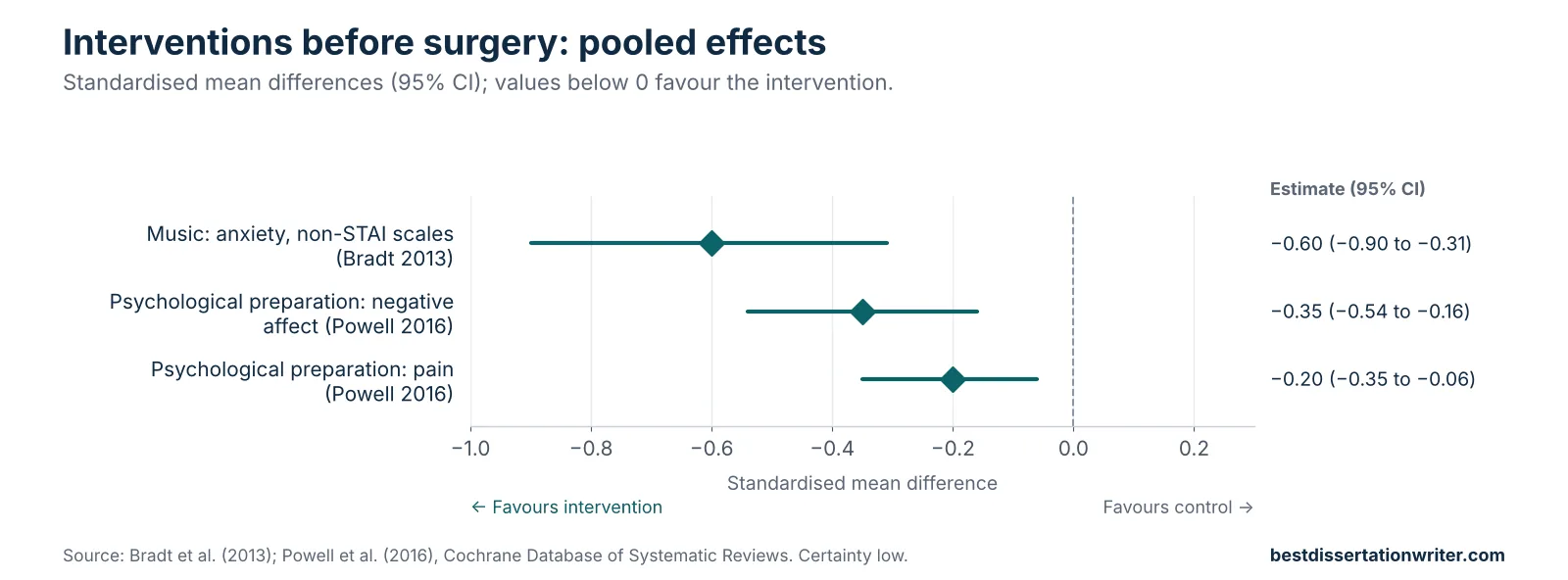
Bradt et al. (2013) reviewed 26 trials with 2,051 participants and found that music listening reduced anxiety by 5.72 points more than standard care on the state anxiety scale of the STAI (95% CI −7.27 to −4.17), and by a standardised mean difference of −0.60 (95% CI −0.90 to −0.31) on other anxiety scales. Music had small effects on heart rate and diastolic blood pressure. Most trials had a high risk of bias because blinding was not possible, but no adverse effects were identified, and one large trial found music more effective than midazolam for reducing anxiety.
These findings suggest that simple, low-cost interventions can reduce distress before surgery. Music in particular requires little staff time and can be offered on the ward, in the anaesthetic room or through the patient’s own device, while psychological preparation can be built into existing preoperative assessment and admission processes.
Theme 3: Format and Timing of Patient Education
Hounsome et al. (2017) reviewed 34 trials with 3,742 participants comparing different formats and timings of information before scheduled adult surgery. Outcomes were measured inconsistently, so results could not be pooled, and blinding was attempted in only 18% of trials. Multimedia information improved knowledge more than text, and text more than verbal information, but the effect of format on anxiety was mixed. The timing of information made no difference to anxiety, pain or length of stay.
This finding suggests that improving knowledge does not automatically reduce anxiety. Patient education remains important for informed consent and recovery, but nurses should not assume that a leaflet or video alone will relieve distress. Patients who are highly anxious may need individual conversation, reassurance and psychological support, in addition to information tailored to how much detail they want.
The review also highlights a gap between what is offered and what is tested. Many services now provide video and online information before surgery, but trials have rarely compared these resources with personal contact from a nurse. It is therefore uncertain whether digital resources can replace face-to-face conversation for anxious patients, or whether they work best as a supplement that frees nursing time for those who need more support.
Discussion
This review shows that preoperative anxiety is common, that it is associated with higher anaesthetic and analgesic requirements and an increased risk of delirium, and that psychological preparation and music can reduce distress. In contrast, changing the format or timing of information improves knowledge but has little consistent effect on anxiety. These findings point to a combined approach, in which clear information is supported by attention to the patient’s emotional needs.
The finding that many patients want more information, together with the limited effect of information format on anxiety, highlights the importance of individualised preoperative education. Some patients cope best with detailed information, while others prefer less and may become more anxious if given too much. The APAIS includes a measure of information need, which can help nurses tailor the amount and type of information they provide.
Identifying anxious patients is the first step. Shawahna et al. (2023) found that female patients and those having surgery within 24 hours were more likely to be anxious, but anxiety can affect anyone. Brief validated tools such as the APAIS can be used in assessment clinics and on admission, allowing nurses to identify patients who may benefit from additional support or referral and to alert the anaesthetist to those with severe preoperative anxiety.
Music listening appears to be one of the simplest effective options. It is safe, inexpensive and acceptable to many patients, and it can be offered during waiting times on the day of surgery, which are often a source of anxiety. Psychological preparation may require more resources, but elements such as sensory information, relaxation techniques and opportunities to ask questions can be incorporated into routine nursing care.
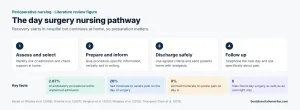
The growth of short-stay and same-day surgery has implications for how anxiety is managed. When patients arrive on the morning of their operation and go home the same day, there is less time for nurses to build rapport, identify concerns and provide preparation. Much of the work of reducing anxiety therefore shifts to preoperative assessment clinics, telephone contact and written or digital resources, and good day surgery nursing depends on using the brief time on the day of surgery well.
Organisational factors also influence preoperative anxiety. Delays, cancellations and long fasting times can increase distress, while continuity of care and a calm environment may reduce it. Nurses and managers can help by keeping patients informed about delays, minimising waiting times where possible and ensuring that patients are greeted and supported as they move from the ward to the operating theatre.
The evidence base has limitations. Much of the intervention evidence is of low certainty, with heterogeneity in interventions and outcome measures and high risk of bias due to lack of blinding. The prevalence study was conducted in one country, and the meta-analysis of consequences showed inconsistencies between its abstract and results. This review relied on openly accessible, English-language sources and did not involve formal systematic screening. Future research should use consistent anxiety measures, evaluate nurse-led interventions in pragmatic trials and examine effects on clinical outcomes such as delirium and recovery.
Implications of Preoperative Anxiety Evidence for Practice
For perioperative nurses, the evidence supports routinely assessing preoperative anxiety and information needs, providing preoperative education tailored to the individual, offering music listening during waiting times and incorporating elements of psychological preparation, such as sensory information and relaxation, into care. Patients with severe anxiety should be identified early so that the anaesthetic team can plan support. Information about anaesthesia for patients and carers is available from the Royal College of Anaesthetists.
Managers should ensure that preoperative assessment services have time and resources for patient education, support staff training in recognising and responding to anxiety and reduce avoidable delays on the day of surgery. Preoperative education can also cover topics such as positioning and skin protection, linking to the prevention of perioperative pressure injuries, and can explain what patients will experience in the operating theatre so that the environment is less unfamiliar.
Conclusion
This systematic review examined the prevalence, consequences and management of preoperative anxiety in adults. Anxiety is common, is associated with greater anaesthetic and analgesic requirements and with delirium, and can be reduced by psychological preparation and music. The format and timing of information affect knowledge more than anxiety.
Future work should also explore patients’ own experience of preparation for surgery, including which aspects of care they find most reassuring. Involving patients in the design of information resources and preoperative pathways may help to ensure that the support offered matches what anxious patients actually need, rather than what services assume they need.
Nurses can make a meaningful difference by assessing anxiety, tailoring preoperative education to each patient and offering simple, evidence-based interventions. Although much of the evidence is of low certainty, these approaches are low-risk and acceptable, and they place the patient’s emotional wellbeing alongside physical preparation for surgery.
References
Bradt, J., Dileo, C., & Shim, M. (2013). Music interventions for preoperative anxiety. Cochrane Database of Systematic Reviews, (6), CD006908. https://doi.org/10.1002/14651858.CD006908.pub2
Hounsome, J., Lee, A., Greenhalgh, J., Lewis, S. R., Schofield-Robinson, O. J., Coldwell, C. H., & Smith, A. F. (2017). A systematic review of information format and timing before scheduled adult surgery for peri-operative anxiety. Anaesthesia, 72(10), 1265–1272. https://doi.org/10.1111/anae.14018
Powell, R., Scott, N. W., Manyande, A., Bruce, J., Vögele, C., Byrne-Davis, L. M. T., Unsworth, M., Osmer, C., & Johnston, M. (2016). Psychological preparation and postoperative outcomes for adults undergoing surgery under general anaesthesia. Cochrane Database of Systematic Reviews, (5), CD008646. https://doi.org/10.1002/14651858.CD008646.pub2
Shawahna, R., Jaber, M., Maqboul, I., Hijaz, H., Tebi, M., Ahmed, N. A.-S., & Shabello, Z. (2023). Prevalence of preoperative anxiety among hospitalized patients in a developing country: A study of associated factors. Perioperative Medicine, 12, 47. https://doi.org/10.1186/s13741-023-00336-w
Shebl, M. A., Toraih, E., Shebl, M., Tolba, A. M., Ahmed, P., Banga, H. S., Orz, M., Tammam, M., Saadalla, K., Elsayed, M., Kamal, M., Abdulla, M., Eldessouky, A. I., Moustafa, Y. T., Mohamed, O. A., & Aiash, H. (2025). Preoperative anxiety and its impact on surgical outcomes: A systematic review and meta-analysis. Journal of Clinical and Translational Science, 9(1), e33. https://doi.org/10.1017/cts.2025.6
Cite this example
Best Dissertation Writers (2026) Preoperative Anxiety and the Effectiveness of Patient Education Delivered by Nurses: A Systematic Review. Available at: https://bestdissertationwriter.com/preoperative-anxiety-literature-review/
Best Dissertation Writers
Get expert help with your nursing literature review
Share your topic and deadline with Best Dissertation Writers and get support tailored to your module brief.