Human Factors and the Reduction of Errors in Perioperative Nursing Practice: A Narrative Review
 By Dr. Robertson Prime, Research Fellow
Updated October 26, 2026
14 min read
About 2,900 words
In this review
Abstract
Background: Many adverse events in surgery arise not from a lack of technical skill but from human factors: the way people, teams, equipment and the working environment interact. Theatre nurses work at the centre of these interactions and can both detect and prevent perioperative errors.
Aim: This narrative review aimed to examine how human factors contribute to perioperative errors and what evidence supports teamwork and non-technical skills interventions for error reduction.
Methods: Evidence was identified through targeted searches of openly accessible bibliographic records, publisher websites and the reference lists of key reviews. Five sources published between 2007 and 2018 were included: two observational studies of operating teams, one national evaluation of team training and two systematic reviews, appraised using CASP checklists and synthesised narratively.
Findings: Direct observation showed that latent failures and flow disruptions were common even in successful operations, and that teamwork and communication failures were the strongest predictor of surgical errors. A review of 28 studies found that teamwork failure was strongly related to technical error. Facilities that implemented medical team training saw an 18% reduction in annual surgical mortality, but a systematic review found that evidence linking teamwork training to patient outcomes remained limited and inconsistent.
Conclusion: Human factors shape safety in the operating theatre. Nurses and theatre leaders should reduce disruptions, strengthen communication and support team training, while recognising that evidence for outcome benefits is still developing.
Keywords: human factors, error reduction, perioperative errors
Introduction
This narrative review critically examines recent evidence on human factors and its implications for perioperative nursing practice.
Surgery is a complex activity in which many people with different roles work together under time pressure, using sophisticated equipment in a busy environment. Most operations go well, but when things go wrong, investigations frequently find that the cause lay not in a lack of knowledge or technical skill but in communication breakdowns, distractions, poorly designed equipment, fatigue or unclear roles. The study of these issues is known as human factors, or ergonomics.
Human factors is the scientific discipline concerned with understanding interactions between people and the other elements of a system, and with designing systems that support safe and effective performance. In healthcare, it examines how the environment, organisation, job and individual characteristics influence behaviour at work. Rather than blaming individuals for errors, a human factors approach asks why the system made the error likely and how it can be redesigned to prevent recurrence.
A narrative review was chosen because the evidence includes observational studies of operating teams, a large national evaluation and systematic reviews, and a narrative approach allows these to be interpreted together.
The topic is important for perioperative nurses because they are present throughout every operation, coordinate the flow of equipment, people and information and are often the first to notice when something is going wrong. Understanding human factors helps nurses to recognise risks, speak up effectively and contribute to safer theatre systems.
Review question
How do human factors contribute to perioperative errors, and what evidence supports interventions that target teamwork and non-technical skills for error reduction?
Background to Human Factors in the Operating Theatre
The modern understanding of human factors in healthcare draws heavily on aviation and other high-risk industries. Concepts such as latent conditions, which are weaknesses in a system that lie dormant until they combine with an error at the front line, and the idea that errors are consequences rather than causes, have shaped patient safety thinking. In the operating theatre, latent conditions might include unreliable equipment, understaffing, poor scheduling or a culture that discourages junior staff from raising concerns.
Non-technical skills are the cognitive and social skills that complement technical skill. They include situation awareness, decision-making, communication, teamwork, leadership and the management of stress and fatigue. Behavioural rating systems have been developed for different members of the theatre team, including surgeons, anaesthetists and scrub practitioners, to describe and assess these skills.
Interventions informed by human factors include team training programmes, structured communication tools such as briefings and debriefings, checklists, standardisation of equipment and processes, reduction of interruptions and redesign of the physical environment. The WHO surgical safety checklist is one widely adopted example, intended to prompt communication and shared awareness at critical points in an operation.
In the United Kingdom, human factors principles are reflected in national standards for invasive procedures, in the training of theatre practitioners and in the approach taken to investigating serious incidents. Despite this, many theatre staff receive limited formal teaching on human factors, and the principles are not always embedded in everyday practice.
Perioperative nursing has always involved attention to the conditions in which care is delivered, from preparing the theatre and checking equipment to coordinating the team and advocating for the patient. A systems perspective gives a formal language to much of this work and helps nurses to explain why apparently routine tasks, such as protecting a count from interruption or insisting on a briefing, matter for patient safety. It also encourages nurses to look beyond the individual who made a mistake to the circumstances that made the mistake possible.
Search Strategy and Methods
Evidence for this example was identified through targeted searches of openly accessible bibliographic records, publisher websites and the reference lists of key reviews. Search terms combined keywords for the concept (“human factors”, “non-technical skills”, “teamwork”, “communication”, “flow disruptions”) with terms for the setting and outcome (“operating theatre”, “operating room”, “perioperative errors”, “surgical errors”, “error reduction”, “mortality”), joined with the Boolean operators AND and OR. A full narrative review for assessment would run the same strategy in CINAHL, PubMed/MEDLINE, the Cochrane Library and Embase and report the number of records screened in a PRISMA flow diagram.
Sources were eligible if they examined how human factors, teamwork or non-technical skills relate to errors or outcomes in surgery, or evaluated interventions targeting these factors. Observational studies, evaluations and systematic reviews were included. Opinion pieces and studies outside the operating theatre were excluded.
Five sources published between 2007 and 2018 were included: two direct observation studies of operating teams, one national evaluation of a medical team training programme and two systematic reviews, one of non-technical skills and technical performance and one of teamwork interventions and patient outcomes (Table 1). Each source was appraised using the Critical Appraisal Skills Programme (CASP) checklist appropriate to its design, and findings were synthesised narratively and grouped into themes.
Key Findings on Human Factors
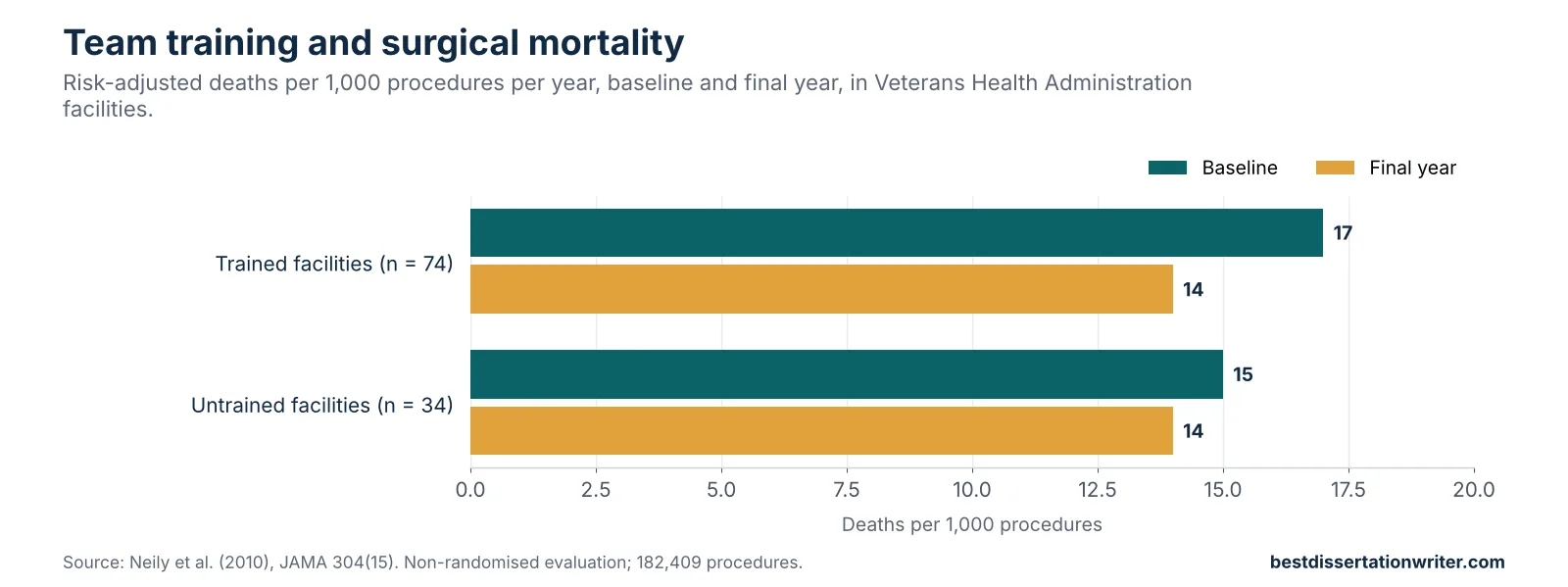
Three themes were identified: latent failures and disruptions in surgical work, the relationship between non-technical skills and technical performance, and the effects of team training on outcomes. Table 1 summarises the included sources, and Figure 1 shows mortality before and after team training in a national programme.
| Author, year | Design | Setting and sample | Key finding |
|---|---|---|---|
| Catchpole et al. (2007) | Direct observation study | Surgical teams in successful operations | Latent failures common in successful operations; many avertable through better teamwork. |
| Wiegmann et al. (2007) | Direct observation study | 31 cardiac operations | Errors rose with flow disruptions; teamwork and communication failures the strongest predictor. |
| Neily et al. (2010) | National before-and-after evaluation | 182,409 procedures; 108 facilities | 18% fall in annual mortality with team training (RR 0.82). |
| Hull et al. (2012) | Systematic review | 28 studies | Teamwork failure strongly related to technical error; fatigue linked to poorer skill. |
| Sun et al. (2018) | Systematic review | 8 studies | Evidence insufficient to show teamwork training improves patient outcomes. |
Theme 1: Human Factors, Latent Failures and Flow Disruptions
Catchpole et al. (2007) used direct observation of surgical teams to identify failures that occurred during operations that had successful outcomes. They found that latent failures, such as problems with equipment, communication and coordination, occurred during operations even when patients came to no apparent harm, and that many of these failures could have been averted by improved teamwork. The study showed that successful operations are not necessarily free from error, and that observing routine work can reveal weaknesses before they lead to harm.
Wiegmann et al. (2007) observed 31 cardiac surgery operations over three weeks and recorded surgical errors and disruptions to the flow of the procedure. Disruptions included teamwork and communication failures, equipment and technology problems, extraneous interruptions, training-related distractions and problems with access to resources. Surgical errors increased significantly as flow disruptions increased, and teamwork and communication failures were the strongest predictor of errors.
These studies suggest that perioperative errors often arise from the accumulation of small disruptions rather than from a single dramatic failure. Each interruption, missing instrument or misunderstanding may seem minor, but together they increase workload and reduce the team’s capacity to detect and correct mistakes. For nurses, who often manage equipment and interruptions, reducing disruptions is a practical route to error reduction.
Theme 2: Non-Technical Skills and Technical Performance
Hull et al. (2012) systematically reviewed 28 studies examining how non-technical skills affect technical performance in surgery. In 21 studies of surgeons, receiving feedback and coping well with stressful events improved some aspects of technical performance, while higher levels of fatigue were linked to poorer surgical skill. In six studies of the whole operating team, teamwork failure was strongly related to technical error. The authors concluded that non-technical skills can enhance technical performance and that their absence can contribute to its decline, although the size of the effect was unclear.
This review supports the view that technical and non-technical skills are interdependent. A surgeon’s technical performance depends partly on the team around them: whether instruments are ready, whether information is shared and whether the environment is calm. Theatre nurses contribute directly to these conditions through their own non-technical skills, such as anticipating the next step, communicating clearly and managing the flow of equipment.
Theme 3: Team Training, Outcomes and Error Reduction
Neily et al. (2010) evaluated a national medical team training programme in the Veterans Health Administration in the United States, analysing 182,409 procedures in 108 facilities. Annual surgical mortality fell by 18% in the 74 facilities that implemented the training (risk ratio 0.82, 95% CI 0.76 to 0.91), compared with 7% in the 34 facilities that had not (risk ratio 0.93, 95% CI 0.80 to 1.06). Risk-adjusted mortality fell from 17 to 14 deaths per 1,000 procedures in trained facilities and from 15 to 14 in untrained facilities, and each additional quarter of training was associated with a further reduction of 0.5 deaths per 1,000 procedures.
Sun et al. (2018) systematically reviewed the impact of improving teamwork on patient outcomes in surgery. From 2,720 records, eight studies met the inclusion criteria, and only three of these supported a positive effect on postoperative outcomes. The authors concluded that evidence was insufficient to show that teamwork training improves patient outcomes, citing small cohorts, the lack of a unified training programme and short training duration.
These findings present a mixed picture. The large national evaluation suggests that team training can be associated with substantial reductions in mortality, but it was non-randomised and may have been affected by other changes in participating facilities. The systematic review shows that the wider evidence base is small and inconsistent, which suggests that the effects of training depend on how it is designed, delivered and sustained.
Discussion
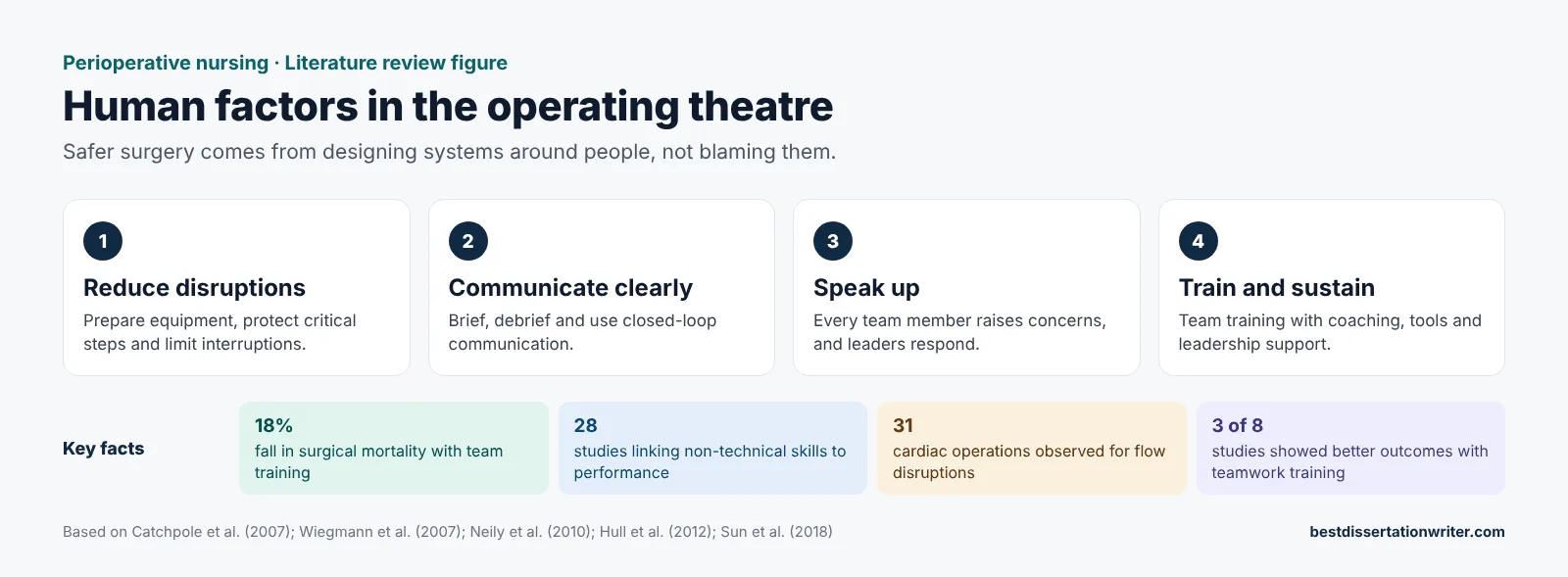
This review shows that human factors play a central role in perioperative errors. Latent failures and flow disruptions are common even in successful operations, teamwork and communication failures are strongly associated with errors and non-technical skills influence technical performance. Team training has been associated with lower mortality in one large evaluation, although the wider evidence for improved patient outcomes is limited.
The evidence suggests that error reduction in theatre depends on system design as much as on individual performance. Reducing avoidable interruptions, ensuring that equipment is checked and available, standardising processes and protecting critical phases of an operation from distraction can reduce the cognitive load on the team. Nurses are well placed to lead many of these changes because they manage the theatre environment and equipment.
Communication is a recurring theme. Briefings before a list, structured handovers, closed-loop communication and debriefings after each case can help teams share information and detect problems early. However, these tools are only effective if they are used meaningfully, and their value depends on a culture in which every member of the team, including the most junior, feels able to speak up. The role of the scrub nurse in voicing concerns about counts, sterility and equipment is an example of how non-technical skills support safety.
Human factors also explain why some never events persist despite established procedures. For example, investigations into retained surgical items frequently identify distraction, handovers and communication failures rather than a lack of knowledge about counting. Addressing these contributing factors requires changes to the system, not simply reminders to individuals to be more careful.
Fatigue and workload deserve particular attention. Hull et al. (2012) found that higher fatigue was linked to poorer surgical skill, and theatre staff frequently work long lists, extended shifts and on-call periods. Rotas that allow adequate rest, scheduling that avoids overrunning lists and a culture in which staff can admit to being tired without stigma are therefore part of a safety strategy. The same principles apply to nurses, whose vigilance during counts, checks and monitoring is affected by fatigue in the same way as that of surgeons.
The physical environment also matters. Noise, clutter, poorly positioned equipment and frequent door openings can distract the team and increase workload. Simple measures, such as agreeing quiet periods during critical phases, organising instrument trolleys consistently and limiting traffic through the theatre, can reduce these pressures without significant cost.
The variable results of team training highlight the importance of implementation. Training that is brief, one-off or not supported by leadership is unlikely to change practice. More promising approaches combine training with ongoing coaching, use of structured tools in everyday work, regular debriefing and leadership commitment, and they are evaluated using both process and outcome measures.
The evidence base has limitations. The observational studies were small and conducted in specific surgical specialties, the national evaluation was non-randomised and conducted in one health system, and the systematic reviews included heterogeneous studies with varying quality. Some details of the earlier observational studies were not available from openly accessible sources. This review relied on openly accessible, English-language sources and did not involve formal systematic screening. Future research should evaluate sustained, multi-component human factors interventions in UK theatres using robust designs.
Implications of Human Factors Evidence for Practice
For perioperative nurses, the evidence supports applying human factors principles in everyday practice: minimising interruptions during critical tasks, preparing and checking equipment before cases, using briefings and debriefings, communicating clearly with closed-loop techniques and speaking up when concerns arise. Nurses should also report near misses and latent hazards so that weaknesses can be addressed before harm occurs. The Clinical Human Factors Group provides resources on human factors in healthcare.
Learning from everyday work is as important as learning from incidents. Short debriefs at the end of a list, in which the team discusses what went well, what caused delays or frustration and what could be improved, can identify latent hazards such as missing equipment or confusing processes. Recording and acting on these observations helps to build a reliable theatre system over time, and it shows staff that their concerns lead to change.
Theatre managers should provide human factors and team training for all staff, protect time for briefings and debriefings, investigate incidents using a systems approach and design workflows that reduce disruptions. These principles apply across settings, including high-throughput lists in day surgery nursing, where time pressure and rapid turnover can increase the risk of perioperative errors.
Conclusion
This narrative review examined how human factors contribute to perioperative errors and what evidence supports interventions to address them. Latent failures and disruptions are common, teamwork and communication failures are strongly linked to errors and non-technical skills influence technical performance. Team training may reduce mortality, but the evidence base remains limited.
Human factors offer perioperative nurses a way of understanding errors that focuses on systems rather than blame. By reducing disruptions, strengthening communication and supporting team training, nurses and theatre leaders can create conditions in which safe surgery is easier to achieve.
References
Catchpole, K. R., Giddings, A. E. B., Wilkinson, M., Hirst, G., Dale, T., & de Leval, M. R. (2007). Improving patient safety by identifying latent failures in successful operations. Surgery, 142(1), 102–110. https://doi.org/10.1016/j.surg.2007.01.033
Hull, L., Arora, S., Aggarwal, R., Darzi, A., Vincent, C., & Sevdalis, N. (2012). The impact of nontechnical skills on technical performance in surgery: A systematic review. Journal of the American College of Surgeons, 214(2), 214–230. https://doi.org/10.1016/j.jamcollsurg.2011.10.016
Neily, J., Mills, P. D., Young-Xu, Y., Carney, B. T., West, P., Berger, D. H., Mazzia, L. M., Paull, D. E., & Bagian, J. P. (2010). Association between implementation of a medical team training program and surgical mortality. JAMA, 304(15), 1693–1700. https://doi.org/10.1001/jama.2010.1506
Sun, R., Marshall, D. C., Sykes, M. C., Maruthappu, M., & Shalhoub, J. (2018). The impact of improving teamwork on patient outcomes in surgery: A systematic review. International Journal of Surgery, 53, 171–177. https://doi.org/10.1016/j.ijsu.2018.03.044
Wiegmann, D. A., ElBardissi, A. W., Dearani, J. A., Daly, R. C., & Sundt, T. M. (2007). Disruptions in surgical flow and their relationship to surgical errors: An exploratory investigation. Surgery, 142(5), 658–665. https://doi.org/10.1016/j.surg.2007.07.034
Cite this example
Best Dissertation Writers (2026) Human Factors and the Reduction of Errors in Perioperative Nursing Practice: A Narrative Review. Available at: https://bestdissertationwriter.com/human-factors-literature-review/
Best Dissertation Writers
Get expert help with your nursing literature review
Share your topic and deadline with Best Dissertation Writers and get support tailored to your module brief.