Safe Sleep Practices and Prevention of Sudden Infant Death: Nursing Education for Parents: A Literature Review
 By Dr. Robertson Prime, Research Fellow
Updated October 17, 2026
15 min read
About 3,000 words
In this review
Abstract
Background: Safe sleep practices, such as placing babies on their backs on a firm, flat surface in their own sleep space, reduce the risk of sudden infant death syndrome (SIDS) and other sleep-related deaths. Nurses and midwives are often the first to teach parents about infant sleep, and the practices they model in hospital can shape what families do at home.
Aim: This narrative review aimed to examine the evidence on sleep-related infant deaths, risk factors in the sleep environment and nursing education for parents about safe sleep.
Methods: Evidence was identified through targeted searches of openly accessible bibliographic records, publisher websites and the reference lists of key reviews. Five sources published between 2013 and 2026 were included: two pooled analyses of case-control studies, a cluster randomised trial, a national policy statement and a national surveillance report, synthesised narratively.
Findings: In US surveillance of 4,861 sudden unexpected infant deaths, 78% had soft bedding in the sleep environment, 75% were not in a crib and 59% were sharing a sleep surface. Bed-sharing increased risk in young breastfed babies of non-smoking parents (adjusted odds ratio 5.1) in one analysis, while another found the greatest risks with sofa-sharing and alcohol. Text and video messages to mothers improved supine sleep from 80.2% to 89.1%, but a nursing quality improvement campaign alone did not change practices.
Conclusion: Nurses should model and teach safe sleep consistently, tailor conversations about bed-sharing to each family’s circumstances and reinforce messages after discharge.
Keywords: safe sleep practices, SIDS, parental education, infant mortality
Introduction
This narrative review critically examines recent evidence on safe sleep practices and its implications for neonatal nursing practice.
Sudden unexpected infant death is the sudden death of a baby under one year old that is not anticipated as a significant possibility beforehand. It includes sudden infant death syndrome (SIDS), in which no cause is found after investigation, as well as accidental suffocation and strangulation in bed and deaths of undetermined cause. Most of these deaths happen during sleep, and many occur in sleep environments with known risk factors.
Public health campaigns that encouraged parents to place babies on their backs to sleep led to large falls in SIDS in many countries from the early 1990s onwards. However, sleep-related deaths remain an important cause of post-neonatal infant mortality. Deaths are more common in families facing social disadvantage, in babies exposed to smoking and in unsafe sleep environments such as sofas and adult beds with soft bedding.
Nurses and midwives are central to prevention. They teach parents about infant sleep in maternity and neonatal units, at home visits and in community clinics, and the way babies are positioned in hospital cots sends a powerful message. Parents of preterm babies, who are at higher risk, may have seen their babies nursed prone or in nests in the neonatal unit and need clear guidance as they approach discharge.
A narrative approach was chosen because the evidence includes surveillance data, pooled case-control analyses, a randomised trial and a policy statement, which are best interpreted together.
Review question
What does the evidence show about sleep-related infant deaths, risk factors in the sleep environment and nursing education to promote safe sleep practices?
Background to Safe Sleep Practices
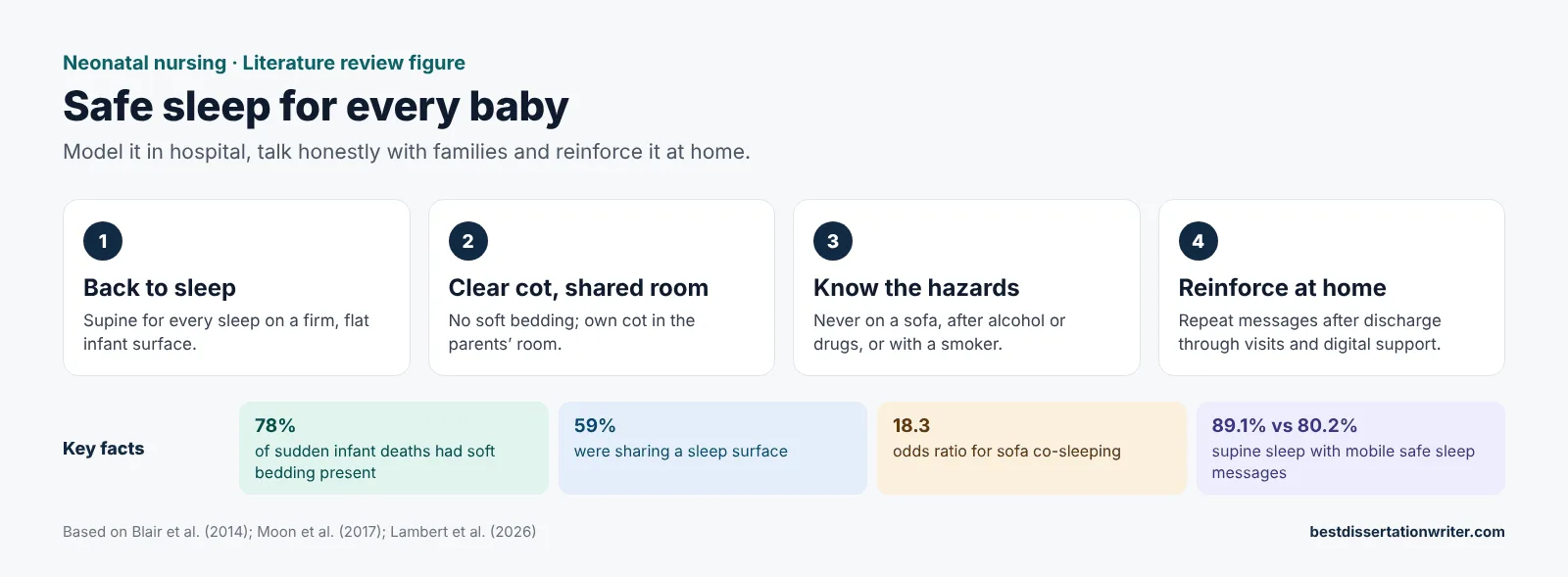
Current recommendations focus on several key practices. Babies should be placed on their backs for every sleep, on a firm, flat sleep surface designed for infants, with no pillows, quilts, bumpers or soft objects. They should sleep in the same room as their parents, in their own cot or bassinet, ideally for at least the first six months. Breastfeeding, avoiding smoke exposure during pregnancy and after birth, and avoiding overheating also reduce risk.
Bed-sharing is one of the most debated areas of safe sleep advice. Some guidance advises against bed-sharing for all babies, while other guidance focuses on avoiding particularly hazardous circumstances, such as sleeping with a baby on a sofa, after drinking alcohol or taking drugs, when a parent smokes, or when the baby was born preterm or with low birthweight. Many parents bed-share, sometimes unintentionally while feeding, so advice must be realistic as well as accurate.
Hospitals have a particular role in modelling safe sleep practices. When parents see babies placed on their backs in clear cots without blankets or toys, they are more likely to copy this at home. Conversely, when they see babies prone, in nests or with rolled blankets, they may assume these are safe. In neonatal units, therapeutic positioning is often needed for medical reasons, so a planned transition to safe sleep positioning before discharge is important.
Parental education about safe sleep is usually delivered through conversations, leaflets and videos before discharge. However, parents receive a great deal of information at this time, and messages may be forgotten or overridden by advice from family, friends and social media. Repeated, consistent messages from trusted professionals, and approaches that address parents’ real concerns, may be more effective than one-off teaching.
Parental education about safe sleep practices is also an opportunity to discuss other aspects of infant mortality prevention, such as smoking cessation, recognising when a baby is unwell and knowing how to get help. Brief, practical conversations that link these topics can help parents to see safe sleep as part of caring for their baby rather than as a list of rules.
Search Strategy and Methods
Evidence for this example was identified through targeted searches of openly accessible bibliographic records, publisher websites and the reference lists of key reviews. Search terms combined keywords for the outcome (“sudden infant death syndrome”, “SIDS”, “sudden unexpected infant death”, “sleep-related infant death”) with terms for risk factors and interventions (“safe sleep”, “bed-sharing”, “supine”, “soft bedding”, “education”, “nurse”, “parents”), joined with the Boolean operators AND and OR. A full narrative review for assessment would run the same strategy in CINAHL, PubMed/MEDLINE, the Cochrane Library and Embase and report the number of records screened in a PRISMA flow diagram.
Sources were eligible if they described risk factors for sleep-related infant deaths, evaluated interventions to promote safe sleep practices or set out current recommendations. Large pooled analyses, randomised trials and national reports were prioritised. A national policy statement was included because it represents the recommendations nurses are expected to teach.
Five sources published between 2013 and 2026 were included: two individual-level analyses of case-control studies, a cluster randomised controlled trial, a national policy statement and a national surveillance report (Table 1). The quality of each source was considered using the Critical Appraisal Skills Programme (CASP) checklists where appropriate, and findings were synthesised narratively.
Key Findings on Safe Sleep Practices
Three themes were identified: the sleep environments in which infants die, the evidence and debate on bed-sharing, and the effectiveness of education to promote safe sleep practices. Table 1 summarises the included sources, and Figure 1 shows how common unsafe sleep factors were among sudden unexpected infant deaths in a recent national report.
| Author, year | Design | Setting and sample | Key finding |
|---|---|---|---|
| Carpenter et al. (2013) | Individual-level analysis of five case-control datasets | 1,472 SIDS cases and 4,679 controls, UK, Europe and Australasia | Bed-sharing aOR 2.7 overall; 5.1 for breastfed babies under 3 months of non-smoking parents vs room-sharing. |
| Blair et al. (2014) | Combined analysis of two case-control studies | 400 SIDS cases and 1,386 controls, England | Sofa-sharing OR 18.3 and co-sleeping after alcohol OR 18.3; bed-sharing without hazards not significant. |
| Moon et al. (2017) | Cluster randomised controlled trial | 1,600 mothers, 16 US hospitals | Mobile messages improved supine sleep (89.1% vs 80.2%) and other practices; nursing QI alone had no effect. |
| Moon et al. (2022) | National policy statement (American Academy of Pediatrics) | Recommendations for reducing sleep-related infant deaths | Supine, firm flat surface, room-sharing ideally 6 months, no soft bedding; hospitals should model safe sleep. |
| Lambert et al. (2026) | National surveillance report (MMWR) | 4,861 sudden unexpected infant deaths, 31 US jurisdictions, 2020–2024 | Unsafe sleep factors in ≥73%; soft bedding 78%, not in crib 75%, surface sharing 59%. |
Theme 1: The Sleep Environments in Which Infants Die
A recent US surveillance report described 4,861 sudden unexpected infant deaths between 2020 and 2024 in 31 jurisdictions covering around 40% of such deaths nationally (Lambert et al., 2026). Unsafe sleep factors were present in at least 73% of cases. Among infants with known information, 78% had soft bedding in the sleep environment, 75% were on a surface other than a crib, 59% were sharing a sleep surface and 46% were found in a non-supine position. Two-thirds were aged under four months.
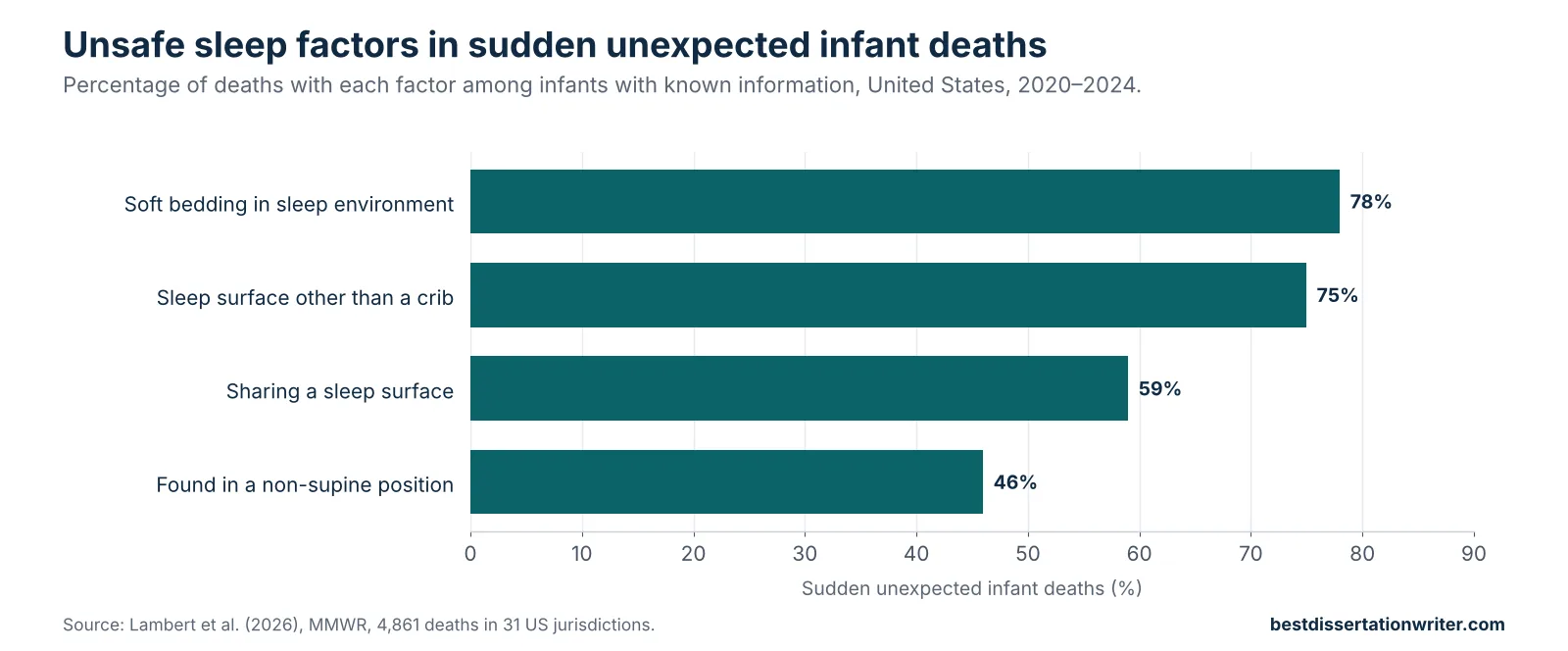
The report also noted gaps in death investigations, such as missing information on airway obstruction and genetic testing, which limit understanding of some deaths. It concluded that unsafe sleep remains common and that detailed data can support targeted prevention. The findings show that, more than three decades after back-to-sleep campaigns began, many babies still die in sleep environments that do not follow recommended safe sleep practices.
The American Academy of Pediatrics policy statement translates this evidence into recommendations (Moon et al., 2022). It advises placing babies supine for every sleep until one year, using a firm, flat, non-inclined surface, room-sharing on a separate infant surface ideally for at least six months, keeping soft bedding out of the sleep area, feeding human milk, offering a pacifier at sleep times and avoiding smoke and nicotine exposure. It also recommends that hospital staff endorse and model safe sleep guidance from the beginning of pregnancy.
Theme 2: The Evidence and Debate on Bed-Sharing
An individual-level analysis of five major case-control datasets from the UK, Europe and Australasia included 1,472 SIDS cases and 4,679 controls (Carpenter et al., 2013). Bed-sharing was associated with increased risk overall (adjusted odds ratio 2.7), and for breastfed babies under three months whose parents did not smoke, drink or use drugs, bed-sharing was associated with a fivefold increase in risk compared with room-sharing (adjusted odds ratio 5.1). The authors estimated that around 88% of bed-sharing deaths might have been avoided if the baby had slept on its back in a cot in the parents’ room.
A combined analysis of two UK case-control studies with 400 SIDS cases and 1,386 controls reached a different emphasis (Blair et al., 2014). Co-sleeping on a sofa (odds ratio 18.3) and co-sleeping with a parent who had drunk more than two units of alcohol (odds ratio 18.3) carried very high risks, and co-sleeping with a smoker was risky in babies under three months. However, bed-sharing in the absence of these hazards was not significantly associated with increased risk. The authors argued for public health messages that target specific hazardous circumstances.
These analyses used overlapping data and different methods, and their differing conclusions have shaped different national guidance. Both agree that sofa-sharing, bed-sharing after alcohol or drugs, bed-sharing with a smoker and bed-sharing with preterm or very young babies are dangerous. For nurses, the practical message is to make sure every family understands these hazards, to recommend a separate cot in the parents’ room as the safest option, and to talk openly and without judgement about bed-sharing so that families who do bed-share can reduce risks.
For neonatal nurses, these findings have particular relevance because preterm and low birthweight babies face higher risks. Parents of these babies may be especially tired and anxious after discharge, and may be tempted to bring the baby into their bed to monitor breathing. Explaining why a separate cot in the parents’ room is safest, while acknowledging these feelings, is an important part of parental education before discharge.
Theme 3: Educating Parents About Safe Sleep Practices
A cluster randomised trial in 16 US hospitals enrolled 1,600 mothers of healthy term newborns and tested a nursing quality improvement campaign on safe sleep and a 60-day mobile health programme delivering text or email messages with short videos (Moon et al., 2017). Mothers who received safe sleep mobile messages were more likely to use the supine position (89.1% compared with 80.2%), room-share without bed-sharing (82.8% compared with 70.4%), avoid soft bedding (79.4% compared with 67.6%) and offer a pacifier.
The nursing quality improvement campaign alone did not significantly change any of these practices. This finding is important because it suggests that hospital teaching and modelling, while necessary, may not be enough on their own to change behaviour after discharge. Messages delivered repeatedly over the first weeks at home, when parents make decisions about sleep, may be more effective. The trial relied on self-reported practices and did not measure deaths.
Together, these findings suggest that education about safe sleep practices should begin in pregnancy, be modelled consistently in hospital and be reinforced after discharge through community visits, digital messages and conversations with health professionals. Education should be tailored to families’ circumstances, including cultural practices, housing and the realities of night-time feeding.
The trial also suggests that the format and timing of parental education matter. Short videos that parents can watch when convenient, and reminders at key ages when sleep practices change, such as when babies start rolling or when parents return to work, may help to sustain safe sleep practices. Nurses can direct families to trusted digital resources and check understanding at follow-up appointments.
Discussion
This review found that most sudden unexpected infant deaths still occur in unsafe sleep environments, particularly with soft bedding, surfaces other than a cot and shared sleep surfaces. Bed-sharing carries clear risks in hazardous circumstances, although analyses differ on the risk in the absence of hazards. Education delivered repeatedly after discharge improved safe sleep practices, while a hospital-based nursing campaign alone did not.
These findings challenge nurses to think beyond discharge teaching. Parents may agree with safe sleep advice in hospital but find it hard to follow at home when they are exhausted, when a baby will only settle when held, or when family members give different advice. Conversations that acknowledge these pressures, offer practical solutions and prepare parents for night-time feeding are likely to be more effective than simply stating rules.
Consistency between professionals in teaching safe sleep practices matters. When health visitors, midwives, neonatal nurses and doctors give different messages, parents may become confused or lose trust. Units and community services should agree on key messages, based on current national guidance, and ensure that hospital practices model them. In neonatal units, a clear plan to move babies to supine sleep in an empty cot before discharge supports this.
Equity in safe sleep practices is a further concern. Sleep-related deaths are more common in disadvantaged families and in some ethnic groups, who may face crowded housing, lack of a cot, smoking and limited access to services. Providing cots or baby boxes where needed, addressing smoking and delivering culturally appropriate education may help to reduce these inequalities in infant mortality.
This review has limitations. The surveillance data are from the United States and are descriptive, the case-control analyses used overlapping datasets with different conclusions, and the trial relied on self-report and did not measure deaths. This review relied on openly accessible, English-language sources and did not involve independent double screening. Future research should test interventions that combine hospital modelling with post-discharge support and measure outcomes in disadvantaged families.
Finally, safe sleep practices should be considered alongside parents’ wellbeing. Exhausted parents are more likely to fall asleep with their baby on a sofa or in an armchair, which carries very high risk. Helping families to plan for night-time feeds, share the load with partners or relatives, and recognise when they are too tired to stay awake while holding the baby may prevent some of the most dangerous situations.
Implications of Safe Sleep Practices Evidence for Practice
Nurses should model safe sleep in every hospital cot, transition preterm babies from therapeutic positioning to supine sleep in an empty cot before discharge, and talk with every family about where and how their baby will sleep, including honest discussion of bed-sharing hazards. Advice on avoiding overheating links with thermoregulation, and babies with neonatal abstinence syndrome need particular attention because of their increased risk.
Discharge preparation should include practical safe sleep teaching alongside neonatal resuscitation training for parents where appropriate, and preterm babies being followed up for retinopathy of prematurity should continue to receive consistent safe sleep messages at outpatient visits.
Conclusion
This narrative review examined the evidence on sleep-related infant deaths and the promotion of safe sleep practices. Most deaths occur in unsafe sleep environments, bed-sharing is dangerous in hazardous circumstances, and education reinforced after discharge improves practices more than hospital-based campaigns alone.
Safe sleep practices are simple but life-saving. Nurses can help to prevent infant deaths by modelling safe sleep, holding honest and supportive conversations with parents and working with community services to reinforce consistent messages during the first months of life.
References
Blair, P. S., Sidebotham, P., Pease, A., & Fleming, P. J. (2014). Bed-sharing in the absence of hazardous circumstances: Is there a risk of sudden infant death syndrome? An analysis from two case-control studies conducted in the UK. PLoS ONE, 9(9), e107799. https://doi.org/10.1371/journal.pone.0107799
Carpenter, R., McGarvey, C., Mitchell, E. A., Tappin, D. M., Vennemann, M. M., Smuk, M., & Carpenter, J. R. (2013). Bed sharing when parents do not smoke: Is there a risk of SIDS? An individual level analysis of five major case–control studies. BMJ Open, 3(5), e002299. https://doi.org/10.1136/bmjopen-2012-002299
Lambert, A. B., Parks, S. E., Cottengim, C., et al. (2026). Characteristics of sudden unexpected infant deaths — United States, 2020–2024. MMWR Morbidity and Mortality Weekly Report, 75(35), 544–550. https://doi.org/10.15585/mmwr.mm7535a1
Moon, R. Y., Carlin, R. F., Hand, I., Task Force on Sudden Infant Death Syndrome, & Committee on Fetus and Newborn. (2022). Sleep-related infant deaths: Updated 2022 recommendations for reducing infant deaths in the sleep environment. Pediatrics, 150(1), e2022057990. https://doi.org/10.1542/peds.2022-057990
Moon, R. Y., Hauck, F. R., Colson, E. R., Kellams, A. L., Geller, N. L., Heeren, T., Kerr, S. M., Drake, E. E., Tanabe, K., McClain, M., & Corwin, M. J. (2017). The effect of nursing quality improvement and mobile health interventions on infant sleep practices: A randomized clinical trial. JAMA, 318(4), 351–359. https://doi.org/10.1001/jama.2017.8982
Cite this example
Best Dissertation Writers (2026) Safe Sleep Practices and Prevention of Sudden Infant Death: Nursing Education for Parents: A Literature Review. Available at: https://bestdissertationwriter.com/safe-sleep-practices-literature-review/
Best Dissertation Writers
Get expert help with your nursing literature review
Share your topic and deadline with Best Dissertation Writers and get support tailored to your module brief.