Parental Stress and Psychological Wellbeing in the Neonatal Intensive Care Unit: An Integrative Review
 By Dr. Robertson Prime, Research Fellow
Updated October 17, 2026
15 min read
About 2,900 words
In this review
Abstract
Background: Parental stress is common when a baby is admitted to a neonatal intensive care unit, as parents face fear for their baby’s life, separation, an unfamiliar environment and the loss of their expected parenting role. High stress, anxiety and post-traumatic stress can affect parents’ health, their relationship with their baby and the baby’s development.
Aim: This integrative review aimed to examine the evidence on parental stress and psychological wellbeing in the neonatal intensive care unit and on interventions that support parents.
Methods: Evidence was identified through targeted searches of openly accessible bibliographic records, publisher websites and the reference lists of key reviews. Five sources published between 2006 and 2024 were included: a randomised controlled trial, three meta-analyses and a meta-review, synthesised thematically.
Findings: Across 53 studies, alteration of the parental role was the greatest source of stress for both mothers and fathers, and mothers reported more stress than fathers. Anxiety affected 41.9% of parents and post-traumatic stress 39.9% in the first month, and post-traumatic stress persisted in 27.1% beyond one year. An educational and behavioural programme reduced maternal stress and shortened stays by 3.8 days, and kangaroo mother care reduced maternal depressive symptoms, stress and anxiety.
Conclusion: Neonatal nurses should screen parents routinely, involve them actively in their baby’s care and connect those with high distress to psychological support.
Keywords: parental stress, NICU parents, parental anxiety
Introduction
This integrative review critically examines recent evidence on parental stress and its implications for neonatal nursing practice.
Having a baby admitted to a neonatal intensive care unit (NICU) is one of the most difficult experiences a parent can face. Instead of taking their baby home, parents may see their newborn in an incubator, attached to monitors, tubes and lines, and cared for by strangers. They may fear for their baby’s survival and future health, feel guilty about a premature birth, and struggle to balance time at the hospital with recovery from birth, work and other children.
These pressures can lead to high levels of stress, anxiety, depression and post-traumatic stress symptoms. Distress may persist long after discharge, affecting parents’ health and relationships, their confidence in caring for their baby, and their interaction with the child as they grow. Because parents’ wellbeing influences infant development, supporting NICU parents is increasingly recognised as part of caring for the baby.
Neonatal nurses spend more time with parents than any other professional. They explain what is happening, teach parents how to care for their baby, notice when parents are struggling and can connect them with support. The way nurses communicate and involve parents can either ease or add to their distress.
An integrative approach was chosen because the evidence includes meta-analyses of prevalence and sources of stress, an intervention trial and a review of reviews, which together describe both the problem and possible responses.
Parental stress also affects the way parents use the unit. Parents who feel overwhelmed may visit less often, avoid asking questions or find it hard to take in information during ward rounds. Nurses who recognise these signs can adapt how they communicate, repeat explanations, and offer parents small, achievable tasks that build confidence over time.
Review question
What does the evidence show about parental stress and psychological wellbeing in the NICU, and which interventions support parents?
Background to Parental Stress
Parental stress in the NICU is often measured with the Parental Stressor Scale: NICU, which asks parents how stressful they find different aspects of the experience. Its subscales cover the sights and sounds of the unit, the baby’s appearance and behaviour, and alteration of the parental role, such as being unable to hold, feed or protect the baby. Other tools measure anxiety, depression and post-traumatic stress symptoms.
Several factors can increase parental stress. Very preterm birth, serious illness, sudden deterioration, long admissions and distance from the hospital all add to the burden. Parents’ previous mental health, social support, financial pressures and experience of birth also matter. Fathers may experience high stress while feeling that their needs are overlooked, and parents from minority or disadvantaged groups may face additional barriers to support.
Parental anxiety and stress can affect how parents interact with their baby. Parents who are highly anxious may find it harder to read their baby’s cues, to hold and feed them confidently, or to visit often. Over time, persistent distress can affect bonding and the child’s emotional and cognitive development. Early recognition and support may therefore benefit the whole family.
Approaches to supporting NICU parents range from information and education to family-centred and family-integrated care models, peer support, psychological therapies and practical help with travel and accommodation. Skin-to-skin contact and active involvement in care give parents a sense of purpose and closeness to their baby. However, the evidence for many of these approaches is still developing.
The physical environment of the unit can add to parental stress. Alarms, bright lights, lack of privacy and limited space at the bedside make it harder for parents to stay and feel at home. Single-family rooms, comfortable chairs, quiet areas and facilities for parents to eat and rest can reduce strain, although these depend on investment and design as well as nursing practice.
Search Strategy and Methods
Evidence for this example was identified through targeted searches of openly accessible bibliographic records, publisher websites and the reference lists of key reviews. Search terms combined keywords for the population (“parents”, “mothers”, “fathers”, “neonatal intensive care”, “NICU”, “preterm”) with terms for outcomes and interventions (“stress”, “anxiety”, “depression”, “post-traumatic stress”, “psychological distress”, “intervention”, “support”), joined with the Boolean operators AND and OR. A full integrative review for assessment would run the same strategy in CINAHL, PubMed/MEDLINE, PsycINFO and the Cochrane Library and report the number of records screened in a PRISMA flow diagram.
Sources were eligible if they examined stress or psychological distress among parents of babies in neonatal intensive care, or evaluated interventions to support them, using any design. Meta-analyses were prioritised to provide robust estimates, and a randomised trial was included as an example of a nurse-relevant intervention. Studies of parents of older children were excluded.
Five sources published between 2006 and 2024 were included: a randomised controlled trial, three systematic reviews with meta-analysis and a meta-review of systematic reviews (Table 1). The quality of each source was considered using the Critical Appraisal Skills Programme (CASP) checklists, and findings were synthesised thematically in line with integrative review methods.
Key Findings on Parental Stress
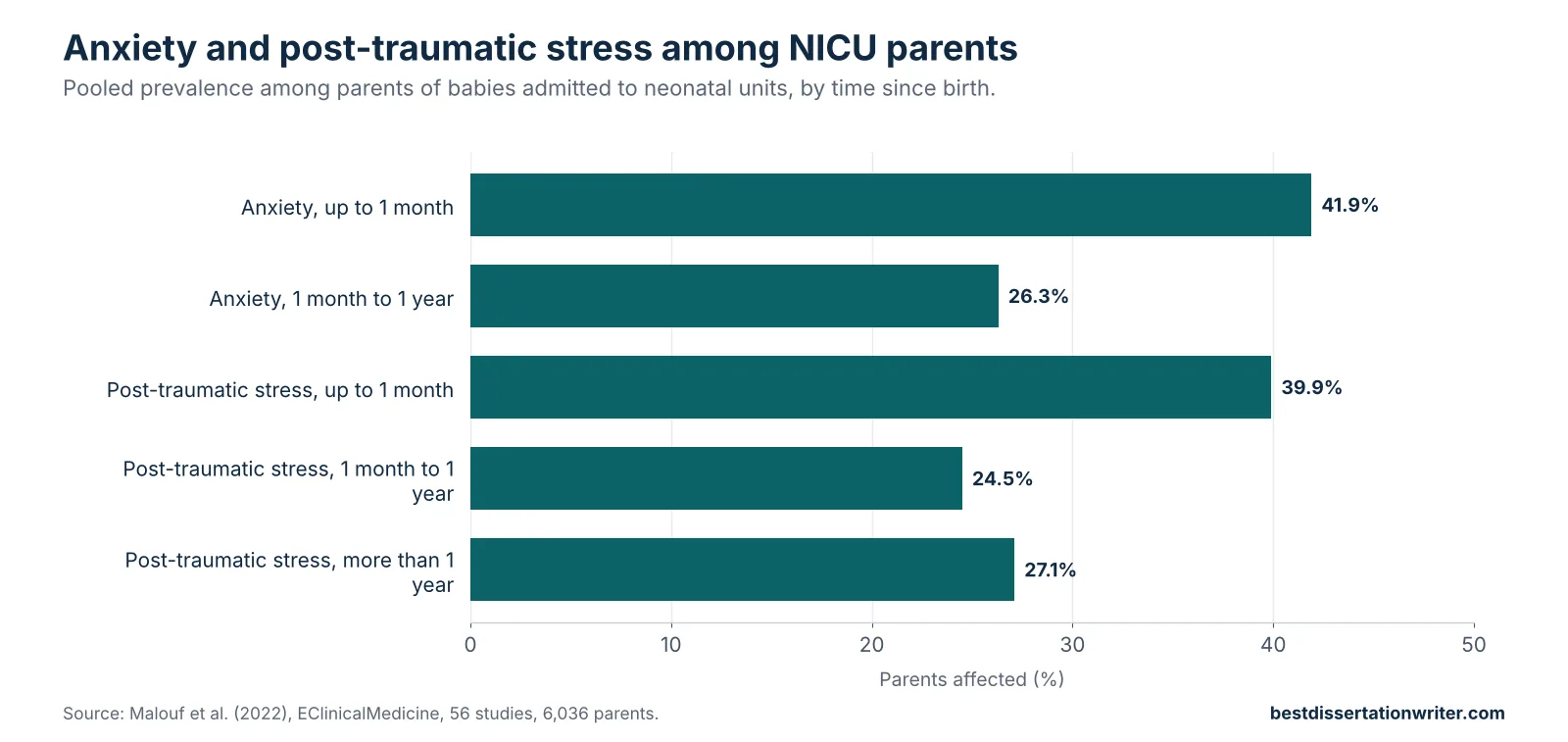
Three themes were identified: the sources of parental stress in the NICU, the scale and persistence of anxiety and post-traumatic stress, and interventions that support NICU parents. Table 1 summarises the included sources, and Figure 1 shows how common anxiety and post-traumatic stress are among parents at different times.
| Author, year | Design | Setting and sample | Key finding |
|---|---|---|---|
| Melnyk et al. (2006) | Randomised controlled trial (COPE) | 260 families of preterm infants, 2 NICUs, USA | Less maternal stress, depression and anxiety; better parent-infant interaction; NICU stay 3.8 days shorter. |
| Caporali et al. (2020) | Meta-analysis | 53 studies, 1993–2019, multiple countries | Parental role alteration the greatest stressor; mothers more stressed than fathers; infant factors not significant. |
| Malouf et al. (2022) | Systematic review and meta-analysis | 56 studies, 6,036 parents | Anxiety 41.9% and PTS 39.9% in first month; PTS 27.1% beyond one year. |
| Pathak et al. (2023) | Systematic review and meta-analysis | 30 trials, 7,719 preterm or low birthweight infants | Kangaroo mother care reduced maternal depressive symptoms (RR 0.76), stress and anxiety. |
| van Wyk et al. (2024) | Meta-review | 54 systematic reviews | Maternal distress 13–93% depending on tool; combined family-centred interventions most promising; routine screening advised. |
Theme 1: The Sources of Parental Stress in the NICU
A meta-analysis of 53 studies published between 1993 and 2019 examined parental stress in the NICU across many countries using the Parental Stressor Scale (Caporali et al., 2020). Alteration of the parental role was the greatest source of stress for both mothers and fathers. Mothers reported higher stress than fathers, but the only subscale with a significant difference was the sights and sounds of the unit. Gestational age, birth weight and comorbidities did not significantly affect stress, while longer stays had a marginal effect.
These findings show that parental stress is driven less by the baby’s medical characteristics than by what the NICU experience does to parents’ role. Being unable to hold, feed or comfort their baby, and feeling that staff are the baby’s main carers, appear to be more distressing than the technology itself. The authors described NICU-related parental stress as a worldwide healthcare issue requiring prompt, tailored support.
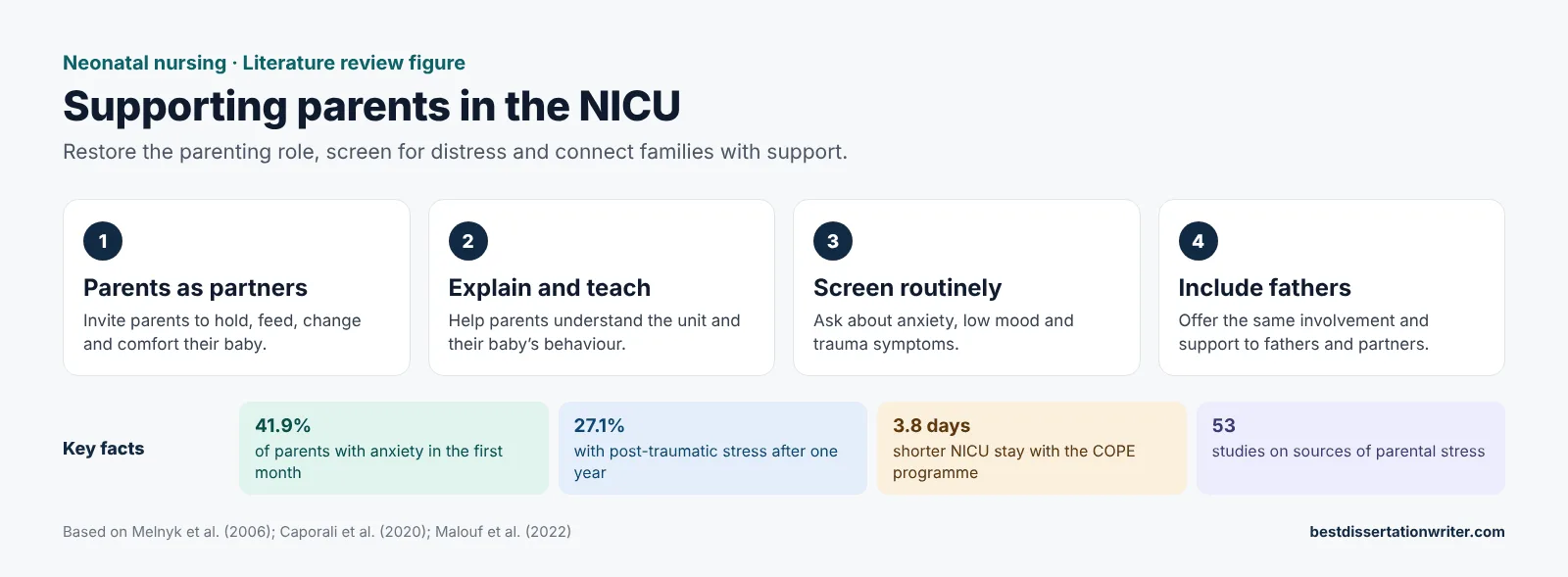
This has direct implications for nursing. If role alteration is the main stressor, interventions that help parents to take an active role, such as holding, feeding, changing and comforting their baby, and taking part in ward rounds, may be among the most effective ways to reduce stress. Nurses can facilitate this every day by inviting parents to participate and teaching them the skills they need.
The finding that infant factors such as gestational age did not strongly predict parental stress is also important. It suggests that nurses should not assume that parents of larger or less unwell babies need less support. Every family admitted to the NICU may experience high parental stress, and support should be offered to all, with more intensive help for those who are struggling.
Theme 2: Anxiety and Post-Traumatic Stress Among NICU Parents
A systematic review and meta-analysis of 56 studies involving 6,036 parents examined the prevalence of anxiety and post-traumatic stress among parents of babies admitted to neonatal units (Malouf et al., 2022). In the first month after birth, 41.9% of parents had anxiety and 39.9% had post-traumatic stress. Between one month and one year, rates fell to 26.3% for anxiety and 24.5% for post-traumatic stress, but post-traumatic stress remained at 27.1% more than one year later, higher than in the general perinatal population.
A meta-review of 54 systematic reviews found that psychological distress among mothers ranged from 13% to 93% depending on the screening tool used, and among fathers from very low levels to 46% (van Wyk et al., 2024). Many different tools and cut-off points were used, making comparison difficult, and little was known about distress among minority groups, siblings, grandparents or families in lower-income countries. The authors recommended routine screening and emphasised that fathers need as much attention as mothers.
Together, these reviews show that parental anxiety and post-traumatic stress are common, may persist long after discharge, and affect fathers as well as mothers. The wide variation in estimates reflects differences in measures and populations, but even the lower estimates suggest that a substantial proportion of NICU parents need support. Both reviews called for routine screening so that distress can be identified and addressed early.
Persistent parental anxiety and post-traumatic stress have consequences beyond the parents themselves. Parents with unresolved trauma may be more anxious about their child’s health, find it harder to respond sensitively to their child and be more likely to seek urgent care. Follow-up after discharge, including asking about parents’ wellbeing at outpatient appointments, could help to identify those who need further support.
Theme 3: Interventions That Support NICU Parents
The COPE (Creating Opportunities for Parent Empowerment) trial randomised 260 families of preterm, low birthweight infants in two US NICUs to an educational and behavioural programme or to a comparison programme of information about hospital services (Melnyk et al., 2006). COPE taught parents about their baby’s characteristics and behaviour and how to parent them. Mothers in the COPE group reported less stress in the NICU and less depression and anxiety two months later, and both parents were rated as interacting more positively with their babies.
The COPE programme also shortened NICU stays by 3.8 days and total hospital stays by 3.9 days. These findings suggest that helping parents to understand and care for their baby benefits both parents and infants, and may reduce costs. The programme used audio and written materials that could be delivered at scale, with nurses well placed to reinforce its messages at the bedside.
Skin-to-skin contact is another intervention with benefits for parents. A meta-analysis of 30 trials found that kangaroo mother care reduced moderate to severe postpartum depressive symptoms in mothers of preterm or low birthweight babies, with high-certainty evidence, and was associated with lower maternal stress and anxiety and stronger attachment, although these outcomes had lower certainty (Pathak et al., 2023). The meta-review also found that combined, family-centred interventions appeared more effective than single interventions (van Wyk et al., 2024).
Discussion
This review found that parental stress in the NICU is common and driven mainly by the disruption of the parenting role, that anxiety and post-traumatic stress affect many parents and can persist beyond the first year, and that interventions which help parents to understand and care for their baby, such as COPE and kangaroo mother care, reduce distress. Combined, family-centred approaches appear more effective than single interventions.
A consistent message is that involving parents in care is not only good for babies but also protects parents’ mental health. When parents are treated as visitors, they may feel helpless and excluded; when they are supported to hold, feed and comfort their baby and to take part in decisions, they may regain a sense of control and connection. Nurses are at the centre of this shift, because they decide day by day how much parents are invited to do.
Screening for parental stress and its consequences is a further priority. Several reviews recommended routine screening for parental anxiety, depression and post-traumatic stress, yet many units have no systematic approach. Screening must be linked to pathways for support, such as psychologists, perinatal mental health services or peer support, otherwise it risks identifying needs that cannot be met. Nurses may be well placed to carry out brief screening and to make referrals.
Fathers and other family members experience parental stress too. Fathers often report high stress but may receive less support, partly because they spend less time on the unit and partly because services are designed around mothers. Inviting fathers to take part in care and asking how they are coping can help, as can flexible visiting and practical support for families with other children or long journeys.
This review has limitations. The included reviews combined studies with different measures and populations, prevalence estimates varied widely, and the intervention trial was conducted in one country two decades ago. This review relied on openly accessible, English-language sources and did not involve independent double screening. Future research should test nurse-delivered screening and support pathways and evaluate interventions for fathers and underserved groups.
Nurses’ own wellbeing is also relevant. Supporting distressed parents day after day can be emotionally demanding, and nurses who feel unsupported may find it harder to offer compassion and time. Training in communication and psychological first aid, together with supervision and team support, can help nurses to respond to parental stress without becoming overwhelmed themselves.
Implications of Parental Stress Evidence for Practice
Neonatal nurses should welcome parents as partners in care, support them to hold, feed and comfort their baby, explain the unit and their baby’s behaviour, and routinely ask about their wellbeing. Kangaroo mother care should be encouraged as a way of reducing parental stress, as described in kangaroo mother care, and parents with signs of distress should be linked with services for perinatal mental health.
Structured models that involve parents throughout the stay, such as family-integrated care, can reduce role alteration, and teaching parents hand hygiene and infection prevention, including measures against late-onset sepsis, gives them a meaningful role in protecting their baby.
Conclusion
This integrative review examined the evidence on parental stress and psychological wellbeing in the neonatal intensive care unit. Stress is common and driven mainly by the loss of the expected parenting role, and anxiety and post-traumatic stress affect many parents for months or years. Interventions that help parents to understand and care for their baby, including COPE and kangaroo mother care, reduce distress.
Supporting parents is part of caring for the baby. Neonatal nurses can reduce parental stress by involving parents as partners, screening for distress and connecting families with support, helping them to leave the NICU more confident and less burdened.
References
Caporali, C., Pisoni, C., Gasparini, L., Ballante, E., Zecca, M., Orcesi, S., & Provenzi, L. (2020). A global perspective on parental stress in the neonatal intensive care unit: A meta-analytic study. Journal of Perinatology, 40, 1739–1752. https://doi.org/10.1038/s41372-020-00798-6
Malouf, R., Harrison, S., Burton, H. A. L., Gale, C., Stein, A., Franck, L. S., & Alderdice, F. (2022). Prevalence of anxiety and post-traumatic stress (PTS) among the parents of babies admitted to neonatal units: A systematic review and meta-analysis. EClinicalMedicine, 43, 101233. https://doi.org/10.1016/j.eclinm.2021.101233
Melnyk, B. M., Feinstein, N. F., Alpert-Gillis, L., Fairbanks, E., Crean, H. F., Sinkin, R. A., Stone, P. W., Small, L., Tu, X., & Gross, S. J. (2006). Reducing premature infants’ length of stay and improving parents’ mental health outcomes with the Creating Opportunities for Parent Empowerment (COPE) neonatal intensive care unit program: A randomized, controlled trial. Pediatrics, 118(5), e1414–e1427. https://doi.org/10.1542/peds.2005-2580
Pathak, B. G., Sinha, B., Sharma, N., Mazumder, S., & Bhandari, N. (2023). Effects of kangaroo mother care on maternal and paternal health: Systematic review and meta-analysis. Bulletin of the World Health Organization, 101, 391–402. https://doi.org/10.2471/BLT.22.288977
van Wyk, L. L., Majiza, A. P., Ely, C. S. E., & Singer, L. T. (2024). Psychological distress in the neonatal intensive care unit: A meta-review. Pediatric Research. https://doi.org/10.1038/s41390-024-03599-1
Cite this example
Best Dissertation Writers (2026) Parental Stress and Psychological Wellbeing in the Neonatal Intensive Care Unit: An Integrative Review. Available at: https://bestdissertationwriter.com/parental-stress-literature-review/
Best Dissertation Writers
Get expert help with your nursing literature review
Share your topic and deadline with Best Dissertation Writers and get support tailored to your module brief.