Barriers and Facilitators to Cancer Screening Uptake: Implications for Nursing Practice: A Systematic Review
 By Dr. Robertson Prime, Research Fellow
Updated October 28, 2026
14 min read
About 2,900 words
In this review
Abstract
Background: Screening can detect breast, cervical and bowel cancer early or prevent them, but its benefit depends on cancer screening uptake, which varies between and within populations. Nurses in primary care, community and oncology settings invite, advise, support and follow up people who are eligible, so evidence on barriers, facilitators and effective interventions is relevant to nursing practice.
Aim: This systematic review aimed to examine the evidence on barriers and facilitators to cancer screening uptake and on interventions that increase it, and to consider the implications for nursing practice.
Methods: Evidence was identified through targeted searches of openly accessible bibliographic records, publisher websites and the reference lists of key reviews. Five systematic reviews published between 2011 and 2026 were included. The research sources were appraised using CASP checklists and synthesised narratively.
Findings: An overview of 41 systematic reviews found that fear of the unknown and lack of knowledge were major barriers, and that a recommendation from a health care provider was the strongest facilitator. A review of 658 studies found that deprivation, lower socioeconomic status, rural residence and being unmarried were associated with lower uptake. A Cochrane review of 38 trials supported invitation letters for cervical screening. A review of 49 primary care studies found that effective interventions were mostly multi-component. In 30 studies of colorectal screening, patient navigation raised uptake by an average of 16.9 percentage points.
Conclusion: Cancer screening uptake is shaped by fear, knowledge, access and trust. Nurses can contribute through recommendation, tailored information, navigation and whole-practice approaches, but evidence on implementation and on equity is still limited.
Keywords: cancer screening uptake, screening participation, cancer screening barriers
Introduction
This systematic review critically examines recent evidence on cancer screening uptake and its implications for cancer nursing practice.
Screening for cancer is offered in many countries to people with no symptoms. Breast, cervical and bowel screening programmes aim to find cancer early, when treatment is more likely to succeed, and in the case of cervical and bowel screening to find and remove changes before they become cancer. These benefits can only be achieved if people take part. Cancer screening uptake is the proportion of eligible people who accept an invitation and complete the test, and it is a key measure of programme performance.
Uptake is not equal. People living in deprived areas, those from some ethnic and religious groups, people with disabilities or mental health problems, and people who face language or transport barriers are often less likely to take part. When screening is taken up more by advantaged groups, a programme intended to reduce harm from cancer can widen health inequalities.
Nurses work at many points in the screening pathway, and their work affects cancer screening uptake directly. Practice nurses take cervical samples and give advice, nurses in community and outreach services reach people who rarely see a doctor, specialist nurses support people who have abnormal results, and oncology nurses meet the consequences when cancer is found late. The answers are considered for their implications for nursing practice.
Review question
What does the evidence show about the barriers and facilitators to cancer screening uptake, and which interventions increase it?
Background to Cancer Screening Uptake
Cancer screening uptake depends on a series of steps: receiving an invitation, understanding its purpose, deciding to attend, arranging the test, completing it and, where necessary, attending for follow-up. A barrier at any step can reduce the benefit. For example, a person may intend to take part but be unable to arrange time off work, or may complete a home test kit but not return it.
Researchers distinguish barriers and facilitators that operate at different levels. Individual factors include knowledge, beliefs and emotions such as fear or embarrassment. Social factors include family, community and religious influences. System factors include how invitations are sent, how easy appointments are to obtain, and whether information is available in a person’s language. Understanding all these levels explains why a single approach to improving cancer screening uptake rarely works for every group.
The reviews included here cover different programmes, populations and health systems. Some address breast, bowel and cervical screening together, and some address a single programme. Most evidence comes from high-income countries, so findings need careful interpretation before they are applied elsewhere.
Terminology varies between reviews. Some use uptake, others use participation, attendance or adherence, and these words may describe slightly different points in the pathway. In this review the terms are used as the original authors used them, and readers should check the definition in each source before comparing figures. Differences in how denominators are calculated, for example whether people who are ineligible or who have recently been screened elsewhere are excluded, can also change the apparent level of participation.
Search Strategy and Methods
Evidence for this example was identified through targeted searches of openly accessible bibliographic records, publisher websites and the reference lists of key reviews. Search terms combined keywords for the outcome (“cancer screening uptake”, “screening participation”, “screening attendance”, “barriers”, “facilitators”) with terms for the intervention and provider (“invitation”, “reminder”, “patient navigation”, “primary care”, “nurse”), joined with the Boolean operators AND and OR. A full systematic review for assessment would run the same strategy in CINAHL, PubMed/MEDLINE, Embase and the Cochrane Library and report the records screened in a PRISMA flow diagram.
Sources were eligible if they were systematic reviews or overviews of reviews of barriers, facilitators or interventions affecting participation in breast, cervical, bowel or other cancer screening. Single primary studies and reviews of diagnostic accuracy were excluded.
Five sources published between 2011 and 2026 were included (Table 1). The quality of each research source was considered using the Critical Appraisal Skills Programme (CASP) checklists, and findings were synthesised narratively.
Key Findings on Cancer Screening Uptake
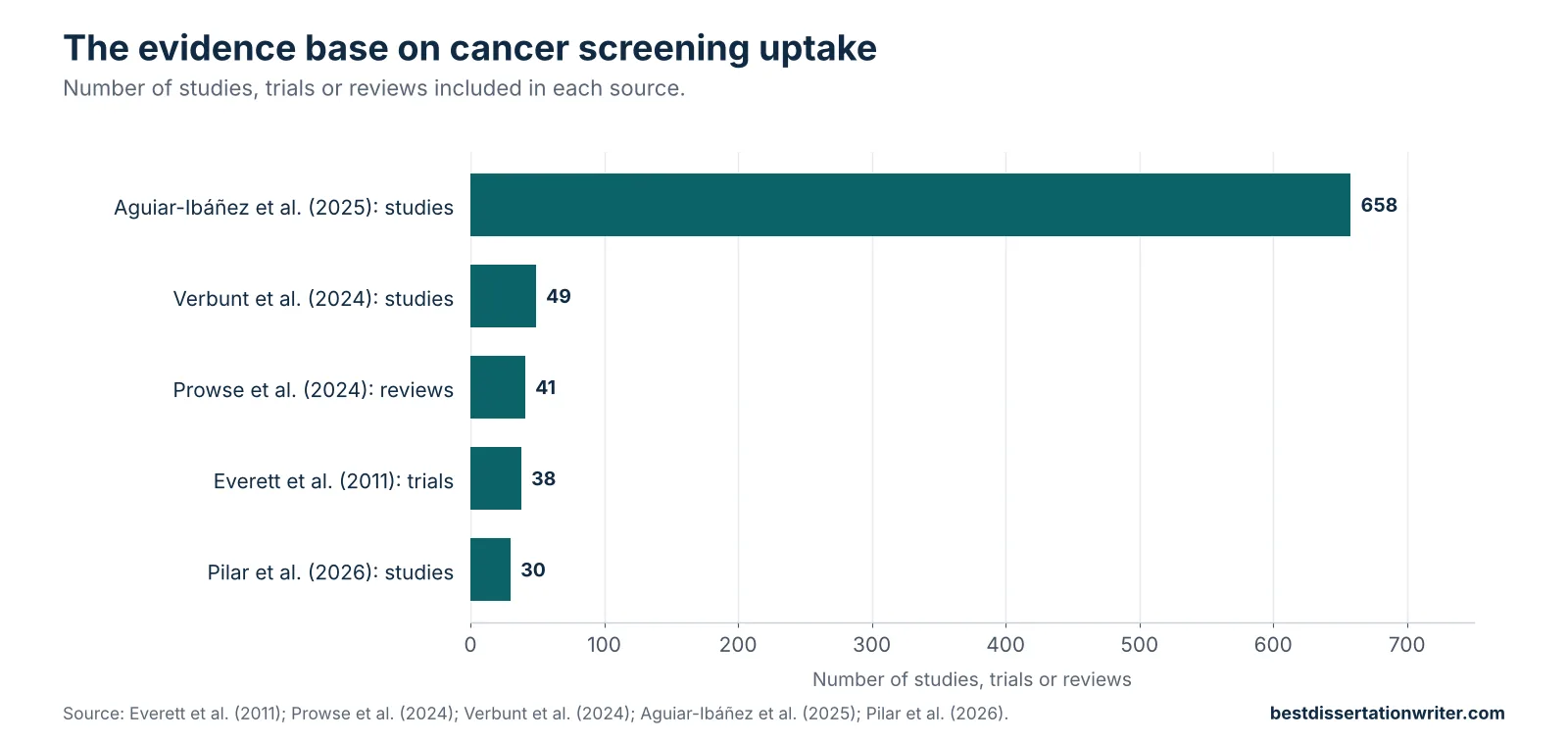
Three themes were identified: the barriers and facilitators that shape cancer screening uptake, and the effect of invitations and primary care interventions, and the contribution of patient navigation. Table 1 summarises the included sources, and Figure 1 shows the size of the evidence base in each review.
| Author, year | Design | Setting and sample | Key finding |
|---|---|---|---|
| Aguiar-Ibáñez et al. (2025) | Systematic literature review | 658 observational studies | Deprivation, lower socioeconomic status, rural residence and being unmarried were barriers; education suggested most often. |
| Everett et al. (2011) | Cochrane review | 38 randomised trials | Invitation letters appear effective for cervical screening; evidence for education limited. |
| Pilar et al. (2026) | Systematic review | 30 studies of colorectal screening | Navigation raised uptake by an average of 16.9 percentage points. |
| Prowse et al. (2024) | Overview of systematic reviews | 41 systematic reviews | Fear and lack of knowledge were main barriers; provider recommendation the strongest facilitator. |
| Verbunt et al. (2024) | Systematic narrative review | 49 primary care studies | Effective interventions were mostly multi-component; whole-of-practice approach and practice champion. |
Theme 1: Barriers and Facilitators
Prowse et al. (2024) carried out an overview of systematic reviews of the factors that influence uptake of bowel, breast and cervical screening in high-income countries. They included 41 systematic reviews and used a narrative approach supported by tabular summaries and qualitative heat maps. Fear of the unknown, meaning fear of a possible cancer diagnosis or an abnormal result, was the most frequent barrier across all three programmes, closely followed by a general lack of knowledge about screening. A recommendation from a health care provider was the strongest facilitator overall. The authors concluded that trust and trusted relationships are central to screening success.
Aguiar-Ibáñez et al. (2025) carried out a systematic literature review of observational studies of barriers to cancer screening uptake, searching literature published between May 2012 and May 2022. From 811 records they included 658 unique studies, of which 199 concerned breast cancer, 278 cervical cancer, 246 colorectal cancer, 37 lung cancer, 12 gastric cancer and 38 prostate cancer, with some studies covering more than one tumour type. Most studies were of medium quality when assessed with the Newcastle-Ottawa Scale.
Being unmarried, higher deprivation, lower socioeconomic status and rural residence were consistent barriers in this review. Race and ethnicity, employment and smoking gave mixed results. Facilitators included older age, a previous history of cancer, a family history, knowledge of the disease, positive attitudes, a recommendation from a primary care professional, insurance and urban residence. The authors described the barriers as complex and called for multi-level strategies that combine universal and cancer-specific approaches. The most frequently suggested strategy was targeted education.
Theme 2: Invitations and Primary Care Interventions
Everett et al. (2011) is a Cochrane review of interventions targeted at women to encourage uptake of cervical screening. It included 38 randomised controlled trials and concluded that invitation letters appear to be effective. Evidence for educational materials was limited, most trials were at moderate risk of bias, and no trial reported informed uptake. The authors noted that most studies came from developed countries, so their relevance to other settings is uncertain. This is an older review, but it remains a clear statement of the effect of invitations.
Verbunt et al. (2024) reviewed primary care practice-based interventions and their effect on participation in population-based cancer screening. They identified 49 studies, 36 from the United States, of which 15 tested single-component interventions and 34 tested multi-component interventions. Interventions with a positive effect were mostly multi-component, and common effective combinations included audit and feedback, provider reminders, practice-facilitated assessment and improvement, and patient education. For bowel screening, giving kits at the point of care was effective. Financial incentives for providers had limited evidence of benefit.
Verbunt et al. also reported two contextual features of effective interventions: a whole-of-practice approach and a practice champion. Nurses frequently fill both roles, since they often lead recall systems, update records and coordinate with colleagues. The authors concluded that increasing participation in primary care probably requires complex interventions that combine practitioner-focused and patient-focused components.
Theme 3: Patient Navigation
Pilar et al. (2026) carried out a systematic review of patient navigation programmes for colorectal cancer screening and follow-up colonoscopy. They included 30 United States studies published from 2004 to 2023, followed PRISMA recommendations and assessed quality with the Cochrane risk of bias tool for randomised trials. Almost all studies (29 of 30) tested multicomponent interventions in which navigation was combined with reminders, small media, mailed stool tests or efforts to address structural barriers.
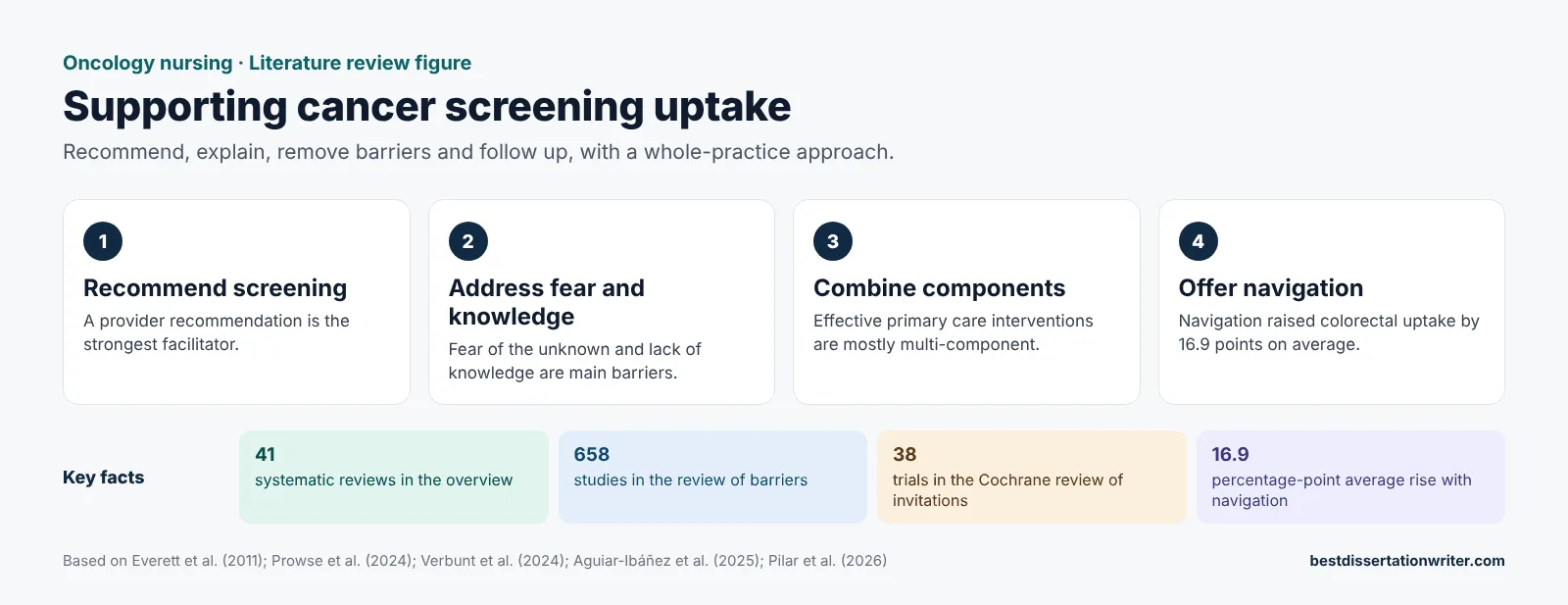
Most studies reported higher uptake after navigation was added, with an average increase of 16.9 percentage points. Navigators included existing staff or health care providers, research team members and lay people, which shows that the role can be taken by nurses or by trained non-clinical staff. The authors noted that little information was reported on implementation outcomes, such as cost and sustainability, and called for more research to guide the use of resources and support equitable implementation.
Across the five sources, three practical messages recur. First, people need to be invited in a way that is clear and personal, and invitations remain among the best-supported interventions. Second, people need a reason to trust the programme, and trust is built through the relationship with a health professional or a respected member of their community. Third, people need the practicalities to work: a convenient time and place, language support, transport and a simple process for returning tests. A nurse who attends to all three is addressing cancer screening barriers at the levels the reviews describe.
These messages are consistent with the idea of screening participation as a process and not a single decision. A person may decline when first invited and accept later after a conversation, or may start a test and not complete it. Services that record each step can see where people drop out and target their effort accordingly, for example by sending a reminder to those who have not returned a kit or by telephoning those who missed an appointment.
The reviews also show the limits of the evidence. Few studies report whether people made an informed choice, even though screening has harms as well as benefits, such as false alarms and overdiagnosis. The Cochrane review found that no trial reported informed uptake of cervical screening. Increasing cancer screening uptake should therefore go together with clear and balanced information, so that people can decide for themselves.
Discussion
This review found that cancer screening uptake is shaped by emotion, knowledge, social context and the way services are organised. The most consistent message across the reviews is that relationships matter: a recommendation from a trusted professional is the strongest facilitator, and trust is central to success. This places nurses, who often have long-standing relationships with patients and communities, in a strong position.
Fear of the unknown is a useful concept for improving cancer screening uptake in practice. People may avoid screening because they are afraid of what it might find, and not because they do not value health. Nurses can acknowledge this fear, explain what the test involves and what happens next, and describe how results are given. This approach respects the person’s concerns while still making the benefits of screening clear.
The evidence on interventions suggests that combined approaches work better than single ones. Invitations are effective, and in primary care a mix of reminders, feedback, education and point-of-care kits appears to be better than a single component. Navigation adds a further increase in colorectal screening, although the studies were United States-based and used differing definitions of navigation. Services should therefore think in terms of packages and consider which components fit their population, a point also made in the review of patient-reported outcome measures, where the response to information mattered as much as its collection.
Equity should guide the choice of intervention. The barriers identified, including deprivation, rural residence, language and culture, mean that universal invitations may not be enough. Targeted work with groups who take part less, developed with their communities, is needed. The reviews of qualitative studies in the overview point to the importance of language support, trusted community leaders and accessible locations, but the original reviews were not all of high quality.
There are limitations. The included sources vary in quality, and many studies in them were observational, so the reasons for non-participation may be affected by confounding. Much of the evidence comes from the United States and other high-income countries, and practice in the United Kingdom may differ. As a systematic review for a student example, it covers five sources and did not search all databases. This review relied on openly accessible, English-language sources.
Implications of Cancer Screening Uptake Evidence for Practice
For practice, the evidence on cancer screening uptake supports routine recommendation of screening by nurses, careful explanation of what to expect, language and accessibility adjustments, active reminders and follow-up, and referral to navigation where it is available. Practice nurses and community nurses should monitor who is not taking part and work with those groups. Information on national programmes is available from Cancer Research UK and Macmillan Cancer Support.
Screening is part of a wider pathway of prevention, treatment and supportive care. When screening does find cancer, patients meet the needs described in the reviews of oral mucositis, which affects people who receive chemotherapy and radiotherapy, and of cancer carers, who support them through treatment. Managers should provide training, protected time for outreach and data on uptake by group.
Future research should test nurse-led approaches directly, since several of the interventions reviewed were delivered by teams in which the contribution of nurses was not separated out. Studies in the United Kingdom, studies that measure informed choice, and evaluations of work with groups who take part less would be especially valuable. Reporting cost and sustainability would also help services to decide which components to adopt.
Conclusion
This systematic review found that cancer screening uptake is influenced by fear, knowledge, social and economic circumstances and the organisation of services, and that a recommendation from a trusted professional is the strongest facilitator.
Invitations, combined primary care interventions and patient navigation can increase participation. By recommending screening, supporting people who are anxious and helping those who face barriers, nurses can contribute to fairer and more effective screening.
References
Aguiar-Ibáñez, R., Mbous, Y. P. V., Sharma, S., Chakali, R., & Chawla, E. (2025). Barriers to cancer screening uptake and approaches to overcome them: A systematic literature review. Frontiers in Oncology, 15. https://doi.org/10.3389/fonc.2025.1575820
Everett, T., Bryant, A., Griffin, M. F., Martin-Hirsch, P. P. L., Forbes, C. A., & Jepson, R. (2011). Interventions targeted at women to encourage the uptake of cervical screening. Cochrane Database of Systematic Reviews, (5), Article CD002834. https://doi.org/10.1002/14651858.CD002834.pub2
Pilar, M., Hoover, S., Roberson, J., Jones, M., & Subramanian, S. (2026). Characteristics and effectiveness of patient navigation programs on colorectal cancer screening and follow-up colonoscopy uptake: A systematic review. AJPM Focus, 5(3), Article 100471. https://doi.org/10.1016/j.focus.2025.100471
Prowse, S. R., Brazzelli, M., & Treweek, S. (2024). What factors influence the uptake of bowel, breast and cervical cancer screening? An overview of international research. European Journal of Public Health, 34(4), 818–825. https://doi.org/10.1093/eurpub/ckae073
Verbunt, E. J., Newman, G., Creagh, N. S., Milley, K. M., Emery, J. D., Kelaher, M. A., Rankin, N. M., & Nightingale, C. E. (2024). Primary care practice-based interventions and their effect on participation in population-based cancer screening programs: A systematic narrative review. Primary Health Care Research & Development, 25, Article e12. https://doi.org/10.1017/S1463423623000713
Cite this example
Best Dissertation Writers (2026) Barriers and Facilitators to Cancer Screening Uptake: Implications for Nursing Practice: A Systematic Review. Available at: https://bestdissertationwriter.com/cancer-screening-uptake-review-review/
Best Dissertation Writers
Get expert help with your nursing literature review
Share your topic and deadline with Best Dissertation Writers and get support tailored to your module brief.