
The Experiences and Support Needs of Cancer Carers: A Qualitative Evidence Synthesis
 By Dr. Robertson Prime, Research Fellow
Updated October 28, 2026
14 min read
About 2,900 words
In this review
Abstract
Background: Cancer carers, the relatives and friends who give unpaid practical and emotional support, often take on demanding roles with little preparation. Their wellbeing affects the people they care for, and nurses are among the health professionals best placed to recognise their needs, yet services still tend to focus on the patient.
Aim: This integrative review aimed to bring together qualitative and quantitative evidence on the experiences and support needs of cancer carers and on the effectiveness of interventions to support them.
Methods: Evidence was identified through targeted searches of openly accessible bibliographic records, publisher websites and the reference lists of key reviews. Five systematic reviews published between 2019 and 2026 were included: four qualitative syntheses and a Cochrane review of trials. The research sources were appraised using CASP checklists and synthesised narratively.
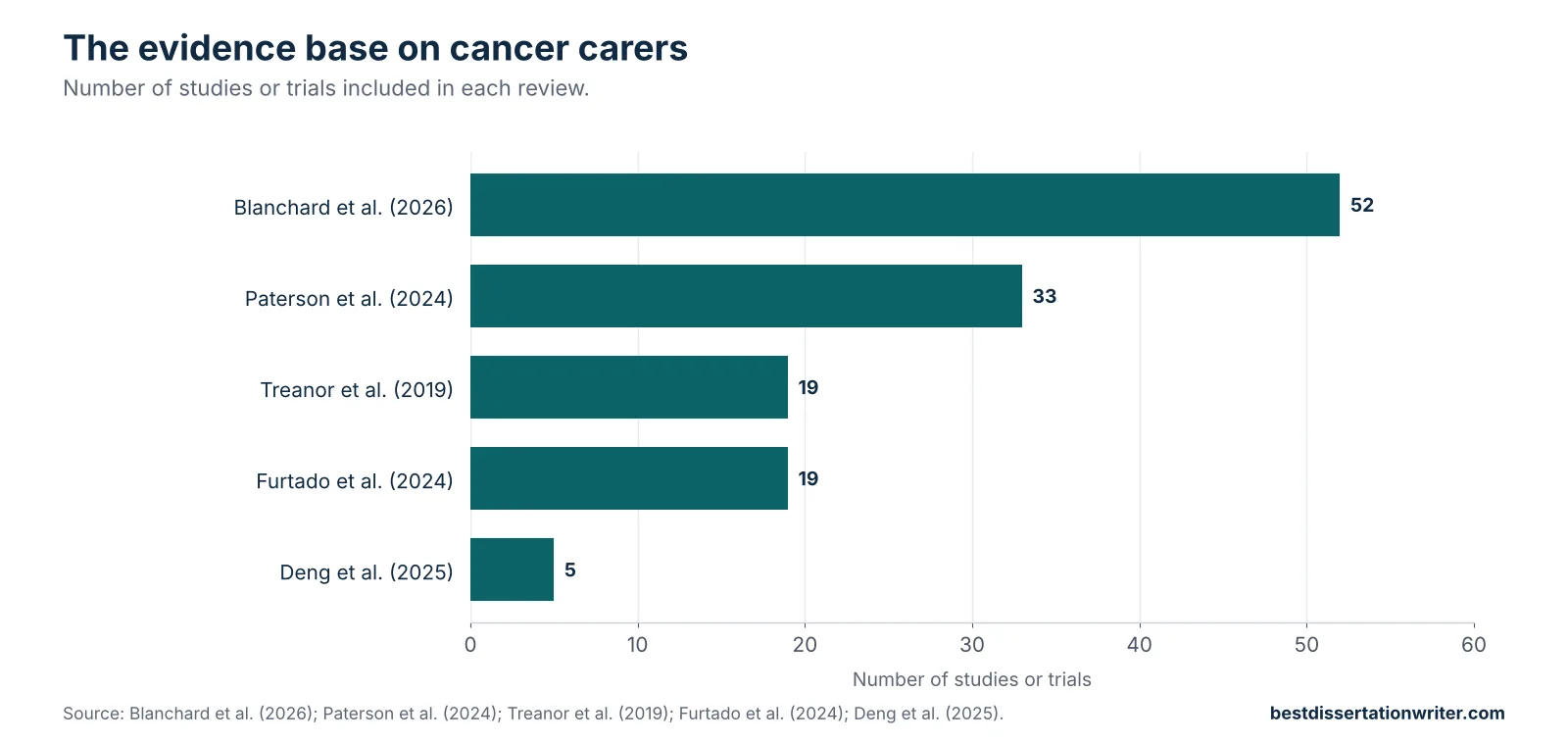
Findings: A synthesis of 52 studies found that family carers faced high physical and psychosocial demands that services did not adequately address, with similar coping strategies in high- and low- and middle-income countries. A synthesis of 33 studies of brain cancer found that carers valued timely information, coordination and empathy, but reported limited emotional support and high burden. A review of 19 studies of upper gastrointestinal cancers highlighted the burden of managing diet. A Cochrane review of 19 trials found that psychosocial interventions made little or no difference to most carer outcomes.
Conclusion: Cancer carers face heavy demands and often feel overlooked. Nurses can help by assessing carers’ needs, giving timely information and coordinating support, but better evidence is needed on which interventions work.
Keywords: cancer carers, family carers, caregiver burden, qualitative synthesis
Introduction
This integrative review critically examines recent evidence on cancer carers and its implications for cancer nursing practice.
Most people with cancer are supported by family members or friends who accompany them to appointments, help with medicines, prepare meals, give personal care and offer emotional support. These informal helpers are often called cancer carers, and the experiences of cancer carers are the subject of this review. They do not choose the role in the way that a paid worker would, and many do not think of themselves as carers at all, but see their actions as part of being a partner, parent, child or friend.
The role can last for months or years and may become more intense as the illness advances. Carers may reduce their paid work, take on household tasks they have not done before and manage symptoms and treatment effects at home, often with limited training. They can experience anxiety, exhaustion, isolation and financial strain, and these effects can influence the person they care for. Despite this, cancer services have traditionally concentrated on the patient and not on cancer carers.
Nurses meet cancer carers in clinics, wards, day units and at home. They are asked questions, they teach practical skills, and they see how well families are coping. An integrative review design was chosen because the question requires both qualitative and quantitative sources to be brought together.
Review question
What do qualitative syntheses show about the experiences and needs of cancer carers, and what does the evidence say about interventions to support them?
Background to Cancer Carers
Caring for someone with cancer varies by cancer type, stage and setting. Cancer carers differ in what they face. Carers of people with brain tumours may face changes in personality and cognition. Carers of people with cancers of the upper digestive tract often need to manage eating and drinking. Carers of people at the end of life may be responsible for home care, medicines and decisions at a time of great emotional strain.
Research uses several terms for the same group, including family carers, informal caregivers and family caregivers. The related idea of caregiver burden describes the physical, emotional, social and financial load of caring. It is a useful concept, but it can overlook the meaning and satisfaction that many carers also report, and good support should respect both.
Qualitative research has been important in this field because it allows carers to describe, in their own words, what helps and what is missing. Systematic reviews of qualitative studies, sometimes called qualitative evidence syntheses, bring these accounts together to identify common themes across settings. They are combined here with a review of trials of supportive interventions.
The balance of this role is not always negative. Several of the sources describe meaning, closeness and satisfaction alongside distress, and the review of home hospice care found that carers valued being present until the end. A balanced approach to support therefore avoids assuming that every carer is in difficulty, while still checking regularly for signs that the demands are becoming too great.
Search Strategy and Methods
Evidence for this example was identified through targeted searches of openly accessible bibliographic records, publisher websites and the reference lists of key reviews. Search terms combined keywords for the population (“cancer carers”, “family carers”, “informal caregivers”, “caregiver burden”) with terms for the evidence and the provider (“qualitative synthesis”, “experiences”, “needs”, “psychosocial intervention”, “nurses”), joined with the Boolean operators AND and OR. A full integrative review for assessment would run the same strategy in CINAHL, PubMed/MEDLINE, PsycINFO and Embase and report the records screened in a PRISMA flow diagram.
Sources were eligible if they were systematic reviews, qualitative syntheses or Cochrane reviews of the experiences, needs or support of carers of adults with cancer. Studies of paediatric oncology, of bereavement alone and of professional carers were excluded.
Five sources published between 2019 and 2026 were included (Table 1). The quality of each research source was considered using the Critical Appraisal Skills Programme (CASP) checklists, and qualitative and quantitative findings were integrated narratively under themes.
Key Findings on Cancer Carers
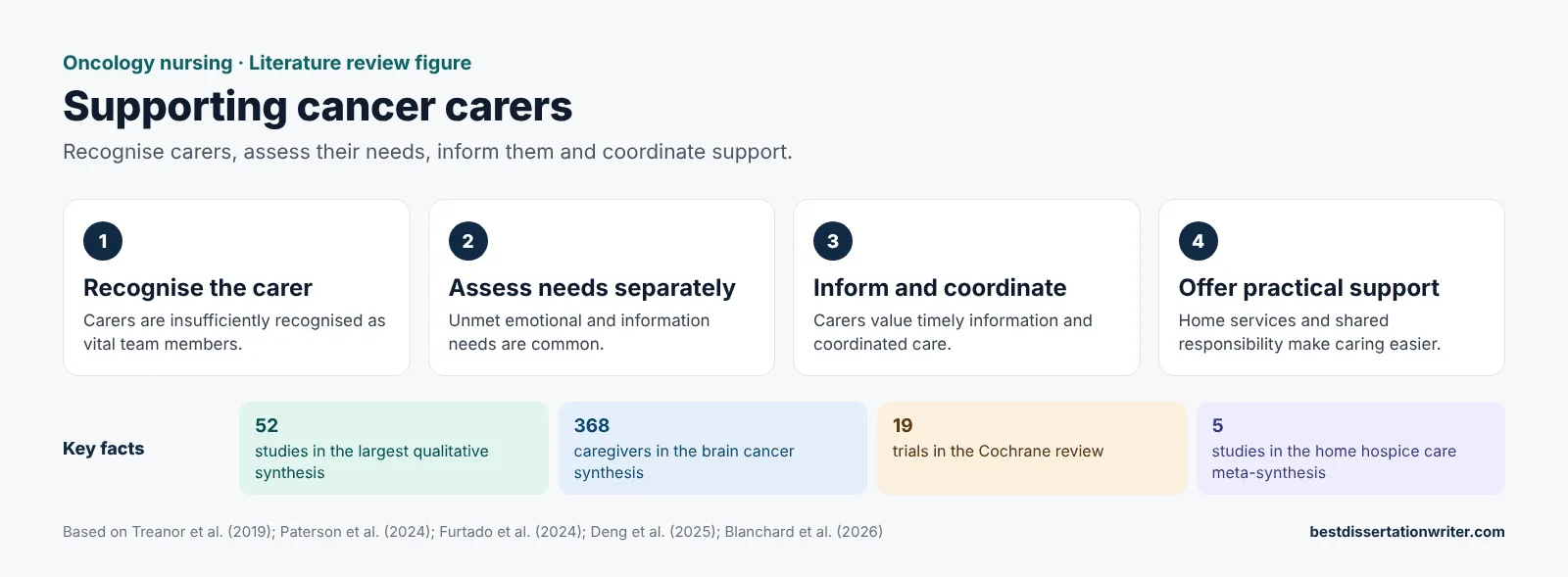
Three themes were identified: the demands placed on cancer carers, what carers find helpful and what is missing, and the evidence for interventions. Table 1 summarises the included sources, and Figure 1 shows the number of studies in each review.
| Author, year | Design | Setting and sample | Key finding |
|---|---|---|---|
| Blanchard et al. (2026) | Qualitative systematic review | 52 studies (41 high-income; 11 low- and middle-income) | High physical and psychosocial demands that services did not adequately address; carers insufficiently recognised. |
| Deng et al. (2025) | Meta-synthesis | 5 studies of home-based hospice care | Carers valued being present and sharing responsibility with palliative teams and relatives. |
| Furtado et al. (2024) | Qualitative systematic review | 19 papers on upper gastrointestinal cancers | Heavy responsibility, especially managing diet; unmet needs and reduced social contact. |
| Paterson et al. (2024) | Qualitative systematic review | 33 studies; 303 patients and 368 caregivers | Valued information, coordination and empathy; unmet emotional support needs and high burden. |
| Treanor et al. (2019) | Cochrane review | 19 trials; almost 4,000 participants | Minimal benefit to carer quality of life; little or no effect on most other outcomes. |
Theme 1: The Demands of Caring
Blanchard et al. (2026) carried out a qualitative systematic review of the experiences of family caregivers caring for people with cancer at home, comparing high-income countries with low- and middle-income countries. Using Joanna Briggs Institute methods and the Transactional Model of Stress and Coping, they synthesised 52 studies from 1,067 records, of which 41 came from high-income countries and 11 from low- and middle-income countries. Family carers faced high physical and psychosocial demands that health and social services did not adequately address, a finding that applies directly to cancer carers.
Coping strategies were similar across settings, but access to resources such as home-based services and financial protection differed. Motivations ranged from moral obligation to seeing care as an extension of the relationship. Caring involved emotional distress alongside meaning and satisfaction. The authors concluded that carers are insufficiently recognised as vital members of the care team and should be included in care planning.
Furtado et al. (2024) reviewed the experiences of informal caregivers supporting individuals with upper gastrointestinal cancers. Searching four databases from inception to February 2021, they included 19 papers, from which 328 findings were extracted and grouped into 16 categories using Joanna Briggs Institute meta-aggregation. Carers took on heavy responsibilities, particularly managing the patient’s diet, because these cancers strongly affect digestion. The nature of the illness disrupted carers’ lives, and their experiences were shaped by unmet needs, insufficient information and a decline in social contact. The authors called for health services to include carers as partners in planning, including in discussions of diagnosis, treatment and side effects.
These findings link to the treatment effects described in other reviews of this series. Carers who manage nausea, weight loss and tiredness at home meet the problems described in the reviews of chemotherapy-induced side effects and of cancer-related fatigue, and they often carry out the daily mouth care that helps to prevent oral mucositis.
Theme 2: What Carers Find Helpful and What Is Missing
Paterson et al. (2024) carried out a qualitative systematic review of supportive care experiences in people affected by brain cancer and their informal caregivers, using meta-aggregation and PRISMA reporting. They included 33 studies, representing 671 participants, of whom 303 were patients and 368 were informal caregivers, and synthesised 220 individual findings into two overall findings.
The first overall finding concerned supports perceived as helpful. Both patients and caregivers valued timely information at the right level, coordinated care, empathetic professionals, peer and social support, and earlier palliative care. The second concerned unmet needs, which included limited information and coordination, inadequate emotional and psychological support, high caregiver burden and distress, social isolation and physical symptom burden. One caregiver was quoted as saying that no one was going to take responsibility and tell them what to do. The authors concluded that services focus almost entirely on patients and called for family-based care and holistic needs assessments for both patients and caregivers.
Deng et al. (2025) added the perspective of families caring for people with terminal cancer at home. Their meta-synthesis of qualitative and mixed methods studies, appraised with CASP and rated with GRADE-CERQual, included five studies published between 1989 and 2022. Carers committed to staying with the patient at home, which they associated with dignity and control, and sharing responsibility with palliative home care teams and with relatives and friends made caring easier to sustain. Both themes were rated as high confidence, although the authors noted that the evidence base was small.
Theme 3: The Evidence for Interventions
Treanor et al. (2019) carried out a Cochrane review of psychosocial interventions for informal caregivers of people living with cancer. It included 19 trials with almost 4,000 participants, comparing psychosocial interventions with usual care in caregivers of people with different cancers at all stages. Interventions were often delivered by nurses or psychologists, in outpatient settings or at home by telephone.
The results were disappointing. The review found a minimal benefit to caregiver quality of life straight after the intervention, which might not last, and little or no effect on caregiver depression, anxiety, distress or physical health. Three studies reported harms, such as increased distress for some carers and patients. No study assessed cost-effectiveness or satisfaction, and the certainty of evidence was generally low. The authors concluded that psychosocial interventions as tested did not make a clinically meaningful difference, and suggested that interventions should be developed with carers and attend to individual needs.
Across the themes, the sources agree on several points that matter for cancer carers. Information is valued when it is timely and pitched at the right level. Care that is coordinated reduces the sense of having to find a way through the system alone. Empathy from professionals is remembered. And practical help, whether from home-based services, from relatives or from peers, makes the work of caring easier to sustain. These are things that nurses can influence even when wider services are limited.
The syntheses also show that cancer carers are not a single group. The demands of managing diet in upper gastrointestinal cancer differ from the cognitive and emotional changes that carers meet in brain cancer, and both differ from the responsibilities of caring for someone who is dying at home. Needs also change over time, from diagnosis through treatment, recovery or progression. Assessment of cancer carers should therefore be repeated, and not limited to the first consultation.
Terminology can hide diversity. Many people do not identify with the word carer and see themselves as a partner, son, daughter or friend, and some may not accept help offered under a label they do not recognise. Nurses can use the person’s own words, ask what they do day to day and then explain what help is available. This approach is more likely to reach the family carers who most need support.
Finally, the findings invite caution about the measurement of caregiver burden. A reduction in burden is not the only goal that carers describe. Many wish to feel prepared, to be listened to and to keep a sense of meaning in the role. Future studies should therefore include outcomes that matter to carers, such as confidence, preparedness and recognition, as well as scores for distress, and should develop interventions in partnership with them.
Discussion
This integrative review brings together a consistent picture from qualitative research and a more cautious picture from trials. Qualitative syntheses from different cancers and countries show that cancer carers work hard, experience distress and often feel unsupported. The trial evidence shows that the interventions tested so far have not made a clear difference to most carer outcomes.
These two findings are not contradictory. Qualitative studies identify needs, such as clear information, coordination, empathy and practical help, that differ from those addressed by many trials, which tested structured psychological programmes. The Cochrane authors themselves suggested that other outcomes and approaches might be more helpful. Nurses can respond to the needs described in the qualitative evidence while services work out which interventions are effective.
The sources also point to a gap in recognition. The synthesis of 52 studies concluded that carers are insufficiently recognised as vital care team members, and the brain cancer review described services that focus almost solely on patients. Practical steps include asking about the carer at the first assessment, offering a separate conversation, giving written information about local and national support and recording the carer’s details and wishes.
There are limitations. The sources are secondary, so details of the primary studies were not examined. Some reviews concerned particular cancers, and the review of home hospice care included only five studies. Most evidence comes from high-income countries, although the 2026 review compared them with low- and middle-income settings. Many carers, including young carers and those from minority groups, may be under-represented. This review relied on openly accessible, English-language sources.
Implications of Cancer Carers Evidence for Practice
For practice, the evidence supports identifying cancer carers early, assessing their needs separately from those of the patient, giving timely and understandable information, coordinating services and referring to peer and palliative support. Information for carers is available from Macmillan Cancer Support and Cancer Research UK.
Services should involve cancer carers in planning care, check that carers know whom to contact, and monitor carer wellbeing as treatment changes. Managers should provide training in carer assessment and ensure that carers are recognised in care pathways and documentation.
Further research is needed on carers from minority ethnic groups, young carers, older carers who are themselves unwell, and carers in rural areas, who are under-represented in the sources reviewed. Trials should test interventions that carers themselves have helped to design, report cost and satisfaction, and follow carers for long enough to show whether benefits last. Studies that separate the contribution of nurses from that of other professionals would help services to decide who is best placed to deliver support.
Conclusion
This integrative review found that cancer carers face heavy physical, emotional and practical demands, value timely information, coordination and empathy, and often feel overlooked, while trials of psychosocial interventions have shown little or no clear benefit.
By recognising carers, assessing their needs and linking them with support, nurses can ease the burden of caring, and research developed with carers should clarify which interventions help most.
References
Blanchard, C. L., Mmoledi, K., Joffe, M., Norris, S., & McInerney, P. (2026). Experiences of family caregivers caring for cancer patients at home: A qualitative systematic review comparing evidence from HICs and LMICs. SSM – Qualitative Research in Health, 9, Article 100773. https://doi.org/10.1016/j.ssmqr.2026.100773
Deng, X. M., Hounsri, K., Lopez, V., & Tam, W. W. S. (2025). Family experiences, needs, and perceptions in home-based hospice care for patients with terminal cancer: Meta-synthesis and systematic review. JMIR Cancer, 11, Article e71596. https://doi.org/10.2196/71596
Furtado, M., Davis, D., Groarke, J. M., & Graham-Wisener, L. (2024). Experiences of informal caregivers supporting individuals with upper gastrointestinal cancers: A systematic review. BMC Health Services Research, 24, Article 932. https://doi.org/10.1186/s12913-024-11306-3
Paterson, C., Roberts, C., Li, J., Chapman, M., Strickland, K., Johnston, N., Law, E., Bacon, R., Turner, M., Mohanty, I., Pranavan, G., & Toohey, K. (2024). What are the experiences of supportive care in people affected by brain cancer and their informal caregivers: A qualitative systematic review. Journal of Cancer Survivorship, 18(5), 1608–1629. https://doi.org/10.1007/s11764-023-01401-5
Treanor, C. J., Santin, O., Prue, G., Coleman, H., Cardwell, C. R., O’Halloran, P., & Donnelly, M. (2019). Psychosocial interventions for informal caregivers of people living with cancer. Cochrane Database of Systematic Reviews, 2020(1), Article CD009912. https://doi.org/10.1002/14651858.CD009912.pub2
Cite this example
Best Dissertation Writers (2026) The Experiences and Support Needs of Cancer Carers: A Qualitative Evidence Synthesis. Available at: https://bestdissertationwriter.com/cancer-carers-literature-review/
Best Dissertation Writers
Get expert help with your nursing literature review
Share your topic and deadline with Best Dissertation Writers and get support tailored to your module brief.