
Transition From Paediatric to Adult Healthcare Services for Young People With Chronic Conditions: A Scoping Review
 By Dr. Robertson Prime, Research Fellow
Updated October 12, 2026
16 min read
About 3,100 words
In this review
Abstract
Background: The move from paediatric to adult healthcare is widely recognised as a vulnerable period for young people with long-term conditions, who may disengage from care, miss appointments or lose contact with services. Guidance recommends that transition should be planned early, coordinated and developmentally appropriate, and children’s nurses are closely involved in preparing young people.
Aim: This scoping review aimed to map what is known about the delivery and effectiveness of transitional care for young people with chronic conditions moving to adult services, and the implications for children’s nursing.
Methods: Evidence was identified through targeted searches of openly accessible bibliographic records, publisher websites and the reference lists of key reviews. Six sources published between 2016 and 2018 were included: a Cochrane review, a randomised trial, two linked reports from a large UK longitudinal cohort study, a national guideline and a professional clinical report, charted, appraised with CASP checklists and synthesised thematically.
Findings: A Cochrane review found only four small trials with low-certainty evidence, while a later nurse-led trial found that young people with congenital heart disease were 1.8 times more likely to attend an adult appointment on time. In a UK cohort, even a coordinated team was experienced by only 61% of young people, just 40% met the adult team before transfer, and fewer than 30% had a written plan or key worker. Meeting the adult team before transfer, appropriate parent involvement and promotion of health self-efficacy were linked to better outcomes.
Conclusion: Children’s nurses should start transition conversations by early adolescence, arrange for young people to meet adult teams before transfer and check that plans are meaningful to them. Parents should be supported to step back gradually as young people gain independence.
Keywords: paediatric to adult healthcare, adult services, transitional care
Introduction
This scoping review critically examines recent evidence on paediatric to adult healthcare and its implications for children’s nursing practice.
Advances in treatment mean that most children with long-term conditions such as type 1 diabetes, congenital heart disease, cerebral palsy, cystic fibrosis and autism now survive into adulthood. At some point in their late teens, these young people must move from children’s services, where care is usually family-centred and multidisciplinary, to adult services, where they are expected to manage appointments, medicines and decisions more independently. This move happens at the same time as other major changes in education, relationships, work and identity.
The move from paediatric to adult healthcare is widely recognised as a vulnerable period. Young people may disengage from care, miss appointments or lose contact with services altogether, and some conditions become harder to control during these years. Children’s nurses are closely involved in this process: they often know the young person and family well, teach self-management skills, coordinate care and, increasingly, lead transition clinics. Their role in preparing young people is central to whether transfer goes well.
A scoping review was chosen because the evidence is broad and varied, including guidelines, trials, cohort studies and professional reports, and because the aim is to map what is known and identify gaps rather than to calculate a single pooled effect.
Review question
What is known about the delivery and effectiveness of transitional care for young people with chronic conditions moving from paediatric to adult healthcare, and what are the implications for children’s nursing?
Background to Paediatric to Adult Healthcare
Transition is a planned, purposeful process that addresses the medical, psychosocial and educational needs of young people as they move from child-centred to adult-oriented care. It is distinct from transfer, which is the single event when responsibility for care passes from one team to another. Good transition begins years before transfer and continues afterwards, until the young person is settled in adult services. Treating transition as a one-off event is one of the main reasons that paediatric to adult healthcare is often experienced as abrupt and poorly coordinated.
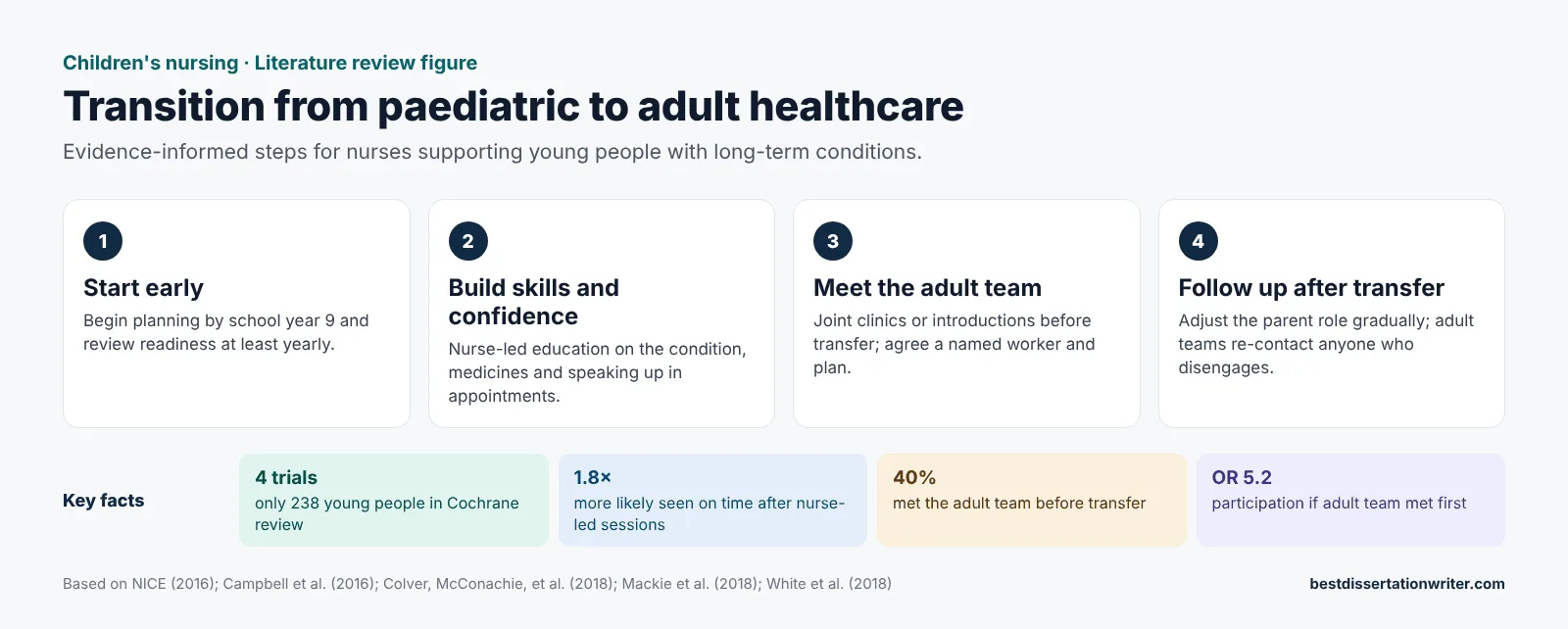
In England, the National Institute for Health and Care Excellence (NICE, 2016) guideline on transition from children’s to adults’ services recommends that planning should begin by school year 9 (age 13 or 14) at the latest. Young people should have a named worker to coordinate support, should meet a practitioner from adult services before they transfer, and should be supported in a developmentally appropriate way rather than according to a fixed age. If a young person stops attending after transfer, adult services should try to contact them and their family and involve other professionals, such as the general practitioner.
In the United States, the Got Transition programme developed the Six Core Elements of Health Care Transition: a transition policy, tracking and monitoring, readiness assessment, planning, transfer of care and transition completion. A 2018 clinical report from the American Academy of Pediatrics, the American Academy of Family Physicians and the American College of Physicians called for this structured approach and offered practice-based quality improvement guidance on planning, transfer and integration into adult care (White et al., 2018).
Despite this guidance, provision of transitional care remains inconsistent. The models in the NICE and American guidance are largely based on expert consensus and limited research, which means that nurses and service leaders need to understand which elements of paediatric to adult healthcare transition are supported by evidence and which still rely mainly on professional judgement.
Search Strategy and Methods
Evidence for this example was identified through targeted searches of openly accessible bibliographic records, publisher websites and the reference lists of key reviews. Search terms combined keywords for the process (“transition”, “transitional care”, “transfer”, “paediatric to adult healthcare”, “adult services”) with terms for the population (“adolescen*”, “young people”, “chronic condition*”, “long-term condition*”), joined with the Boolean operators AND and OR. A full scoping review for assessment would run the same strategy in CINAHL, PubMed/MEDLINE, the Cochrane Library and Embase and report the number of records screened in a PRISMA flow diagram.
Sources were eligible if they addressed the transition of young people aged around 12 to 25 years with a chronic physical or neurodevelopmental condition from paediatric to adult healthcare, and reported guidance, the delivery of transitional care features or outcomes of transition interventions. Guidelines, Cochrane reviews, randomised trials, cohort studies and professional reports were included. Studies focusing only on mental health services, social care or education transitions were excluded.
Six sources published between 2016 and 2018 were included: one Cochrane review, one randomised trial, two linked reports from a large UK longitudinal cohort study, one national guideline and one professional clinical report (Table 1). In line with scoping review methods, the aim was to chart the evidence rather than to judge it, but the quality of each source was also appraised using the Critical Appraisal Skills Programme (CASP) checklist appropriate to its design, and findings were grouped into themes.
Key Findings on Paediatric to Adult Healthcare
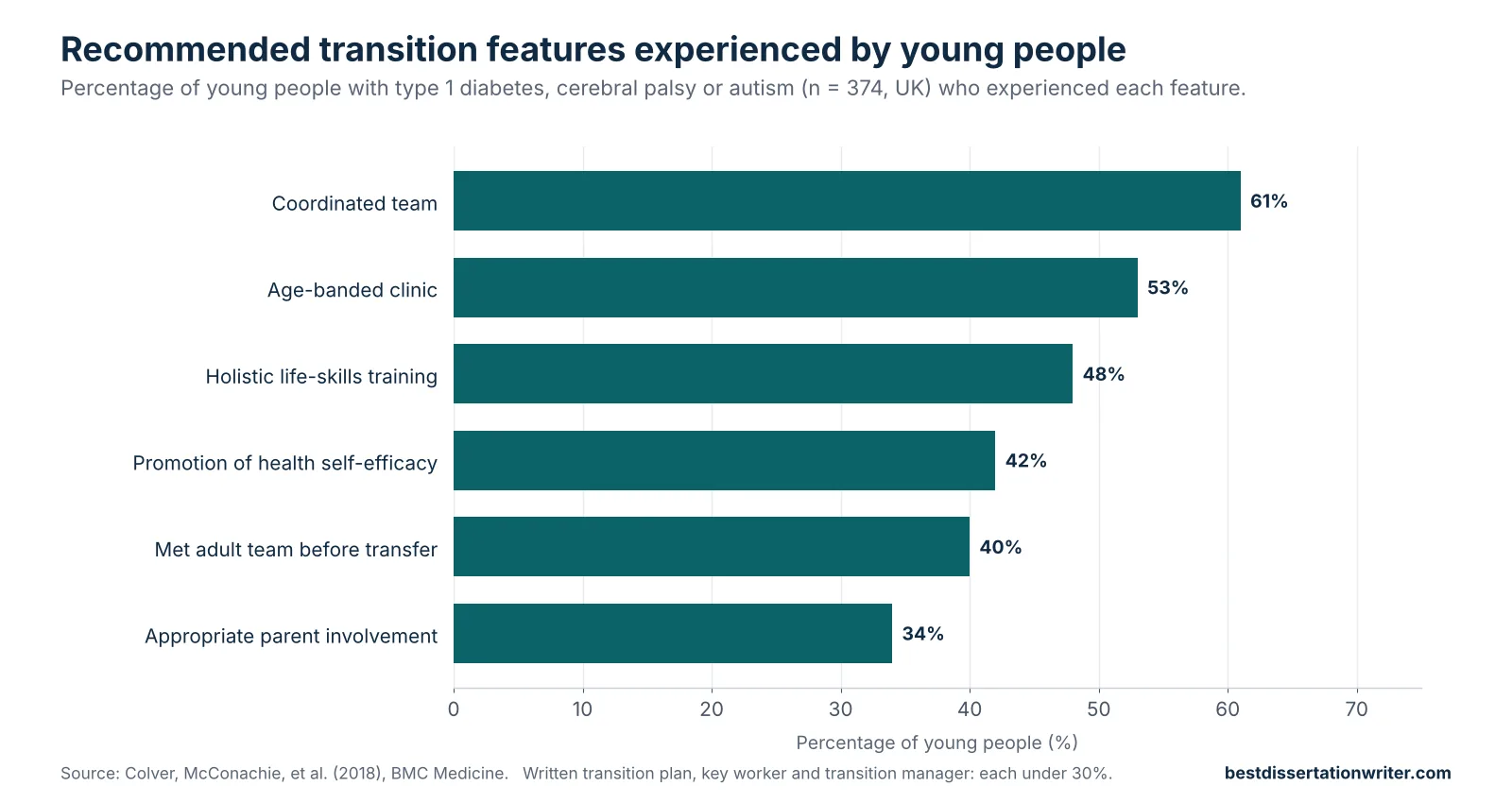
Three themes were identified: the effectiveness of structured transition interventions, the gap between recommended features and what young people actually experience, and the features of transitional care linked to better outcomes. Table 1 summarises the included sources, and Figure 1 shows how many young people in a large UK study experienced each recommended feature of transitional care.
| Author, year | Design | Setting and sample | Key finding |
|---|---|---|---|
| Campbell et al. (2016) | Cochrane systematic review | 4 RCTs, 238 adolescents; spina bifida, heart disease, diabetes and mixed conditions | Nurse-led and technology-based interventions may slightly improve readiness, self-management and knowledge; low-certainty evidence. |
| NICE (2016) | National guideline | Young people moving from children’s to adults’ health and social care in England | Start planning by year 9; named worker; meet adult practitioners before transfer; follow up non-attendance. |
| Colver, McConachie, et al. (2018) | Longitudinal cohort study | 374 young people aged 14–18 with diabetes, cerebral palsy or autism; UK | Parent involvement, self-efficacy promotion and meeting the adult team before transfer linked to better outcomes. |
| Colver, Pearse, et al. (2018) | Longitudinal mixed-methods study | Same UK cohort; 304 young people at second visit | Services provided few recommended features; low agreement between services and young people (30% for written plan). |
| Mackie et al. (2018) | Randomised controlled trial | 121 adolescents aged 16–17 with congenital heart disease | Two nurse-led sessions reduced delay to adult care (1.8 times more likely seen on time) and improved knowledge. |
| White et al. (2018) | Professional clinical report | AAP, AAFP and ACP guidance for primary care | Structured, quality improvement approach to transition, consistent with the Six Core Elements. |
Theme 1: Effectiveness of Structured Transition Interventions
Campbell et al. (2016) carried out a Cochrane review of interventions to improve the transition of adolescents from paediatric to adult healthcare. Only four randomised trials with 238 participants met the inclusion criteria. They tested a two-day workshop for young people with spina bifida, a nurse-led teaching session with a health passport for young people with heart disease, a web- and text message-based educational programme for mixed conditions, and a structured programme with a transition coordinator for type 1 diabetes.
The nurse-led and technology-based interventions may slightly improve transition readiness and self-management, and the nurse-led session improved young people’s knowledge of their condition, but the certainty of all evidence was low (Campbell et al., 2016). Telephone calls from a transition coordinator made little or no difference to transfer to adult diabetes services at 12 months. Follow-up lasted only 4 to 12 months, which the authors noted may be too short to detect change in a process that takes years, and no firm conclusions could be drawn.
Mackie et al. (2018) provided stronger evidence for a nurse-led approach. In a randomised trial of 121 young people aged 16 to 17 years with moderate or complex congenital heart disease, the intervention consisted of two one-hour individual sessions with a cardiology nurse on heart disease education and self-management. Compared with usual care, young people in the intervention group were 1.8 times more likely to have an adult cardiology appointment within one month of the recommended time (95% confidence interval 1.1 to 2.9). They also had higher knowledge scores up to 18 months and better self-management scores.
Together, these studies suggest that brief, targeted education by nurses can improve knowledge and reduce delays in reaching adult services. However, the trials were small, each involved a single condition, and none followed young people long enough to show effects on long-term health outcomes. This makes it difficult to generalise to the wide range of conditions in which young people move from paediatric to adult healthcare, or to know whether early gains in knowledge last.
Theme 2: The Gap Between Recommended and Experienced Transitional Care
A large UK research programme followed 374 young people with type 1 diabetes, cerebral palsy, or autism spectrum disorder with an associated mental health problem as they moved towards adult services. Colver, Pearse, et al. (2018) compared what services said they provided with what young people reported experiencing. Fewer than half of services said that they offered an age-banded clinic, a written transition plan, a transition manager for the clinical team, a protocol for promoting health self-efficacy or holistic life-skills training.
Young people reported experiencing these features less often than services claimed to provide them. Agreement between services and young people was only 30% for a written transition plan, 43% for holistic life-skills training and 49% for a key worker, although it was higher for appropriate parent involvement and promotion of health self-efficacy (Colver, Pearse, et al., 2018). Interviews showed that young people and families understood the features in different ways, suggesting that a transition plan may exist on paper without being meaningful to the young person.
Colver, McConachie, et al. (2018) reported how many young people experienced each feature during the study. Even the most common feature, a coordinated team, was experienced by only 61%, while just 40% met the adult team before transfer and 34% experienced appropriate parent involvement. A written transition plan, a key worker and a transition manager were each experienced by fewer than 30%. For many young people in the study, therefore, the move from paediatric to adult healthcare lacked several of the elements that national guidance regards as essential.
Theme 3: Features of Transitional Care Linked to Better Outcomes in Paediatric to Adult Healthcare
Colver, McConachie, et al. (2018) followed young people aged 14 to 18 years with four annual home visits, and 274 (73%) completed follow-up. Three features were associated with better outcomes. Appropriate parent involvement was linked to better mental wellbeing, promotion of health self-efficacy was linked to greater satisfaction with services, and meeting the adult team before transfer was linked to greater participation in arranging services (odds ratio 5.2, 95% confidence interval 2.1 to 12.8) and greater autonomy in appointments.
These findings support several NICE (2016) recommendations, particularly meeting an adult practitioner before transfer and involving parents in a way that matches the young person’s wishes. The study’s strengths include its size, its inclusion of three very different conditions and its recruitment across many UK sites. However, it was observational, so associations may partly reflect differences between young people and services, and slightly fewer participants were recruited from more deprived areas, which may limit how far the results apply to the most disadvantaged families moving to adult services.
Discussion
This scoping review found broad agreement across guidance that transition from paediatric to adult healthcare should start early, be planned and coordinated, involve meeting adult teams before transfer and continue after transfer. However, the evidence that specific interventions improve outcomes is limited. The only Cochrane review found four small trials with low-certainty evidence, while a later nurse-led trial showed reduced delays in reaching adult care and better knowledge and self-management.
A striking finding is the gap between policy and practice. In the UK cohort, most young people did not experience many of the features that guidance recommends, and services and young people often disagreed about whether features had been provided. This suggests that auditing service specifications alone is not enough; services need to ask young people and families directly about their experience of transitional care. It also suggests that simply having a transition policy does not guarantee good paediatric to adult healthcare.
The evidence highlights the importance of relationships. Meeting the adult team before transfer, appropriate parent involvement and a coordinated team are all relational rather than technical features. Children’s nurses are well placed to build these relationships, through joint clinics, introductions to adult nurses and conversations with parents about their changing role. The nurse-led trial by Mackie et al. (2018) shows that even brief, structured contact with a nurse can make a measurable difference.
There are tensions to manage. Encouraging independence means gradually seeing young people alone, yet the cohort study found that appropriate parent involvement was linked to better wellbeing. The aim is therefore not to remove parents but to change their role over time. Similarly, NICE (2016) advises against transfer at a fixed age, but many services still set age limits, which can force transfer at a time of instability, such as during examinations or a deterioration in health.
This review relied on openly accessible, English-language sources, did not involve independent double screening and included a small number of sources, most published between 2016 and 2018. Little evidence came from low- and middle-income countries, and few studies examined long-term clinical outcomes, costs or loss to follow-up after transfer. Future research on paediatric to adult healthcare should use longer follow-up, include a wider range of conditions and measure outcomes that matter to young people, such as continuity of care, confidence and quality of life.
Implications of Paediatric to Adult Healthcare Evidence for Practice
Children’s nurses should start conversations about transition by early adolescence, assess readiness regularly and teach young people to understand their condition, manage medicines and speak for themselves in appointments. They should help arrange joint clinics or introductions so that young people meet adult services staff before transfer, and should agree a named worker and a written plan with the young person, checking that the plan is understood. Parents should be supported to step back gradually, and adult teams should follow up anyone who misses early appointments.
Transition planning should be integrated with condition-specific care, for example in type 1 diabetes, and built on the partnership approach of family-centred care. Self-management teaching should include recognising when illness needs urgent help, drawing on evidence about fever management in children that young people may otherwise never have been taught directly, and adult wards admitting young people should understand how paediatric early warning systems differ from adult tools.
Conclusion
This scoping review mapped the evidence on transition from paediatric to adult healthcare for young people with chronic conditions. Guidance consistently recommends early, planned, coordinated transition, and nurse-led education can improve knowledge, self-management and timely attendance at adult services. However, most young people do not experience the recommended features, and trial evidence remains limited and short term.
Meeting the adult team before transfer, appropriate parent involvement and promotion of self-efficacy are the features most clearly linked to better outcomes. By building these into everyday practice and checking that young people experience them, children’s nurses can help make paediatric to adult healthcare a planned journey rather than an abrupt ending.
References
Campbell, F., Biggs, K., Aldiss, S. K., O’Neill, P. M., Clowes, M., McDonagh, J., While, A., & Gibson, F. (2016). Transition of care for adolescents from paediatric services to adult health services. Cochrane Database of Systematic Reviews, (4), CD009794. https://doi.org/10.1002/14651858.CD009794.pub2
Colver, A., McConachie, H., Le Couteur, A., Dovey-Pearce, G., Mann, K. D., McDonagh, J. E., Pearce, M. S., Vale, L., Merrick, H., & Parr, J. R. (2018). A longitudinal, observational study of the features of transitional healthcare associated with better outcomes for young people with long-term conditions. BMC Medicine, 16, 111. https://doi.org/10.1186/s12916-018-1102-y
Colver, A., Pearse, R., Watson, R. M., Fay, M., Rapley, T., Mann, K. D., Le Couteur, A., Parr, J. R., & McConachie, H. (2018). How well do services for young people with long term conditions deliver features proposed to improve transition? BMC Health Services Research, 18, 337. https://doi.org/10.1186/s12913-018-3168-9
Mackie, A. S., Rempel, G. R., Kovacs, A. H., Kaufman, M., Rankin, K. N., Jelen, A., Yaskina, M., Sananes, R., Oechslin, E., Dragieva, D., Mustafa, S., Williams, E., Schuh, M., Manlhiot, C., Anthony, S. J., Magill-Evans, J., Nicholas, D., & McCrindle, B. W. (2018). Transition intervention for adolescents with congenital heart disease. Journal of the American College of Cardiology, 71(16), 1768–1777. https://doi.org/10.1016/j.jacc.2018.02.043
National Institute for Health and Care Excellence. (2016). Transition from children’s to adults’ services for young people using health or social care services (NICE guideline NG43). https://www.nice.org.uk/guidance/ng43
White, P. H., Cooley, W. C., & Transitions Clinical Report Authoring Group. (2018). Supporting the health care transition from adolescence to adulthood in the medical home. Pediatrics, 142(5), e20182587. https://doi.org/10.1542/peds.2018-2587
Cite this example
Best Dissertation Writers (2026) Transition From Paediatric to Adult Healthcare Services for Young People With Chronic Conditions: A Scoping Review. Available at: https://bestdissertationwriter.com/paediatric-to-adult-healthcare-review/
Best Dissertation Writers
Get expert help with your nursing literature review
Share your topic and deadline with Best Dissertation Writers and get support tailored to your module brief.