Nursing Support for Children and Families Managing Type 1 Diabetes: A Scoping Review
 By Dr. Robertson Prime, Research Fellow
Updated October 12, 2026
15 min read
About 3,100 words
In this review
Abstract
Background: Type 1 diabetes is an autoimmune condition in which the body stops producing insulin, and it is one of the most common serious long-term conditions of childhood. In England and Wales, more than 33,000 children and young people are cared for by paediatric diabetes units, and much of the daily workload of glucose checks, carbohydrate counting and insulin delivery falls on parents.
Aim: This scoping review aimed to map what is known about the needs of children and families living with the condition, and how nursing support, including family support, education and psychosocial care, can address those needs.
Methods: Evidence was identified through targeted searches of openly accessible bibliographic records, publisher websites and the reference lists of key reviews. Six sources published between 2012 and 2026 were included: a systematic mixed-studies review, a qualitative evidence synthesis, an international clinical guideline, an integrative review, a systematic review of transition interventions and a national audit report, appraised with CASP checklists, charted and synthesised narratively.
Findings: On average, 33.5% of parents reported distress at diagnosis and 19% one to four years later, and parents of young children described constant worry and vigilance. Family-centred interventions more consistently improved family functioning and wellbeing than HbA1c, and international guidance places routine psychosocial assessment at the centre of care. National median HbA1c fell from 72.7 to 58.0 mmol/mol between 2009/10 and 2024/25 alongside rapid uptake of technology, but inequalities persist and effective, theory-based transition models have not yet been identified.
Conclusion: Children’s nurses should combine expert education on insulin and technology with family support that addresses parents’ emotional needs, psychological screening and early preparation for transition to adult services.
Keywords: type 1 diabetes, family support, insulin
Introduction
This scoping review critically examines recent evidence on type 1 diabetes and its implications for children’s nursing practice.
Type 1 diabetes is an autoimmune condition in which the body stops producing insulin, and it is one of the most common serious long-term conditions of childhood. From the day of diagnosis, children and their families must check glucose levels, count carbohydrates, give insulin by injection or pump, and respond to high and low glucose at home, at school and through the night. The daily workload falls largely on parents, especially when children are young.
In England and Wales, more than 33,000 children and young people with type 1 diabetes are cared for by paediatric diabetes units, and more than 3,000 are newly diagnosed each year (Royal College of Paediatrics and Child Health [RCPCH], 2026). Paediatric diabetes specialist nurses, ward nurses, school nurses and community children’s nurses provide much of the education, practical support and emotional support that families need, from diagnosis through to transfer to adult services.
A scoping review design was chosen because the evidence is broad and varied, ranging from national audit data and international guidelines to qualitative syntheses and reviews of family-based and transition interventions. A scoping approach allows this range of evidence to be mapped, gaps to be identified and implications for nursing to be drawn.
Review question
What is known about the needs of children and families living with type 1 diabetes, and how can nursing support, including family support, education and psychosocial care, address those needs?
Background to Type 1 Diabetes
Management of type 1 diabetes in children has changed rapidly. Multiple daily injections and finger-prick testing have increasingly been replaced by insulin pumps, real-time continuous glucose monitoring and hybrid closed loop systems, in which an algorithm adjusts insulin delivery automatically in response to glucose readings. These technologies can improve glucose control and reduce some of the burden of care, but families still need extensive education to use them safely and to respond when systems fail.
Glycated haemoglobin (HbA1c) is the main measure of long-term glucose control, and higher levels are associated with a greater risk of later complications affecting the eyes, kidneys, nerves and heart. In England and Wales, the National Paediatric Diabetes Audit (NPDA) reports HbA1c and the delivery of key care processes for every paediatric diabetes unit each year, providing a picture of how outcomes and services are changing over time.
Living with type 1 diabetes also has psychological and social consequences. Children may experience fear of hypoglycaemia, diabetes distress, low mood and disordered eating, while parents may experience anxiety, sleep disruption, guilt and strain on family relationships and finances. Adolescence adds the challenge of gradually transferring responsibility from parents to the young person, and later the move from paediatric to adult services, when engagement with care and glucose control often worsen.
Children’s nurses are central to the multidisciplinary team that supports families. Paediatric diabetes specialist nurses provide education at diagnosis, insulin dose adjustment advice, telephone support, school liaison and technology training. Ward and community nurses support families during illness and crises. Understanding the evidence on what families need, and which forms of support help, enables nurses to target their limited time where it matters most.
Search Strategy and Methods
Evidence for this example was identified through targeted searches of openly accessible bibliographic records, publisher websites and the reference lists of key reviews. Search terms combined keywords for the population (“type 1 diabetes”, “child*”, “adolescent*”, “parent*”, “family”) with terms for support and outcomes (“nurs*”, “education”, “family support”, “psychosocial”, “parental distress”, “transition”, “HbA1c”), joined with the Boolean operators AND and OR. A full scoping review for assessment would run the same strategy in CINAHL, PubMed/MEDLINE, the Cochrane Library, PsycINFO and Embase and report the number of records screened in a PRISMA flow diagram.
Sources were eligible if they addressed the needs, experiences or support of children and young people under 18 years with type 1 diabetes and their families, or reported national outcomes of paediatric diabetes care. Systematic, integrative and qualitative evidence syntheses, international clinical guidelines and national audit reports were included. Studies of adults only, studies of type 2 diabetes alone and laboratory or drug trials without a family or support component were excluded, in line with the broad but focused aims of a scoping review of type 1 diabetes care.
Six sources published between 2012 and 2026 were included: one systematic mixed-studies review, one qualitative evidence synthesis, one international clinical guideline, one integrative review, one systematic review of transition interventions and one national audit report (Table 1). Although formal appraisal is optional in scoping reviews, the quality of each source was appraised using the Critical Appraisal Skills Programme (CASP) checklist appropriate to its design, and findings were charted and synthesised narratively into themes.
Key Findings on Type 1 Diabetes
Three themes were identified: the psychological burden of type 1 diabetes on parents and families, family-based interventions and psychosocial care, and outcomes, technology and transition. Table 1 summarises the included sources, and Figure 1 shows the national trend in HbA1c among children and young people in England and Wales.
| Author, year | Design | Setting and sample | Key finding |
|---|---|---|---|
| Whittemore et al. (2012) | Systematic mixed-studies review | 34 quantitative and qualitative studies of parents | Distress in 10–74% of parents; average 33.5% at diagnosis and 19% one to four years later. |
| Kimbell et al. (2021) | Qualitative evidence synthesis | 14 studies of parents of children aged eight or under | Diabetes monopolised family life; professionals mostly helpful; peer contact with other parents valued. |
| de Wit et al. (2022) | International clinical guideline (ISPAD) | Children, adolescents and young adults with diabetes | Routine psychosocial screening from age 12, family assessment and integrated mental health care. |
| Ispriantari et al. (2023) | Integrative review | 9 studies of family-centred interventions; USA, UK and Denmark | Inconsistent HbA1c effects; improvements in teamwork, coping and quality of life in some studies. |
| Aljohani et al. (2024) | Systematic review | 22 studies of transition interventions, ages 10–25 | Mostly service-based and rarely theory-based; psychological outcomes seldom measured. |
| RCPCH (2026) | National audit report | 35,801 children and young people in paediatric diabetes units | Median HbA1c 58.0 mmol/mol; 62% using closed loop; gaps by deprivation and ethnicity. |
Theme 1: The Psychological Burden of Type 1 Diabetes on Families
In a systematic mixed-studies review of 34 articles, Whittemore et al. (2012) examined the psychological experience of parents of children with type 1 diabetes. Reported rates of parental distress ranged from 10% to 74% across studies. On average, 33.5% of parents reported distress at diagnosis and 19% reported distress one to four years later. Parental distress was associated with more child stress and depressive symptoms, more behavioural problems, lower child-reported quality of life and poorer diabetes management.
The qualitative studies in the same review described diagnosis as a profound shock that disrupted family life, followed by gradual adjustment with continuing stress. Whittemore et al. (2012) recommended screening parents for psychological distress and developing preventive interventions. The wide range of distress estimates reflects differences in measures and samples, and many included studies were small and cross-sectional, which limits conclusions about cause and effect. Nevertheless, the association between parental and child wellbeing is consistent.
A more recent qualitative synthesis focused on parents of young children aged eight years or under. Kimbell et al. (2021) synthesised 14 studies and identified two themes. The first, monopolisation of life, captured constant worry and vigilance that affected parents’ wellbeing, relationships and finances, made trusted childcare hard to find and limited personal choices, although diabetes technologies could ease some of this burden. The second described professional and informal family support: health professionals were generally seen as helpful, but some encounters caused frustration and anxiety, and contact with other parents was highly valued.
Together, these syntheses show that parents of children with the condition carry a heavy emotional and practical load, particularly in the early years and during the night. For nurses, the findings suggest that support should address the whole family rather than glucose management alone, and that the way professionals communicate can either reduce or add to parental anxiety.
Theme 2: Family-Based Interventions and Psychosocial Care
Interventions that involve the whole family have been tested as a way to improve both health and family outcomes. In an integrative review published in a children’s nursing journal, Ispriantari et al. (2023) screened 2,746 records and included nine studies of family-centred interventions from the United States, the United Kingdom and Denmark. Four interventions were non-technological, two used technology and three combined both approaches. Three studies reported significant reductions in HbA1c, but five found no significant effect.
Outcomes for families were more encouraging. Six studies assessed parent–child teamwork, with reduced family conflict in two, and some studies reported improvements in children’s quality of life and problem-solving and in parents’ quality of life, coping and depression (Ispriantari et al., 2023). However, the review included only nine heterogeneous studies, most from one country, and integrative review methods do not allow pooled estimates. The evidence therefore suggests that family-centred approaches can help, but it does not identify which components are most effective.
International guidance places psychosocial care at the centre of diabetes management. The International Society for Pediatric and Adolescent Diabetes (ISPAD) guideline states that psychosocial care should be an integral part of collaborative, person-centred care (de Wit et al., 2022). It recommends routine use of validated, age-appropriate psychosocial assessments, screening of young people aged 12 years and over for depressive symptoms, diabetes distress and disordered eating, and preventive support after diagnosis and before adolescence. Mental health professionals are described as essential members of the team.
The ISPAD guideline also recommends assessing family functioning and parental wellbeing, notes that diabetes-specific family conflict can worsen adherence, glycaemic control and mood, and advises that parents should remain involved through adolescence, with responsibility shifting gradually and by mutual agreement (de Wit et al., 2022). This guidance aligns closely with the findings on parental distress and gives nurses a clear framework for family support, although guideline recommendations are largely based on observational evidence and expert consensus.
Theme 3: Outcomes, Technology and Transition
National audit data show substantial improvement in glucose control over the last fifteen years. The NPDA report for 2024/25 found that the national median HbA1c among children and young people with type 1 diabetes fell from 72.7 mmol/mol in 2009/10 to 58.0 mmol/mol in 2024/25, with the mean falling from 75.4 to 61.1 mmol/mol (RCPCH, 2026). In 2024/25, 69% were using an insulin pump and 62% a hybrid closed loop system, compared with 55% and 36% the previous year, and 93% used real-time continuous glucose monitoring.
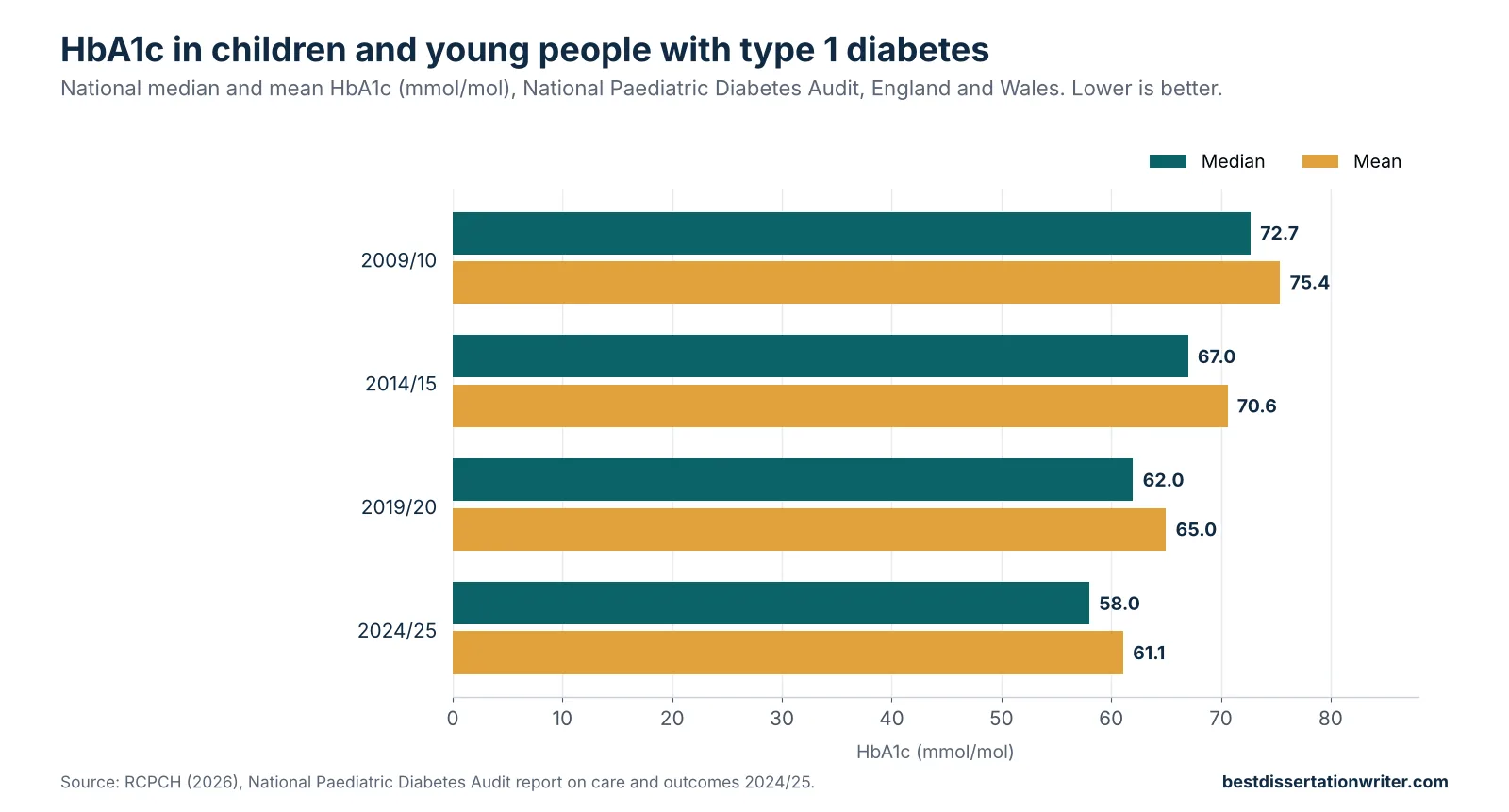
The same audit reported persistent inequalities. In 2024/25, the median HbA1c was 60.0 mmol/mol in the most deprived areas compared with 56.0 mmol/mol in the least deprived, and 64.5 mmol/mol among Black children and young people compared with 58.0 mmol/mol among White children. Hybrid closed loop use was lower among Black children (51.7%) than White children (63.6%). In addition, 84% had a psychological assessment, of whom 27% needed additional support, and 22% of newly diagnosed children presented in diabetic ketoacidosis (RCPCH, 2026).
Transition to adult services is a vulnerable period. In a systematic review of 22 studies of transition interventions for young people aged 10 to 25 years, Aljohani et al. (2024) found that most interventions were organised around services, such as transition planning, coordination, pre-transition education, joint clinics and prompting strategies, and rarely drew on theory. Most studies measured metabolic outcomes, while psychological outcomes such as acceptance and self-management activation were rarely reported. The authors concluded that effective, theory-based transition models have not yet been identified.
Discussion
This scoping review maps a body of evidence showing that type 1 diabetes in childhood places a substantial psychological load on parents, that family-centred and psychosocial support are widely recommended, and that national outcomes have improved markedly alongside rapid uptake of technology. The improvement in HbA1c is encouraging, but it coincides with changes in technology, service organisation and national quality improvement programmes, so the specific contribution of nursing support cannot be isolated from audit data.
A clear tension exists between technology and family burden. Pumps, continuous monitoring and closed loop systems may reduce some aspects of the workload and were identified by parents as helpful (Kimbell et al., 2021), yet they also bring new tasks, alarms and data to interpret. The ISPAD guideline notes that continuous monitoring data can be a source of conflict, although research has not shown that it increases conflict overall (de Wit et al., 2022). Technology therefore changes, rather than removes, the need for nursing education and family support in type 1 diabetes.
Inequalities in outcomes and access to technology are a further concern. Children from more deprived areas and Black children had higher HbA1c and lower closed loop use (RCPCH, 2026). Families with fewer resources may face greater barriers to attending clinics, using technology and accessing psychological support. Nurses are well placed to identify these barriers, adapt education to health literacy and language needs, and advocate for equitable access, but the evidence on interventions that reduce inequalities in type 1 diabetes care remains limited.
The evidence on family-based and transition interventions is promising but weak. Both Ispriantari et al. (2023) and Aljohani et al. (2024) found heterogeneous interventions, inconsistent outcome measures and limited theoretical grounding. Effects on HbA1c were inconsistent, while effects on family relationships and wellbeing were more often positive. This suggests that family-centred nursing support may be valued for its effects on quality of life and coping even when glycaemic benefits are uncertain, and that outcome measures should capture what matters to families.
The evidence base has limitations. The parental distress review is more than a decade old and predates widespread technology use, the qualitative synthesis focused on young children, and the audit data are descriptive. This review relied on openly accessible, English-language sources and did not involve independent double screening. Future research should evaluate nurse-led family support and psychological screening programmes, test theory-based transition models and examine how to reduce inequalities in outcomes and access to technology.
Implications of Type 1 Diabetes Evidence for Practice
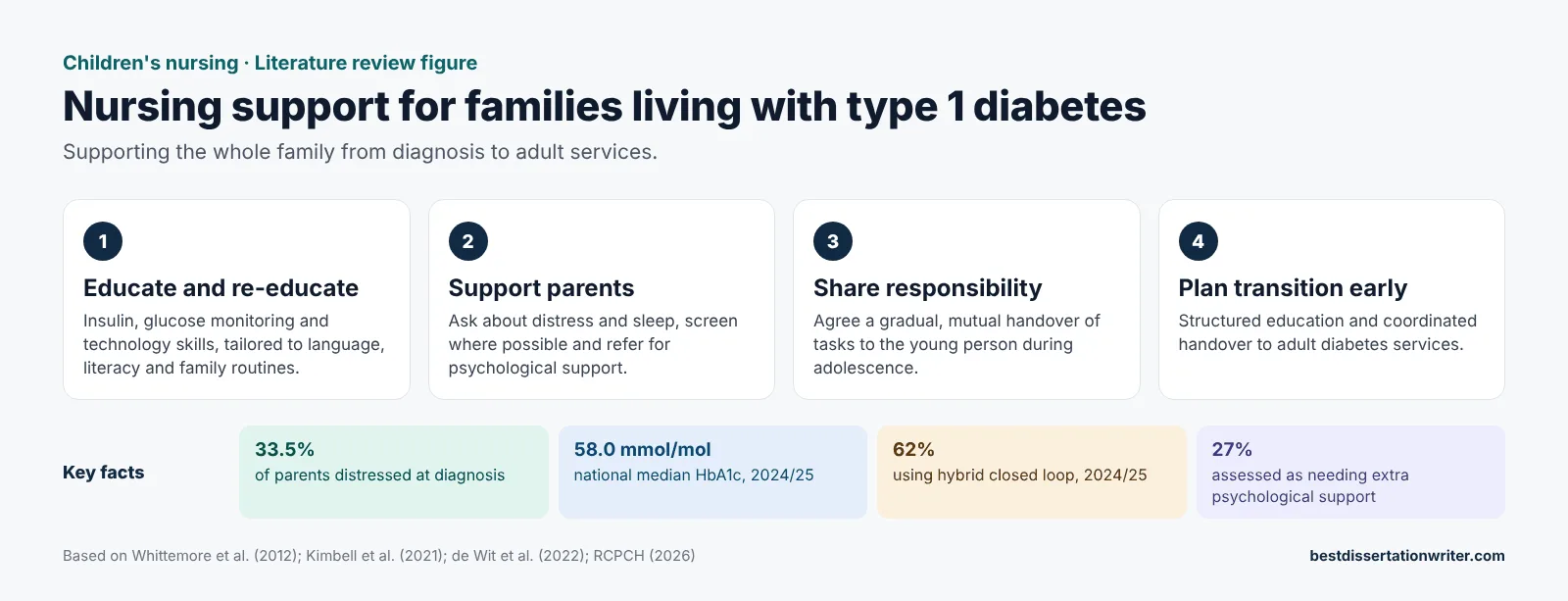
For children’s nurses, the evidence supports offering family support that addresses emotional as well as practical needs from the time of diagnosis. Nurses should ask parents about their own wellbeing, sleep and distress, use validated screening where available and refer to psychological services when needed. Education on insulin, glucose monitoring and technology should be repeated and tailored to the family’s circumstances, language and health literacy. Nurses should help families to agree a gradual, shared transfer of responsibility during adolescence and connect parents with peer support. Teams should also review their own audit data to identify gaps in outcomes between groups.
Preparation for the move from paediatric to adult healthcare should start early, with structured education and coordinated handover between teams. Children with long-term conditions also need up-to-date routine immunisations, so nurses may need to respond sensitively to parental vaccine hesitancy. The same principles of supported self-management and partnership apply to young people with asthma and reflect the wider philosophy of family-centred care.
Conclusion
This scoping review mapped evidence on nursing support for children and families managing type 1 diabetes. Parents experience high levels of distress, especially around diagnosis, and family-centred interventions and psychosocial care can improve family functioning and wellbeing, although their effects on HbA1c are inconsistent. National outcomes have improved, but inequalities persist and transition remains a vulnerable time.
Children’s nurses can strengthen care by combining expert education on insulin and technology with consistent family support, psychological screening and early preparation for transition. Treating the whole family as the focus of care offers the best opportunity to help children and young people with type 1 diabetes grow into confident, healthy adults.
References
Aljohani, N., Donetto, S., Due-Christensen, M., & Forbes, A. (2024). The journey to adulthood: A systematic review of interventions in type 1 diabetes paediatric to adult transition care. Pediatric Diabetes, 2024, 1773726. https://doi.org/10.1155/2024/1773726
de Wit, M., Gajewska, K. A., Goethals, E. R., McDarby, V., Zhao, X., Hapunda, G., Delamater, A. M., & DiMeglio, L. A. (2022). ISPAD Clinical Practice Consensus Guidelines 2022: Psychological care of children, adolescents and young adults with diabetes. Pediatric Diabetes, 23(8), 1373–1389. https://doi.org/10.1111/pedi.13428
Ispriantari, A., Agustina, R., Konlan, K. D., & Lee, H. (2023). Family-centered interventions for children and adolescents with type 1 diabetes mellitus: An integrative review. Child Health Nursing Research, 29(1), 7–23. https://doi.org/10.4094/chnr.2023.29.1.7
Kimbell, B., Lawton, J., Boughton, C., Hovorka, R., & Rankin, D. (2021). Parents’ experiences of caring for a young child with type 1 diabetes: A systematic review and synthesis of qualitative evidence. BMC Pediatrics, 21, 160. https://doi.org/10.1186/s12887-021-02569-4
Royal College of Paediatrics and Child Health. (2026). National Paediatric Diabetes Audit (NPDA) report on care and outcomes 2024/25. Royal College of Paediatrics and Child Health. https://www.rcpch.ac.uk/resources/npda-annual-reports
Whittemore, R., Jaser, S., Chao, A., Jang, M., & Grey, M. (2012). Psychological experience of parents of children with type 1 diabetes: A systematic mixed-studies review. The Diabetes Educator, 38(4), 562–579. https://doi.org/10.1177/0145721712445216
Cite this example
Best Dissertation Writers (2026) Nursing Support for Children and Families Managing Type 1 Diabetes: A Scoping Review. Available at: https://bestdissertationwriter.com/type-1-diabetes-literature-review/
Best Dissertation Writers
Get expert help with your nursing literature review
Share your topic and deadline with Best Dissertation Writers and get support tailored to your module brief.