Nursing Interventions to Support Breastfeeding and Optimal Infant Nutrition: A Systematic Review
 By Dr. Robertson Prime, Research Fellow
Updated October 12, 2026
16 min read
About 3,200 words
In this review
Abstract
Background: Infant nutrition in the first months and years of life shapes growth, resistance to infection and, in all likelihood, later health, yet many babies are not breastfed as recommended. The World Health Organization reports that about 47% of infants aged 0 to 6 months were exclusively breastfed over the period 2018 to 2025. Nurses, midwives and health visitors are often the first professionals parents turn to when feeding becomes difficult.
Aim: This systematic review aimed to identify which nursing and health service interventions support breastfeeding and optimal infant feeding, and what they mean for children’s nursing practice.
Methods: Evidence was identified through targeted searches of openly accessible bibliographic records, publisher websites and the reference lists of key reviews. Seven sources published between 2016 and 2026 were included: two papers from the Lancet breastfeeding series, a systematic review of the Baby-Friendly Hospital Initiative, a Cochrane systematic review, two WHO guidelines and a WHO fact sheet, appraised with CASP checklists and synthesised narratively.
Findings: Breastfeeding protected against childhood infections and benefited mothers, and scaling it up to near-universal levels was estimated to prevent 823,000 child deaths a year, although much of this evidence is observational. A Cochrane review of 116 trials found that breastfeeding-only support reduced the risk of stopping exclusive breastfeeding at six months (RR 0.90), with modest effects of moderate certainty. Adherence to the Ten Steps of the Baby-Friendly Hospital Initiative improved breastfeeding outcomes in a dose–response pattern, community support after discharge appeared essential, and WHO guidance supports responsive complementary feeding from six months.
Conclusion: Children’s nurses should offer every family proactive, scheduled breastfeeding support that continues after discharge, follow maternity practices based on the Ten Steps and give consistent, non-judgemental advice on complementary and formula feeding.
Keywords: infant nutrition, breastfeeding, infant feeding
Introduction
This systematic review critically examines recent evidence on infant nutrition and its implications for children’s nursing practice.
What babies are fed in the first months and years of life shapes their growth, their resistance to infection and, in all likelihood, their health in later childhood and adulthood. Breast milk provides the nutrients, antibodies and living cells that young infants need, yet many babies around the world are not breastfed as recommended. Where breastfeeding stops early, the move to formula or to poorly timed and nutritionally weak complementary foods can leave infants exposed to infection, undernutrition or excess weight gain.
Nurses, midwives and health visitors are often the professionals parents turn to first when feeding becomes difficult. They are present in maternity units, neonatal and children’s wards, community clinics and family homes, which places them at the centre of infant nutrition support. Their advice on positioning and attachment, their response to worries about milk supply and their guidance on starting solid foods can determine whether families meet recommended feeding goals. Poorly informed or inconsistent advice, by contrast, can undermine parents’ confidence at a vulnerable time.
A systematic approach was chosen so that Cochrane reviews, systematic reviews and international guidelines could be identified and appraised against explicit criteria. Bringing this evidence together matters because infant nutrition support is delivered by many different staff across hospital and community settings, and practice is not always based on the strongest available evidence.
Review question
Which nursing and health service interventions support breastfeeding and optimal infant nutrition, and what are the implications for children’s nursing practice?
Background to Infant Nutrition
The World Health Organization (WHO) and UNICEF recommend that breastfeeding starts within one hour of birth, that infants are exclusively breastfed for the first six months, that safe complementary foods are introduced from six months, and that breastfeeding continues to two years of age or beyond (World Health Organization [WHO], 2026). These four recommendations form the core of international guidance on infant nutrition and underpin national policies in the United Kingdom and elsewhere.
Despite this guidance, global rates remain low. The most recent WHO fact sheet reports that about 47% of infants aged 0 to 6 months were exclusively breastfed over the period 2018 to 2025 (WHO, 2026). In the first paper of the Lancet breastfeeding series, Victora et al. (2016) reported that exclusive breastfeeding in low- and middle-income countries reached only 37%, and that rates of breastfeeding at 12 months fell as national income rose, with most high-income countries reporting low prevalence.
Infant feeding is influenced by far more than individual choice. Maternity care practices, the availability of skilled support after discharge, return to paid work, family attitudes and the marketing of breast-milk substitutes all affect whether mothers start and continue breastfeeding (Rollins et al., 2016). These influences mean that unmet need for skilled support, rather than a lack of motivation, can be an important barrier.
Infant nutrition does not end with breastfeeding. From six months, infants need complementary foods that supply energy, iron, zinc and other nutrients that breast milk alone cannot provide in sufficient amounts. The quality of these foods, the way they are offered and the avoidance of sugary and highly processed products shape both growth and lifelong eating habits (WHO, 2023). Nursing support therefore needs to span the whole period from birth to the second year of life.
Search Strategy and Methods
Evidence for this example was identified through targeted searches of openly accessible bibliographic records, publisher websites and the reference lists of key reviews. Search terms combined keywords for the topic (“infant nutrition”, “breastfeeding”, “breast feeding”, “infant feeding”, “complementary feeding”, “Baby-Friendly”) with terms for interventions and outcomes (“support”, “counselling”, “education”, “exclusive breastfeeding”, “duration”, “nurs*”, “midwi*”), joined with the Boolean operators AND and OR. A full systematic review for assessment would run the same strategy in CINAHL, PubMed/MEDLINE, the Cochrane Library and Embase and report the number of records screened in a PRISMA flow diagram.
Sources were eligible if they examined the importance of breastfeeding or interventions to support breastfeeding and infant nutrition for healthy term infants from birth to two years, or set out international recommendations for infant feeding practice. Cochrane reviews, systematic reviews, major evidence syntheses and WHO guidelines were prioritised. Studies limited to preterm or sick infants in neonatal units were excluded, because the infant nutrition needs of this group and the interventions used differ from those of healthy babies.
Seven sources published between 2016 and 2026 were included: two papers from the Lancet breastfeeding series, one systematic review of the Baby-Friendly Hospital Initiative, one Cochrane systematic review, two WHO guidelines and one WHO fact sheet (Table 1). The quality of each source was appraised using the Critical Appraisal Skills Programme (CASP) checklist appropriate to its design, with guidelines judged on the transparency of their evidence base, and findings were synthesised narratively and grouped into themes.
Key Findings on Infant Nutrition
Three themes were identified: the health and economic case for breastfeeding as the foundation of infant nutrition, the effectiveness of breastfeeding support interventions, and the role of maternity facility practices and complementary feeding guidance. Table 1 summarises the included sources, and Figure 1 presents the pooled effects of breastfeeding support on the risk of mothers stopping breastfeeding at different time points.
| Author, year | Design | Setting and sample | Key finding |
|---|---|---|---|
| Pérez-Escamilla et al. (2016) | Systematic review | 58 reports from 19 countries; Baby-Friendly Hospital Initiative | Adherence to the Ten Steps improved breastfeeding outcomes in a dose–response pattern; community support essential. |
| Rollins et al. (2016) | Evidence synthesis with meta-analyses (Lancet series) | Global; interventions in health services, communities and workplaces | Combined health system and community interventions gave the largest gains; not breastfeeding costs about US$302 billion a year. |
| Victora et al. (2016) | Evidence synthesis with meta-analyses (Lancet series) | Global; epidemiology and health effects of breastfeeding | Breastfeeding protects against infection; scale-up could prevent 823,000 child deaths a year. |
| WHO (2017) | International guideline | Facilities providing maternity and newborn services | Recommendations on facility practices that informed the revised Ten Steps to Successful Breastfeeding. |
| Gavine et al. (2022) | Cochrane systematic review | 116 trials; more than 98,816 mother–infant pairs | Support reduced stopping exclusive breastfeeding at 6 months (RR 0.90); moderate certainty. |
| WHO (2023) | International guideline | Complementary feeding of children aged 6 to 23 months | Start solids at 6 months, continue breastfeeding, offer diverse foods and practise responsive feeding. |
| WHO (2026) | Fact sheet | Global infant and young child feeding data | About 47% of infants aged 0 to 6 months were exclusively breastfed in 2018 to 2025. |
Theme 1: Breastfeeding as the Foundation of Infant Nutrition
Victora et al. (2016) brought together a series of meta-analyses on the short- and long-term effects of breastfeeding. Breastfeeding protected against childhood infections and malocclusion, was associated with higher scores on intelligence tests and probably reduced overweight and diabetes later in life. Exclusively breastfed infants under six months had a small fraction of the mortality risk of those who were not breastfed. For mothers, breastfeeding was associated with protection against breast cancer and improved birth spacing.
The authors estimated that scaling up breastfeeding to near-universal levels could prevent 823,000 child deaths and 20,000 deaths from breast cancer each year (Victora et al., 2016). These figures make a powerful case for investment, but they rest largely on observational studies, in which families who breastfeed may differ in many ways from those who do not. The pooled gain of 2.6 intelligence points, for example, was drawn from studies that adjusted for maternal intelligence, yet residual confounding cannot be excluded.
The economic analysis in the second paper of the series reinforced this case. Rollins et al. (2016) estimated that the global economic losses linked to not breastfeeding amounted to about US$302 billion a year. They also described how the breast-milk substitute industry, with global sales of US$44.8 billion in 2014, competes with breastfeeding through marketing that the International Code of Marketing of Breast-milk Substitutes seeks to restrict, although the Code’s effect depends on national legislation, monitoring and enforcement.
For nurses, these findings explain why breastfeeding is treated as a public health priority rather than a lifestyle preference. They also highlight a tension: the evidence that breastfeeding benefits infant nutrition and health is strong, but parents who cannot or choose not to breastfeed must not feel judged. Accurate, balanced information and practical support, rather than pressure, are the approaches most consistent with both the evidence and person-centred care.
Theme 2: Breastfeeding Support and Infant Nutrition Outcomes
The strongest evidence on what nurses and other professionals can do comes from the updated Cochrane review by Gavine et al. (2022). It included 116 trials with more than 98,816 mother–infant pairs, 103 of which contributed data. Support was defined broadly and included face-to-face or telephone contact, counselling, education and practical help from professionals or trained lay supporters. Interventions were grouped into breastfeeding-only support and breastfeeding-plus support, in which breastfeeding help was combined with other forms of care.
Breastfeeding-only support reduced the risk of stopping exclusive breastfeeding at six months (risk ratio [RR] 0.90) and at four to six weeks (RR 0.83), and reduced the risk of stopping any breastfeeding at both time points (Gavine et al., 2022). Breastfeeding-plus support also reduced stopping exclusive breastfeeding at six months (RR 0.79) and any breastfeeding at six months (RR 0.94). Most of these estimates were judged to be of moderate certainty.
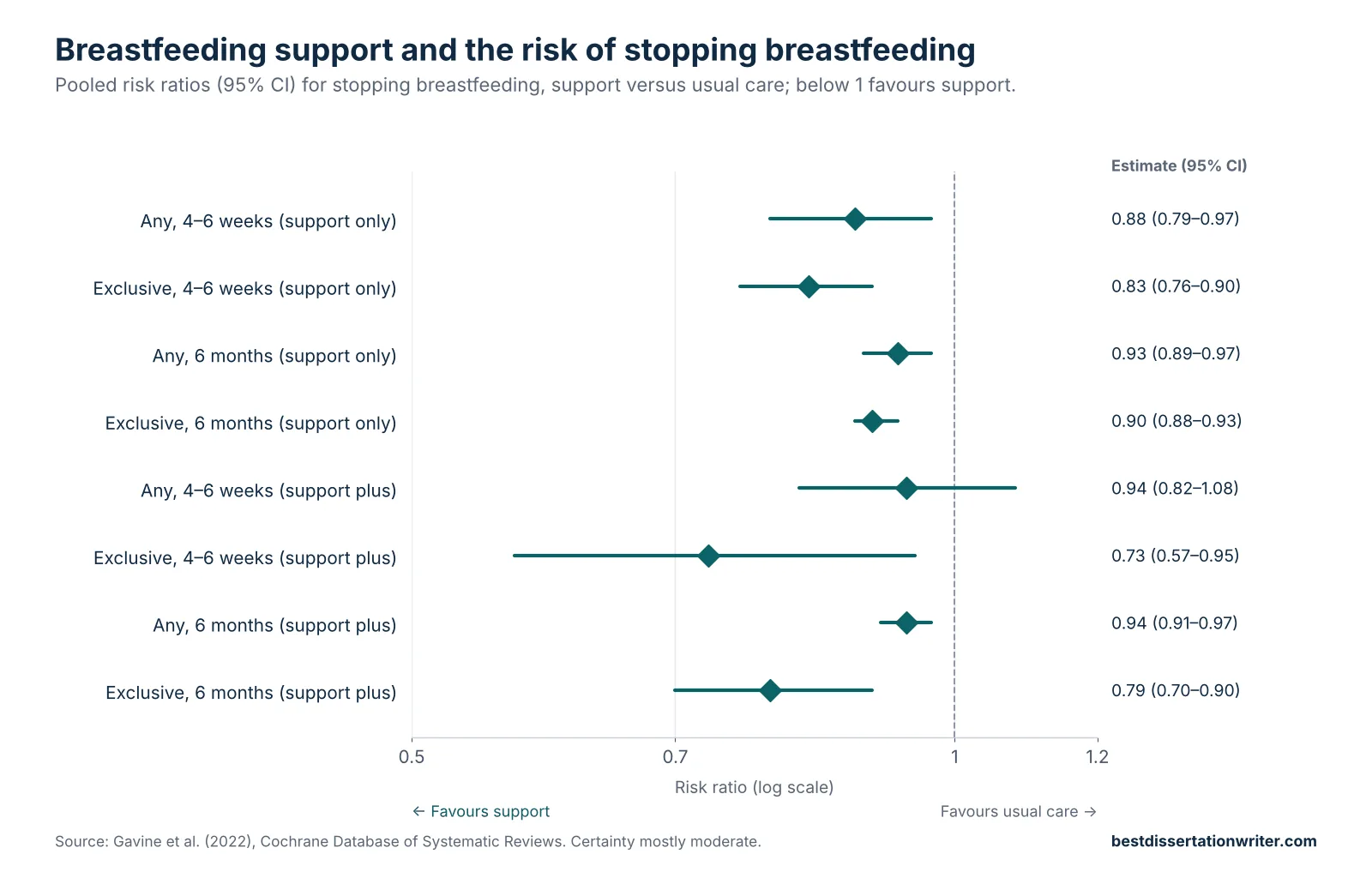
The effects are modest in relative terms, but they apply to a very common outcome and to large numbers of families, so their public health value is considerable. Meta-regression found no clear difference in effect according to who provided the support or whether it was delivered face to face or by telephone, although the authors noted that statistical power was limited (Gavine et al., 2022). Support involving four to eight contacts appeared to be associated with better exclusive breastfeeding outcomes.
Rollins et al. (2016) reached a complementary conclusion from a broader set of meta-analyses: breastfeeding practices respond to well-delivered interventions across health services, families and communities, and workplaces. Combining health system and community interventions was associated with the largest gains, increasing exclusive breastfeeding around two and a half times. This suggests that hospital-based nursing support is most effective when it is linked with continuing help at home and in the community.
Theme 3: Facility Practices and Infant Nutrition Beyond Six Months
The Baby-Friendly Hospital Initiative (BFHI) aims to make maternity facilities supportive of breastfeeding through the Ten Steps to Successful Breastfeeding. In a systematic review of 58 reports from 19 countries, Pérez-Escamilla et al. (2016) found that adherence to the Ten Steps improved short-, medium- and long-term breastfeeding outcomes, including early initiation, exclusive breastfeeding at discharge and the duration of any and exclusive breastfeeding. The more steps mothers were exposed to, the better their outcomes, suggesting a dose–response relationship.
The review also found that community support after discharge, the final step, appeared essential for sustaining these gains (Pérez-Escamilla et al., 2016). However, most included studies were quasi-experimental or observational, with only three randomised trials contributing reports, and the content and quality of BFHI implementation varied between countries. The WHO (2017) guideline on protecting, promoting and supporting breastfeeding in maternity and newborn services subsequently informed a revision of the Ten Steps, which places immediate skin-to-skin contact, rooming-in, responsive feeding and coordinated discharge support at the centre of facility care.
Infant nutrition support must continue as babies grow. The WHO (2023) guideline for complementary feeding of children aged 6 to 23 months recommends introducing complementary foods at six months while continuing breastfeeding, offering animal-source foods, fruits and vegetables daily, limiting foods and drinks high in sugar, salt or trans fats, and using responsive feeding. For non-breastfed children aged 12 to 23 months, animal milk is recommended and follow-up formula is not.
The complementary feeding guideline acknowledges that most topics lacked robust randomised trials (WHO, 2023), so several recommendations rest on observational evidence and expert judgement. Even so, its emphasis on responsive feeding, recognising and responding to hunger and fullness cues, aligns closely with breastfeeding guidance and gives nurses a consistent message to share with families across the first two years of infant feeding.
Discussion
This review shows that breastfeeding is central to infant nutrition and child health and that supportive interventions delivered by nurses, midwives, other professionals and trained peers increase how long mothers breastfeed. The evidence is strongest for organised support with a planned series of contacts, combining facility-based care with continuing help in the community, and for maternity practices that follow the Ten Steps. Together, these findings place infant nutrition support firmly within the everyday responsibilities of nursing.
The quality of the evidence varies across the included sources. The Cochrane review provides moderate-certainty evidence from randomised trials, whereas the health benefits described in the Lancet series and much of the BFHI evidence come from observational designs that are vulnerable to confounding. The size of the support effect in trials is also modest, and the interventions tested varied widely in content, intensity and timing, so not every support programme can be expected to work equally well in every setting (Gavine et al., 2022).
There is a gap between knowing that support works and providing it reliably. Rollins et al. (2016) argued that weak political commitment, inadequate maternity protection and aggressive marketing of breast-milk substitutes undermine breastfeeding in many countries. In practice, short postnatal stays, staff shortages and limited community services can mean that families leave hospital before feeding is established and receive little follow-up. Strengthening infant nutrition support therefore depends on service design as well as on individual nursing skill.
Equity is another important concern. Victora et al. (2016) found that in high-income countries, mothers from more advantaged groups tend to breastfeed for longer, whereas in low- and middle-income countries the pattern is often reversed. Support that is offered only to those who ask for it may widen these gaps. Proactive support with a planned series of contacts, which the Cochrane evidence suggests may be beneficial, may be more likely to reach families who face the greatest barriers to optimal infant nutrition.
The evidence base has limitations. Most trials focused on breastfeeding duration rather than wider nutritional outcomes, such as growth or the quality of complementary diets, and few were set in UK children’s nursing services. This review relied on openly accessible, English-language sources and did not involve independent double screening. Future research should evaluate integrated programmes that support families from birth through complementary feeding, include fathers and wider family members, and measure longer-term growth and health outcomes.
Implications of Infant Nutrition Evidence for Practice
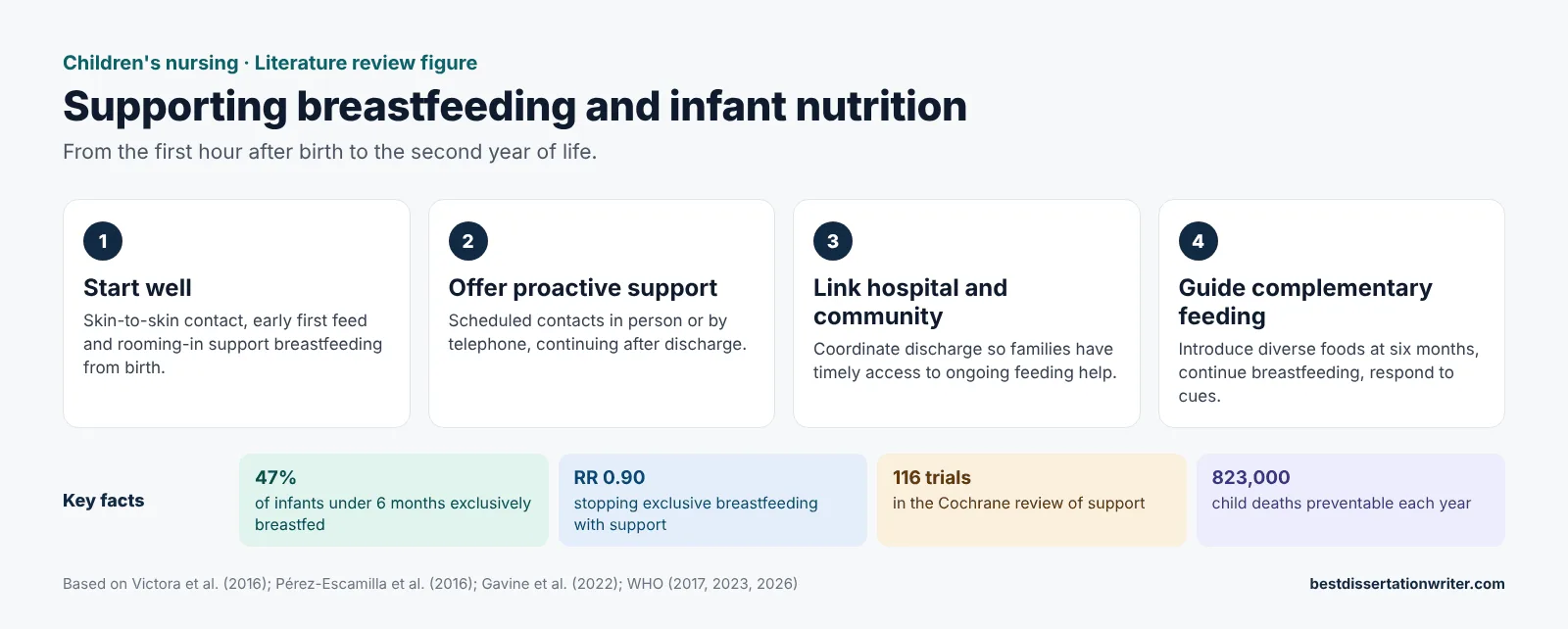
For children’s nurses, the evidence supports offering every family scheduled, proactive breastfeeding support rather than waiting for problems to arise, with contact continuing after discharge either in person or by telephone. Nurses should help with positioning and attachment, recognise feeding cues, keep mothers and babies together, avoid unnecessary formula supplementation and refer to specialist lactation services when difficulties persist. From six months, they should give consistent advice on responsive complementary feeding and on limiting sugary and highly processed foods. Families who use formula should receive equally respectful guidance on safe preparation and responsive bottle feeding.
Infant feeding advice fits naturally within family-centred care, which recognises parents as partners and includes the wider family in decisions. Early feeding patterns link to later weight, making this work part of preventing childhood obesity, and the same conversations offer a chance to discuss healthy routines such as screen time in the early years. Nurses supporting infants with painful feeding difficulties or procedures should also use validated pain assessment tools.
Conclusion
This systematic review examined nursing interventions to support breastfeeding and optimal infant nutrition. Breastfeeding brings substantial benefits for children and mothers, organised support reduces the risk of stopping breastfeeding early, and maternity practices based on the Ten Steps improve breastfeeding outcomes, although much of the supporting evidence is observational and the effects of support are modest.
Children’s nurses can improve infant nutrition by providing proactive, consistent support from birth, linking hospital and community care and continuing to guide families through complementary feeding. Treating feeding support as a core nursing responsibility, rather than a task left to specialists, offers a practical way to give every child a healthier start in life.
References
Gavine, A., Shinwell, S. C., Buchanan, P., Farre, A., Wade, A., Lynn, F., Marshall, J., Cumming, S. E., Dare, S., & McFadden, A. (2022). Support for healthy breastfeeding mothers with healthy term babies. Cochrane Database of Systematic Reviews, (10), CD001141. https://doi.org/10.1002/14651858.CD001141.pub6
Pérez-Escamilla, R., Martinez, J. L., & Segura-Pérez, S. (2016). Impact of the Baby-friendly Hospital Initiative on breastfeeding and child health outcomes: A systematic review. Maternal & Child Nutrition, 12(3), 402–417. https://doi.org/10.1111/mcn.12294
Rollins, N. C., Bhandari, N., Hajeebhoy, N., Horton, S., Lutter, C. K., Martines, J. C., Piwoz, E. G., Richter, L. M., & Victora, C. G. (2016). Why invest, and what it will take to improve breastfeeding practices? The Lancet, 387(10017), 491–504. https://doi.org/10.1016/S0140-6736(15)01044-2
Victora, C. G., Bahl, R., Barros, A. J. D., França, G. V. A., Horton, S., Krasevec, J., Murch, S., Sankar, M. J., Walker, N., Rollins, N. C., & The Lancet Breastfeeding Series Group. (2016). Breastfeeding in the 21st century: Epidemiology, mechanisms, and lifelong effect. The Lancet, 387(10017), 475–490. https://doi.org/10.1016/S0140-6736(15)01024-7
World Health Organization. (2017). Guideline: Protecting, promoting and supporting breastfeeding in facilities providing maternity and newborn services. World Health Organization. https://www.who.int/publications/i/item/9789241550086
World Health Organization. (2023). WHO guideline for complementary feeding of infants and young children 6–23 months of age. World Health Organization. https://www.who.int/publications/i/item/9789240081864
World Health Organization. (2026, August 4). Infant and young child feeding [Fact sheet]. https://www.who.int/news-room/fact-sheets/detail/infant-and-young-child-feeding
Cite this example
Best Dissertation Writers (2026) Nursing Interventions to Support Breastfeeding and Optimal Infant Nutrition: A Systematic Review. Available at: https://bestdissertationwriter.com/infant-nutrition-literature-review/
Best Dissertation Writers
Get expert help with your nursing literature review
Share your topic and deadline with Best Dissertation Writers and get support tailored to your module brief.