Fever Management in Children and the Effectiveness of Parental Education by Nurses: A Literature Review
 By Dr. Robertson Prime, Research Fellow
Updated October 12, 2026
16 min read
About 3,200 words
By Dr. Robertson Prime, Research Fellow
Updated October 12, 2026
16 min read
About 3,200 words
In this review
Abstract
Background: Fever management in children is an everyday concern for nurses, because fever is one of the most common reasons that parents seek help for a young child. Most episodes are caused by self-limiting viral infections, yet fear of fever drives frequent temperature checks, unnecessary antipyretic doses, dosing errors and avoidable visits to health services.
Aim: This narrative review aimed to examine current evidence on managing fever in children and how effective parental education delivered by nurses and other professionals is in changing parents’ beliefs and practices.
Methods: Evidence was identified through targeted searches of openly accessible bibliographic records, publisher websites and the reference lists of key reviews. Seven sources published between 2001 and 2024 were included: a national guideline, a professional clinical report, a Cochrane review, a systematic review with meta-analysis, a cross-sectional survey, a qualitative study and a before-and-after educational study, appraised with CASP checklists and synthesised narratively.
Findings: In a survey of 340 caregivers, 91% believed that fever could cause harmful effects and 85% would wake a sleeping child to give medicine, and qualitative work showed that fever carries a strong emotional burden for parents. Guidance agrees that antipyretics should relieve distress rather than lower temperature and that sponging should be avoided, while combined or alternating antipyretics lowered temperature more without clear evidence of greater comfort. A brief leaflet and video raised caregivers’ correct definition of fever from 41% to 94%, but professionals also often overtreat fever.
Conclusion: Nurses should give consistent, compassionate advice that combines reassurance with clear safety-netting, and improving nurses’ own knowledge may be a precondition for effective parental education.
Keywords: fever management in children, paediatric fever, parental education, antipyretics
Introduction
This narrative review critically examines recent evidence on fever management in children and its implications for children’s nursing practice.
Fever is one of the most common reasons that parents seek help for a young child. Most episodes of paediatric fever are caused by self-limiting viral infections, yet a raised temperature often provokes intense worry. Parents may wake a sleeping child to give medicine, sponge the child with cold water or attend an emergency department because the number on the thermometer seems frightening, even when the child is otherwise well.
Children’s nurses meet these families in emergency departments, wards, general practice, telephone advice services and the community. They are often the professionals who explain what a temperature means, how to give antipyretics safely and which warning signs need urgent attention. Parental education is therefore a core nursing task, and the quality of that education shapes how families care for febrile children at home and how they use health services.
A narrative review was chosen because the relevant evidence is diverse, combining guidelines, a Cochrane review, surveys, a qualitative study and an educational trial, and could not be meaningfully pooled. Clarifying this evidence matters because, in fever management in children, unnecessary treatment and anxiety remain common despite clear national guidance.
Review question
What does current evidence say about fever management in children, and how effective is parental education delivered by nurses and other professionals in changing parents’ beliefs and practices?
Background to Fever Management in Children
Fever is a physiological response in which the body raises its temperature set point, usually in response to infection. The American Academy of Pediatrics clinical report by Sullivan and Farrar (2011) describes fever as a mechanism with beneficial effects in fighting infection, and states that there is no evidence that fever itself worsens the course of an illness or causes long-term neurological harm. Its main cost to the child is discomfort, which is why the report argues that comfort, rather than a normal temperature, should guide treatment.
In the United Kingdom, fever management in children under five is guided by the National Institute for Health and Care Excellence guideline NG143 (NICE, 2019). It uses a traffic light system to classify children as low, intermediate or high risk of serious illness according to features such as colour, activity, breathing, circulation and hydration. A temperature of 38°C or higher in an infant under three months is treated as high risk, and 39°C or higher at three to six months as at least intermediate risk. Beyond these age-specific thresholds, risk is judged mainly on the child’s overall clinical features rather than on the temperature reading.
The idea of “fever phobia” was introduced by Schmitt in 1980 to describe parents’ exaggerated fears about the harms of fever. Crocetti et al. (2001) repeated and extended this work two decades later and found that many of the same misconceptions persisted. Such fears matter because they drive frequent temperature checks, unnecessary doses of antipyretics, dosing errors and avoidable visits to health services.
Fever management in children therefore has two linked parts: recognising the small number of children who are seriously ill, and supporting the large majority who are not to recover comfortably at home. Nurses contribute to both, through assessment and safety-netting advice, and through parental education that addresses fear as well as facts.
Search Strategy and Methods
Evidence for this example was identified through targeted searches of openly accessible bibliographic records, publisher websites and the reference lists of key reviews. Search terms relevant to fever management in children combined keywords for the condition (“fever”, “pyrexia”, “febrile”), the population (“child*”, “infant*”, “paediatric”) and the intervention or outcome (“antipyretic*”, “paracetamol”, “ibuprofen”, “parent* education”, “fever phobia”, “knowledge”), joined with the Boolean operators AND and OR. A full narrative review for assessment would run the same strategy in CINAHL, PubMed/MEDLINE, the Cochrane Library and Embase and report the number of records screened in a PRISMA flow diagram.
Sources were eligible if they addressed fever management in children aged under 18 years, including antipyretic treatment, physical cooling, parents’ or professionals’ beliefs about fever, or educational interventions for caregivers or nurses. National guidelines, professional clinical reports, Cochrane and systematic reviews, and primary studies reporting parental knowledge or practice were included. Studies of fever in neonatal intensive care, or of specific conditions such as febrile neutropenia, were excluded.
Seven sources published between 2001 and 2024 were included: one national guideline, one professional clinical report, one Cochrane review, one systematic review with meta-analysis, one cross-sectional survey, one qualitative study and one before-and-after educational study (Table 1). The earliest source was retained because it provides the benchmark against which later work on fever phobia is compared. The quality of each source was appraised using the Critical Appraisal Skills Programme (CASP) checklist appropriate to its design, and findings were synthesised narratively.
Key Findings on Fever Management in Children
Three themes were identified: parents’ fears and practices in fever management in children, the evidence on antipyretics and physical cooling in fever management in children, and the effectiveness of parental education by nurses and other professionals. Table 1 summarises the included sources, and Figure 1 shows how caregivers’ beliefs and intended practices changed after a brief educational intervention in an emergency department.
| Author, year | Design | Setting and sample | Key finding |
|---|---|---|---|
| Crocetti et al. (2001) | Cross-sectional survey | 340 caregivers; two urban paediatric clinics, Baltimore, USA | 91% believed fever could cause harm; 56% very worried; 25% treated temperatures below 37.8°C; dosing errors common. |
| Sullivan and Farrar (2011) | Professional clinical report (AAP) | Healthy febrile children; review of evidence | Aim of treatment is comfort, not normal temperature; antipyretics do not prevent febrile seizures; about 15% of parents overdose. |
| Wong et al. (2013) | Cochrane systematic review | 6 trials, 915 febrile children | Combined or alternating paracetamol and ibuprofen lowered temperature more than one drug; effect on discomfort unclear. |
| NICE (2019) | National guideline (NG143) | Children under 5 years with fever; UK | Traffic light risk assessment; antipyretics only for distress; no tepid sponging; safety-netting advice for parents. |
| Vicens-Blanes et al. (2021) | Systematic review with meta-analysis | 41 studies of doctors and nurses; 5 in meta-analysis | Professionals tended to overtreat fever; education improved nurses’ knowledge and attitudes; high risk of bias. |
| Merlo et al. (2023) | Qualitative interview study | 19 participants: 10 mothers, 5 paediatricians, 4 medical assistants; Switzerland | Fever phobia has emotional and relational roots; trust in the healthcare team builds caregiver confidence. |
| Lynch et al. (2024) | Before-and-after educational study | 51 caregivers of febrile children; paediatric emergency department | Leaflet and video raised correct fever definition from 41% to 94% and reduced routine antipyretic use. |
Theme 1: Parents’ Fears and Practices in Fever Management in Children
Crocetti et al. (2001) interviewed 340 caregivers at two urban paediatric clinics in Baltimore. Over half (56%) were very worried about the potential harm of fever, and 91% believed that fever could cause harmful effects, including brain damage (21%) and death (14%). Half (52%) would check their child’s temperature every hour or more often, a quarter gave antipyretics for temperatures below 37.8°C, and 85% would wake a sleeping child to give medicine. Compared with Schmitt’s survey 20 years earlier, more caregivers named seizures as a harm and more treated temperatures that may have been normal.
These beliefs had practical consequences. In the same survey, 14% of caregivers gave paracetamol (acetaminophen) and 44% gave ibuprofen more often than recommended, and of the 73% who sponged their child, 18% used alcohol. Sullivan and Farrar (2011) similarly noted that about 15% of parents give supratherapeutic doses of paracetamol or ibuprofen, and that dosing by weight rather than age reduces errors. Fear of fever can thus translate directly into a safety risk for the child.
The survey has clear limitations. It was conducted in 1999 in two urban clinics in one American city, used a single interviewer and relied on what caregivers said they would do rather than observed behaviour. It cannot show whether these figures apply to parents in the United Kingdom today. Nevertheless, its findings are widely cited because they show that fever phobia persisted over two decades despite advances in medical knowledge.
Merlo et al. (2023) added a qualitative perspective through interviews with 19 participants in Switzerland: ten mothers, five paediatricians and four medical assistants. They found that managing paediatric fever carries a strong emotional burden, that overtreatment arises when a child’s “right to be sick” is not accepted, and that a trusting relationship with the healthcare team helps caregivers to feel confident. The authors argued that fever phobia should be understood not only as a knowledge gap but as an emotional and relational problem, which has direct relevance to how nurses communicate.
Theme 2: Antipyretics and Physical Cooling
Both the NICE (2019) guideline and the AAP clinical report agree that antipyretics should be used to relieve distress or discomfort, not simply to lower temperature. NICE (2019) advises that paracetamol or ibuprofen should be considered only if the child appears distressed, that the two should not be given at the same time, and that alternating them should be considered only if distress persists or recurs before the next dose is due. Both sources state that antipyretics do not prevent febrile convulsions and should not be used for that purpose.
The Cochrane review by Wong et al. (2013) examined combined and alternating paracetamol and ibuprofen in six trials with 915 children. Combined therapy lowered mean temperature by 0.70°C more than a single drug at four hours, and fewer children remained febrile. Alternating therapy also lowered temperature more than monotherapy. However, evidence on children’s discomfort was limited and inconclusive, the quality of evidence was moderate to low, and there was insufficient evidence to say whether combined or alternating therapy was better. The authors called for future trials to measure discomfort with standardised tools.
This review highlights an important tension. Lowering a number on the thermometer is easy to measure, but it is not the outcome that matters most to the child. Combining or alternating antipyretics adds complexity and the potential for dosing errors, which Sullivan and Farrar (2011) also identified. For most families, a single correctly dosed antipyretic given for distress, combined with fluids and comfort, is consistent with the guidance.
Physical methods of cooling are also discouraged. NICE (2019) does not recommend tepid sponging and advises parents to avoid both underdressing and over-wrapping a febrile child. Sullivan and Farrar (2011) note that sponging can lower temperature without improving comfort and that alcohol baths are inappropriate because of the risk of absorption. Despite this, Crocetti et al. (2001) found that nearly three-quarters of caregivers sponged their febrile child, some with alcohol, showing a long-standing gap between evidence and home practice.
Theme 3: Parental Education by Nurses to Improve Fever Management in Children
Lynch et al. (2024) evaluated a brief educational intervention for 51 caregivers of febrile children aged over six months in a paediatric emergency department. Caregivers completed a survey before and after receiving an infographic leaflet and a short video. The proportion who correctly defined fever as 38°C or higher rose from 41% to 94%, and the belief that a higher fever means a more serious infection fell from 76% to 8%. Caregivers who said they would always give antipyretics fell from 78% to 22%.
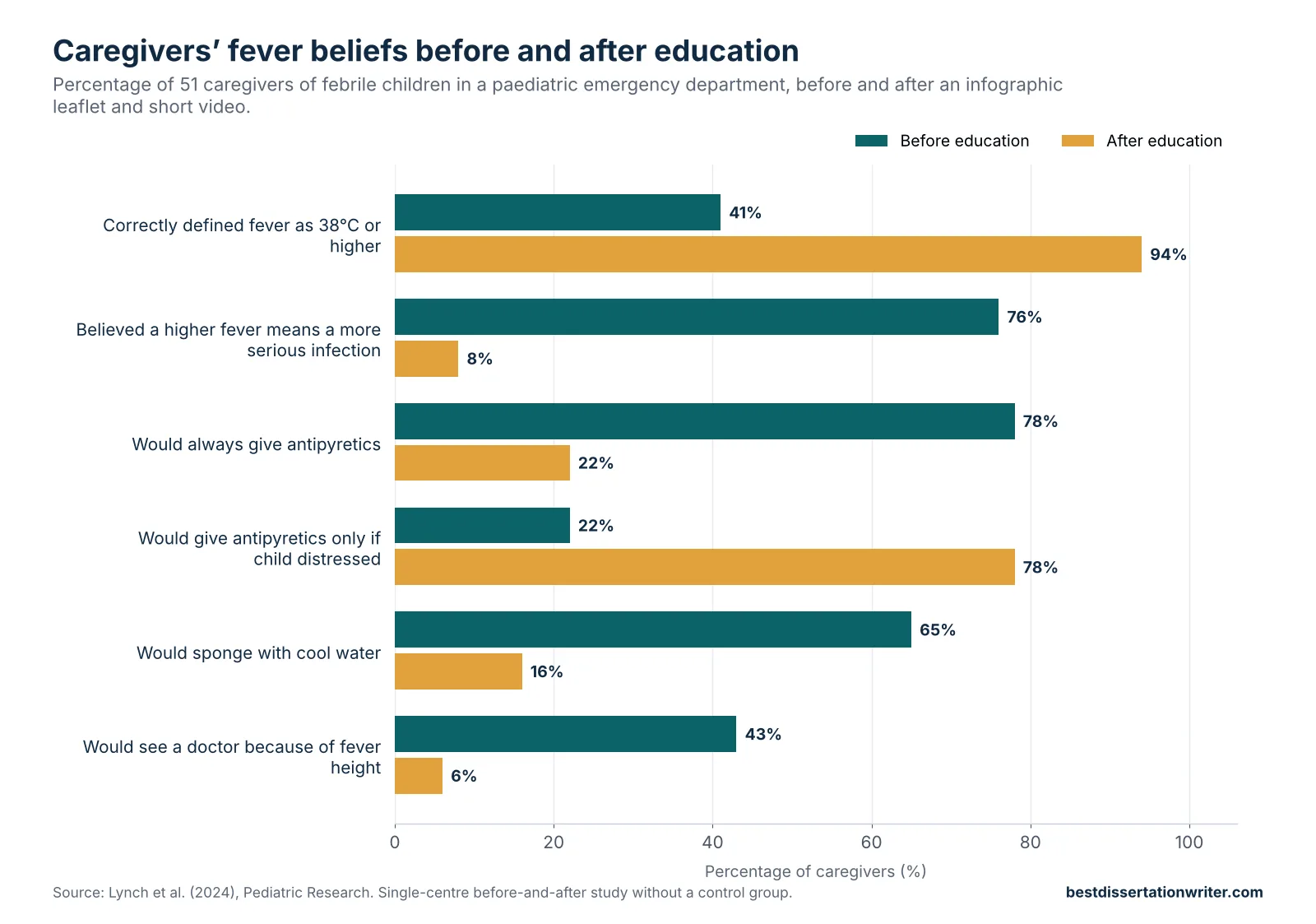
These are striking changes, and caregivers rated both the leaflet and the video as helpful. However, the study was small, took place in one department, had no control group and measured knowledge and intentions immediately after the intervention rather than actual behaviour during later illnesses. It therefore shows that parental education can rapidly correct misconceptions, but not whether the effect lasts or reduces repeat attendance. The simple, low-cost materials are nevertheless easy for nurses to adopt.
Educators must also recognise that professionals can share parents’ fears. In a systematic review with meta-analysis, Vicens-Blanes et al. (2021) included 41 studies of doctors’ and nurses’ knowledge, attitudes and perceptions. Professionals often treated fever at low thresholds around 38°C, recommended physical cooling and commonly alternated antipyretics, practices that the authors interpreted as overtreatment. A meta-analysis of five studies of educational programmes for nurses found significant improvements in knowledge and attitudes but not perceptions, although all studies had a high risk of bias.
Taken together, this theme suggests that education can change what parents and nurses know, but that consistent messages from professionals are essential. If one nurse advises giving antipyretics only for distress while another recommends sponging or alternating drugs, parents are likely to remain uncertain. Training nurses first may therefore be a precondition for effective parental education.
Discussion
This review shows a consistent message across guidelines and evidence on fever management in children: fever is usually a helpful response to infection, antipyretics should be used to relieve distress rather than to normalise temperature, and physical cooling should be avoided. Yet parents’ and professionals’ beliefs and practices often diverge from this guidance, and fever phobia appears to have persisted for decades. The main challenge in fever management in children is not a lack of guidance but its translation into everyday practice.
The evidence on parental education is encouraging but weak. The before-and-after study by Lynch et al. (2024) produced large improvements in knowledge, but without a control group, follow-up or measures of behaviour. The meta-analysis by Vicens-Blanes et al. (2021) found improvements in nurses’ knowledge, yet the high risk of bias meant that educational programmes could be neither recommended nor discouraged. Stronger designs, such as randomised trials with follow-up during later illnesses, are needed.
The qualitative findings of Merlo et al. (2023) offer an explanation for why information alone may be insufficient. If fear is rooted in emotion and in the relationship with professionals, then parental education about fever management in children must also offer reassurance, acknowledge parents’ worry and build confidence. Paediatric fever is therefore an area in which nurses, who often spend more time with families than other professionals, have a particular contribution to make.
There is also a safety dimension. Reassuring parents must not mean dismissing them. NICE (2019) stresses safety-netting advice, including how to recognise dehydration and a non-blanching rash, checking on the child during the night and seeking help if the child seems more unwell or the parent feels unable to cope. Effective education therefore balances reducing unnecessary fear with ensuring that parents recognise genuine warning signs.
The evidence base has limitations. The key survey of parental beliefs is more than 20 years old and from the United States, the qualitative study was small and Swiss, and the educational study was small, uncontrolled and based in a single emergency department. This review relied on openly accessible, English-language sources and did not involve independent double screening. Future research should test nurse-led parental education using controlled designs, measure real behaviour and health service use over time, and include families from diverse cultural and socioeconomic backgrounds.
Implications of Fever Management in Children Evidence for Practice
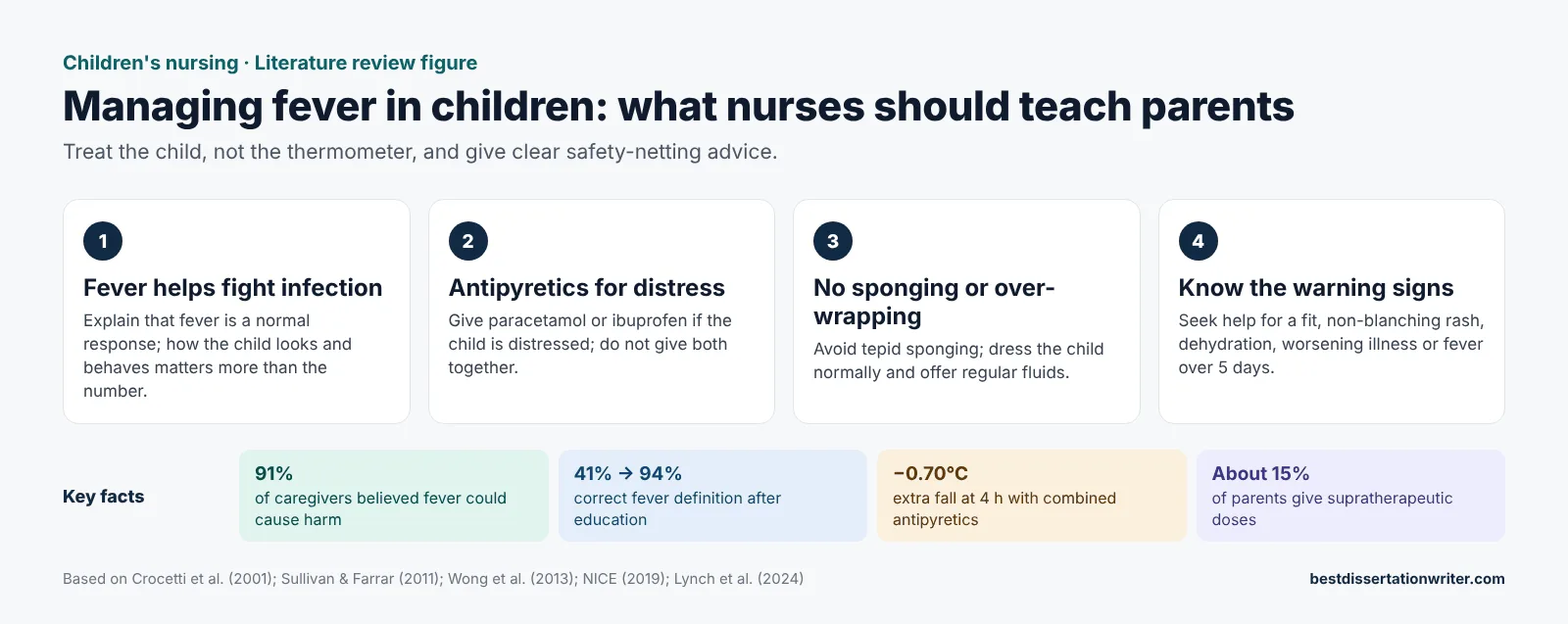
For children’s nurses, the evidence supports clear, consistent advice: treat the child, not the thermometer. Nurses should explain that fever helps to fight infection, that antipyretics are for distress, that the two drugs should not be given together and that sponging is not recommended. They should check that parents can calculate and measure doses accurately, ideally by weight, and should provide written or video materials as well as verbal advice. Safety-netting information should accompany every discharge.
Fever advice should be delivered within family-centred care, acknowledging parents’ worry and building their confidence. For children in hospital, temperature is one of several observations recorded on paediatric early warning systems, and nurses should interpret it in context rather than in isolation. Fever carries different significance for children undergoing cancer treatment, for whom urgent assessment is essential, and the same trust-based communication that helps with parental vaccine hesitancy can help reduce fever phobia.
Conclusion
This narrative review examined current evidence on fever management in children and the effectiveness of parental education. Guidelines agree that antipyretics should relieve distress rather than lower temperature and that physical cooling should be avoided, but parents and professionals often hold fears that lead to overtreatment. Brief education can rapidly improve parents’ knowledge, although the evidence is limited by small, uncontrolled studies.
Children’s nurses are well placed to close the gap in fever management in children between evidence and practice by giving consistent, compassionate and practical advice. Improving nurses’ own knowledge, offering simple written and video resources and combining reassurance with clear safety-netting can help parents to manage fever confidently and safely at home.
References
Crocetti, M., Moghbeli, N., & Serwint, J. (2001). Fever phobia revisited: Have parental misconceptions about fever changed in 20 years? Pediatrics, 107(6), 1241–1246. https://doi.org/10.1542/peds.107.6.1241
Lynch, C. J., Kuhar, M., Blackburn, C., & Barrett, M. J. (2024). Fever education for caregivers in the emergency room (The FEVER study)–an interventional trial. Pediatric Research, 96(1), 172–176. https://doi.org/10.1038/s41390-024-03047-0
Merlo, F., Falvo, I., Caiata-Zufferey, M., Schulz, P. J., Milani, G. P., Simonetti, G. D., Bianchetti, M. G., & Fadda, M. (2023). New insights into fever phobia: A pilot qualitative study with caregivers and their healthcare providers. European Journal of Pediatrics, 182(2), 651–659. https://doi.org/10.1007/s00431-022-04704-4
National Institute for Health and Care Excellence. (2019). Fever in under 5s: Assessment and initial management (NICE guideline NG143). https://www.nice.org.uk/guidance/ng143
Sullivan, J. E., Farrar, H. C., Section on Clinical Pharmacology and Therapeutics, & Committee on Drugs. (2011). Fever and antipyretic use in children. Pediatrics, 127(3), 580–587. https://doi.org/10.1542/peds.2010-3852
Vicens-Blanes, F., Miró-Bonet, R., & Molina-Mula, J. (2021). Analysis of nurses’ and physicians’ attitudes, knowledge, and perceptions toward fever in children: A systematic review with meta-analysis. International Journal of Environmental Research and Public Health, 18(23), 12444. https://doi.org/10.3390/ijerph182312444
Wong, T., Stang, A. S., Ganshorn, H., Hartling, L., Maconochie, I. K., Thomsen, A. M., & Johnson, D. W. (2013). Combined and alternating paracetamol and ibuprofen therapy for febrile children. Cochrane Database of Systematic Reviews, (10), CD009572. https://doi.org/10.1002/14651858.CD009572.pub2
Cite this example
Best Dissertation Writers (2026) Fever Management in Children and the Effectiveness of Parental Education by Nurses: A Literature Review. Available at: https://bestdissertationwriter.com/fever-management-in-children-review/
Best Dissertation Writers
Get expert help with your nursing literature review
Share your topic and deadline with Best Dissertation Writers and get support tailored to your module brief.