
Nursing Care and Psychosocial Support for Children Undergoing Cancer Treatment: An Integrative Review
 By Dr. Robertson Prime, Research Fellow
Updated October 12, 2026
16 min read
About 3,200 words
In this review
Abstract
Background: For children undergoing cancer treatment, months or years of chemotherapy, radiotherapy, surgery or stem cell transplantation bring repeated admissions, painful procedures, physical side effects and long periods away from school and friends. Around 400,000 children and adolescents aged 0 to 19 years develop cancer each year, and nurses are the professionals that children and families see most often.
Aim: This integrative review aimed to examine the main symptom and psychosocial needs of children with cancer during treatment, and what the evidence says about nursing care and psychosocial interventions to meet them.
Methods: Evidence was identified through targeted searches of openly accessible bibliographic records, publisher websites and the reference lists of key reviews. Seven sources published between 2015 and 2026 were included: an international registry study, psychosocial care standards, a systematic review of randomised trials, an integrative review of symptoms, a repeated-measures symptom study, a meta-analysis of technology-based interventions and a WHO fact sheet, appraised with CASP checklists and synthesised thematically.
Findings: At home after discharge, the most frequent symptoms were fatigue (52.1%) and nausea (50.7%), and distress was higher on days with pain, fatigue or nausea, showing a close link between physical and emotional distress. In 12 randomised trials, nine reported significant psychological improvements, and technology-based interventions were associated with reductions in anxiety and depression. Fifteen evidence-based standards set out a framework for psychosocial care, although such care remains variable and inequitable worldwide.
Conclusion: Nurses can make psychosocial support part of everyday care by assessing symptoms regularly, managing them promptly, preparing children for procedures and supporting families in hospital and at home.
Keywords: children undergoing cancer treatment, paediatric oncology, childhood cancer, psychosocial support
Introduction
This integrative review critically examines recent evidence on children undergoing cancer treatment and its implications for children’s nursing practice.
A diagnosis of cancer changes a child’s life almost overnight. Treatment with chemotherapy, radiotherapy, surgery or stem cell transplantation often lasts months or years and brings repeated admissions, painful procedures, physical side effects and long periods away from school and friends. Families must learn complex care routines while coping with fear and uncertainty, and siblings may feel left out. For children undergoing cancer treatment, the physical and emotional demands of therapy are closely linked, so good care must address both.
Nurses are the professionals children and families see most often throughout this journey. They administer treatment, assess and manage symptoms, prepare children for procedures, teach parents and coordinate care between hospital, home and school. Their daily contact means that nurses are well placed to notice when a child is struggling emotionally, and to offer or arrange psychosocial support before problems become entrenched. Yet nursing time is limited, and it is not always clear which forms of support make the greatest difference.
An integrative design was chosen because the relevant evidence is diverse, ranging from population registry data and consensus standards to symptom studies, systematic reviews and meta-analyses. Integrating these different forms of evidence allows a fuller picture of children’s needs and of the support that nurses can provide than any single design would give.
Review question
What are the main symptom and psychosocial needs of children undergoing cancer treatment, and what does the evidence say about nursing care and psychosocial interventions to meet them?
Background to Children Undergoing Cancer Treatment
Childhood cancer is rare compared with cancer in adults, but it remains a leading cause of illness-related death in children. The World Health Organization (WHO, 2026) estimates that around 400,000 children and adolescents aged 0 to 19 years develop cancer each year. In high-income countries more than 80% are cured, whereas in most low- and middle-income countries fewer than 30% are cured. The WHO fact sheet on cancer in children also notes that psychosocial and supportive care is variable and inequitable around the world.
Population data show that the burden of childhood cancer is growing. Using 153 registries in 62 countries, departments and territories, Steliarova-Foucher et al. (2017) reported an age-standardised incidence of 140.6 per million person-years in children aged 0 to 14 years during 2001–10, up from 124.0 in the 1980s. Leukaemia, central nervous system tumours and lymphomas were the most common cancers. These figures mean that every children’s hospital, not only specialist paediatric oncology centres, will care for children with cancer at some point.
Rising survival has shifted attention from survival alone to the quality of life of children undergoing cancer treatment. Intensive protocols cause fatigue, nausea, pain, mucositis, appetite loss and changes in appearance, while frequent hospital stays disrupt friendships, education and family life. Children may experience sadness, worry, fear of procedures and a sense of losing control. Parents commonly report high levels of distress, and their coping influences the child’s own adjustment.
Psychosocial support refers to the emotional, social, educational and practical help that enables children and families to cope with illness and treatment. It includes assessment of needs, information and preparation, psychological therapies, social and school support and care for parents and siblings. For children undergoing cancer treatment in paediatric oncology, this support is delivered by a multidisciplinary team, but nurses provide much of it informally during everyday care, for example through explanation, reassurance, play and attention to how the child is feeling.
Search Strategy and Methods
Evidence for this example was identified through targeted searches of openly accessible bibliographic records, publisher websites and the reference lists of key reviews. Search terms combined keywords for the population (“child*”, “adolescent*”, “paediatric oncology”, “childhood cancer”, “cancer treatment”) with terms for needs and care (“symptom*”, “psychosocial”, “anxiety”, “depression”, “nursing”, “intervention”), joined with the Boolean operators AND and OR. A full integrative review for assessment would run the same strategy in CINAHL, PubMed/MEDLINE, the Cochrane Library, Embase and PsycINFO and report the number of records screened in a PRISMA flow diagram.
Sources were eligible if they addressed children or adolescents with cancer during active treatment and reported incidence or survival, symptom or psychosocial needs, standards of care, or the effects of psychosocial interventions. Consistent with an integrative design, quantitative studies, reviews, meta-analyses, consensus standards and international policy sources were all eligible. Studies limited to long-term survivors after treatment had ended, to adults or to parents alone were excluded, so that the review stayed focused on children undergoing cancer treatment.
Seven sources published between 2015 and 2026 were included: an international registry study, a set of evidence-based psychosocial standards, a systematic review of randomised trials, an integrative review of symptoms, a repeated-measures symptom study, a meta-analysis of technology-based interventions and a WHO fact sheet (Table 1). Each source was appraised using the Critical Appraisal Skills Programme (CASP) checklist appropriate to its design, and findings were compared and synthesised thematically. Because the designs differed, statistical pooling was not attempted, and the evidence for children undergoing cancer treatment was integrated narratively.
Key Findings on Children Undergoing Cancer Treatment
Three themes were identified: the symptom burden experienced by children undergoing cancer treatment, the effectiveness of psychosocial interventions, and the standards and nursing role needed to make psychosocial support routine. Table 1 summarises the included sources, and Figure 1 presents the frequency of physical and psychological symptoms reported by children and adolescents at home after a hospital stay.
| Author, year | Design | Setting and sample | Key finding |
|---|---|---|---|
| Wiener et al. (2015) | Evidence-based standards (introduction to special issue) | 15 psychosocial standards for children with cancer and families; 1,217 studies reviewed | All 15 standards strongly recommended; high-quality evidence for assessment, neurocognitive monitoring, psychosocial support and procedural interventions. |
| Steliarova-Foucher et al. (2017) | Population-based registry study | 153 registries in 62 countries; diagnoses 2001–10 | Incidence in ages 0–14 was 140.6 per million person-years, up from 124.0 in the 1980s. |
| Coughtrey et al. (2018) | Systematic review of RCTs | 12 trials; children and young people under 18 with cancer | Nine trials showed psychological benefits; six showed benefits for physical symptoms or wellbeing. |
| Linder and Hooke (2019) | Integrative review | Studies 2008–2018 of children receiving cancer treatment | Pain highly prevalent and linked to poorer emotional health; sadness the most prevalent psychosocial symptom. |
| Torres et al. (2019) | Repeated-measures descriptive study | 58 children and adolescents aged 8–17; five days at home after discharge, USA | Fatigue (52.1%), nausea (50.7%) and pain (42.3%) common; symptoms often unreported. |
| Öztürk and Kılıçarslan Törüner (2022) | Meta-analysis of RCTs | 12 trials of technology-based interventions; ages 6–24 during cancer treatment | Reduced anxiety (g −0.89) and depression (g −1.05); longer interventions had larger effects. |
| World Health Organization (2026) | International fact sheet | Children and adolescents aged 0–19 worldwide | About 400,000 new cases a year; over 80% cured in high-income but under 30% in most low- and middle-income countries. |
Theme 1: The Symptom Burden of Children Undergoing Cancer Treatment
Symptoms are central to the experience of treatment. In an integrative review of studies published between 2008 and 2018, Linder and Hooke (2019) identified 43 publications on pain, 20 on sadness and 8 on symptom clusters. Pain was highly prevalent and distressing, varied across chemotherapy cycles and was associated with poorer functional status and emotional health. Sadness was the most prevalent psychosocial symptom. Although it tended to decrease over the course of treatment, children whose sadness persisted experienced it as more severe and more distressing.
For children undergoing cancer treatment, symptoms do not stop at discharge. Torres et al. (2019) followed 58 children and adolescents aged 8 to 17 years, recruited from paediatric oncology units of two children’s hospitals in the United States, for five days at home after discharge. Using the Memorial Symptom Assessment Scale, the most frequent physical symptoms were fatigue (52.1%), nausea (50.7%), lack of appetite (43.7%) and pain (42.3%). The most frequent psychological symptoms were difficulty sleeping (21.1%), worrying (18.3%), feeling sad (18.3%) and feeling nervous (16.9%).
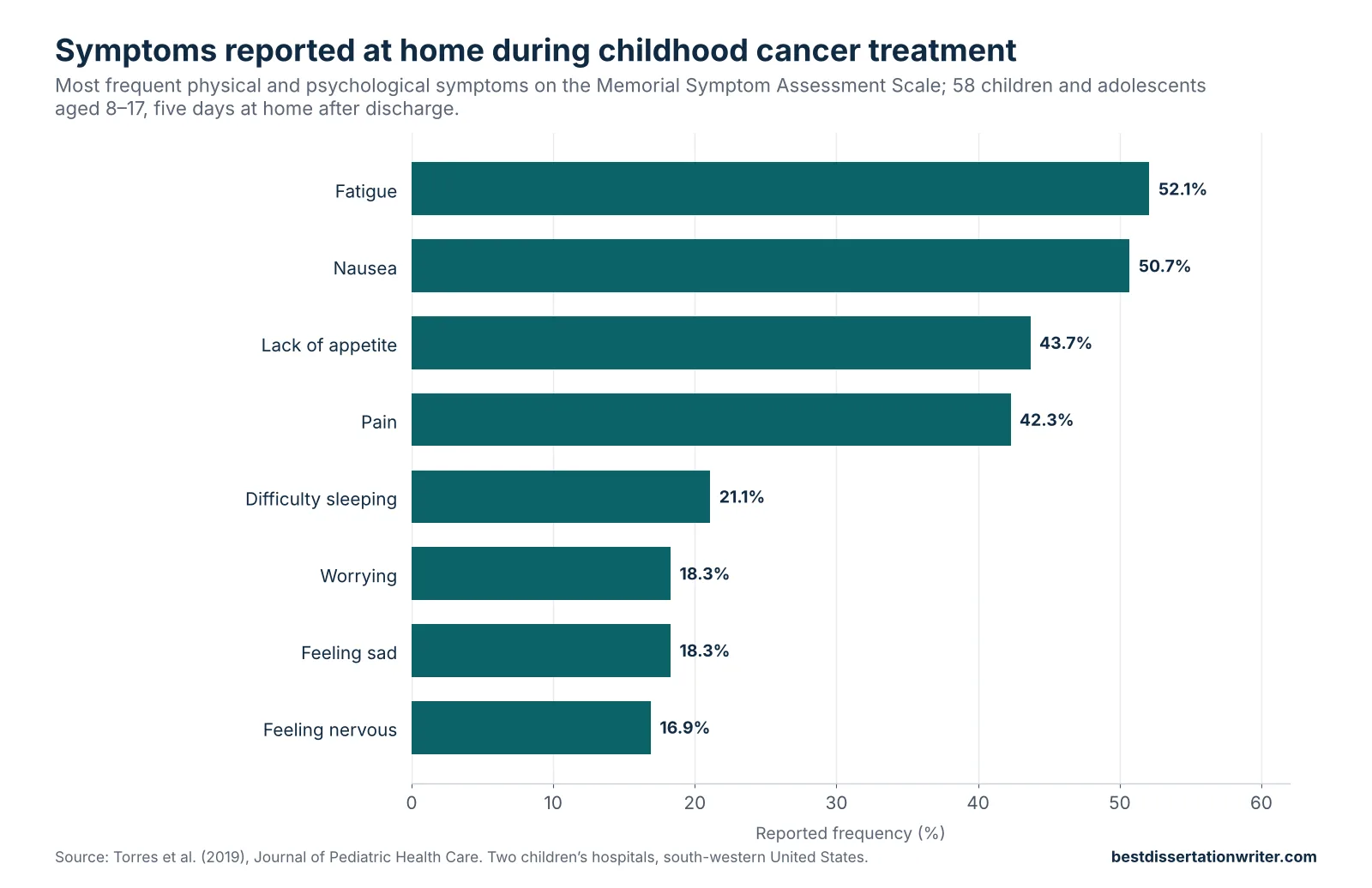
Torres et al. (2019) also found that psychological and global distress scores were higher on days when pain, fatigue or nausea were present, and that many symptoms went unreported. This link between physical and emotional distress is important for nursing. It suggests that good control of physical symptoms is itself a form of psychosocial support, and that emotional symptoms may be missed if assessment focuses only on physical side effects. The small, single-country sample and short follow-up limit generalisation, but the pattern is consistent with the wider literature reviewed by Linder and Hooke (2019).
Both sources highlight the importance of hearing directly from the child. Self-report tools allow children to describe symptoms that adults may underestimate, such as sadness or worry, and repeated assessment shows how symptoms change across treatment cycles. Linder and Hooke (2019) therefore called for routine symptom assessment to support clinicians, together with further research on how to relieve symptoms and build resilience. For nurses, the message is that symptom assessment should be regular, child-centred and continue across the transition from hospital to home.
Theme 2: Effectiveness of Psychosocial Interventions
Several reviews have examined whether structured psychosocial interventions improve outcomes. Coughtrey et al. (2018) identified 12 randomised controlled trials involving children and young people under 18 with current or past cancer. Interventions included cognitive behavioural therapy, family therapy, therapeutic music videos, coping skills training and wish fulfilment. Nine trials reported significant psychological improvements, and six reported benefits for physical symptoms or wellbeing, including reduced procedural pain and symptom distress. The authors concluded that psychosocial interventions are effective at reducing anxiety and depressive symptoms and at improving quality of life.
More recent evidence has focused on technology. Öztürk and Kılıçarslan Törüner (2022) meta-analysed 12 randomised trials of technology-based psychosocial interventions, such as games, applications and online programmes, for young people aged 6 to 24 years during cancer treatment. Compared with standard care, the interventions were associated with reductions in anxiety (Hedges’ g −0.89) and depression (g −1.05), and longer interventions produced larger effects on distress and resilience. Technology may be particularly useful during isolation, when face-to-face contact with peers and professionals is restricted.
These findings are encouraging, but they must be interpreted with caution. Both reviews included relatively few trials, many with small samples, and the interventions, age ranges and outcome measures varied widely. The technology review included young adults up to 24 years, so its results may not apply directly to younger children. Few trials were led or delivered by nurses, which makes it difficult to judge how far the benefits would transfer to routine ward care for children undergoing cancer treatment. Nevertheless, the consistent direction of effect suggests that structured psychosocial support is worth providing.
Theme 3: Standards and the Nursing Role in Psychosocial Support
The most comprehensive guidance on psychosocial care in this field comes from the Standards for the Psychosocial Care of Children with Cancer and Their Families. Wiener et al. (2015) described how 15 standards were developed after a review of 1,217 studies published between 1995 and 2015. All 15 received strong recommendations. The evidence was judged to be of high quality for four standards: psychosocial assessment, neurocognitive monitoring, access to psychosocial support and psychological interventions for invasive procedures. Other standards address parents’ mental health, siblings, school re-entry, adherence, palliative care and bereavement.
Several standards fall squarely within nursing practice. Developmentally appropriate preparation for invasive procedures, tailored psychoeducation and anticipatory guidance, opportunities for social interaction, monitoring of treatment adherence and coordination of school re-entry all depend on nurses who know the child and family well. The standards also call for collaboration between medical and psychosocial teams, recognising that psychosocial care is everyone’s responsibility rather than an optional extra provided only by psychologists.
However, standards describe what should happen rather than what does happen. The WHO (2026) notes that psychosocial and supportive care remains variable and inequitable worldwide, and services in many settings lack the psychologists, social workers and play specialists that the standards assume. In such settings, nurses may be the main or only source of psychosocial care. This makes it important that nurses have the skills to assess needs, offer basic emotional support and recognise when a child or parent needs specialist referral.
Discussion
This integrative review shows that children undergoing cancer treatment experience a substantial and fluctuating burden of physical and psychological symptoms, both in hospital and at home. Fatigue, nausea, appetite loss and pain are common, while sadness and worry are the most frequent emotional symptoms. Evidence from randomised trials suggests that structured psychosocial interventions can reduce anxiety and depression, and consensus standards set out a clear framework for comprehensive psychosocial care.
A key finding is the close connection between physical and emotional distress. Torres et al. (2019) found that distress scores were higher on days when children had pain, fatigue or nausea, and Linder and Hooke (2019) linked pain to poorer emotional health. This suggests that symptom management and psychosocial support should not be separated into different roles or care plans. A nurse who treats nausea promptly, explains what to expect and helps a child to rest is providing psychosocial as well as physical care.
There is a tension, however, between the strength of the standards and the strength of the intervention evidence. Wiener et al. (2015) made strong recommendations for all 15 standards, yet the trials reviewed by Coughtrey et al. (2018) and Öztürk and Kılıçarslan Törüner (2022) were few, small and heterogeneous. Strong recommendations partly reflect professional consensus and ethical judgement as well as trial evidence. For children undergoing cancer treatment, it would be unacceptable to withhold basic emotional support while waiting for larger trials, but services should still evaluate what they provide.
Equity is another important issue. The large survival gap between high-income and low- and middle-income countries described by the WHO (2026) is matched by differences in access to psychosocial care. Most of the intervention studies come from well-resourced health systems, and technology-based programmes may not be accessible to families without reliable internet or devices. Low-cost nurse-delivered approaches, such as structured symptom assessment, preparation and family education, may offer the most realistic route to wider access for children undergoing cancer treatment.
The evidence base has limitations. Several sources were small or from single countries, symptom studies used short follow-up, and the reviews combined different interventions and age groups. This review relied on openly accessible, English-language sources, used a limited number of sources and did not involve independent double screening or formal quality scoring. Future research should test nurse-led psychosocial interventions in randomised trials, use consistent child-reported outcomes, follow children across the whole treatment period and include low-resource settings and children of different ages and cultural backgrounds.
Implications of Children Undergoing Cancer Treatment Evidence for Practice
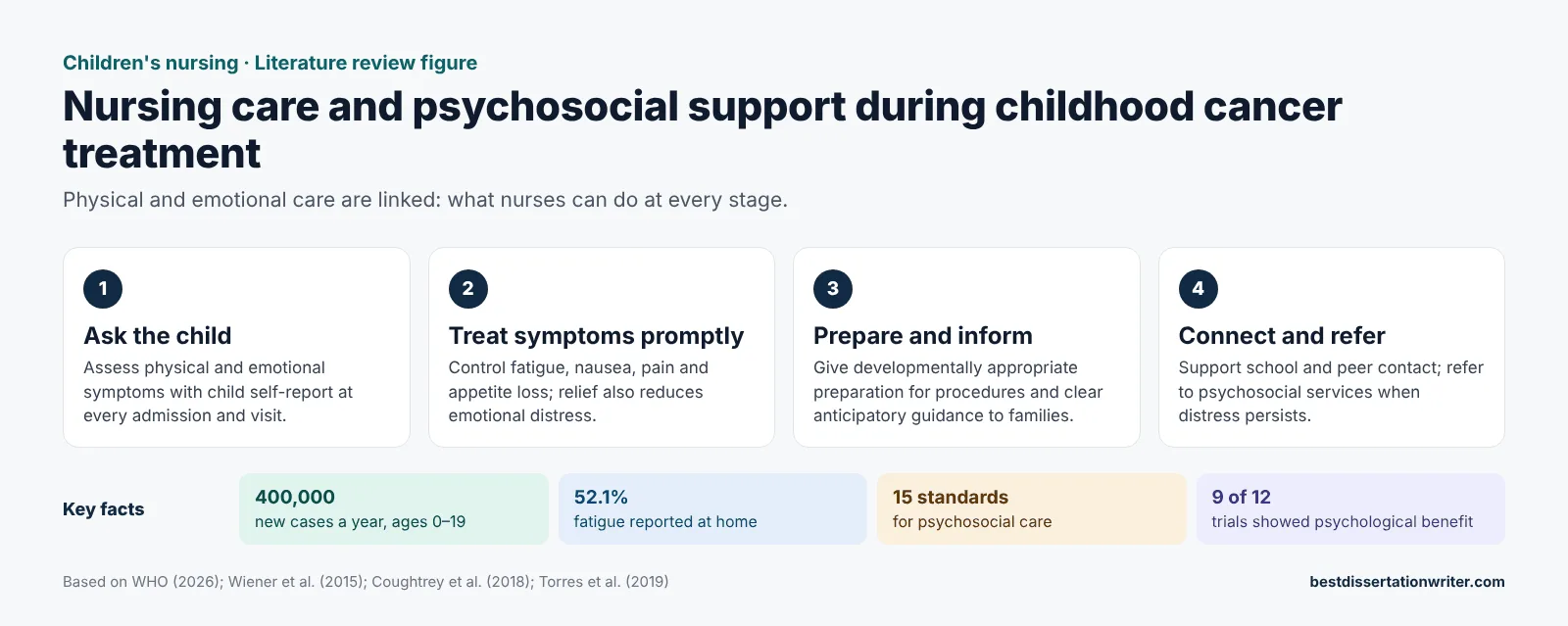
For children’s nurses, the evidence supports routine, child-reported assessment of both physical and emotional symptoms at every admission and clinic visit, with plans to manage fatigue, nausea, pain and appetite loss at home as well as on the ward. Nurses should prepare children for procedures in a developmentally appropriate way, give families clear anticipatory guidance, encourage contact with friends and school and refer to psychology or social work when distress persists. Discharge planning should include simple ways for children and parents to record and report symptoms, so that problems are not missed between visits.
This care sits within wider children’s nursing evidence. Many of the stresses these children face overlap with the psychological effects of hospitalisation seen in other children, and preparation and distraction techniques from play therapy are valuable during repeated procedures. Supporting parents through family-centred care is essential, and for the youngest patients feeding difficulties during treatment can draw on evidence about infant nutrition.
Conclusion
This integrative review examined nursing care and psychosocial support for children undergoing cancer treatment. Children experience a heavy and changing burden of symptoms, with fatigue, nausea, pain and sadness among the most common, and physical and emotional distress are closely linked. Psychosocial interventions appear to reduce anxiety and depression, although the trials are small and varied, and evidence-based standards provide a clear framework for comprehensive care.
For children undergoing cancer treatment, nurses can make psychosocial support part of everyday care by assessing symptoms regularly, managing them promptly, preparing children for procedures and supporting families at home and in hospital. Treating emotional wellbeing as a core outcome of treatment, rather than an afterthought, will help more children to cope with cancer and its treatment.
References
Coughtrey, A., Millington, A., Bennett, S., Christie, D., Hough, R., Su, M., Constantinou, M., & Shafran, R. (2018). The effectiveness of psychosocial interventions for psychological outcomes in paediatric oncology: A systematic review. Journal of Pain and Symptom Management, 55(3), 1004–1017. https://doi.org/10.1016/j.jpainsymman.2017.09.022
Linder, L. A., & Hooke, M. C. (2019). Symptoms in children receiving treatment for cancer—Part II: Pain, sadness, and symptom clusters. Journal of Pediatric Oncology Nursing, 36(4), 262–279. https://doi.org/10.1177/1043454219849578
Steliarova-Foucher, E., Colombet, M., Ries, L. A. G., Moreno, F., Dolya, A., Bray, F., Hesseling, P., Shin, H. Y., Stiller, C. A., & IICC-3 contributors. (2017). International incidence of childhood cancer, 2001–10: A population-based registry study. The Lancet Oncology, 18(6), 719–731. https://doi.org/10.1016/S1470-2045(17)30186-9
Torres, V., Nunes, M. D. R., Silva-Rodrigues, F. M., Bravo, L., Adlard, K., Secola, R., Fernandes, A. M., Nascimento, L. C., & Jacob, E. (2019). Frequency, severity, and distress associated with physical and psychosocial symptoms at home in children and adolescents with cancer. Journal of Pediatric Health Care, 33(4), 404–414. https://doi.org/10.1016/j.pedhc.2018.11.007
Wiener, L., Kazak, A. E., Noll, R. B., Patenaude, A. F., & Kupst, M. J. (2015). Standards for the psychosocial care of children with cancer and their families: An introduction to the special issue. Pediatric Blood & Cancer, 62(S5), S419–S424. https://doi.org/10.1002/pbc.25675
World Health Organization. (2026, March 10). Cancer in children [Fact sheet]. https://www.who.int/news-room/fact-sheets/detail/cancer-in-children
Öztürk, Ç., & Kılıçarslan Törüner, E. (2022). Effectiveness of technology-based psychosocial interventions for child, adolescents and young adults undergoing cancer treatment: A meta-analysis of randomised controlled trials. European Journal of Cancer Care, 31(1), e13515. https://doi.org/10.1111/ecc.13515
Cite this example
Best Dissertation Writers (2026) Nursing Care and Psychosocial Support for Children Undergoing Cancer Treatment: An Integrative Review. Available at: https://bestdissertationwriter.com/children-undergoing-cancer-treatment/
Best Dissertation Writers
Get expert help with your nursing literature review
Share your topic and deadline with Best Dissertation Writers and get support tailored to your module brief.