
Post-Intensive Care Syndrome and the Role of Nurses in Recovery: A Scoping Review
 By Dr. Robertson Prime, Research Fellow
Updated October 17, 2026
14 min read
About 2,800 words
In this review
Abstract
Background: Post-intensive care syndrome describes new or worsening physical, cognitive and mental health problems that persist after critical illness. As more patients survive intensive care, the long-term burden on survivors and their families has become a major concern for nursing.
Aim: This scoping review aimed to map the evidence on post-intensive care syndrome and on nurse-led and follow-up interventions to support recovery.
Methods: Evidence was identified through targeted searches of openly accessible bibliographic records, publisher websites and the reference lists of key reviews. Five sources published between 2009 and 2018 were included: a stakeholder consensus report, two cohort studies, a randomised controlled trial and a Cochrane review, charted and summarised narratively.
Findings: A stakeholder conference defined the syndrome across physical, cognitive and mental health domains, applying to survivors and families. Five years after severe lung injury, survivors walked only about 76% of the predicted distance. Twelve months after critical illness, 34% had cognitive scores similar to moderate traumatic brain injury. A nurse-led follow-up programme did not improve quality of life, and a Cochrane review found too little evidence to judge follow-up services.
Conclusion: Nurses should raise awareness of PICS, prepare patients and families for recovery and contribute to the development and evaluation of better follow-up models.
Keywords: post-intensive care syndrome, PICS, ICU survivors
Introduction
This scoping review critically examines recent evidence on post-intensive care syndrome and its implications for critical care nursing practice.
Advances in intensive care mean that more people survive critical illnesses such as sepsis, respiratory failure and major trauma. Survival, however, is often only the beginning of a long recovery. Many ICU survivors leave hospital weak, exhausted and unable to return to their previous lives, and some experience problems with memory and concentration, anxiety, depression or post-traumatic stress that persist for months or years. Families who supported them through critical illness may also struggle.
In 2010, a stakeholder conference introduced the term post-intensive care syndrome, or PICS, to describe these problems and to raise awareness among clinicians, patients and policymakers. The concept has helped to shift attention from short-term survival to long-term recovery, and it has encouraged intensive care teams to consider what happens to patients after they leave the unit.
Nurses are involved throughout this journey. In intensive care, nursing practices such as sedation management, delirium prevention and early mobilisation may influence long-term outcomes. Nurses support families, often provide follow-up services and contribute to rehabilitation on the wards and in the community. Understanding post-intensive care syndrome is therefore relevant to nurses in many settings.
A scoping review approach was chosen because the evidence is broad, spanning definitions, long-term cohort studies and intervention studies, and the aim was to map what is known and identify gaps rather than to estimate a single effect.
Review question
What does the evidence show about post-intensive care syndrome and about nurse-led and follow-up interventions to support recovery?
Background to Post-Intensive Care Syndrome
The physical domain includes intensive care unit-acquired weakness, reduced exercise capacity, fatigue, pain and impaired lung function. Muscle wasting can begin within days of admission, particularly in patients who are deeply sedated, immobile or septic. Physical problems may limit walking, self-care and return to work.
The cognitive domain includes problems with memory, attention, executive function and processing speed. Delirium during critical illness, hypoxia, hypotension and sedative exposure have been proposed as contributors. Cognitive impairment may not be obvious at discharge but can affect people’s ability to manage finances, medicines and employment.
The mental health domain includes anxiety, depression and post-traumatic stress. Survivors may have frightening memories or delusional experiences from their time in intensive care, including hallucinations or paranoid beliefs that staff were trying to harm them. These memories can be more distressing than memories of real events and may contribute to post-traumatic stress symptoms.
Family members can also experience anxiety, depression, post-traumatic stress and complicated grief, sometimes described as post-intensive care syndrome-family. Caring for a survivor at home adds to their burden. Recognising PICS in both patients and families is a first step towards providing support.
Social and economic consequences add to the burden. Survivors may be unable to return to work, lose income and depend on family members for care, while relatives may reduce their own working hours. These consequences can persist long after the medical problems have been addressed and are rarely captured in clinical outcome measures, yet they shape the quality of life of ICU survivors and their families.
Search Strategy and Methods
Evidence for this example was identified through targeted searches of openly accessible bibliographic records, publisher websites and the reference lists of key reviews. Search terms combined keywords for the condition (“post-intensive care syndrome”, “PICS”, “ICU survivors”, “long-term outcomes”, “critical illness”) with terms for outcomes and interventions (“cognitive impairment”, “physical function”, “follow-up”, “rehabilitation”, “nurse-led”), joined with the Boolean operators AND and OR. A full scoping review for assessment would run the same strategy in CINAHL, PubMed/MEDLINE, the Cochrane Library and Embase and report the number of records screened in a PRISMA flow diagram.
Sources were eligible if they defined, described or measured long-term outcomes after critical illness in adults, or evaluated interventions to improve them, using any design. Landmark cohort studies were included because they describe the nature and duration of problems, and trials and a Cochrane review were included to assess interventions. Studies limited to children were excluded.
Five sources on post-intensive care syndrome published between 2009 and 2018 were included: a stakeholder consensus report, two prospective cohort studies, a pragmatic randomised controlled trial and a Cochrane systematic review (Table 1). In line with scoping review methods, data were charted on design, population, outcomes and findings. Quality was considered using the Critical Appraisal Skills Programme (CASP) checklists where appropriate, and findings were summarised narratively.
Key Findings on Post-Intensive Care Syndrome
Three themes were identified: defining post-intensive care syndrome, the nature and persistence of long-term problems, and the limited evidence for follow-up interventions. Table 1 summarises the included sources, and Figure 1 shows the persistence of cognitive impairment after critical illness.
| Author, year | Design | Setting and sample | Key finding |
|---|---|---|---|
| Cuthbertson et al. (2009) | Pragmatic randomised controlled trial (PRaCTICaL) | 286 ICU survivors, 3 UK hospitals | Nurse-led follow-up programme did not improve quality of life at 12 months and cost more than standard care. |
| Herridge et al. (2011) | Prospective cohort study | 109 ARDS survivors followed for 5 years | Six-minute walk about 76% of predicted at 5 years; physical and psychological problems persisted in patients and families. |
| Needham et al. (2012) | Stakeholder consensus conference report | 31 invited stakeholders, Society of Critical Care Medicine | Defined post-intensive care syndrome across physical, cognitive and mental health, applying to survivors and families. |
| Pandharipande et al. (2013) | Prospective multicentre cohort study | 821 adults with respiratory failure or shock, USA | At 12 months, 34% had cognition similar to moderate brain injury and 24% similar to mild Alzheimer’s disease. |
| Schofield-Robinson et al. (2018) | Cochrane systematic review | 5 studies, 1,707 ICU survivors | Too little evidence to judge follow-up services; probably no difference in mortality or PTSD. |
Theme 1: Defining Post-Intensive Care Syndrome
A Society of Critical Care Medicine conference brought together 31 invited stakeholders, including clinicians, researchers and representatives of patients and families, to discuss long-term outcomes after intensive care (Needham et al., 2012). The stakeholders agreed on post-intensive care syndrome as the recommended term for new or worsening problems in physical, cognitive or mental health that arise after critical illness and persist beyond the acute hospital stay, and they noted that the term can apply to survivors or family members.
The conference identified three priorities: raising awareness and education, understanding and addressing barriers to practice, and identifying research gaps and resources. The authors emphasised that improving outcomes would require collaboration across inpatient and outpatient settings. The consensus nature of this report means that it reflects expert opinion rather than new data, but it has shaped research and practice internationally.
A shared definition matters in practice. Before the term was introduced, problems after intensive care were described in many different ways by different specialties, making it difficult to recognise patterns or plan services. A common language helps nurses to explain these problems to patients and families and to communicate concerns to colleagues in other settings.
Theme 2: The Nature and Persistence of Long-Term Problems
A cohort study followed 109 survivors of acute respiratory distress syndrome for five years (Herridge et al., 2011). At five years, survivors walked a median of 436 metres in six minutes, about 76% of the predicted distance, and their physical quality of life scores remained below population norms. Lung function was normal or near normal, suggesting that weakness rather than lung damage was the main cause of disability. Physical and psychological problems persisted in both patients and family caregivers.
A multicentre cohort study of 821 adults with respiratory failure or shock examined cognitive function after critical illness (Pandharipande et al., 2013). Three months after discharge, 40% had global cognition scores similar to those of patients with moderate traumatic brain injury, and 26% had scores similar to those of patients with mild Alzheimer’s disease. At 12 months, these proportions were 34% and 24%. Longer duration of delirium in hospital was associated with worse cognitive outcomes, and impairment affected both older and younger patients.
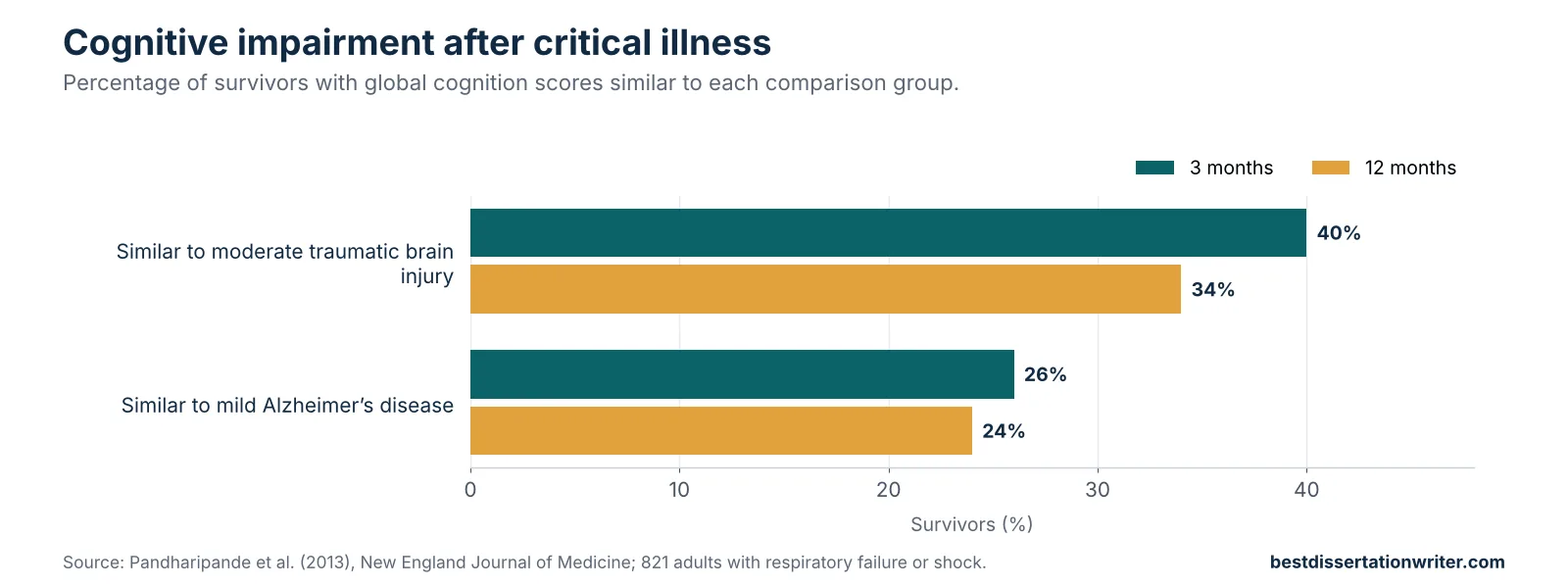
These studies show that PICS is common, serious and long-lasting. The finding that delirium was linked to long-term cognitive impairment connects intensive care nursing practice directly to recovery after discharge. However, cohort studies cannot show that delirium causes later impairment, and survivors who were willing and able to take part may differ from those who were not.
For nurses caring for patients after discharge from intensive care, these findings highlight the importance of looking beyond the obvious. A patient who appears physically recovered may still struggle with memory, concentration or low mood, and a patient who seems cognitively intact may be too weak to manage at home. Simple screening for cognitive and psychological problems, alongside physical assessment, can help to identify needs that might otherwise be missed.
Theme 3: The Limited Evidence for Follow-Up Interventions
The PRaCTICaL trial randomised 286 patients in three UK hospitals to a nurse-led intensive care follow-up programme or standard care (Cuthbertson et al., 2009). At 12 months, there was no difference in physical or mental health-related quality of life, and the programme cost more than standard care. The authors concluded that it was neither effective nor cost-effective and called for further work on rehabilitation, delirium, cognition and relatives.
A Cochrane review identified five studies, four of them randomised, with 1,707 participants, evaluating follow-up services for ICU survivors (Schofield-Robinson et al., 2018). There was probably no difference in mortality or post-traumatic stress, and it was unclear whether follow-up services improved depression, anxiety, physical function, cognitive function or return to work. The authors concluded that there was too little evidence to judge whether follow-up services work, and no study measured adverse effects.
These findings are disappointing given the scale of post-intensive care syndrome. They may reflect interventions that started too late, were not intensive enough, did not target individual needs or were delivered without links to community services. They also suggest that follow-up clinics alone may be insufficient and that recovery may depend on actions taken during intensive care as well as after it.
Families deserve particular attention. In many follow-up models, the focus is on the survivor, yet relatives may be exhausted, anxious and uncertain about how to help. Involving families in discharge planning, offering them information about common problems and signposting them to support can reduce their isolation and help them to support the survivor’s recovery.
The variation between studies also reflects differences in who was included, when outcomes were measured and which instruments were used. Agreement on a core set of outcomes and measures would make it easier to compare studies and to judge which interventions help recovery.
Discussion
This scoping review found that post-intensive care syndrome is well defined and common, with physical weakness persisting for years and cognitive impairment affecting about a third of survivors a year after critical illness. In contrast, the evidence on how to help survivors recover is limited, and a nurse-led follow-up programme and other follow-up services have not shown clear benefits. This gap between the size of the problem and the strength of the solutions is a key finding.
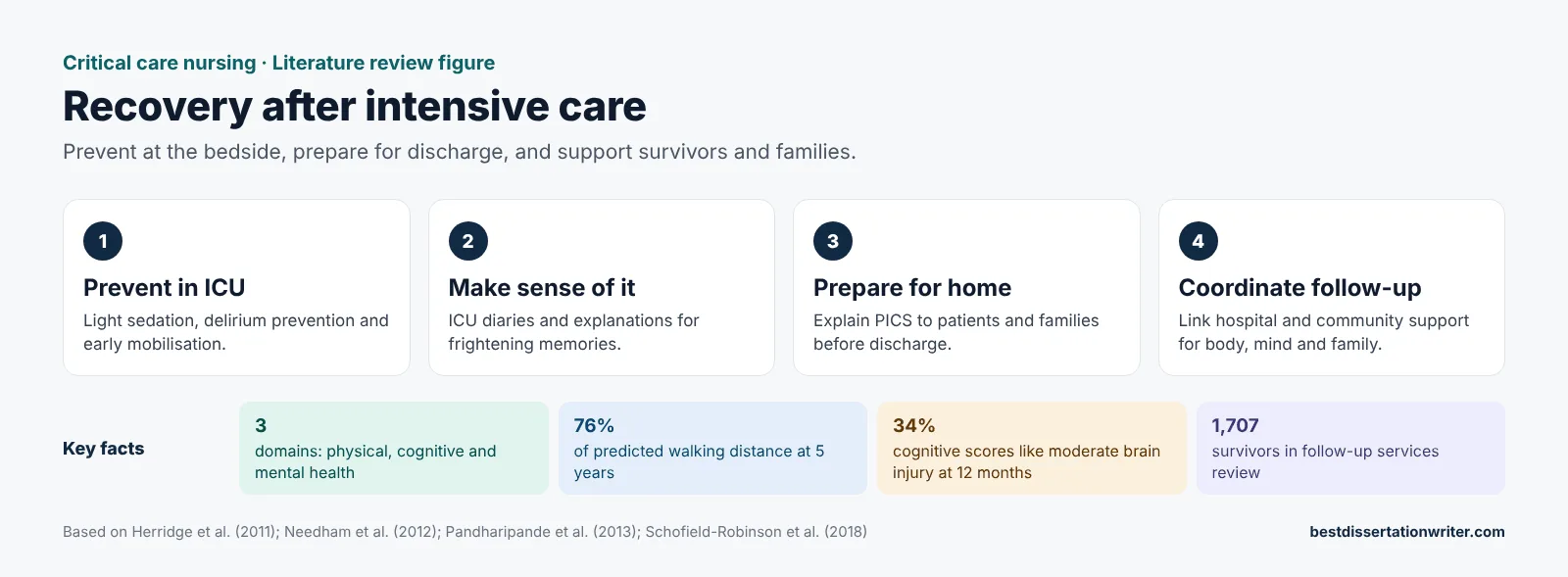
One implication is that prevention during intensive care may be as important as follow-up afterwards. Practices that reduce sedation, prevent delirium, promote early mobilisation and involve families may reduce the risk of long-term problems. ICU diaries, which help survivors to make sense of their experience, may reduce psychological distress for some. Nurses deliver many of these interventions, which places them at the centre of efforts to prevent post-intensive care syndrome.
Another implication is that follow-up services may need to be redesigned. Rather than a single clinic, survivors may need coordinated, multidisciplinary support that addresses physical, cognitive and psychological problems together, includes families, and links hospital and community services. Peer support, in which survivors meet others with similar experiences, is one approach that has been developed in response to these needs.
Recognition is also a challenge. Many general practitioners, community nurses and therapists are unaware of post-intensive care syndrome, and survivors may not connect their problems with their time in intensive care. Discharge information that explains PICS, and handover to primary care, can help survivors and families to understand what is happening and seek help.
This review has limitations. It included a small number of sources, several of which are now dated, and the cohort studies included specific populations. Scoping reviews do not assess the certainty of evidence in detail. This review relied on openly accessible, English-language sources and did not involve independent double screening. Future research should evaluate integrated, needs-based recovery programmes for ICU survivors and their families.
Survivors’ own accounts suggest what good support might look like. Many describe wanting to understand what happened to them, to have their symptoms taken seriously and to meet others who have been through similar experiences. They value continuity, practical help with returning to work and daily activities, and recognition that recovery takes time. These priorities should inform the design and evaluation of future services.
Implications of Post-Intensive Care Syndrome Evidence for Practice
Critical care nurses should help to prevent post-intensive care syndrome by minimising sedation, preventing delirium and supporting early mobilisation, and should consider ICU diaries for patients at risk of psychological distress. Before discharge, nurses should explain PICS to patients and families and ensure that information is passed to ward and community teams. Clear communication about end-of-life care and support for families are also important, since relatives can experience similar problems.
Managers should ensure adequate nurse staffing levels to deliver preventive care and should support the development of follow-up services that are coordinated, multidisciplinary and evaluated. Rehabilitation should build on early mobilisation begun in intensive care.
Education for nurses on wards and in the community about post-intensive care syndrome is also needed, so that problems are recognised after patients leave intensive care. Including PICS in discharge summaries and handover can help to ensure continuity.
Conclusion
This scoping review mapped the evidence on post-intensive care syndrome and interventions to support recovery. The syndrome affects physical, cognitive and mental health and can persist for years, affecting survivors and families. Evidence for follow-up services, including a nurse-led programme, has not shown clear benefits, and research on effective interventions is urgently needed.
For critical care nurses, preventing post-intensive care syndrome begins at the bedside and continues through discharge and beyond. Raising awareness, preparing families and contributing to better models of recovery are important parts of the nursing role.
Above all, recognising that survival is not the same as recovery should guide how intensive care teams plan care from the first day of admission until long after discharge.
References
Cuthbertson, B. H., Rattray, J., Campbell, M. K., Gager, M., Roughton, S., Smith, A., Hull, A., Breeman, S., Norrie, J., Jenkinson, D., Hernández, R., Johnston, M., Wilson, E., & Waldmann, C. (2009). The PRaCTICaL study of nurse led, intensive care follow-up programmes for improving long term outcomes from critical illness: A pragmatic randomised controlled trial. BMJ, 339, b3723. https://doi.org/10.1136/bmj.b3723
Herridge, M. S., Tansey, C. M., Matté, A., et al. (2011). Functional disability 5 years after acute respiratory distress syndrome. New England Journal of Medicine, 364(14), 1293–1304. https://doi.org/10.1056/NEJMoa1011802
Needham, D. M., Davidson, J., Cohen, H., et al. (2012). Improving long-term outcomes after discharge from intensive care unit: Report from a stakeholders’ conference. Critical Care Medicine, 40(2), 502–509. https://doi.org/10.1097/CCM.0b013e318232da75
Pandharipande, P. P., Girard, T. D., Jackson, J. C., et al. (2013). Long-term cognitive impairment after critical illness. New England Journal of Medicine, 369(14), 1306–1316. https://doi.org/10.1056/NEJMoa1301372
Schofield-Robinson, O. J., Lewis, S. R., Smith, A. F., McPeake, J., & Alderson, P. (2018). Follow-up services for improving long-term outcomes in intensive care unit (ICU) survivors. Cochrane Database of Systematic Reviews, (11), CD012701. https://doi.org/10.1002/14651858.CD012701.pub2
Cite this example
Best Dissertation Writers (2026) Post-Intensive Care Syndrome and the Role of Nurses in Recovery: A Scoping Review. Available at: https://bestdissertationwriter.com/post-intensive-care-syndrome-review/
Best Dissertation Writers
Get expert help with your nursing literature review
Share your topic and deadline with Best Dissertation Writers and get support tailored to your module brief.