Medical Device-Related Pressure Injuries in Critically Ill Patients: A Systematic Review
 By Dr. Robertson Prime, Research Fellow
Updated October 17, 2026
14 min read
About 2,800 words
In this review
Abstract
Background: Device-related pressure injuries are caused by sustained pressure from medical devices such as endotracheal tubes, nasogastric tubes, masks and catheters. Critically ill patients are especially vulnerable because they depend on many devices, often cannot report discomfort and have fragile skin and tissue perfusion.
Aim: This systematic review aimed to examine the evidence on the frequency, risk factors and prevention of device-related pressure injuries in critically ill and hospitalised patients.
Methods: Evidence was identified through targeted searches of openly accessible bibliographic records, publisher websites and the reference lists of key reviews. Five sources published between 2010 and 2024 were included: two observational studies of devices, an international point-prevalence study, a systematic review and meta-analysis and a Cochrane review, synthesised narratively.
Findings: A third (34.5%) of hospital-acquired pressure ulcers in one hospital were device-related, and patients with devices were 2.4 times more likely to develop an ulcer. A meta-analysis of 29 studies estimated a pooled incidence of 12%. In a Brazilian intensive care unit, 62.4% of patients had a device-related injury, most often from orotracheal and nasogastric tubes. Silicone foam dressings halved pressure ulcer incidence overall, on low-certainty evidence.
Conclusion: Critical care nurses should inspect skin under every device at least once per shift, reposition and pad devices, and include devices in pressure injury risk assessment.
Keywords: device-related pressure injuries, device-related pressure injury, endotracheal tube
Introduction
This systematic review critically examines recent evidence on device-related pressure injuries and its implications for critical care nursing practice.
Most pressure injuries develop over bony areas such as the sacrum and heels, where body weight compresses tissue against a support surface. Device-related pressure injuries are different. They are caused by medical devices that press on skin or mucous membranes, and they usually take the shape of the device. They may occur on the ears, nose, lips, neck, face or urethra, in areas with little fat to cushion the pressure, and they can develop quickly.
Critically ill patients are particularly at risk. A typical ventilated patient may have an endotracheal tube and holder, a nasogastric tube, a urinary catheter, arterial and central lines, a pulse oximeter probe, electrodes and sometimes a cervical collar or non-invasive ventilation mask. Oedema, low blood pressure, vasopressors and poor nutrition reduce tissue tolerance, and sedation prevents patients from reporting pain or moving away from pressure.
Prevention is largely a nursing responsibility. Nurses secure devices, reposition tubes and masks, inspect the skin beneath them and apply protective dressings. Yet devices are sometimes treated as untouchable, especially when moving them risks dislodgement, and the skin beneath them may go unchecked for long periods. Device-related pressure injuries are therefore increasingly recognised as an important indicator of nursing quality and patient safety.
A systematic review approach was chosen to bring together observational studies, a meta-analysis and a Cochrane review and to judge the strength of the evidence.
Review question
What does the evidence show about the frequency, risk factors and prevention of device-related pressure injuries in critically ill and hospitalised patients?
Background to Device-Related Pressure Injuries
A device-related pressure injury results from the use of a device designed and applied for diagnostic or therapeutic purposes. Because devices are fixed in place and often tightened to prevent movement, they create sustained pressure and shear on a small area of tissue. Moisture from saliva, sweat or secretions, heat and friction add to the risk.
Mucosal injuries, such as those caused by an endotracheal tube on the lips or a nasogastric tube in the nostril, cannot be staged using the usual pressure injury classification because mucosa has a different structure from skin. They are nonetheless painful and can become infected. Injuries from non-invasive ventilation masks on the bridge of the nose became more visible during the COVID-19 pandemic, when many patients needed prolonged mask ventilation or prone positioning.
Standard risk assessment tools, such as the Braden scale, were developed for conventional pressure injuries and do not account for devices. As a result, patients may be judged at low risk even when several devices are pressing on vulnerable areas. For this reason, many units now assess the skin under and around every device as a separate part of routine care, more often where there is oedema or fluid shifts.
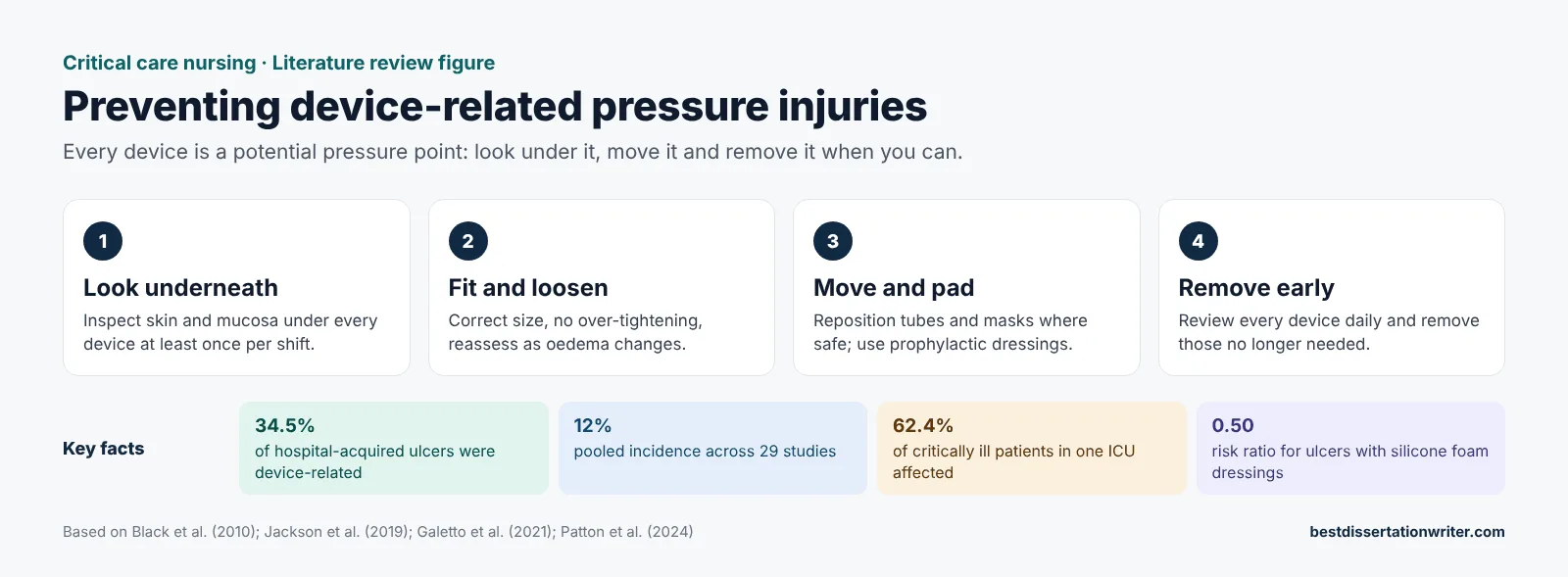
Prevention strategies include choosing the correct size of device, avoiding over-tightening, securing tubes in a way that allows repositioning, rotating or moving devices where safe, padding high-risk areas with prophylactic dressings, keeping skin dry and removing devices as soon as they are no longer needed.
Device-related pressure injuries also carry costs. They prolong treatment, require dressings and specialist review, may become infected and can leave visible scars on the face. A single device-related pressure injury on the lip or nose can be a lasting reminder of critical illness for survivors. Because they are largely preventable, these injuries are increasingly included in hospital quality indicators and incident reporting systems.
Search Strategy and Methods
Evidence for this example was identified through targeted searches of openly accessible bibliographic records, publisher websites and the reference lists of key reviews. Search terms combined keywords for the condition (“device-related pressure injury”, “medical device-related pressure ulcer”, “mucosal pressure injury”) with terms for the setting and prevention (“intensive care”, “critical care”, “endotracheal tube”, “nasogastric tube”, “prophylactic dressing”, “silicone foam”), joined with the Boolean operators AND and OR. A full systematic review for assessment would run the same strategy in CINAHL, PubMed/MEDLINE, the Cochrane Library and Embase and report the number of records screened in a PRISMA flow diagram.
Sources were eligible if they reported the frequency, risk factors or prevention of pressure injuries related to medical devices, or pressure injuries in intensive care more broadly, in adults. Observational studies were included because they provide most of the evidence on frequency and risk, and a Cochrane review was included to assess prophylactic dressings. Studies limited to neonates were excluded.
Five sources published between 2010 and 2024 were included: a hospital quality improvement analysis, a cross-sectional study in intensive care, an international point-prevalence study, a systematic review and meta-analysis and a Cochrane systematic review (Table 1). The quality of each source was considered using the Critical Appraisal Skills Programme (CASP) checklists, and findings were synthesised narratively.
Key Findings on Device-Related Pressure Injuries
Three themes were identified: the frequency of device-related pressure injuries, the devices and patient factors involved, and the evidence for prevention. Table 1 summarises the included sources, and Figure 1 compares estimates of frequency across studies.
| Author, year | Design | Setting and sample | Key finding |
|---|---|---|---|
| Black et al. (2010) | Secondary analysis of quality improvement data | 2,178 hospitalised patients, USA | 34.5% of hospital-acquired pressure ulcers were device-related; patients with devices 2.4 times more likely to develop ulcers. |
| Jackson et al. (2019) | Systematic review and meta-analysis | 29 observational studies, 126,150 patients | Pooled incidence 12% and prevalence 10%; respiratory devices, collars, tubing, splints and IV catheters common. |
| Galetto et al. (2021) | Cross-sectional study | 93 critically ill patients, Brazil | 62.4% had device-related injuries; orotracheal and nasogastric tubes most common; linked to oedema and longer device use. |
| Labeau et al. (2021) | International point-prevalence study (DecubICUs) | 13,254 patients, 1,117 ICUs, 90 countries | Pressure injury prevalence 26.6%; ICU-acquired 16.2%; associated with higher mortality. |
| Patton et al. (2024) | Cochrane systematic review | 51 trials, 13,303 participants | Silicone foam dressings halved pressure ulcer incidence (RR 0.50), low to very low certainty; no device-specific results. |
Theme 1: The Frequency of Device-Related Pressure Injuries
An analysis of eight quarterly pressure ulcer prevalence studies in a US hospital examined 2,178 patients (Black et al., 2010). Of 113 hospital-acquired pressure ulcers, 39 (34.5%) were related to medical devices. Patients with a medical device were 2.4 times more likely to develop a pressure ulcer of any kind. Several risk factors were identified, but none distinguished device-related ulcers from conventional ones, suggesting that the same vulnerable patients develop both.
A systematic review and meta-analysis of 29 observational studies with 126,150 patients estimated the frequency of device-related injuries in hospital (Jackson et al., 2019). The pooled incidence was 12% and the pooled prevalence 10%, although heterogeneity between studies was high. Respiratory devices, cervical collars, tubing, splints and intravenous catheters were the devices most often involved. The authors described these injuries as a significant patient safety issue and a key indicator of nursing quality.
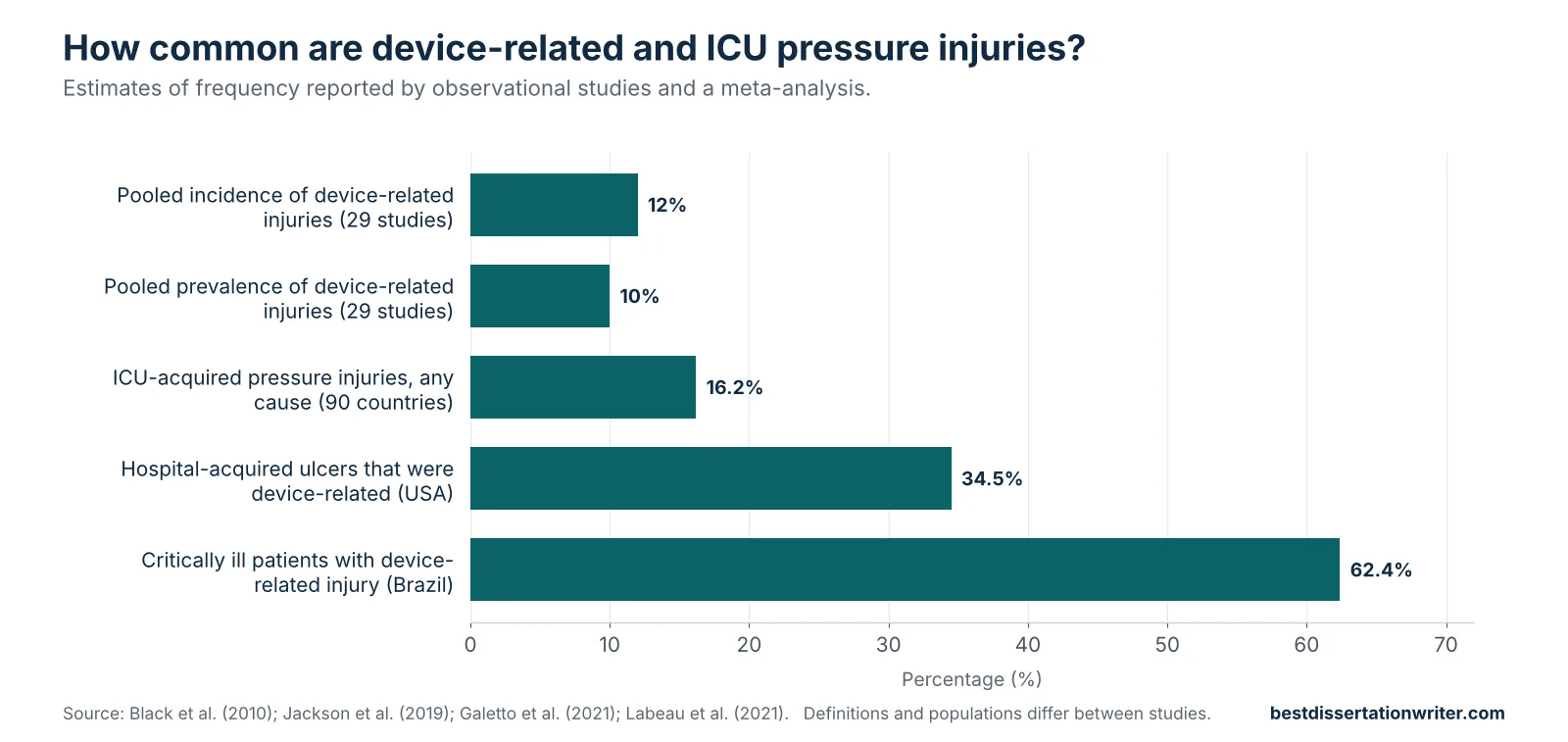
The DecubICUs point-prevalence study examined 13,254 patients in 1,117 intensive care units in 90 countries (Labeau et al., 2021). Overall, 26.6% of patients had a pressure injury, and 16.2% had an injury acquired in intensive care. Mechanical ventilation at admission and longer stays were among the factors associated with ICU-acquired injuries, and more severe injuries were associated with higher odds of death. Although the study did not report device-related injuries separately, it shows the scale of pressure injury in intensive care, where devices are almost universal.
Taken together, these studies show that device-related pressure injuries are not rare complications but a common harm, particularly where patients depend on several devices for long periods. The variation in estimates reflects differences in definitions, populations and how carefully skin under devices was examined, which suggests that many injuries may go unrecorded where inspection is not routine.
Theme 2: Devices and Patient Factors
A cross-sectional study of 93 critically ill patients in Brazil found that 58 (62.4%) had at least one device-related pressure injury (Galetto et al., 2021). The orotracheal tube, nasogastric tube and urinary catheter were the devices most commonly involved, and the ears, nasal ala and urethral meatus were the most affected sites. Injuries were associated with severe oedema, lower Braden and Glasgow Coma Scale scores, longer stays, use of more than one device and longer device use.
These findings highlight the devices that nurses handle every day. An endotracheal tube secured with tapes or ties can injure the lips, corners of the mouth and ears, and a nasogastric tube can erode the nostril. Because these injuries develop in visible places, they can also be distressing for patients and families and may leave lasting scars.
The association with oedema and with lower Braden scores suggests that the general condition of the patient matters as well as the device. Fluid shifts can make a device that fitted well on admission become tight over the following days, so regular reassessment is needed. The link with the number of devices and duration of use supports reviewing every device daily and removing those that are no longer needed.
For bedside nurses, this means that a device-related pressure injury may begin within hours of a device being placed or tightened. Recording the position of the endotracheal tube at the lips, checking that tube holders are not pressing on the corners of the mouth and moving the tube from side to side when safe are simple actions that can reduce sustained pressure on one area.
Theme 3: Evidence for Prevention
A Cochrane review of 51 randomised trials with 13,303 participants examined dressings and topical agents for preventing pressure ulcers (Patton et al., 2024). Silicone foam dressings, compared with no dressing, reduced the incidence of pressure ulcers by about half (risk ratio 0.50), with fewer stage 1 and stage 2 ulcers, but the certainty of evidence was low or very low. The review did not report results specifically for device-related injuries or for intensive care.
Despite this limitation, prophylactic dressings are widely used beneath devices such as non-invasive ventilation masks and tube holders, where they redistribute pressure and reduce friction and moisture. The Cochrane evidence suggests that they may help but does not establish their effect in this specific use. Dressings must also be removed regularly to inspect the skin, since they can hide early damage.
None of the included sources evaluated a complete prevention bundle for device-related pressure injuries in intensive care. In practice, prevention depends on combining several measures: appropriate device selection and fitting, regular inspection, repositioning, padding and removal. Evidence for these measures comes largely from expert consensus and quality improvement projects rather than trials.
Education is a recurring theme in quality improvement work on device-related pressure injuries. Staff may not realise how quickly damage can occur under a device, or may be unsure whether it is safe to move a tube. Clear local guidance, practical training and visual prompts at the bedside can help nurses to make prevention of device-related pressure injuries part of routine care.
Discussion
This review found that device-related pressure injuries are common, accounting for about a third of hospital-acquired pressure ulcers in one hospital and affecting most critically ill patients in a small Brazilian study. A meta-analysis estimated a pooled incidence of 12%, and pressure injuries of all types affect more than a quarter of intensive care patients worldwide. Respiratory devices and tubes, including the endotracheal tube and nasogastric tube, are among the most frequent causes.
The evidence for prevention is limited. Silicone foam dressings reduce pressure ulcers overall, but their specific effect beneath devices has not been established in trials, and few studies have evaluated prevention bundles in intensive care. Much of current practice therefore rests on expert consensus, physiological reasoning and local quality improvement, which highlights an important gap for research.
For nurses, the key message is that devices must be included in every pressure injury assessment. Standard risk tools may underestimate risk, so nurses should look specifically at the skin under and around each device, particularly in patients with oedema, multiple devices or long stays. Documenting each device, the condition of the skin beneath it and the actions taken can help teams to detect early damage and evaluate prevention.
Teamwork is also needed. Repositioning an endotracheal tube safely may require two people, and changes to device fixation may need input from doctors, respiratory therapists or specialist nurses. Tissue viability teams can support education and audit. Involving the whole team helps to overcome the reluctance to touch devices that is often a barrier to prevention.
This review has limitations. It included a small number of sources, most observational, with wide variation in definitions and methods. The Brazilian study was small and conducted in a single unit, and the Cochrane review did not address devices specifically. This review relied on openly accessible, English-language sources and did not involve independent double screening. Future research should test prevention bundles for device-related injuries in intensive care.
Finally, incident reporting should capture every device-related pressure injury, with details of the device, site and stage, so that units can identify patterns, target education and measure the effect of changes. Sharing these data with staff helps to make prevention a visible priority.
Implications of Device-Related Pressure Injuries Evidence for Practice
Critical care nurses should inspect the skin and mucosa beneath every device at least once per shift, reposition tubes and masks where safe, avoid over-tightening, and use prophylactic dressings under high-risk devices. Every device should be reviewed daily and removed when no longer needed. These measures extend wider principles of pressure ulcer prevention and lessons from hospital-acquired pressure ulcers to the intensive care setting.
Comfort and rest matter too, since pain from devices can contribute to sleep disruption. Nurses who are unable to deliver basic preventive care because of workload may experience moral distress, so adequate staffing supports both patients and nurses.
Patients who are awake should be asked whether devices feel tight or painful, and families can be encouraged to tell nurses if they notice redness or marks around tubes and masks.
Conclusion
This systematic review examined the evidence on device-related pressure injuries in critically ill and hospitalised patients. These injuries are common, especially in intensive care, and are linked to respiratory devices, tubes, oedema and longer device use. Silicone foam dressings reduce pressure ulcers overall, but evidence for preventing device-related injuries specifically is limited.
Preventing device-related pressure injuries depends on nurses treating every device as a potential source of harm, inspecting skin regularly and acting early. Research is needed to test prevention bundles and to strengthen the evidence base for practice.
References
Black, J. M., Cuddigan, J. E., Walko, M. A., Didier, L. A., Lander, M. J., & Kelpe, M. R. (2010). Medical device related pressure ulcers in hospitalized patients. International Wound Journal, 7(5), 358–365. https://doi.org/10.1111/j.1742-481X.2010.00699.x
Galetto, S. G. da S., Nascimento, E. R. P. do, Hermida, P. M. V., Busanello, J., Malfussi, L. B. H. de, & Lazzari, D. D. (2021). Medical device-related pressure injuries in critical patients: Prevalence and associated factors. Revista da Escola de Enfermagem da USP, 55, e20200397. https://doi.org/10.1590/1980-220X-REEUSP-2020-0397
Jackson, D., Sarki, A., Betteridge, R., & Brooke, J. (2019). Medical device-related pressure ulcers: A systematic review and meta-analysis. International Journal of Nursing Studies, 92, 109–120. https://doi.org/10.1016/j.ijnurstu.2019.02.006
Labeau, S. O., Afonso, E., Benbenishty, J., et al. (2021). Prevalence, associated factors and outcomes of pressure injuries in adult intensive care unit patients: The DecubICUs study. Intensive Care Medicine, 47(2), 160–169. https://doi.org/10.1007/s00134-020-06234-9
Patton, D., Moore, Z. E. H., Boland, F., Chaboyer, W. P., Latimer, S. L., Walker, R. M., & Avsar, P. (2024). Dressings and topical agents for preventing pressure ulcers. Cochrane Database of Systematic Reviews, (12), CD009362. https://doi.org/10.1002/14651858.CD009362.pub4
Cite this example
Best Dissertation Writers (2026) Medical Device-Related Pressure Injuries in Critically Ill Patients: A Systematic Review. Available at: https://bestdissertationwriter.com/device-related-pressure-injuries-review/
Best Dissertation Writers
Get expert help with your nursing literature review
Share your topic and deadline with Best Dissertation Writers and get support tailored to your module brief.