Nurse-Led Weaning From Mechanical Ventilation: A Systematic Review
 By Dr. Robertson Prime, Research Fellow
Updated October 17, 2026
14 min read
About 2,800 words
In this review
Abstract
Background: Weaning from mechanical ventilation is the process of reducing ventilator support until a patient can breathe without it, and it can account for a large part of the time spent on a ventilator. Nurses are at the bedside throughout this process, and in many units they share decisions about weaning with physicians or lead them through protocols.
Aim: This systematic review aimed to examine the evidence on protocolised and nurse-led approaches to weaning critically ill adults from mechanical ventilation.
Methods: Evidence was identified through targeted searches of openly accessible bibliographic records, publisher websites and the reference lists of key reviews. Five sources published between 1996 and 2014 were included: two randomised controlled trials, a before-and-after study, an international survey and a Cochrane systematic review, synthesised narratively.
Findings: Across 17 trials, protocolised weaning reduced the total duration of ventilation by 26% and weaning duration by 70% without additional harm. Daily screening followed by a spontaneous breathing trial shortened ventilation from 6.0 to 4.5 days, and pairing it with a daily sedation interruption increased ventilator-free days (14.7 compared with 11.6). Nurses and physicians shared weaning decisions in most ICUs, but collaboration was lower where nurse-to-patient ratios were less than one to one.
Conclusion: Critical care nurses should use weaning and sedation protocols, screen patients daily for readiness and take an active part in decisions, supported by adequate staffing and training.
Keywords: weaning from mechanical ventilation, nurse-led protocol, extubation
Introduction
This systematic review critically examines recent evidence on weaning from mechanical ventilation and its implications for critical care nursing practice.
Mechanical ventilation saves lives, but every extra day on a ventilator increases the risk of complications such as ventilator-associated pneumonia, muscle weakness, delirium and the need for tracheostomy. Getting patients off the ventilator as soon as they are ready, without removing support too early, is therefore one of the main goals of intensive care. The process of reducing support until a patient can breathe without it is known as weaning.
Weaning from mechanical ventilation can be quick for patients recovering from a short illness or anaesthesia, but slow and difficult for those with severe illness, chronic lung disease or prolonged sedation. Delays often occur not because patients are unready, but because readiness is not recognised promptly. Decisions may wait for a physician’s ward round, sedation may be deeper than needed, and assessments may be inconsistent between staff and shifts.
Nurses are at the bedside continuously and are well placed to recognise when patients are ready to wean. Protocols that set out clear criteria for screening, breathing trials and extubation can allow nurses, often alongside respiratory therapists, to move weaning forward without waiting for orders. In some countries, nurses manage ventilator settings and weaning directly; in others, decisions remain mainly with physicians.
A systematic review approach was chosen to bring together randomised trials, a Cochrane review and studies of how weaning decisions are made in practice.
For patients and families, weaning from mechanical ventilation is often a time of hope and anxiety. Patients may be frightened by breathlessness during trials, unable to speak because of the tube and uncertain whether they will manage without the ventilator. Nurses provide reassurance, explanation and practical support, such as positioning, communication aids and calm coaching through difficult moments.
Review question
What does the evidence show about protocolised and nurse-led approaches to weaning from mechanical ventilation in critically ill adults?
Background to Weaning From Mechanical Ventilation
Weaning from mechanical ventilation usually involves three steps. First, patients are screened for readiness, using criteria such as improvement in the underlying illness, adequate oxygenation, stable circulation and the ability to breathe spontaneously. Second, a spontaneous breathing trial tests whether the patient can breathe with little or no support, typically for 30 minutes to two hours. Third, if the trial is passed, the team decides on extubation, considering the patient’s ability to protect the airway and clear secretions.
Sedation has a major influence on weaning from mechanical ventilation. Deep or continuous sedation can delay awakening, reduce respiratory drive and prevent patients from taking part in breathing trials. Daily interruption of sedation, sometimes called a spontaneous awakening trial, and protocols that target lighter sedation aim to make patients ready for weaning sooner. Coordination between sedation and weaning is therefore essential.
Weaning protocols vary in content and in who uses them. Some are simple checklists for daily screening, while others set out detailed steps for reducing pressure support. Some are delivered by nurses, some by respiratory therapists and some by physicians, and computerised systems can automatically reduce support according to a protocol. The effects of protocols may depend on how well usual care is already organised.
A nurse-led protocol gives nurses explicit authority to screen patients, start breathing trials and, in some units, adjust ventilator settings and recommend extubation. This approach draws on nurses’ continuous presence, but it requires training, confidence, adequate staffing and clear agreement with medical colleagues about roles and escalation.
Failed extubation is an important risk. Patients who need to be re-intubated have worse outcomes, so weaning decisions must balance the risks of prolonged ventilation against the risks of removing support too soon. Assessment of cough strength, secretions, conscious level and airway swelling helps to judge readiness for extubation, and these are areas in which nursing observation is particularly valuable.
Search Strategy and Methods
Evidence for this example was identified through targeted searches of openly accessible bibliographic records, publisher websites and the reference lists of key reviews. Search terms combined keywords for the intervention (“weaning”, “ventilator weaning”, “protocol”, “spontaneous breathing trial”, “nurse-led”, “sedation interruption”) with terms for the population (“mechanical ventilation”, “critically ill”, “intensive care”), joined with the Boolean operators AND and OR. A full systematic review for assessment would run the same strategy in CINAHL, PubMed/MEDLINE, the Cochrane Library and Embase and report the number of records screened in a PRISMA flow diagram.
Sources were eligible if they evaluated protocolised or nurse-involved approaches to weaning critically ill adults, or examined how weaning decisions are shared between professions. Randomised trials and systematic reviews were prioritised, and a before-and-after study and an international survey were included to reflect practice context. Studies of children and of long-term weaning units only were excluded.
Five sources published between 1996 and 2014 were included: two randomised controlled trials, a before-and-after study, an international survey and a Cochrane systematic review (Table 1). The quality of each source was considered using the Critical Appraisal Skills Programme (CASP) checklists, drawing on the certainty ratings reported by the Cochrane review, and findings were synthesised narratively.
Key Findings on Weaning From Mechanical Ventilation
Three themes were identified: the effectiveness of weaning protocols, the value of daily screening and paired sedation and breathing trials, and the role of nurses in weaning decisions. Table 1 summarises the included sources, and Figure 1 shows how often nurses and physicians shared weaning decisions in an international survey.
| Author, year | Design | Setting and sample | Key finding |
|---|---|---|---|
| Ely et al. (1996) | Randomised controlled trial | 300 ventilated adults, USA | Daily screening plus breathing trial: median ventilation 4.5 vs 6.0 days; complications 20% vs 41%. |
| Blackwood et al. (2006) | Before-and-after study with reference unit | Two ICUs, Northern Ireland | Protocolised weaning did not reduce ventilation duration; no increase in re-intubation or mortality. |
| Girard et al. (2008) | Randomised controlled trial (ABC) | 338 medical ICU patients, 4 US hospitals | Paired awakening and breathing trials: ventilator-free days 14.7 vs 11.6; more self-extubation (10% vs 4%). |
| Rose et al. (2011) | International cross-sectional survey | 586 ICUs, 8 European countries | Shared decisions in most ICUs (71–88%); less collaboration with ratios below 1:1, more with protocols. |
| Blackwood et al. (2014) | Cochrane systematic review | 17 trials, 2,434 adults | Protocolised weaning reduced ventilation by 26% and weaning by 70%; no added harm; heterogeneity high. |
Theme 1: Do Weaning Protocols Work?
A Cochrane review of 17 randomised or quasi-randomised trials with 2,434 critically ill adults compared protocolised with non-protocolised weaning (Blackwood et al., 2014). Protocolised weaning reduced the total duration of mechanical ventilation by 26%, the duration of weaning by 70% and intensive care stay by 11%, with no evidence of additional harm. The certainty of evidence was moderate for duration of ventilation and low for weaning duration and intensive care stay.
However, heterogeneity between trials was substantial. Reductions were seen in medical, surgical and mixed units but not in neurosurgical units, and subgroup analyses did not explain the variation. The authors noted that many trials gave insufficient detail about usual care, which may have differed widely between settings. Protocols are likely to help most where usual practice is slow or inconsistent.
A before-and-after study in Northern Ireland illustrates this point (Blackwood et al., 2006). After protocolised weaning was introduced in one unit, the duration of ventilation did not fall, and after adjustment intensive care stay was longer, while a reference unit showed no change. Re-intubation and mortality did not increase, and tracheostomies were more frequent after the change, which may reflect other shifts in practice over the same period. The authors concluded that protocolised weaning did not reduce the duration of ventilation in that setting, where usual care may already have been efficient.
Theme 2: Daily Screening and Paired Awakening and Breathing Trials
An early randomised trial in the United States enrolled 300 ventilated patients (Ely et al., 1996). Respiratory therapists screened all patients each morning, and those in the intervention group who passed the screen had a two-hour spontaneous breathing trial monitored by nurses and therapists. Median duration of ventilation was 4.5 days in the intervention group and 6.0 days in the control group, and complications occurred in 20% compared with 41%, with lower intensive care costs.
The Awakening and Breathing Controlled trial randomised 338 medical patients in four United States hospitals to daily sedation interruption followed by a spontaneous breathing trial, or to breathing trials with usual sedation (Girard et al., 2008). The paired approach increased ventilator-free days (14.7 compared with 11.6) and shortened time to discharge from intensive care and hospital. One-year mortality was lower (44% compared with 55%), but self-extubation was more frequent (10% compared with 4%), although re-intubation rates were similar.
Together, these trials show that, in weaning from mechanical ventilation, structured daily routines, rather than ad hoc decisions, can speed safe weaning. They also highlight the close link between sedation and weaning, and the importance of nurses in carrying out awakening trials, monitoring breathing trials and ensuring patient safety, including preventing self-extubation.
For nursing practice, a nurse-led protocol that combines sedation interruption with breathing trials needs careful planning. Awakening trials can cause agitation, pain and distress, and nurses must decide when to restart sedation and how to keep patients safe. Clear criteria, adequate staffing and support from colleagues are needed so that nurses can carry out these trials confidently every day.
Theme 3: Nurses and Weaning Decisions
An international survey of 586 intensive care units in eight European countries examined who makes decisions about ventilation and weaning (Rose et al., 2011). Nurses and physicians shared most decisions: collaboration was reported for titration of ventilator settings in 88% of units, weaning readiness in 85%, recognition of weaning failure in 84%, weaning method in 73% and extubation readiness in 71%. Patterns varied between countries.
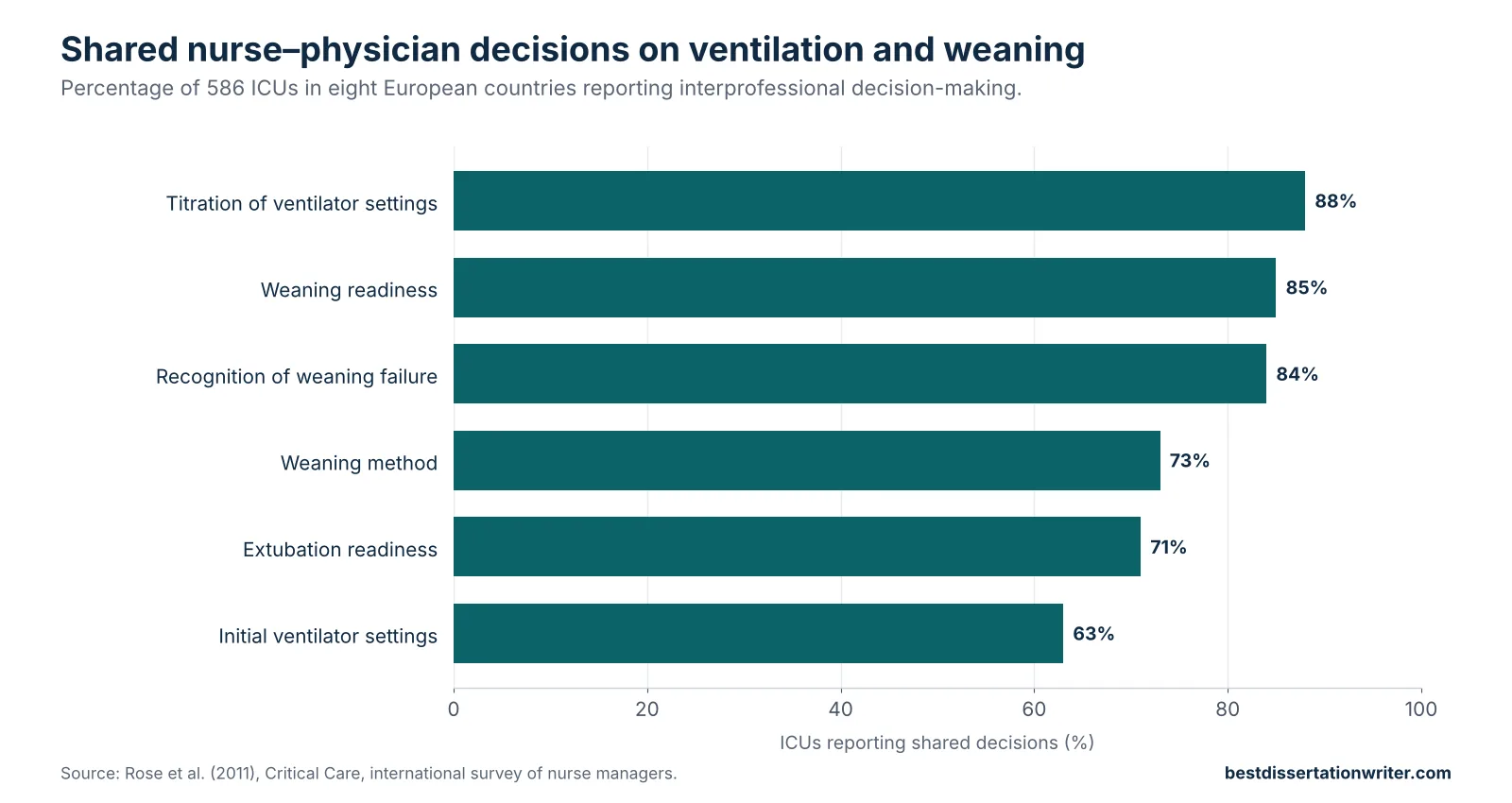
Collaboration was less likely in units where the nurse-to-patient ratio was less than one to one, for example for titrating ventilator settings and deciding on extubation readiness, and more likely where weaning protocols were used. The authors suggested that lack of collaboration could delay adjustments and recognition of readiness, prolonging ventilation. These findings link the effectiveness of nurse involvement in weaning to staffing levels and to the presence of protocols.
These survey findings matter for any unit considering a nurse-led protocol for weaning from mechanical ventilation. Where nurses already share decisions, a protocol may formalise and speed existing practice. Where decisions rest mainly with physicians, introducing nurse-led weaning requires attention to culture, education, professional boundaries and staffing, as well as to the content of the protocol itself.
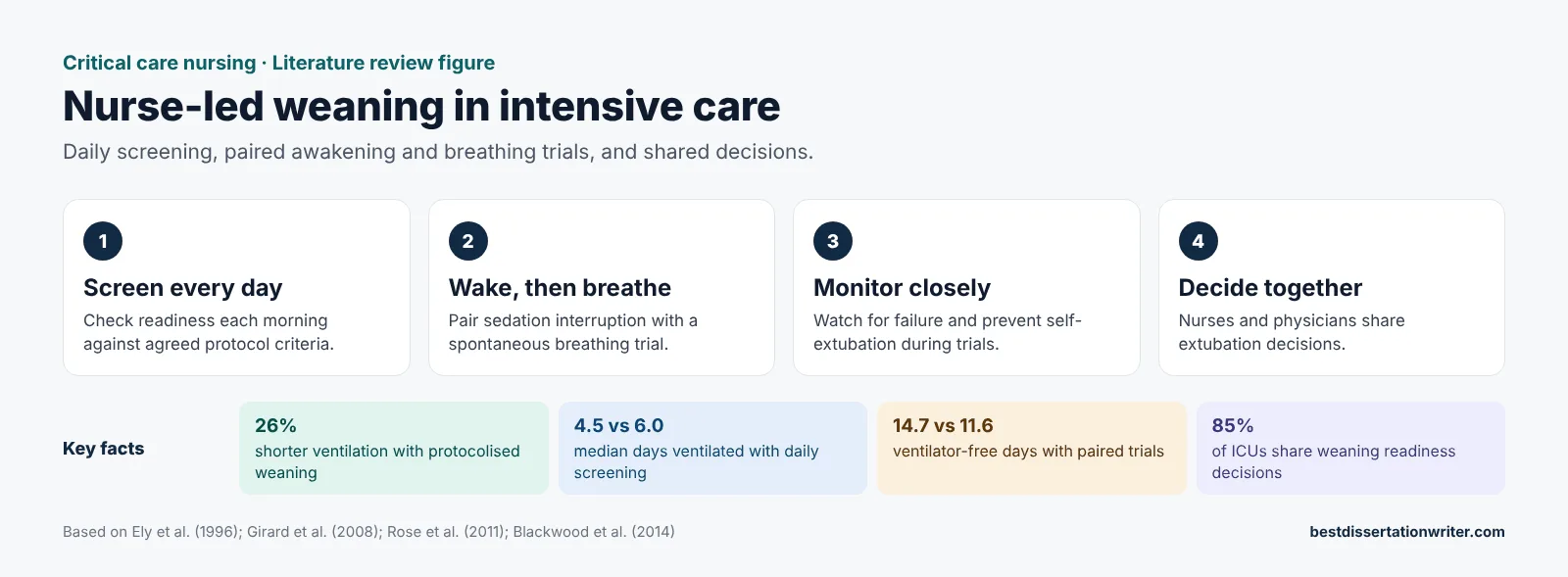
Across the three themes, the evidence suggests that the most important ingredient in timely weaning from mechanical ventilation is not a particular protocol but a reliable daily process: someone checks readiness every day, sedation is lightened, trials happen promptly and decisions are made without unnecessary delay. Nurses are well placed to make that process happen.
Discussion
This review found moderate-certainty evidence that protocolised weaning reduces the duration of mechanical ventilation, and trial evidence that daily screening, spontaneous breathing trials and paired sedation interruption shorten ventilation and improve outcomes. However, effects vary between settings, and protocols may add little where usual care is already efficient. Nurses share most weaning decisions in European units, and collaboration is greater where staffing is better and protocols exist.
The role of nurses is central to these findings. Protocols work by removing delays in recognising readiness, and nurses are best placed to recognise readiness because they are present continuously. A nurse-led protocol makes this role explicit, giving nurses authority to screen, start trials and escalate, while physicians remain involved in decisions about extubation and complex cases. Such approaches depend on nurses having the knowledge and confidence to assess respiratory function and interpret trials.
Staffing levels affect what nurses can do during weaning from mechanical ventilation. In units where one nurse cares for more than one ventilated patient, nurses may have less time to assess readiness, conduct trials and take part in decisions, which may slow weaning. Investment in staffing and training is therefore part of any strategy to improve weaning, not an optional extra.
Patient safety must also be considered. Lighter sedation and earlier trials increase the risk of self-extubation, as seen in the paired trial, and failed extubation can be harmful. Careful monitoring, clear criteria for stopping trials and teamwork during extubation are essential. Patients’ comfort, including pain and anxiety, should be assessed and managed throughout weaning.
This review has limitations. Several included studies are dated, the Cochrane review found substantial heterogeneity, and few trials evaluated nurse-led protocols specifically. This review relied on openly accessible, English-language sources and did not involve independent double screening. Future research should test nurse-led protocols in different staffing models and examine outcomes such as long-term function and patient experience.
Education is a recurring theme. Nurses need knowledge of respiratory physiology, ventilator modes, signs of weaning failure and extubation criteria to take an active role. Simulation, competency frameworks and support from experienced colleagues can build confidence, particularly for newly qualified nurses in intensive care.
Implications of Weaning From Mechanical Ventilation Evidence for Practice
Critical care nurses should screen ventilated patients daily for readiness, coordinate sedation interruption with spontaneous breathing trials, monitor trials closely and contribute actively to decisions about extubation, using an agreed nurse-led protocol where available. Lighter sedation and readiness for weaning are closely linked to ICU delirium prevention and early mobilisation.
Shortening ventilation also reduces the risk of ventilator-associated pneumonia, and regular ICU pain assessment helps patients to remain comfortable during breathing trials and after extubation.
Patients who have been through weaning from mechanical ventilation often remember breathlessness and fear, and follow-up conversations can help them understand what happened. Their feedback can also help units to improve how trials are explained and supported.
Conclusion
This systematic review examined the evidence on protocolised and nurse-led approaches to weaning from mechanical ventilation. Protocols and structured daily routines reduce the duration of ventilation, and pairing sedation interruption with breathing trials improves outcomes, although effects vary by setting. Nurses share most weaning decisions, and their involvement is greater with better staffing and protocols.
Nurses are central to safe and timely weaning. Protocols that recognise their expertise, supported by adequate staffing and training, can help patients to breathe on their own sooner and more safely.
Units should audit time to extubation, re-intubation and self-extubation rates to check that a nurse-led protocol is delivering safe, timely weaning from mechanical ventilation.
References
Blackwood, B., Burns, K. E. A., Cardwell, C. R., & O’Halloran, P. (2014). Protocolized versus non-protocolized weaning for reducing the duration of mechanical ventilation in critically ill adult patients. Cochrane Database of Systematic Reviews, (11), CD006904. https://doi.org/10.1002/14651858.CD006904.pub3
Blackwood, B., Wilson-Barnett, J., Patterson, C. C., Trinder, T. J., & Lavery, G. G. (2006). An evaluation of protocolised weaning on the duration of mechanical ventilation. Anaesthesia, 61(11), 1079–1086. https://doi.org/10.1111/j.1365-2044.2006.04830.x
Ely, E. W., Baker, A. M., Dunagan, D. P., Burke, H. L., Smith, A. C., Kelly, P. T., Johnson, M. M., Browder, R. W., Bowton, D. L., & Haponik, E. F. (1996). Effect on the duration of mechanical ventilation of identifying patients capable of breathing spontaneously. New England Journal of Medicine, 335(25), 1864–1869. https://doi.org/10.1056/NEJM199612193352502
Girard, T. D., Kress, J. P., Fuchs, B. D., et al. (2008). Efficacy and safety of a paired sedation and ventilator weaning protocol for mechanically ventilated patients in intensive care (Awakening and Breathing Controlled trial): A randomised controlled trial. The Lancet, 371, 126–134. https://doi.org/10.1016/S0140-6736(08)60105-1
Rose, L., Blackwood, B., Egerod, I., Haugdahl, H. S., Hofhuis, J., Isfort, M., Kydonaki, K., Schubert, M., Sperlinga, R., Spronk, P., Storli, S., McAuley, D. F., & Schultz, M. J. (2011). Decisional responsibility for mechanical ventilation and weaning: An international survey. Critical Care, 15(6), R295. https://doi.org/10.1186/cc10588
Cite this example
Best Dissertation Writers (2026) Nurse-Led Weaning From Mechanical Ventilation: A Systematic Review. Available at: https://bestdissertationwriter.com/weaning-from-mechanical-ventilation/
Best Dissertation Writers
Get expert help with your nursing literature review
Share your topic and deadline with Best Dissertation Writers and get support tailored to your module brief.