Health Inequalities Experienced by People with Learning Disabilities and the Role of Nursing: A Systematic Review
 By Dr. Robertson Prime, Research Fellow
Updated October 12, 2026
16 min read
About 3,300 words
In this review
Abstract
Background: People with learning disabilities experience marked health inequalities, dying many years earlier than the general population, and a large share of their deaths are judged avoidable. These differences are widely attributed to the way services are organised and delivered rather than to learning disability itself.
Aim: This systematic review aimed to establish the scale and causes of health inequalities experienced by people with learning disabilities and the role of nursing in reducing them.
Methods: Targeted searches of openly accessible bibliographic records, publisher websites and the reference lists of key reviews identified seven sources published between 2008 and 2025: a national inquiry, a population-based confidential inquiry, a national cohort study, a national mortality review report, a qualitative interview study and two mixed-methods studies. Sources were appraised with CASP checklists and synthesised narratively.
Findings: In a confidential inquiry of 247 deaths, median age at death was 13 years lower for men and 20 years lower for women than in the general population, and 37% of deaths were amenable to good-quality healthcare compared with 13% in the general population. A national cohort study found an adjusted mortality hazard ratio of 3.1, and the national mortality review judged 39% of deaths in 2023 avoidable compared with 21% in the general population. Qualitative and mixed-methods studies linked these outcomes to poor communication, negative attitudes, failure to identify patients and inconsistent reasonable adjustments, with liaison nurses acting as key enablers.
Conclusion: The gap is large, persistent and largely avoidable. Nurses can help to close it by identifying patients, making reasonable adjustments routine, listening to carers and supporting liaison and annual health check services.
Keywords: health inequalities, access to healthcare, reasonable adjustments
Introduction
This systematic review critically examines recent evidence on health inequalities and its implications for learning disability nursing practice.
People with learning disabilities have more physical and mental health needs than the general population, yet they have long found it harder to obtain timely and effective healthcare. Epilepsy, respiratory disease, constipation, dysphagia, sensory impairment and mental ill health are all more common, and symptoms may be missed when a person cannot easily describe pain or distress. The result is a persistent gap in health outcomes that begins in childhood and widens across the life course, so that health inequalities for this group are among the starkest in the National Health Service.
Over the past two decades, a series of inquiries and reviews has shown that many of these deaths and much of this suffering could have been prevented. Nurses are central to the response. Learning disability nurses work as liaison nurses in acute hospitals, in community teams and in primary care, while adult, mental health and children’s nurses meet people with learning disabilities in every setting. How nurses identify people, communicate with them, involve carers and adapt care has a direct influence on whether health inequalities are narrowed or reinforced.
A systematic review approach was chosen so that the strongest available evidence, including population-based mortality studies, national inquiries and studies of hospital care, could be identified and appraised in a transparent way. Bringing these sources together helps to show not only how large the problem is but also which parts of it nurses can change.
Review question
What is the scale of health inequalities experienced by people with learning disabilities, what causes them, and what is the role of nursing in reducing them?
Background to Health Inequalities
In public health, the term refers to systematic, avoidable and unfair differences in health between groups of people. For people with learning disabilities, these differences arise partly from genetic and biological factors associated with particular conditions, but also from poverty, social exclusion, poor health literacy and, crucially, barriers in access to healthcare. Distinguishing differences that are inevitable from those that are avoidable is important, because only the latter are amenable to changes in services and professional practice.
Concern about these issues gained national attention in England when Mencap (2007) published Death by Indifference, which described the deaths of six people with learning disabilities in NHS care and argued that institutional discrimination existed within the health service. The report prompted the Secretary of State for Health to commission an independent inquiry led by Sir Jonathan Michael, which made ten recommendations for change across the health system (Michael, 2008). Regular health checks in primary care and better information on the health of people with learning disabilities were among the responses that followed.
The legal framework for responding to health inequalities is the duty to make reasonable adjustments. Under the Equality Act 2010, service providers must take reasonable steps to remove the disadvantages that disabled people would otherwise face. In healthcare, reasonable adjustments can include longer appointments, easy read information, quiet waiting areas, flexible visiting for carers, the use of hospital passports and adapting the way that examinations and procedures are carried out. These adjustments are not optional extras but a legal requirement.
Since 2017, the Learning from Lives and Deaths (LeDeR) programme has reviewed the deaths of people with learning disabilities in England, and since 2021 its annual reports have been produced by King’s College London on behalf of NHS England. Together with earlier confidential inquiries and cohort studies, LeDeR provides one of the most detailed pictures of avoidable mortality for any population group, making it possible to track whether health inequalities are narrowing over time.
Search Strategy and Methods
Evidence for this example was identified through targeted searches of openly accessible bibliographic records, publisher websites and the reference lists of key reviews. Search terms combined keywords for the population (“learning disabilit*”, “intellectual disabilit*”) with terms for outcomes and causes (“health inequalities”, “mortality”, “avoidable death*”, “access to healthcare”, “reasonable adjustments”, “liaison nurs*”), joined with the Boolean operators AND and OR. A full systematic review for assessment would run the same strategy in CINAHL, PubMed/MEDLINE, PsycINFO, the Cochrane Library and Embase and report the number of records screened in a PRISMA flow diagram.
Sources were eligible if they reported on mortality, avoidable deaths, access to healthcare or the delivery of reasonable adjustments for adults with learning disabilities in the United Kingdom, and if they used a clear empirical or inquiry-based method. National inquiries and mortality review reports were included because much of the key evidence on health inequalities in England has been published in these formats. Opinion pieces, studies limited to a single clinical condition and studies of children only were excluded.
Seven sources published between 2008 and 2025 were included: one national independent inquiry, one population-based confidential inquiry, one national cohort study, one national mortality review report, one qualitative interview study, and two mixed-methods studies of hospital care and liaison nursing (Table 1). The quality of each source was appraised using the Critical Appraisal Skills Programme (CASP) checklist appropriate to its design, and findings were synthesised narratively into themes relevant to health inequalities and nursing practice.
Key Findings on Health Inequalities
Three themes were identified: the scale of premature and avoidable mortality; barriers in access to healthcare and the role of discrimination; and the delivery of reasonable adjustments, including the contribution of liaison nurses. Table 1 summarises the included sources, and Figure 1 compares the proportion of deaths judged avoidable or amenable to healthcare in three studies of health inequalities.
| Author, year | Design | Setting and sample | Key finding |
|---|---|---|---|
| Michael (2008) | National independent inquiry | Public consultation, research review, witness and stakeholder evidence; England | Significant gap between policy, law and practice; avoidable suffering and likely avoidable deaths; reasonable adjustments often not made. |
| Ali et al. (2013) | Qualitative interview study | 14 patient–carer dyads plus one carer; mild and moderate learning disabilities; England | About half felt the patient had been treated unfairly; barriers included attitudes, communication and lack of reasonable adjustments. |
| Heslop et al. (2014) | Population-based confidential inquiry | 247 deaths, five primary care trust areas, south-west England, 2010–2012 | Median age at death 13 (men) and 20 (women) years below general population; 37% of deaths amenable to healthcare vs 13%. |
| Tuffrey-Wijne et al. (2014) | Mixed-methods study | Six acute NHS trusts; 990 staff questionnaires, 68 staff and 33 patient interviews, carers | Reasonable adjustments inconsistent and dependent on individuals; liaison nurses and ward managers were key enablers. |
| MacArthur et al. (2015) | Mixed-methods study | Four Scottish health boards; 323 liaison nurse referrals; 85 stakeholders | Facilitating reasonable adjustments across seven areas was central to the learning disability liaison nurse role. |
| Hosking et al. (2016) | Cohort study | 343 English general practices; 16,666 adults with learning disabilities, 113,562 controls | Adjusted mortality hazard ratio 3.1; 37.0% of deaths amenable to healthcare vs 22.5% in comparison group. |
| King’s College London (2025) | National mortality review report (LeDeR) | 3,556 deaths of people with learning disabilities notified in 2023, England | 39% of deaths avoidable vs 21% in general population; delays in care in 37% of reviewed deaths. |
Theme 1: The Scale of Health Inequalities in Mortality
The Confidential Inquiry into Premature Deaths of People with Learning Disabilities (CIPOLD) reviewed 247 deaths of people aged four and over in five primary care trust areas in south-west England between 2010 and 2012 (Heslop et al., 2014). The median age at death was 65 years for men and 63 years for women, which was 13 and 20 years lower than in the general population respectively. In addition, 37% of deaths were from causes amenable to good-quality healthcare, compared with 13% in the general population, a contrast that places health inequalities in mortality at the centre of the evidence.
Hosking et al. (2016) tested whether this pattern held at national level, using primary care records from 343 general practices in England. Among 16,666 adults with learning disabilities and 113,562 matched controls, mortality was over three times higher in people with learning disabilities, with a hazard ratio of 3.1 after adjustment for comorbidity, smoking and deprivation. Risk was higher still for people with Down syndrome or epilepsy, and 37.0% of deaths were judged amenable to healthcare intervention, compared with 22.5% in the comparison group.
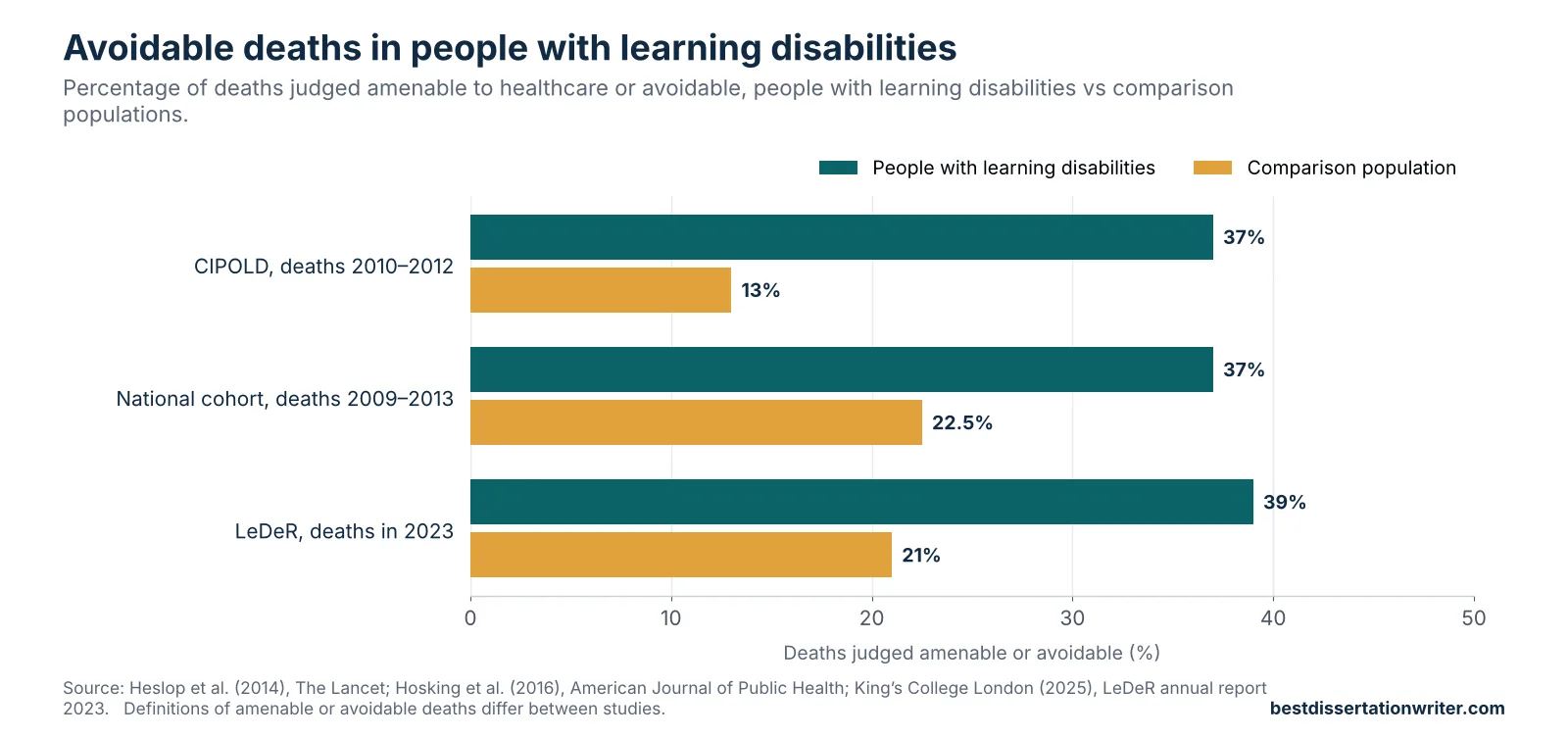
The most recent LeDeR report covered 3,556 deaths of people with learning disabilities notified in 2023 (King’s College London, 2025). It found that 39% of deaths were avoidable, down from 46% in 2021 but still almost double the rate of 21% in the general population. People with severe or profound learning disabilities had a median age at death of 57 years, compared with 64 years in the comparison group, and between 2021 and 2023 people from Asian and Asian British backgrounds had a median age at death of 43 years, 20 years lower than people from White backgrounds.
These studies differ in design and in the way avoidable deaths were defined, so the figures are not directly comparable. CIPOLD used detailed case review in one region, Hosking et al. (2016) used routinely recorded data, and LeDeR relies on notifications and local reviews whose completeness varies. Nevertheless, the consistency of the findings across methods and over more than a decade is striking, and it strengthens the conclusion that health inequalities in mortality are large and have narrowed only slowly.
Theme 2: Barriers in Access to Healthcare
The independent inquiry by Michael (2008) drew on a public consultation, a review of research and the views of witnesses and stakeholders. It found a significant level of avoidable suffering from untreated ill health, a high likelihood that avoidable deaths were occurring, and appalling examples of discrimination, abuse and neglect alongside some good practice. It linked much of this risk to the failure to make reasonable adjustments, and it described people with learning disabilities as often invisible in the system, receiving less effective care than they were entitled to.
Ali et al. (2013) explored the experiences of patients with mild and moderate learning disabilities and their carers in 14 patient–carer pairs and one additional carer. About half of participants felt that the patient had been treated unfairly or discriminated against by health services. Barriers included negative staff attitudes, failure to make reasonable adjustments, poor communication, lack of knowledge about local services, disputes about eligibility, inadequate support for carers and language difficulties for families from minority ethnic groups. Most participants could, however, describe at least one example of good practice.
Heslop et al. (2014) found that compared with a comparator group, the deaths of people with learning disabilities were more often associated with problems in advance care planning, adherence to the Mental Capacity Act, living in inappropriate accommodation, adjusting care as needs changed and carers not feeling listened to. The LeDeR report similarly identified delays in care or treatment in 37% of reviewed deaths and found that diagnosis and treatment guidelines were not met in 28% (King’s College London, 2025). These findings show that barriers in access to healthcare persist well after the original inquiries.
Theme 3: Reasonable Adjustments and the Contribution of Nurses to Reducing Health Inequalities
Tuffrey-Wijne et al. (2014) studied the delivery of reasonable adjustments in six acute NHS hospital trusts in England, using 990 staff questionnaires, 68 staff interviews, 33 interviews with adults with learning disabilities, 88 carer questionnaires and 37 carer interviews, together with participant observation. Hospital strategies did not consistently lead to reasonable adjustments being made. Good practice depended largely on individual staff, and the main barriers were the lack of an effective way to identify and flag patients, limited staff understanding of the adjustments needed, unclear accountability and insufficient resources.
The same study identified the learning disability liaison nurse and the ward manager as the key enablers of reasonably adjusted care (Tuffrey-Wijne et al., 2014). MacArthur et al. (2015) examined this liaison role in four Scottish health boards, analysing 323 referrals recorded by six liaison nurses over 18 months and interviewing or holding focus groups with 85 stakeholders. Facilitating reasonable adjustments was central to the role and covered seven areas, including access to information, adjustments to care, an appropriate care environment, identifying patient need and the use of specialist tools and resources.
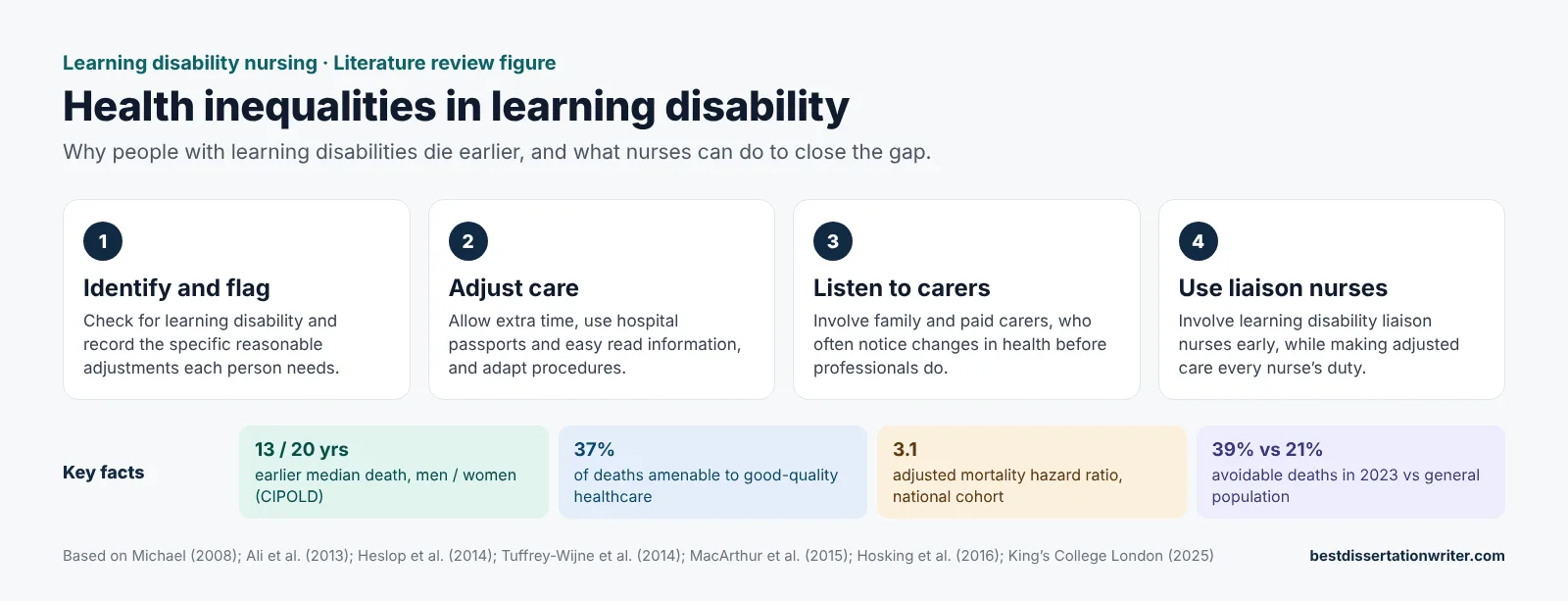
Both studies show that liaison nurses can make hospital care safer and more person-centred, and so help to reduce health inequalities, but they also reveal a weakness: if reasonable adjustments depend on a small number of specialist nurses or committed individuals, they will be patchy across wards, shifts and organisations. The evidence therefore points to the need for every nurse to understand and deliver reasonable adjustments, with liaison nurses providing expertise, training and leadership rather than acting as the only source of adjusted care.
Discussion
This systematic review shows that people with learning disabilities in England die many years earlier than the general population and that over a third of their deaths are avoidable or amenable to healthcare. The evidence on health inequalities is consistent across a regional confidential inquiry, a national cohort study and a national mortality review, and it suggests that the gap has narrowed only modestly despite repeated reports and policy initiatives.
The sources agree that much of this inequality arises from the way services are organised and delivered rather than from learning disability itself. Failure to identify people, poor communication, negative attitudes, diagnostic delays, not listening to carers and failure to make reasonable adjustments recur from Michael (2008) to the LeDeR report. This consistency is a strength of the evidence, but it is also troubling, because it implies that well-known problems have not been fully addressed in practice.
There is a tension between the policy emphasis on reasonable adjustments and the reality described in hospitals. Tuffrey-Wijne et al. (2014) found that organisational strategies did not reliably translate into adjusted care at the bedside, while MacArthur et al. (2015) showed what can be achieved when liaison nurses are available. Reducing health inequalities is therefore likely to require both specialist roles and mainstream changes, such as electronic flagging of the adjustments a person needs, mandatory training and clear accountability for making adjustments.
The evidence also shows that health inequalities are not uniform within the learning disability population. People with severe or profound learning disabilities, people with epilepsy or Down syndrome and people from minority ethnic groups appear to be at particular risk (Hosking et al., 2016; King’s College London, 2025). Approaches that treat people with learning disabilities as a single group may therefore miss those with the greatest needs, and nurses should consider how intersecting disadvantages affect access to healthcare for each person.
This review has limitations. This review relied on openly accessible, English-language sources, did not involve independent double screening and included a small number of sources, most of them from England. Mortality studies used different definitions of avoidable or amenable deaths, and the qualitative studies had small samples. Future research should evaluate interventions that aim to reduce health inequalities, such as liaison nursing, hospital flagging systems and reasonable adjustment training, using designs that measure effects on patient outcomes and avoidable deaths.
Implications of Health Inequalities Evidence for Practice
For nurses in every field, the evidence supports a proactive approach. Nurses should check whether a patient has a learning disability, ask about and record the reasonable adjustments the person needs, use hospital passports, allow extra time, involve family carers and paid supporters, and escalate concerns when a person’s behaviour or presentation changes. Learning disability liaison nurses should be involved early, and ward managers should ensure that adjusted care does not depend on individual goodwill.
In primary care, nurses can support access to healthcare by promoting annual health checks and health action plans. Across all settings, flexible communication strategies and good therapeutic communication skills help people to express pain and distress, while careful discharge planning that involves carers can prevent avoidable readmissions.
Conclusion
This systematic review found consistent evidence that people with learning disabilities die considerably earlier than the general population and that many of these deaths are avoidable. The causes lie largely in barriers in access to healthcare, poor communication, failure to listen to carers and inconsistent reasonable adjustments, all of which are within the influence of health services and nurses. These health inequalities are therefore not inevitable.
Reducing health inequalities will require nurses to make reasonable adjustments routine, to work closely with liaison nurses and carers, and to challenge practice that falls short. Specialist roles are valuable, but lasting change depends on every nurse treating adjusted, person-centred care as a core professional and legal duty.
References
Ali, A., Scior, K., Ratti, V., Strydom, A., King, M., & Hassiotis, A. (2013). Discrimination and other barriers to accessing health care: Perspectives of patients with mild and moderate intellectual disability and their carers. PLoS ONE, 8(8), e70855. https://doi.org/10.1371/journal.pone.0070855
Equality Act 2010, c. 15. https://www.legislation.gov.uk/ukpga/2010/15/contents
Heslop, P., Blair, P. S., Fleming, P., Hoghton, M., Marriott, A., & Russ, L. (2014). The Confidential Inquiry into premature deaths of people with intellectual disabilities in the UK: A population-based study. The Lancet, 383(9920), 889–895. https://doi.org/10.1016/S0140-6736(13)62026-7
Hosking, F. J., Carey, I. M., Shah, S. M., Harris, T., DeWilde, S., Beighton, C., & Cook, D. G. (2016). Mortality among adults with intellectual disability in England: Comparisons with the general population. American Journal of Public Health, 106(8), 1483–1490. https://doi.org/10.2105/AJPH.2016.303240
King’s College London. (2025). LeDeR annual report 2023: Learning from lives and deaths – people with a learning disability and autistic people. King’s College London. https://www.kcl.ac.uk/ioppn/assets/pdfs/leder/leder-annual-report-2023.pdf
MacArthur, J., Brown, M., McKechanie, A., Mack, S., Hayes, M., & Fletcher, J. (2015). Making reasonable and achievable adjustments: The contributions of learning disability liaison nurses in ‘Getting it right’ for people with learning disabilities receiving general hospitals care. Journal of Advanced Nursing, 71(7), 1552–1563. https://doi.org/10.1111/jan.12629
Mencap. (2007). Death by indifference: Following up the Treat me right! report. Mencap.
Michael, J. (2008). Healthcare for all: Report of the independent inquiry into access to healthcare for people with learning disabilities. Department of Health.
Tuffrey-Wijne, I., Goulding, L., Giatras, N., Abraham, E., Gillard, S., White, S., Edwards, C., & Hollins, S. (2014). The barriers to and enablers of providing reasonably adjusted health services to people with intellectual disabilities in acute hospitals: Evidence from a mixed-methods study. BMJ Open, 4(4), e004606. https://doi.org/10.1136/bmjopen-2013-004606
Cite this example
Best Dissertation Writers (2026) Health Inequalities Experienced by People with Learning Disabilities and the Role of Nursing: A Systematic Review. Available at: https://bestdissertationwriter.com/health-inequalities-literature-review/
Best Dissertation Writers
Get expert help with your nursing literature review
Share your topic and deadline with Best Dissertation Writers and get support tailored to your module brief.