Nurse-Led Epilepsy Management for Adults with Learning Disabilities: A Systematic Review
 By Dr. Robertson Prime, Research Fellow
Updated October 12, 2026
16 min read
About 3,200 words
By Dr. Robertson Prime, Research Fellow
Updated October 12, 2026
16 min read
About 3,200 words
In this review
Abstract
Background: Effective epilepsy management is a core part of learning disability nursing, because epilepsy affects an estimated 22.2% of people with intellectual disability compared with about 1% of the general population. Epilepsy remains one of the leading causes of avoidable death in this group, and services are expected to provide regular review and individualised care.
Aim: This systematic review aimed to examine the evidence on nurse-led and service-level epilepsy management for adults with learning disabilities and its implications for nursing practice.
Methods: Targeted searches of openly accessible bibliographic records, publisher websites and the reference lists of key reviews identified seven sources published between 2015 and 2026: a Cochrane review, a systematic review of service responses, a cluster randomised trial, a national guideline, a case-control study, a population-based mortality study and a national mortality review report. Sources were appraised with CASP checklists and synthesised narratively.
Findings: Epilepsy was the primary cause of 16.2% of 9,756 reviewed deaths of adults with intellectual disability and epilepsy, and people who died of epilepsy did so at a median age of 56 years. A case-control study linked the absence of an epilepsy review in the previous year to a higher risk of death, while review by learning disability psychiatrists was associated with 72% lower odds of death. A cluster trial of 312 adults found that a specialist nurse competency framework gave no clinical benefit over usual care, although it was probably cost-effective. Evidence on medication and on seizure management plans was limited in quality.
Conclusion: Regular, coordinated review, individual care plans and close work with carers appear more important than any single model of nurse-led epilepsy management. Learning disability nurses should champion annual review, risk assessment and accessible information.
Keywords: epilepsy management, seizure management, care plan
Introduction
This systematic review critically examines recent evidence on epilepsy management and its implications for learning disability nursing practice.
Epilepsy is one of the most common long-term conditions among people with learning disabilities. Seizures are often frequent, difficult to control and accompanied by other health problems, and many people take several medicines that can affect alertness, mood and behaviour. Because some people cannot describe their seizures or side effects, they depend on families and support staff to observe, record and report what happens. Poorly controlled epilepsy can lead to injuries, hospital admissions, loss of skills and, at worst, premature death.
Learning disability nurses play a central part in epilepsy management. They support people and carers to record seizures, help to write and update a seizure management plan, monitor the effects of medication, train support staff to give rescue medication and coordinate care between general practice, neurology and psychiatry services. In some services, specialist epilepsy nurses or learning disability nurses with advanced epilepsy training lead this work, but there is debate about whether nurse-led models improve outcomes compared with usual care.
A systematic approach was chosen so that the strongest available evidence, including Cochrane and systematic reviews, a cluster randomised trial, national guidance and large mortality studies, could be identified and appraised in a transparent way. Bringing these sources together allows the effects of epilepsy management to be considered alongside the risks it aims to reduce.
Review question
What is the evidence for nurse-led and service-level epilepsy management for adults with learning disabilities, and what are the implications for nursing practice?
Background to Epilepsy Management
A learning disability, called intellectual disability in much of the international literature, involves a significantly reduced ability to understand new or complex information and to learn new skills, beginning before adulthood. Epilepsy affects an estimated 22.2% of people with intellectual disability, compared with about 1% of the general population (Shankar et al., 2026). Many people also have additional physical health conditions, take several medicines and rely on others to recognise and report their seizures.
Epilepsy management for this group involves more than prescribing antiseizure medicines. It includes an accurate diagnosis, distinguishing seizures from other behaviours, choosing and reviewing medication, assessing the risk of injury and sudden death, planning how carers should respond to prolonged seizures and supporting the person to live as independently as possible. Each of these steps can be complicated by communication difficulties, diagnostic overshadowing and the involvement of many different services.
In England, the National Institute for Health and Care Excellence (NICE, 2022) guideline on the epilepsies recommends that adults with epilepsy and a learning disability have a monitoring review at least once a year, longer appointments, information in accessible formats and the involvement of family, carers or an advocate where the person wishes. It also describes a central role for epilepsy specialist nurses in providing information, education and support, and in agreeing a care plan with each person.
National mortality reviews have increased attention to these issues. The Learning from Lives and Deaths (LeDeR) programme has repeatedly identified epilepsy as a major cause of avoidable death in people with learning disabilities, and its most recent report named epilepsy care as a priority area for improvement (King’s College London, 2026). This makes the effectiveness of epilepsy management a question of safety as well as quality of life.
Search Strategy and Methods
Evidence for this example was identified through targeted searches of openly accessible bibliographic records, publisher websites and the reference lists of key reviews. Search terms combined keywords for the condition and care (“epilepsy management”, “seizure management”, “epilepsy specialist nurse”, “nurse-led”, “care plan”, “epilepsy-related death”, “SUDEP”) with terms for the population (“learning disabilit*”, “intellectual disabilit*”), joined with the Boolean operators AND and OR. A full systematic review for assessment would run the same strategy in CINAHL, PubMed/MEDLINE, PsycINFO, the Cochrane Library and Embase and report the number of records screened in a PRISMA flow diagram.
Sources were eligible if they evaluated treatment, nursing or service approaches to epilepsy management for adults with learning or intellectual disabilities, or reported epilepsy-related deaths and their risk factors in ways that could inform management. Systematic reviews, randomised trials, national guidelines and large observational studies published from 2010 onward were prioritised. Studies limited to children, single case reports and studies of epilepsy surgery alone were excluded.
Seven sources published between 2015 and 2026 were included: one Cochrane review, one systematic review of service responses, one cluster randomised controlled trial, one national guideline, one case-control study, one population-based mortality study and one national mortality review report (Table 1). The quality of each source was appraised using the Critical Appraisal Skills Programme (CASP) checklist appropriate to its design, and the findings on epilepsy management were synthesised narratively into themes.
Key Findings on Epilepsy Management
Three themes were identified: epilepsy management and the prevention of avoidable death, the effectiveness of nurse-led and specialist service models, and the evidence on medication, review and seizure management plans. Table 1 summarises the included sources, and Figure 1 shows the leading causes of avoidable death among adults with a learning disability in England, including epilepsy.
| Author, year | Design | Setting and sample | Key finding |
|---|---|---|---|
| Jackson et al. (2015) | Cochrane systematic review | 14 RCTs, 1,116 people with intellectual disabilities and epilepsy | Antiepileptic drugs increased responder rates versus placebo; no clear best drug; low to moderate quality evidence. |
| Robertson et al. (2017) | Systematic review | 35 studies of service responses since 1990; no RCTs | Inconsistent specialist access; care plans 60–65%, annual review 71–81%; need for carer and staff education. |
| Ring et al. (2018) | Cluster randomised controlled trial (EpAID) | 312 adults with intellectual disability and epilepsy; 17 clusters in England | Nurse competency framework gave no clinical benefit over usual care; probably cost-effective. |
| NICE (2022) | National clinical guideline (NG217) | Children, young people and adults with epilepsy; section on learning disabilities | At least annual review, longer appointments, accessible information; central role for epilepsy specialist nurses. |
| Sun et al. (2023) | Case-control study | 190 deaths and 910 living controls; ten regions of England and Wales | No epilepsy review in previous 12 months linked to death; psychiatry review linked to 72% lower odds. |
| Shankar et al. (2026) | Population-based mortality analysis | 9,756 LeDeR-reviewed deaths of adults with intellectual disability and epilepsy, 2016–2021 | Epilepsy primary cause in 16.2%; median age at death 56 vs 62 years; poor care and no health check linked to death. |
| King’s College London (2026) | National mortality review report (LeDeR 2024) | Deaths of adults with a learning disability reviewed in England in 2024 | 39.0% of deaths avoidable vs 21.1%; epilepsy 9.4% of avoidable deaths, third leading cause. |
Theme 1: Epilepsy Management and the Prevention of Avoidable Death
The largest study of epilepsy-related deaths used all deaths of adults with intellectual disability and epilepsy reviewed by the LeDeR programme between 2016 and 2021 (Shankar et al., 2026). Of 9,756 deaths, epilepsy was the primary cause in 1,584 (16.2%). People who died of epilepsy had a median age at death of 56 years, compared with 62 years for those who died of other causes. Deaths were more common among people with moderate to profound intellectual disability and among people of African or Asian ethnicity.
Shankar et al. (2026) found that poor quality of care, gaps in services and the lack of an annual health check were associated with epilepsy-related death, whereas input from psychiatry and from speech and language therapy appeared protective. The study was large and population-based, but it relied on information collected in mortality reviews, which vary in completeness, and it could not show that better epilepsy management would have prevented individual deaths.
A case-control study across ten regions of England and Wales compared 190 adults with epilepsy and intellectual disability who had died with 910 living controls (Sun et al., 2023). Those who died were less likely to have had an epilepsy risk assessment. Age over 50 years, more physical health conditions, antipsychotic use and the absence of an epilepsy review in the previous 12 months were associated with a higher risk of epilepsy-related death. Review by psychiatrists in intellectual disability services was associated with 72% lower odds of death than review in neurology services.
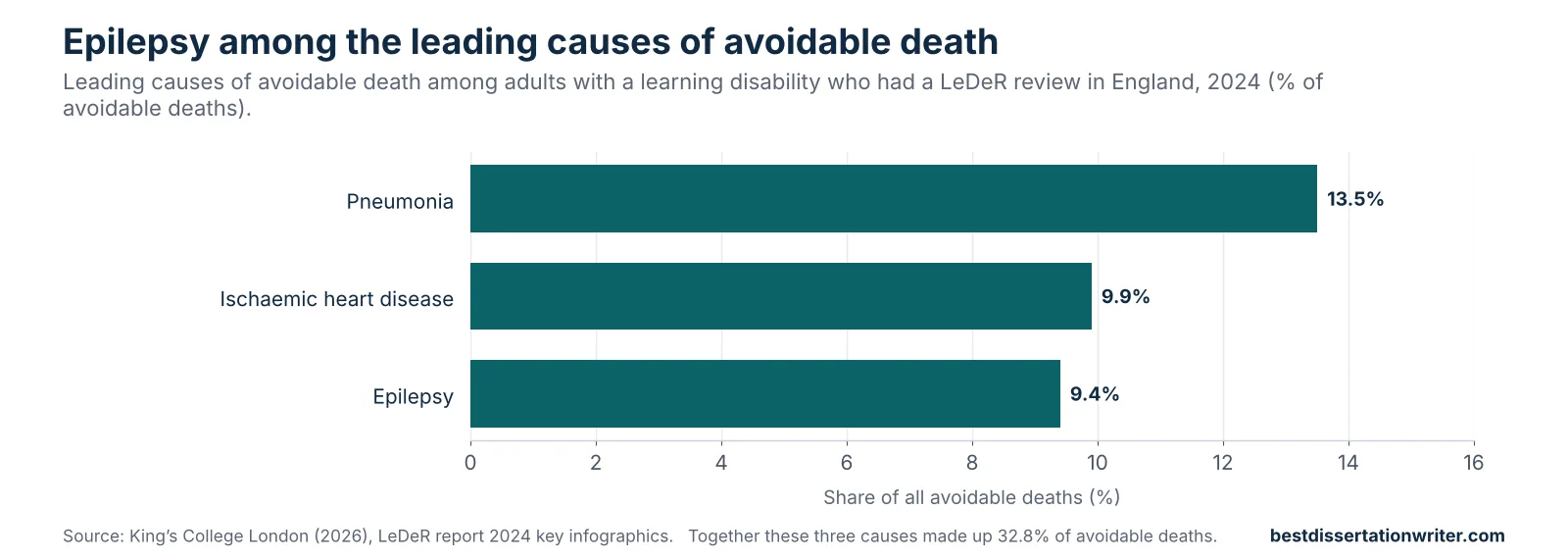
National data place these findings in context. In the 2024 LeDeR report, 39.0% of deaths of adults with a learning disability were judged avoidable, compared with 21.1% in the general population, and epilepsy was the third most common avoidable cause, accounting for 9.4% of avoidable deaths after pneumonia and ischaemic heart disease (King’s College London, 2026). Together, these studies suggest that regular review, risk assessment and coordinated care are central to epilepsy management, although observational designs cannot exclude confounding by severity of disability or health.
Theme 2: Nurse-Led and Specialist Service Models
The strongest test of nurse-led epilepsy management was the EpAID cluster randomised trial (Ring et al., 2018). Community intellectual disability teams were randomised either to use the Learning Disability Epilepsy Specialist Nurse Competency Framework or to continue usual treatment. The trial recruited 312 adults aged 18 to 65 years with an intellectual disability and epilepsy who had had at least one seizure in the previous six months, from 17 clusters. There was no significant difference in seizure severity, the primary outcome, or in any secondary outcome.
Ring et al. (2018) concluded that the framework conferred no clinical benefit over usual treatment, although it was likely to be cost-effective, mainly because support costs were lower. A subgroup analysis hinted at possible benefit for people with mild to moderate intellectual disability, but this was not significant. The intervention could not be blinded, and usual treatment varied widely between sites, so the trial compared one structured model with a range of existing practice rather than with no nursing input.
A systematic review of service responses helps to explain this finding. Robertson et al. (2017) identified 35 studies published since 1990, but none was a randomised trial or similarly robust intervention study, and overall quality was low. Access to specialist epilepsy services was inconsistent, and the authors highlighted the important role of proxies, such as families and support staff, and the need for epilepsy education for staff, carers and people with intellectual disabilities themselves.
NICE (2022) nevertheless recommends that epilepsy specialist nurses should have a central role in information, education and support, act as a point of contact for other services, and offer people whose seizures continue at least two sessions a year and a session after any emergency department visit. The guideline therefore supports specialist nursing input on the basis of expert consensus and wider evidence, while the only trial specific to this population did not show a clinical benefit.
Theme 3: Medication, Review and Seizure Management Plans
Medication is the main treatment for epilepsy, but trials rarely include people with intellectual disabilities. A Cochrane review by Jackson et al. (2015) identified 14 randomised trials with 1,116 participants. In most trials, antiepileptic drugs produced a significantly higher rate of responders, defined as a reduction in seizures of 50% or more, than placebo. However, the review could not determine which drugs were more effective than others, adverse events were inconsistently recorded and the quality of evidence was rated low to moderate.
Jackson et al. (2015) also noted that behavioural effects were small where they were measured, but most trials lacked reliable behavioural measures. For nurses, this means that changes in behaviour, sleep or alertness after a change in medication need careful observation and reporting, because trials provide little guidance. Monitoring side effects is a key part of epilepsy management in this group, and it depends on carers who know the person’s usual presentation.
The review of service responses by Robertson et al. (2017) reported wide variation in basic processes of care. Across the included studies, between 71% and 81% of people had an epilepsy review in the previous 12 months, care plans were reported for between 60% and 65% in two studies, and seizure diaries were used for between 83% and 93%. A written care plan and an agreed seizure management protocol were therefore missing for a substantial minority of people.
These findings link directly to the mortality evidence. The absence of an epilepsy review in the previous year was a risk factor for death (Sun et al., 2023), and NICE (2022) recommends at least annual review for adults with epilepsy and a learning disability. A current care plan that sets out seizure types, triggers, rescue medication, monitoring at night and when to call for help translates review findings into everyday seizure management by carers and support staff.

Discussion
This systematic review found a clear gap between the size of the problem and the strength of the intervention evidence. Epilepsy is common in people with learning disabilities and causes a large share of avoidable deaths, yet the only randomised trial of a nurse-led model found no clinical benefit over usual care (Ring et al., 2018). Evidence on epilepsy management therefore rests largely on observational studies, guidelines and expert consensus.
The negative trial result should not be over-interpreted. Usual care in EpAID was delivered by community intellectual disability teams and varied widely between sites, and the primary outcome, carer-rated seizure severity, may not capture outcomes such as safety, confidence or avoided admissions. The finding that the framework was probably cost-effective also suggests that structured nursing may change how care is delivered even when seizure outcomes are similar.
The observational studies point to features of epilepsy management that may matter more than who delivers it. Regular review, risk assessment, attention to physical health and polypharmacy, and multidisciplinary input were all associated with fewer epilepsy-related deaths (Sun et al., 2023; Shankar et al., 2026). These features are consistent with NICE (2022) recommendations, but because the studies were not randomised, people who received better care may also have differed in other ways.
There is also a tension between the protective effect of review by intellectual disability psychiatrists and the national emphasis on epilepsy specialist nurses. In practice, the two are complementary: nurses often coordinate reviews, gather seizure records and support carers, while doctors adjust treatment. The 2024 LeDeR report called for research into how epilepsy specialist nurses and pharmacists can work across community settings, which reflects continuing uncertainty about who should lead epilepsy management in the community (King’s College London, 2026).
This review has limitations. It relied on openly accessible, English-language sources, did not involve independent double screening and included only seven sources, most of them from the United Kingdom. Several figures, such as the proportion of people with a care plan, were drawn from a review that summarised older and heterogeneous studies. Future research should test nurse-led epilepsy management with longer follow-up and outcomes that matter to people and carers, including injuries, hospital admissions, quality of life and deaths.
Implications of Epilepsy Management Evidence for Practice
Learning disability nurses should ensure that every adult with epilepsy has at least an annual review, an epilepsy risk assessment and an up-to-date care plan that covers seizure description, rescue medication, night-time monitoring and when to seek emergency help. Nurses should support carers to keep accurate seizure records, observe for medication side effects and changes in behaviour, and share information between general practice, neurology and psychiatry. Accessible information and longer appointments help people to take part in decisions about their own care.
Behaviour change should prompt a review of seizures and medication before it is attributed to distress, which links epilepsy care to positive behaviour support. Seizures and sedating medicines can affect swallowing, so nurses should also be alert to dysphagia and aspiration risk. Supporting medication adherence and preventing medication administration errors, including with rescue medicines, are equally important parts of safe care.
Conclusion
This systematic review examined the evidence on nurse-led and service-level epilepsy management for adults with learning disabilities. Epilepsy causes many avoidable deaths, and observational studies link regular review, risk assessment and multidisciplinary care with lower risk, but the only trial of a nurse competency framework showed no clinical benefit over usual care, and evidence on medication is limited.
For learning disability nurses, the practical message is to make the basics reliable: annual review, an individual care plan, accurate seizure records, careful medication monitoring and close partnership with carers. Strengthening these elements of epilepsy management, while building better evidence on specialist nursing roles, offers the best current route to reducing avoidable epilepsy-related deaths.
References
Jackson, C. F., Makin, S. M., Marson, A. G., & Kerr, M. (2015). Pharmacological interventions for epilepsy in people with intellectual disabilities. Cochrane Database of Systematic Reviews, (9), CD005399. https://doi.org/10.1002/14651858.CD005399.pub3
King’s College London. (2026). LeDeR report 2024. NHS England. https://www.kcl.ac.uk/ioppn/leder/leder2024/leder-2024-report.pdf
National Institute for Health and Care Excellence. (2022). Epilepsies in children, young people and adults (NICE guideline NG217). https://www.nice.org.uk/guidance/ng217
Ring, H., Howlett, J., Pennington, M., Smith, C., Redley, M., Murphy, C., Hook, R., Platt, A., Gilbert, N., Jones, E., Kelly, J., Pullen, A., Mander, A., Donaldson, C., Rowe, S., Wason, J., & Irvine, F. (2018). Training nurses in a competency framework to support adults with epilepsy and intellectual disability: The EpAID cluster RCT. Health Technology Assessment, 22(10), 1–104. https://doi.org/10.3310/hta22100
Robertson, J., Baines, S., Emerson, E., & Hatton, C. (2017). Service responses to people with intellectual disabilities and epilepsy: A systematic review. Journal of Applied Research in Intellectual Disabilities, 30(1), 1–32. https://doi.org/10.1111/jar.12228
Shankar, R., Henley, W. E., Alauddin, S., Watkins, L. V., Tromans, S. J., Laugharne, R. A., McLean, B., & Heslop, P. (2026). Epilepsy-related premature mortality in adults with intellectual disability in England: A population-based analysis. Journal of Neurology, Neurosurgery & Psychiatry, 97(4), 325–334. https://doi.org/10.1136/jnnp-2025-337291
Sun, J. J., Watkins, L., Henley, W., Laugharne, R., Angus-Leppan, H., Sawhney, I., Shahidi, M. M., Purandare, K., Eyeoyibo, M., Scheepers, M., Lines, G., Winterhalder, R., Perera, B., Hyams, B., Ashby, S., & Shankar, R. (2023). Mortality risk in adults with intellectual disabilities and epilepsy: An England and Wales case–control study. Journal of Neurology, 270(7), 3527–3536. https://doi.org/10.1007/s00415-023-11701-6
Cite this example
Best Dissertation Writers (2026) Nurse-Led Epilepsy Management for Adults with Learning Disabilities: A Systematic Review. Available at: https://bestdissertationwriter.com/epilepsy-management-literature-review/
Best Dissertation Writers
Get expert help with your nursing literature review
Share your topic and deadline with Best Dissertation Writers and get support tailored to your module brief.