Sexual Health Education and Support for People with Learning Disabilities: A Scoping Review
 By Dr. Robertson Prime, Research Fellow
Updated October 12, 2026
15 min read
About 3,000 words
In this review
Abstract
Background: People with learning disabilities have the same rights to relationships, sexuality and sexual health as everyone else, yet access to sexual health education is often limited, late or focused mainly on risk. The United Nations Convention on the Rights of Persons with Disabilities recognises a right to age-appropriate reproductive and family planning education.
Aim: This scoping review aimed to map evidence on the content, delivery and outcomes of sexual health education and support for people with learning disabilities, and the implications for learning disability nursing.
Methods: Evidence was identified through targeted searches of openly accessible bibliographic records, publisher websites and the reference lists of key reviews. Seven sources published between 2006 and 2025 were included: four systematic reviews, one meta-analysis, one controlled trial and one international convention, appraised with CASP checklists and charted thematically.
Findings: Adults with intellectual disabilities wanted knowledge, relationships and support to express their sexuality, but described tension between autonomy and protection from harm. A meta-analysis of 31 independent studies found a moderate global effect of programmes (d 0.64) and large effects on decision making (1.03) and inappropriate behaviours (1.26). Reviews of relationships education found that people valued programmes but were rarely involved in designing them, and that 135 different outcomes had been reported, mostly knowledge-based and measured with instruments lacking established psychometric properties. A Spanish controlled trial with 99 participants improved sexual knowledge.
Conclusion: Nurses should offer accessible, rights-based education about relationships and sexual health, co-produced with people with learning disabilities and their supporters, and evaluate it with meaningful outcomes beyond knowledge.
Keywords: sexual health education, relationships education, sex and relationships education
Introduction
This scoping review critically examines recent evidence on sexual health education and its implications for learning disability nursing practice.
Relationships, intimacy and sexuality are part of everyday life for most adults. People with learning disabilities have the same wishes for friendship, love, sexual relationships and, for some, parenthood. Yet they have often been regarded as asexual, as perpetually childlike or as needing protection from sexuality altogether. As a result, many grow up with little information about their bodies, relationships, consent, contraception or sexually transmitted infections, and with few opportunities to ask questions.
A lack of sexual health education can have serious consequences. Without accessible information, people may be less able to recognise abuse, to understand consent, to protect themselves from infection or unplanned pregnancy, or to seek help. Limited knowledge can also lead to behaviour that others see as inappropriate, which may then be managed through restriction rather than education. At the same time, people may be denied the positive experiences of intimacy and relationships that others take for granted.
Learning disability nurses often support people with questions about relationships, puberty, menstruation, contraception, sexual health checks and safeguarding. They may teach individuals or groups, support families and paid staff, and work with sexual health services to make reasonable adjustments. Understanding what effective sexual health education looks like is therefore directly relevant to nursing practice, and to protecting rights as well as health.
A scoping review design was chosen because the evidence is diverse, ranging from rights frameworks and qualitative studies to meta-analysis and controlled trials, and the aim was to map its extent and gaps rather than to estimate a single effect.
Review question
What is known about the content, delivery and outcomes of sexual health education for people with learning disabilities, and what are the implications for nursing?
Background to Sexual Health Education
The United Nations (2006) Convention on the Rights of Persons with Disabilities sets out the rights of disabled people to marry and found a family on the basis of free and full consent, to decide freely and responsibly on the number and spacing of their children, and to have access to age-appropriate information, reproductive and family planning education. Article 25 requires that disabled people receive the same range and quality of health care, including in the area of sexual and reproductive health. Sexual health education is therefore a matter of rights, not a privilege.
Terminology varies. In the United Kingdom, school-based sex and relationships education was renamed relationships and sex education, and many programmes for people with learning disabilities use similar labels. International literature also refers to sexuality education, affective-sexual education and relationship and sexuality education. These terms overlap, but they share a broad focus on bodies, relationships, consent, safety and sexual health, rather than on biology alone.
People with learning disabilities may need information to be adapted. Abstract concepts, long sentences and euphemisms can be hard to understand, and learning may take longer and need repetition. Some people learn best through pictures, models, role play or real-life practice. Family carers and paid staff also influence what people learn and are allowed to do, and their own attitudes and confidence in discussing sexuality can either open or close opportunities for sexual health education.
Barriers are found at several levels. Some people with learning disabilities may leave school having received little or no sex and relationships education, for example because it was not prioritised or because they were withdrawn from lessons. Adult services may not see sexuality as part of their role, and mainstream sexual health clinics may not make reasonable adjustments. These gaps mean that many adults rely on informal sources of information, which may be inaccurate or unsafe.
Search Strategy and Methods
Evidence for this example was identified through targeted searches of openly accessible bibliographic records, publisher websites and the reference lists of key reviews. Search terms combined keywords for the population (“learning disab*”, “intellectual disab*”) with terms for the intervention and topic (“sexual health education”, “sex education”, “relationships education”, “sex and relationships education”, “sexuality”, “affective-sexual”), joined with the Boolean operators AND and OR. A full scoping review for assessment would run the same strategy in CINAHL, PubMed/MEDLINE, PsycINFO, the Cochrane Library and Embase and report the number of records screened in a PRISMA flow diagram.
Sources were eligible if they examined the views, needs, content, delivery or outcomes of sexuality, relationships or sexual health education for children, young people or adults with learning or intellectual disabilities, or set out international rights relevant to this topic. Systematic reviews, meta-analyses, controlled studies and international instruments were prioritised. Single case reports and studies focused solely on sexual abuse prevalence were excluded.
Seven sources published between 2006 and 2025 were included: four systematic reviews, one meta-analysis, one controlled trial and one international convention (Table 1). The quality of each source was appraised using the Critical Appraisal Skills Programme (CASP) checklist appropriate to its design, and findings were charted and synthesised narratively into three themes relevant to sexual health education.
Key Findings on Sexual Health Education
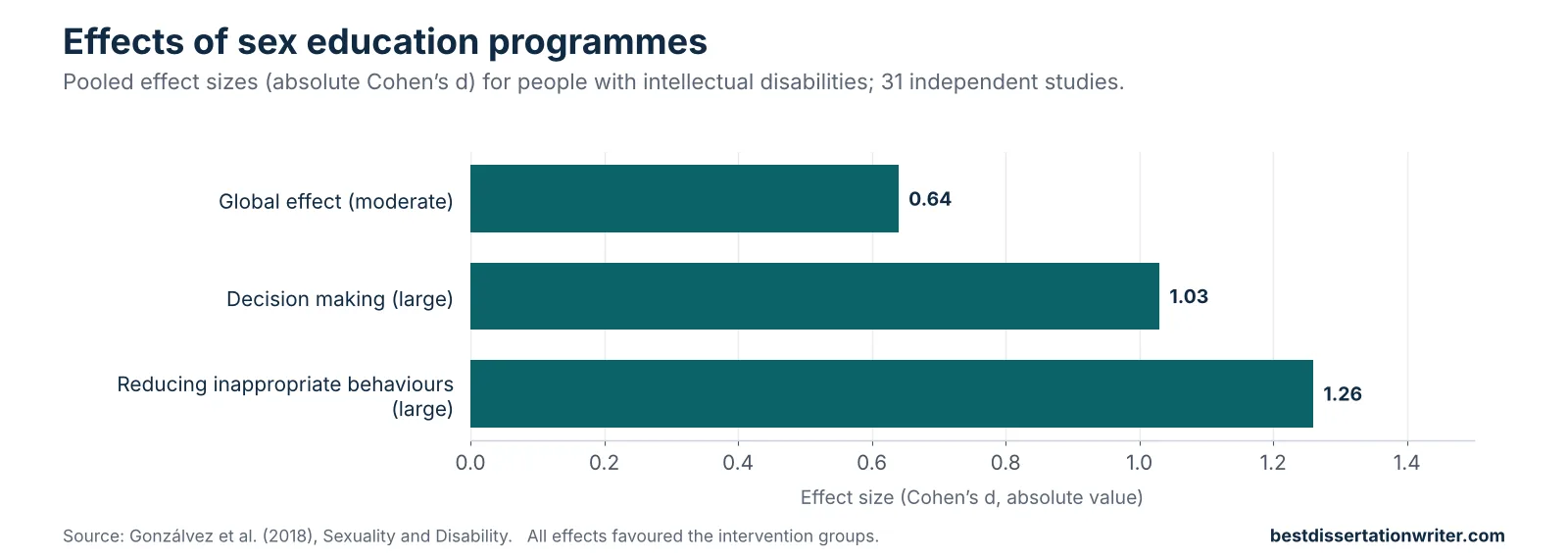
Three themes were identified: the views and needs of people with learning disabilities; the effectiveness of education programmes; and the design, delivery and evaluation of relationships education. Table 1 summarises the included sources, and Figure 1 presents pooled effect sizes for sex education programmes reported in a meta-analysis.
| Author, year | Design | Setting and sample | Key finding |
|---|---|---|---|
| United Nations (2006) | International convention | Convention on the Rights of Persons with Disabilities, Articles 23 and 25 | Right to age-appropriate information, reproductive and family planning education and to sexual and reproductive health care. |
| Brown and McCann (2018) | Systematic review | 23 papers (2006–2016) including the voices of adults with intellectual disabilities | Five themes, including autonomy versus risk of harm; adults need education and support to express their sexuality. |
| Gonzálvez et al. (2018) | Meta-analysis | 31 independent studies from 8 research reports (1988–2017) | Moderate global effect (d 0.64); large effects for inappropriate behaviours (1.26) and decision making (1.03). |
| McCann et al. (2019) | Systematic review | 8 studies of people with intellectual disabilities in education programmes | Programmes seen as helpful; little involvement in design; content focused on risk rather than intimacy. |
| Brown et al. (2020) | Systematic review | 12 studies of programme design, content and delivery | Nurses and teachers most often delivered programmes; no longitudinal evidence of impact. |
| Paulauskaite et al. (2022) | Systematic review of outcomes | 42 studies of students with intellectual disability | 135 outcomes, mostly knowledge-based; no instruments with established psychometric properties. |
| Estruch-García et al. (2025) | Controlled trial | 99 adults with moderate intellectual disabilities and 30 support staff; Spain | Saludiversex-M improved sexual knowledge compared with controls. |
Theme 1: The Views and Needs of People with Learning Disabilities
Brown and McCann (2018) systematically reviewed 23 papers published between 2006 and 2016 that included the voices of adults with intellectual disabilities about sexuality; 18 were qualitative and five quantitative. Five themes were identified: autonomy versus risk of harm, knowledge and sexuality, self-determination and taking control, relationships and intimacy, and encouragement and supports. The authors concluded that adults with intellectual disabilities need education and support to express their sexuality and meet their individual needs.
The tension between autonomy and protection is central to this evidence. People wanted relationships and control over their lives, but carers and services often prioritised safety, sometimes restricting opportunities for privacy and intimacy. Knowledge was frequently limited, and people valued encouragement from trusted supporters. Most included studies were qualitative and from high-income countries, with eight from the UK, so the findings describe experiences in depth but cannot show how common they are.
These findings suggest that sexual health education for people with learning disabilities should not be limited to facts about anatomy and risk. People also wanted to learn how to meet others, how to manage relationships and how to ask for support, and they valued being treated as adults capable of making choices. Education that ignores these wishes may be accurate but irrelevant to the lives people want to lead.
Theme 2: The Effectiveness of Sexual Health Education Programmes
Gonzálvez et al. (2018) meta-analysed 31 independent studies drawn from eight research reports published between 1988 and 2017. Effects favoured the intervention groups, with a moderate global effect (d 0.64) and large effects for reducing inappropriate behaviours (1.26) and for decision making (1.03). The global effect was moderated by single-sex groups, publication between 2000 and 2009 and the training and experience of the trainer. The small number of reports and the age of many studies limit the confidence that can be placed in these estimates.
More recent controlled evidence comes from Spain. Estruch-García et al. (2025) evaluated the Saludiversex-M affective-sexual education programme with 99 participants with moderate intellectual disabilities, using a controlled design. Knowledge about sexuality increased significantly in the intervention group compared with the control group. The 30 support staff who rated participants observed greater knowledge and reported less concern about uninhibited behaviours. However, the study measured knowledge and staff perceptions rather than long-term behaviour or relationships.
Taken together, the quantitative evidence suggests that structured sexual health education can produce meaningful short-term gains, particularly in knowledge and decision making. The moderating effect of trainer training reported by Gonzálvez et al. (2018) is especially relevant to nursing, because it implies that the skills and confidence of the educator influence outcomes. Neither source, however, showed whether gains were maintained or translated into safer or more fulfilling relationships over time.
Theme 3: Designing, Delivering and Evaluating Relationships Education
McCann et al. (2019) reviewed eight studies on the views and experiences of people with intellectual disabilities taking part in relationships education and sex education programmes. Three themes emerged: designing and developing programmes, participating in them and perceived benefits. People generally found programmes helpful, reporting improved self-esteem, sexual knowledge, decision-making and understanding of consent and safety. However, they were rarely involved in programme design, and content tended to focus on risk rather than pleasure, desire and intimacy.
Brown et al. (2020) examined the design, content and delivery of relationship and sexuality education programmes in 12 studies, nine qualitative and three quantitative. Four themes were identified: the principles informing programme development, design and content, delivery, and evaluation. Nurses and teachers were the professionals who most commonly delivered programmes. No longitudinal studies were found, so the impact of programmes on behaviour and sustained outcomes remained unknown, and only one study focused specifically on adults.
Measurement is a major gap. Paulauskaite et al. (2022) identified 135 outcomes of relationships education for students with intellectual disability across 42 studies, 43 in secondary and 92 in further education, with none in primary education. Most outcomes were knowledge-based rather than focused on skills or attitudes, and students, parents and teachers valued different outcomes. Five instruments were used, but none had established psychometric properties for this population, which makes it difficult to compare programmes or combine results.
The role of nurses in delivery is notable. Brown et al. (2020) found that nurses were among the professionals most often delivering programmes, which places them in a strong position to integrate sexual health education into wider health care. However, delivery by professionals alone may not be enough: peer educators and trusted supporters were also described as valuable, and the reviews repeatedly called for people with learning disabilities to help shape what is taught and how.
Discussion
This scoping review shows that people with learning disabilities want knowledge, relationships and support, that education programmes can improve knowledge and decision making, and that the design and evaluation of programmes remain underdeveloped. The rights framework of the United Nations (2006) and the voices captured by Brown and McCann (2018) point in the same direction: sexual health education should enable people to make informed choices, not only protect them from harm.
There is a tension between risk-focused and rights-based approaches. Programmes often emphasise abuse prevention, contraception and appropriate behaviour, which are important, but McCann et al. (2019) found that pleasure, desire and intimacy were often neglected. The large effect on inappropriate behaviours reported by Gonzálvez et al. (2018) may be welcomed by services, yet a programme judged mainly on reducing unwanted behaviour may say little about whether people enjoy fulfilling relationships.
The evidence on effectiveness is limited. The meta-analysis relied on few research reports, many of them older, and the Spanish trial measured short-term knowledge. Paulauskaite et al. (2022) showed that outcomes are inconsistent and instruments are not validated, so it is unclear whether programmes change behaviour, relationships or sexual health over time. Co-production with people with learning disabilities, recommended by McCann et al. (2019) and Brown et al. (2020), was rarely reported, which may limit how relevant programmes are to their intended audience.
Families and paid staff are central to whether learning is put into practice. Earlier sex and relationships education in schools may have been limited or absent for many adults with learning disabilities, so support in adulthood often has to fill gaps. Carers who are anxious about sexuality may restrict privacy or discourage relationships, while those who feel confident can reinforce what has been learned. Including supporters in sexual health education, while respecting the person’s confidentiality and autonomy, may therefore improve its impact.
This review has limitations. This review relied on openly accessible, English-language sources, did not involve independent double screening and included a small number of sources, several of them reviews with overlapping studies. Evidence came mainly from high-income countries, and few studies included people with severe or profound learning disabilities or lesbian, gay, bisexual and transgender people. Future research should co-produce and evaluate sexual health education using validated outcomes, longer follow-up and diverse participants.
Implications of Sexual Health Education Evidence for Practice
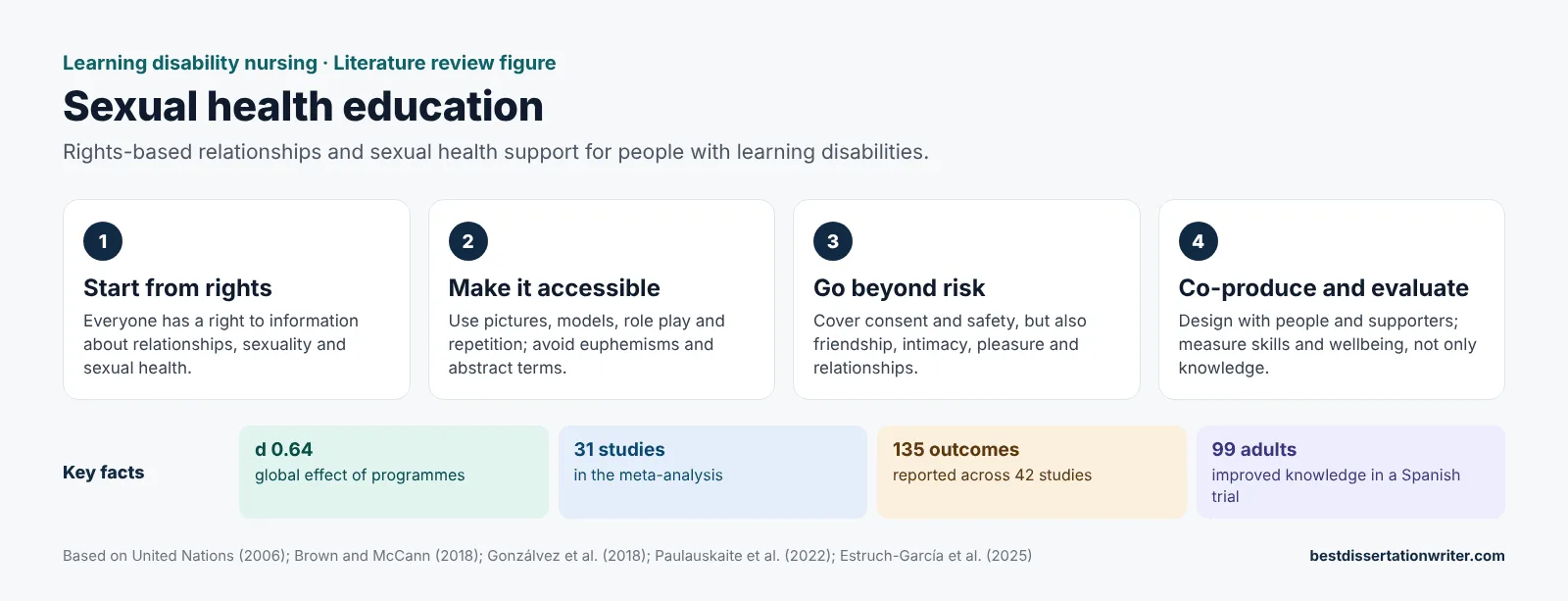
For learning disability nurses, the evidence supports offering accessible, rights-based education that covers relationships, consent, safety, contraception and sexual health, as well as intimacy and pleasure. Teaching should use pictures, models, role play and repetition, be adapted to the individual and involve trusted supporters. Nurses can also support family carers and paid staff to feel confident discussing sexuality, and work with sexual health services to make reasonable adjustments. Programmes should be co-produced and evaluated with outcomes that matter to people with learning disabilities.
Poor access to sexual health information and services contributes to health inequalities. Sexual health, contraception and cervical screening can be discussed during annual health checks, using the communication strategies that suit each person. Decisions about relationships and sexual activity also require careful attention to mental capacity, since capacity to consent to sexual relations is assessed differently from other decisions and education can help people to develop it.
Conclusion
This scoping review mapped evidence on sexual health education for people with learning disabilities. People want knowledge, relationships and support, programmes can improve knowledge and decision making, and many programmes are valued by participants. However, programmes are rarely co-produced, focus mainly on risk and are evaluated with inconsistent, unvalidated outcomes.
Learning disability nurses have an important role in providing and supporting rights-based sexual health education that enables people to enjoy safe and fulfilling relationships. Further research should develop co-produced programmes and test their long-term impact on wellbeing, relationships and sexual health.
References
Brown, M., & McCann, E. (2018). Sexuality issues and the voices of adults with intellectual disabilities: A systematic review of the literature. Research in Developmental Disabilities, 74, 124–138. https://doi.org/10.1016/j.ridd.2018.01.009
Brown, M., McCann, E., Truesdale, M., Linden, M., & Marsh, L. (2020). The design, content and delivery of relationship and sexuality education programmes for people with intellectual disabilities: A systematic review of the international evidence. International Journal of Environmental Research and Public Health, 17(20), 7568. https://doi.org/10.3390/ijerph17207568
Estruch-García, V., Gil-Llario, M. D., Fernández-García, O., & Ballester-Arnal, R. (2025). An affective-sexual education program for people with moderate intellectual disabilities: Analysis of its effectiveness in the Spanish context. Perspectives on Sexual and Reproductive Health, 57(1), 95–103. https://doi.org/10.1111/psrh.12291
Gonzálvez, C., Fernández-Sogorb, A., Sanmartín, R., Vicent, M., Granados, L., & García-Fernández, J. M. (2018). Efficacy of sex education programs for people with intellectual disabilities: A meta-analysis. Sexuality and Disability, 36(4), 331–347. https://doi.org/10.1007/s11195-018-9545-9
McCann, E., Marsh, L., & Brown, M. (2019). People with intellectual disabilities, relationship and sex education programmes: A systematic review. Health Education Journal, 78(8), 885–900. https://doi.org/10.1177/0017896919856047
Paulauskaite, L., Rivas, C., Paris, A., & Totsika, V. (2022). A systematic review of relationships and sex education outcomes for students with intellectual disability reported in the international literature. Journal of Intellectual Disability Research, 66(7), 577–616. https://doi.org/10.1111/jir.12952
United Nations. (2006). Convention on the Rights of Persons with Disabilities. https://www.ohchr.org/en/instruments-mechanisms/instruments/convention-rights-persons-disabilities
Cite this example
Best Dissertation Writers (2026) Sexual Health Education and Support for People with Learning Disabilities: A Scoping Review. Available at: https://bestdissertationwriter.com/sexual-health-education-review-review/
Best Dissertation Writers
Get expert help with your nursing literature review
Share your topic and deadline with Best Dissertation Writers and get support tailored to your module brief.