Pharmacological and Non-Pharmacological Pain Relief in Labour: A Review of Midwifery Evidence
 By Dr. Robertson Prime, Research Fellow
Updated October 12, 2026
15 min read
About 3,000 words
In this review
Abstract
Background: Pain relief in labour ranges from epidural analgesia and opioids to water immersion, relaxation and continuous support, and each option carries different benefits and trade-offs. Women’s experiences of labour pain and of the care they receive can shape how they feel about birth long afterwards.
Aim: This systematic review aimed to examine how effective pharmacological and non-pharmacological methods of labour pain management are, how women experience them, and what this means for midwifery practice.
Methods: Evidence was identified through targeted searches of openly accessible bibliographic records, publisher websites and the reference lists of key reviews. Six sources published between 2012 and 2019 were included: a Cochrane overview of reviews, four Cochrane systematic reviews and a qualitative systematic review, appraised with CASP checklists and synthesised thematically.
Findings: Across 40 trials with over 11,000 women, epidural analgesia reduced pain and increased satisfaction but was associated with more assisted vaginal births (risk ratio 1.44), with no clear difference in caesarean birth. Water immersion in the first stage reduced the use of regional analgesia (39% versus 43%), and relaxation, yoga and music may reduce pain, although certainty was low. Continuous support reduced the use of any analgesia and negative feelings about childbirth, while qualitative evidence showed that women value information, choice and supportive relationships whichever method they use.
Conclusion: Midwives should offer balanced information on all options, make water immersion and continuous support routinely available and support women’s informed choices about epidural analgesia without judgement.
Keywords: pain relief in labour, labour pain, epidural, water immersion
Introduction
This systematic review critically examines recent evidence on pain relief in labour and its implications for midwifery practice.
Labour pain is one of the most intense experiences that many women will have, and how it is managed is one of the main concerns of women preparing for birth. Women differ widely in how they experience labour pain and in what they want from pain relief. Some hope to avoid medication, others plan an epidural from the outset, and many change their minds as labour progresses. Good care therefore depends on accurate information, a range of available options and staff who respond to each woman’s changing needs.
Midwives are central to this care. They discuss options during pregnancy, offer water immersion, positions, massage and inhaled analgesia, administer opioids, care for women with an epidural and provide the continuous presence that many women value most. How midwives present the evidence can influence women’s choices, so they need a clear understanding of what each method of pain relief in labour can and cannot achieve.
A systematic approach was chosen because the evidence includes Cochrane reviews of many randomised trials as well as qualitative research. Considering both allows clinical effectiveness to be weighed alongside women’s priorities, such as control, support and satisfaction.
Review question
How effective are pharmacological and non-pharmacological methods of pain relief in labour, how do women experience them, and what are the implications for midwifery practice?
Background to Pain Relief in Labour
Methods of pain relief in labour are often divided into pharmacological and non-pharmacological approaches. Pharmacological methods include inhaled analgesia such as nitrous oxide, parenteral opioids such as pethidine, and regional analgesia, usually an epidural or combined spinal-epidural. Non-pharmacological methods include water immersion, relaxation, breathing, massage, acupuncture, hypnosis, transcutaneous electrical nerve stimulation (TENS) and the continuous presence of a supportive companion or midwife.
These approaches work in different ways. Pharmacological methods aim to reduce or remove the sensation of pain, while many non-pharmacological methods aim to help women cope with pain, feel more in control and reduce fear and tension. This difference matters when judging the evidence, because a method that does not lower pain scores may still improve a woman’s experience of birth, while a method that removes pain may bring side effects or a higher chance of intervention.
A Cochrane overview by Jones et al. (2012) brought together 15 Cochrane reviews with 255 trials and three non-Cochrane reviews with 55 trials. It grouped methods into those that work, those that may work and those with insufficient evidence. Epidural analgesia, combined spinal-epidural and inhaled analgesia were judged effective; water immersion, relaxation, acupuncture, massage and local anaesthetic nerve blocks may work; and there was insufficient evidence for hypnosis, biofeedback, sterile water injection, aromatherapy, TENS and parenteral opioids.
The overview also showed gaps in the evidence. Parenteral opioids were less effective than epidurals, more women receiving pethidine than other opioids had side effects such as drowsiness and nausea, and only two of 57 opioid trials reported breastfeeding outcomes. Such gaps mean that some commonly used methods of pain relief in labour have a weaker evidence base than their routine use might suggest.
Search Strategy and Methods
Evidence for this example was identified through targeted searches of openly accessible bibliographic records, publisher websites and the reference lists of key reviews. Search terms combined keywords for the topic (“pain relief in labour”, “labour pain”, “analgesia”, “intrapartum”) with terms for interventions (“epidural”, “opioid”, “water immersion”, “relaxation”, “continuous support”, “midwi*”), joined with the Boolean operators AND and OR. A full systematic review for assessment would run the same strategy in CINAHL, MIDIRS, PubMed/MEDLINE, the Cochrane Library and Embase and report the number of records screened in a PRISMA flow diagram.
Sources were eligible if they evaluated pharmacological or non-pharmacological pain relief in labour for women giving birth at term, or explored women’s experiences of these methods. Cochrane reviews and systematic reviews were prioritised because they summarise many trials. Studies of analgesia for caesarean birth or for pain after birth were excluded.
Six sources published between 2012 and 2019 were included: a Cochrane overview of systematic reviews, four Cochrane systematic reviews and a qualitative systematic review (Table 1). The quality of each source was appraised using the Critical Appraisal Skills Programme (CASP) checklist appropriate to its design, and findings were synthesised narratively and grouped into themes.
Key Findings on Pain Relief in Labour
Three themes were identified: the effectiveness and trade-offs of epidural analgesia, the role of water immersion and relaxation-based methods, and continuous support and women’s experiences of pain relief in labour. Table 1 summarises the included sources, and Figure 1 presents the pooled effects of epidural analgesia on birth and neonatal outcomes.
| Author, year | Design | Setting and sample | Key finding |
|---|---|---|---|
| Jones et al. (2012) | Cochrane overview of systematic reviews | 15 Cochrane reviews (255 trials) and 3 non-Cochrane reviews (55 trials) | Epidurals, combined spinal-epidural and inhaled analgesia effective; water immersion, relaxation, massage and acupuncture may work. |
| Bohren et al. (2017) | Cochrane systematic review | 27 trials; 26 with data from 15,858 women in 17 countries | Continuous support reduced any analgesia use (RR 0.90) and negative feelings about birth (RR 0.69). |
| Anim-Somuah et al. (2018) | Cochrane systematic review | 40 trials, over 11,000 women | Epidurals reduced pain but increased assisted vaginal birth (RR 1.44); no clear difference in caesarean birth. |
| Cluett et al. (2018) | Cochrane systematic review | 15 trials, 3,663 women in hospital labour wards | First-stage water immersion reduced regional analgesia use (RR 0.91) with no evidence of increased harm. |
| Smith et al. (2018) | Cochrane systematic review | 19 studies, 2,519 women | Relaxation, yoga and music may reduce pain, mainly in early labour; low to very low certainty. |
| Thomson et al. (2019) | Qualitative systematic review | 24 studies from upper-middle and high-income countries | Experiences were mixed; women need clear information on benefits and risks of all methods. |
Theme 1: Epidural Analgesia as Pain Relief in Labour
Anim-Somuah et al. (2018) updated the Cochrane review of epidural versus non-epidural or no analgesia, including 40 trials with over 11,000 women. Compared with opioids, epidural analgesia lowered pain scores (standardised mean difference −2.64, 95% CI −4.56 to −0.73; five trials, 1,133 women), increased the number of women rating their pain relief as excellent or very good (risk ratio 1.47, 95% CI 1.03 to 2.08) and greatly reduced the need for additional pain relief (risk ratio 0.10, 95% CI 0.04 to 0.25).
Epidural analgesia was, however, associated with more assisted vaginal births (30 trials, 9,948 women; risk ratio 1.44, 95% CI 1.29 to 1.60). A post hoc analysis restricted to trials conducted after 2005 found no clear difference (risk ratio 1.19, 95% CI 0.97 to 1.46). There was no clear difference in caesarean birth, long-term backache, admission to neonatal intensive care or low Apgar scores, but women with an epidural had more hypotension, motor blockade, fever and urinary retention, and longer first and second stages of labour.
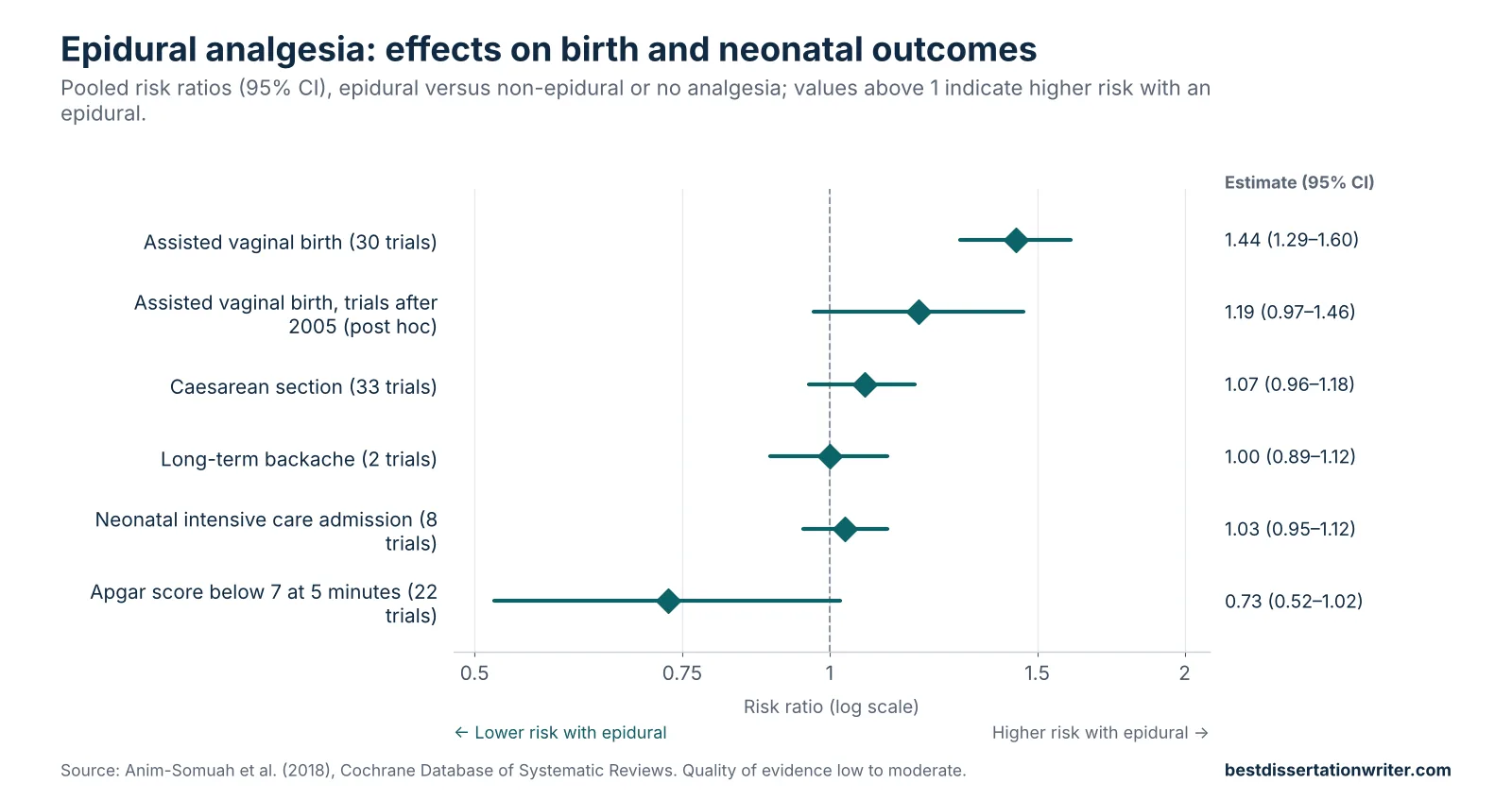
These findings support epidural analgesia as the most effective method for reducing labour pain, while showing that it is not without consequences. Much of the evidence was of low quality, and the comparisons for pain and satisfaction were mainly with opioids rather than with no analgesia, so the results say less about how epidurals compare with non-pharmacological methods. For midwives, the important message is that women can be told honestly that an epidural is very effective, that it may increase the chance of an assisted birth and that it does not appear to increase caesarean birth.
Theme 2: Water Immersion and Relaxation-Based Methods
Water immersion is a midwife-led method that many women find attractive. In a Cochrane review of 15 trials with 3,663 women, Cluett et al. (2018) found that immersion during the first stage of labour reduced the use of regional analgesia (39% versus 43%; risk ratio 0.91, 95% CI 0.83 to 0.99; moderate certainty). Immersion probably had little effect on spontaneous vaginal birth, instrumental birth, caesarean birth or severe perineal trauma, and there was no evidence of increased harm to women or babies.
The review had important limitations. All trials took place in hospital labour wards, none was set in midwifery-led care, and the abstract did not report pain scores. Evidence for immersion during the second stage, and therefore for birth in water, was limited to small trials with no clear differences. Even so, a modest reduction in epidural use without evidence of harm supports offering water immersion as a routine option for women at low risk of complications.
Smith et al. (2018) reviewed relaxation techniques in 19 studies involving 2,519 women. Relaxation reduced pain in the latent phase in one trial (mean difference −1.25 on a 0–10 scale), yoga reduced pain and increased satisfaction with pain relief in one small trial, and music reduced pain in the latent phase in two trials (mean difference −0.73). There was no strong evidence of benefit in the active phase. The certainty of evidence was low to very low, but these methods are low risk and may help women cope in early labour, when many are at home. They are best seen as part of a wider approach to pain relief in labour rather than as alternatives to medication.
Theme 3: Continuous Support and Women’s Experiences
The presence of a supportive person throughout labour influences both pain relief and the experience of birth. In a Cochrane review of 27 trials, of which 26 with 15,858 women in 17 countries provided data, Bohren et al. (2017) found that women who received continuous support were more likely to have a spontaneous vaginal birth (risk ratio 1.08, 95% CI 1.04 to 1.12) and less likely to use any intrapartum analgesia (risk ratio 0.90, 95% CI 0.84 to 0.96), to have a caesarean birth (risk ratio 0.75, 95% CI 0.64 to 0.88) or to report negative feelings about childbirth (risk ratio 0.69, 95% CI 0.59 to 0.79).
Labours were also shorter by a mean of 0.69 hours. All of these outcomes were rated as low-quality evidence, and support was provided by different people, including hospital staff, doulas and companions chosen by the woman. Nevertheless, the consistent benefits suggest that one-to-one support is an important part of pain relief in labour, not an optional addition to it, and that it reduces the need for analgesia without the side effects of medication.
Thomson et al. (2019) synthesised 24 qualitative studies of women’s experiences of epidurals, opioids, relaxation and massage, all from upper-middle or high-income countries. Five themes emerged: desires for pain relief, impact on pain, the influence and experience of support, the influence on focus and capabilities, and the impact on wellbeing and health. Experiences were mixed. Medication could reduce pain but caused side effects, whereas non-pharmacological methods might not reduce pain but helped women connect with staff and birth companions. The authors concluded that women need clear information about the benefits and risks of every option.
Discussion
This review shows that there is no single best method of pain relief in labour. Epidural analgesia is the most effective way to reduce pain but brings a higher chance of assisted vaginal birth and side effects such as motor blockade and fever. Water immersion and continuous support reduce the use of analgesia with no evidence of harm, while relaxation-based methods may help in early labour. Women’s accounts show that each method is judged by how it fits with their hopes, their sense of control and the support around them.
There is a tension between measuring success by pain scores and by women’s experiences. Trials usually measure pain intensity, mode of birth and analgesia use, whereas the qualitative evidence suggests that women also value being informed, involved and accompanied. A woman who has an epidural after a long labour, with good support, may feel more positive than one who avoids medication but feels unsupported. Midwives should therefore avoid presenting non-pharmacological methods as superior or epidurals as a failure.
The evidence also has important weaknesses. Many trials were small and could not be blinded, and certainty was often rated low or very low. The finding on assisted birth changed when only more recent trials were analysed, which suggests that results may depend on how epidurals are delivered, and evidence on water immersion came from hospital settings rather than midwifery-led units. The overview by Jones et al. (2012) is now more than a decade old, so its conclusions about methods with insufficient evidence may have changed as new trials have been published.
Women’s choices about pain relief in labour are also shaped by the way options are framed. Describing methods as natural or medical, or implying that coping without analgesia is an achievement, can leave women who use an epidural feeling that they have failed. The qualitative evidence suggests that what matters is whether women felt informed and supported, and that methods are judged against their own hopes. Midwives therefore need to present the trial evidence neutrally and let each woman weigh it against her own values and preferences for pain relief in labour.
Organisational factors influence what women can actually choose. Access to an anaesthetist, the availability of birth pools and staffing levels that allow one-to-one care all vary between services. Where these resources are limited, women’s choices about labour pain may be shaped more by what is available than by their preferences or the evidence. Information given in pregnancy should therefore be honest about local services as well as about effectiveness.
This review has limitations. It relied on openly accessible, English-language sources, did not involve independent double screening and included a small number of sources, several of which were reviews with overlapping trials. Future research should compare methods in midwifery-led settings, report women’s satisfaction and sense of control as core outcomes, examine effects on breastfeeding and test how best to provide balanced information during pregnancy.
Implications of Pain Relief in Labour Evidence for Practice
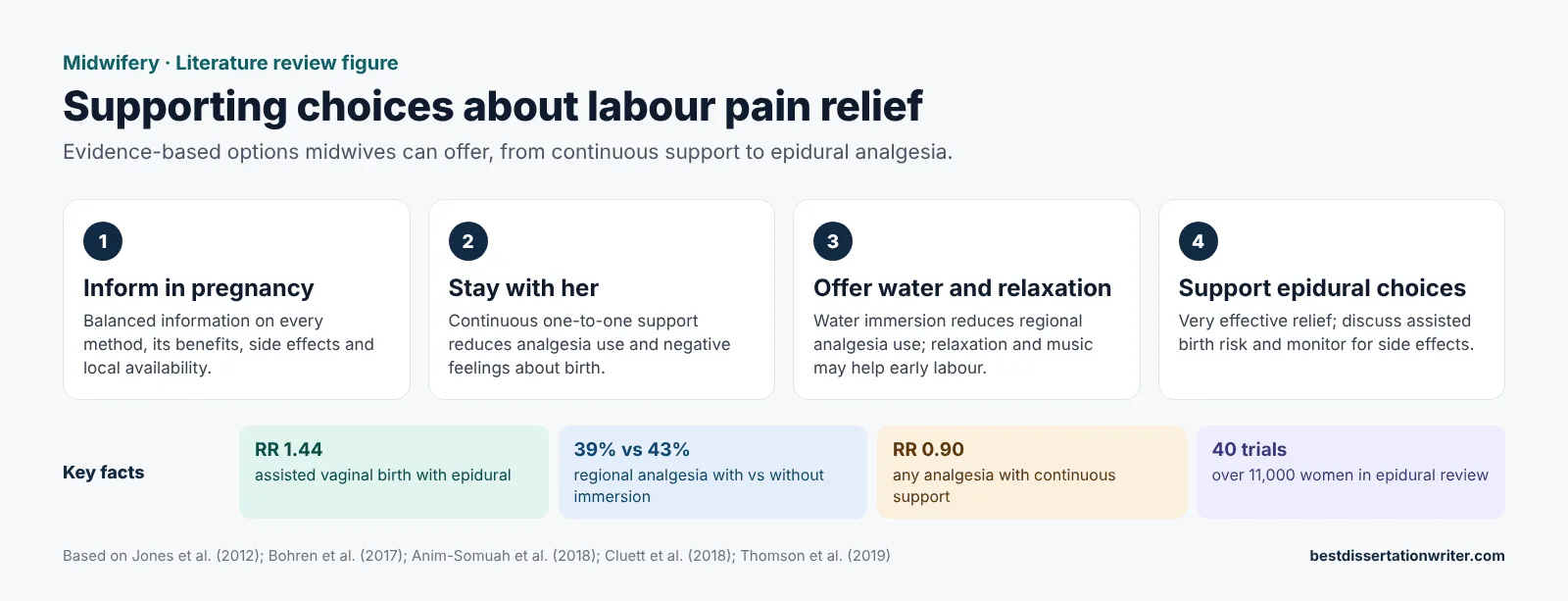
For midwives, the evidence supports giving every woman balanced information during pregnancy about all methods, including their benefits, side effects and effects on the chance of assisted birth, and revisiting choices as labour progresses. Water immersion, positions, relaxation and continuous one-to-one support should be routinely available, and women who request an epidural should be supported to have one without judgement. Discussing pain early is also important for women with fear of childbirth, so that worries can be explored well before labour, and these conversations can be built into antenatal education.
Plans should also account for each woman’s clinical situation. Women with conditions such as gestational diabetes may need additional monitoring during labour, which can affect which options are practical, and their midwives should discuss this in advance. Because only two of 57 opioid trials reported breastfeeding outcomes, the effects of labour analgesia on feeding remain uncertain, and midwives should support breastfeeding initiation attentively after every type of pain relief in labour.
Conclusion
This systematic review examined pharmacological and non-pharmacological pain relief in labour. Epidural analgesia gives the most effective relief but increases assisted vaginal birth, water immersion reduces the use of regional analgesia, relaxation-based methods may help in early labour, and continuous support reduces analgesia use and negative feelings about birth, although much of the evidence is of low certainty.
Midwives can improve women’s experiences of pain relief in labour by giving honest, balanced information, offering a full range of options, providing continuous support and respecting women’s choices as labour unfolds.
References
Anim-Somuah, M., Smyth, R. M. D., Cyna, A. M., & Cuthbert, A. (2018). Epidural versus non-epidural or no analgesia for pain management in labour. Cochrane Database of Systematic Reviews, (5), CD000331. https://doi.org/10.1002/14651858.CD000331.pub4
Bohren, M. A., Hofmeyr, G. J., Sakala, C., Fukuzawa, R. K., & Cuthbert, A. (2017). Continuous support for women during childbirth. Cochrane Database of Systematic Reviews, (7), CD003766. https://doi.org/10.1002/14651858.CD003766.pub6
Cluett, E. R., Burns, E., & Cuthbert, A. (2018). Immersion in water during labour and birth. Cochrane Database of Systematic Reviews, (5), CD000111. https://doi.org/10.1002/14651858.CD000111.pub4
Jones, L., Othman, M., Dowswell, T., Alfirevic, Z., Gates, S., Newburn, M., Jordan, S., Lavender, T., & Neilson, J. P. (2012). Pain management for women in labour: An overview of systematic reviews. Cochrane Database of Systematic Reviews, (3), CD009234. https://doi.org/10.1002/14651858.CD009234.pub2
Smith, C. A., Levett, K. M., Collins, C. T., Armour, M., Dahlen, H. G., & Suganuma, M. (2018). Relaxation techniques for pain management in labour. Cochrane Database of Systematic Reviews, (3), CD009514. https://doi.org/10.1002/14651858.CD009514.pub2
Thomson, G., Feeley, C., Moran, V. H., Downe, S., & Oladapo, O. T. (2019). Women’s experiences of pharmacological and non-pharmacological pain relief methods for labour and childbirth: A qualitative systematic review. Reproductive Health, 16, 71. https://doi.org/10.1186/s12978-019-0735-4
Cite this example
Best Dissertation Writers (2026) Pharmacological and Non-Pharmacological Pain Relief in Labour: A Review of Midwifery Evidence. Available at: https://bestdissertationwriter.com/pain-relief-in-labour-literature-review/
Best Dissertation Writers
Get expert help with your nursing literature review
Share your topic and deadline with Best Dissertation Writers and get support tailored to your module brief.