Midwifery Interventions to Support Breastfeeding Initiation and Duration: A Systematic Review
 By Dr. Robertson Prime, Research Fellow
Updated October 12, 2026
15 min read
About 2,900 words
By Dr. Robertson Prime, Research Fellow
Updated October 12, 2026
15 min read
About 2,900 words
In this review
Abstract
Background: Breastfeeding initiation is the first step towards the health benefits of breastfeeding for infants and mothers, yet many women who start to breastfeed stop earlier than they intended. A Lancet series estimated that scaling up breastfeeding to near-universal levels could prevent about 823,000 child deaths and about 20,000 deaths from breast cancer each year.
Aim: This systematic review aimed to examine which midwifery interventions support women to start breastfeeding and continue for longer, and what this means for midwifery practice.
Methods: Evidence was identified through targeted searches of openly accessible bibliographic records, publisher websites and the reference lists of key reviews. Six sources published between 2011 and 2022 were included: four systematic reviews (three Cochrane reviews), a qualitative metasynthesis and an evidence review from a Lancet series, appraised with CASP checklists and synthesised thematically.
Findings: Health professional-led education increased the number of women who started breastfeeding (risk ratio 1.43), as did lay and peer counselling (risk ratio 1.22), although the evidence was of low certainty. Early skin-to-skin contact increased successful first breastfeeds and exclusive breastfeeding up to one month, and exposure to more Baby-Friendly steps showed a dose–response relationship with better outcomes. Across 116 trials, breastfeeding support reduced the risk of stopping exclusive breastfeeding at six months (risk ratio 0.90), and women valued support that was relational, continuous and skilled.
Conclusion: Midwives should combine antenatal information, uninterrupted skin-to-skin contact and skilled, predictable postnatal support. Services should link hospital care to community support so that early gains in initiation are sustained.
Keywords: breastfeeding initiation, skilled support, exclusive breastfeeding
Introduction
This systematic review critically examines recent evidence on breastfeeding initiation and its implications for midwifery practice.
Breastfeeding protects infants against infection and supports their long-term health, and it also benefits the women who breastfeed. International and national policies therefore promote breastfeeding initiation soon after birth and encourage women to continue, ideally with exclusive breastfeeding for the first six months. In practice, many women stop much earlier than they had planned, often in the first weeks after birth when problems with attachment, pain or perceived milk supply are common and professional contact is limited.
Midwives are present at the moment when breastfeeding begins. They provide antenatal information, support the first feed in the birth room, help with positioning and attachment on the postnatal ward and at home, and decide when women are referred for specialist help. The quality and timing of this skilled support may influence whether a woman starts to breastfeed at all and whether she is still breastfeeding when midwifery care ends. Breastfeeding initiation is therefore a practical test of how well maternity services translate policy into everyday care.
A systematic approach was chosen because the evidence includes Cochrane reviews of randomised trials, a large systematic review of the Baby-Friendly Hospital Initiative and qualitative research on women’s experiences. Bringing these together allows the effectiveness of interventions to be judged alongside what women say makes support helpful.
Review question
Which midwifery interventions support women to start breastfeeding and continue for longer, and what are the implications for midwifery practice?
Background to Breastfeeding Initiation
The case for breastfeeding was set out in the Lancet Breastfeeding Series. Victora et al. (2016) reported that only 37% of infants younger than six months in low- and middle-income countries were exclusively breastfed, and that breastfeeding duration was generally shorter in high-income countries. Their meta-analyses found protection against child infections and malocclusion and higher intelligence, together with protection against breast cancer for women who breastfeed. They estimated that scaling up breastfeeding to near-universal levels could prevent about 823,000 child deaths and about 20,000 breast cancer deaths each year.
Breastfeeding initiation describes whether an infant is put to the breast or receives breast milk at all, and early initiation usually refers to breastfeeding within the first hour after birth. These measures differ from continuation and exclusivity, which describe whether and how a woman is still breastfeeding weeks or months later. The distinction matters for this review, because interventions that help women start may not be enough to help them continue, and outcome definitions differ between trials.
The Baby-Friendly Hospital Initiative, launched by the World Health Organization and UNICEF, sets out ten steps for maternity facilities. These include supporting early contact between mother and baby, supporting breastfeeding initiation soon after birth, keeping mothers and babies together and linking women to community support after discharge. Many of these steps are delivered directly by midwives, so the evidence on the initiative is highly relevant to midwifery practice.
Support for breastfeeding can be provided by health professionals, such as midwives, health visitors and lactation consultants, or by trained lay and peer supporters. It can be delivered face to face or by telephone, to individuals or groups, and before or after birth. This variety makes it difficult to identify a single best model and explains why the reviews included here group interventions in broad categories.
Search Strategy and Methods
Evidence for this example was identified through targeted searches of openly accessible bibliographic records, publisher websites and the reference lists of key reviews. Search terms combined keywords for the outcome (“breastfeeding initiation”, “early initiation”, “exclusive breastfeeding”, “breastfeeding duration”) with terms for interventions and population (“support”, “education”, “peer”, “skin-to-skin”, “Baby-Friendly”, “midwi*”, “postnatal”), joined with the Boolean operators AND and OR. A full systematic review for assessment would run the same strategy in CINAHL, MIDIRS, PubMed/MEDLINE, the Cochrane Library and Embase and report the number of records screened in a PRISMA flow diagram.
Sources were eligible if they evaluated interventions to promote breastfeeding initiation, continuation or exclusivity among healthy women and term infants, or explored women’s experiences of breastfeeding support. Systematic reviews and Cochrane reviews were prioritised because they summarise many trials, and a qualitative metasynthesis was included to capture women’s perspectives. Studies limited to preterm or unwell infants were excluded because their feeding needs differ.
Six sources published between 2011 and 2022 were included: three Cochrane systematic reviews, a systematic review of the Baby-Friendly Hospital Initiative, a qualitative metasynthesis and an evidence review from the Lancet Breastfeeding Series (Table 1). The quality of each source was appraised using the Critical Appraisal Skills Programme (CASP) checklist appropriate to its design, and findings were synthesised narratively and grouped into themes relating to breastfeeding initiation and continuation.
Key Findings on Breastfeeding Initiation
Three themes were identified: education and counselling to increase breastfeeding initiation, care around birth including skin-to-skin contact and Baby-Friendly practices, and skilled support to sustain breastfeeding after the early days. Table 1 summarises the included sources, and Figure 1 presents pooled effects of education, counselling and skin-to-skin contact on breastfeeding initiation and early breastfeeding outcomes.
| Author, year | Design | Setting and sample | Key finding |
|---|---|---|---|
| Schmied et al. (2011) | Qualitative metasynthesis | 31 studies of women’s experiences of peer and professional support | Authentic presence and facilitative, person-centred support were helpful; disconnected, technique-focused encounters were not. |
| Balogun et al. (2016) | Cochrane systematic review | 28 RCTs, 107,362 women, seven countries | Professional-led education (RR 1.43) and lay counselling (RR 1.22) increased initiation; low certainty. |
| Moore et al. (2016) | Cochrane systematic review | 46 trials; 38 trials (3,472 women and infants) with data | Skin-to-skin contact increased successful first breastfeeds (RR 1.32) and exclusive breastfeeding to one month (RR 1.30). |
| Pérez-Escamilla et al. (2016) | Systematic review | 58 reports from 19 countries on the Baby-Friendly Hospital Initiative | Dose–response between Baby-Friendly steps and outcomes including early initiation; community support essential. |
| Victora et al. (2016) | Evidence review and meta-analyses (Lancet series) | Global data on breastfeeding practices and outcomes | Near-universal breastfeeding could prevent about 823,000 child deaths and 20,000 breast cancer deaths a year. |
| Gavine et al. (2022) | Cochrane systematic review | 116 trials, more than 98,816 mother–infant pairs | Support reduced stopping exclusive breastfeeding at six months (RR 0.90); moderate certainty. |
Theme 1: Education and Counselling to Increase Breastfeeding Initiation
The Cochrane review by Balogun et al. (2016) is the most direct evidence on interventions to increase breastfeeding initiation. It included 28 randomised trials involving 107,362 women in seven countries. Compared with standard care, health professional-led breastfeeding education and support increased the number of women who started breastfeeding (five trials, 564 women; risk ratio 1.43, 95% CI 1.07 to 1.92). Counselling and support led by non-health professionals, such as peer counsellors, also increased initiation (eight trials, 5,712 women; risk ratio 1.22, 95% CI 1.06 to 1.40).
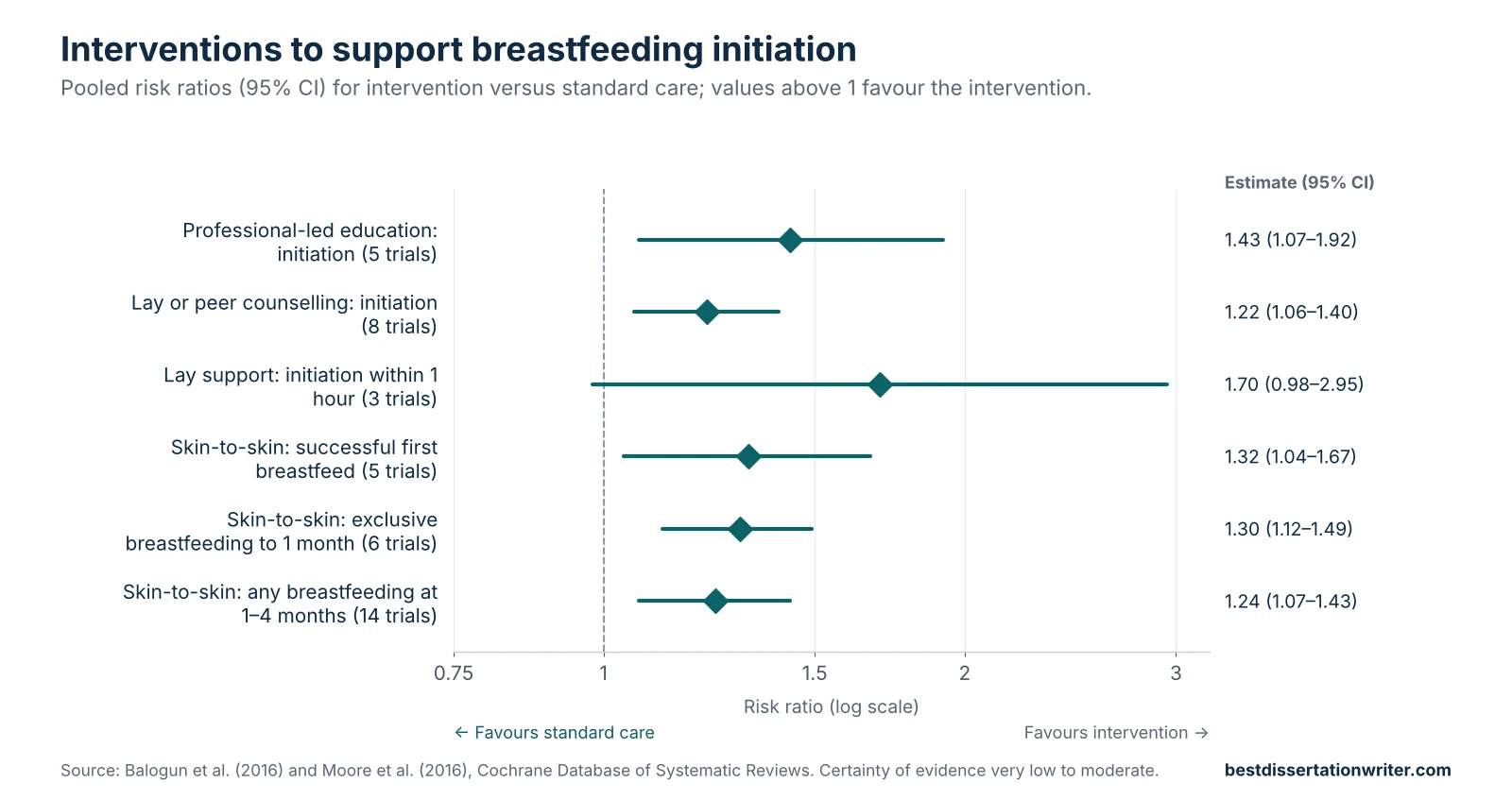
The certainty of both findings was rated low, and the effect of lay support on early initiation within one hour was uncertain (three trials, 76,373 women; risk ratio 1.70, 95% CI 0.98 to 2.95). Other comparisons, including multimedia education, early mother–infant contact and community breastfeeding groups, showed no clear difference in initiation. The authors noted that most trials were conducted in the United States among low-income women of varied ethnicity and feeding intention, which limits how far the results can be applied to the United Kingdom and other settings.
These findings suggest that contact with a knowledgeable person, whether a midwife or a trained peer, makes a modest difference to whether women start breastfeeding. Leaflets or videos alone did not show the same effect. For midwives, the message is that antenatal conversations about feeding are worth having, but they are most likely to influence decisions when they are personal, responsive to a woman’s questions and linked to practical help after birth.
Theme 2: Skin-to-Skin Contact and Baby-Friendly Care Around Birth
Care in the first hours after birth shapes the start of breastfeeding. In a Cochrane review of 46 trials, of which 38 trials with 3,472 women and infants contributed data, Moore et al. (2016) found that early skin-to-skin contact increased breastfeeding at one to four months (risk ratio 1.24, 95% CI 1.07 to 1.43), exclusive breastfeeding from discharge to one month (risk ratio 1.30, 95% CI 1.12 to 1.49) and exclusive breastfeeding at six weeks to six months (risk ratio 1.50, 95% CI 1.18 to 1.90), with moderate-certainty evidence for these outcomes.
Skin-to-skin contact also increased the number of successful first breastfeeds (five trials, 575 women; risk ratio 1.32, 95% CI 1.04 to 1.67), although heterogeneity between these trials was high. A sensitivity analysis found that skin-to-skin contact was associated with a longer mean duration of breastfeeding of 64 days, based on low-certainty evidence from six trials. Because skin-to-skin contact is low cost and can be offered after most births, these findings give midwives a simple and strongly supported way to promote breastfeeding initiation.
The wider organisation of maternity care also matters. In a systematic review of 58 reports from 19 countries, Pérez-Escamilla et al. (2016) found a dose–response relationship between the number of Baby-Friendly steps that women were exposed to and the likelihood of better outcomes, including early initiation, exclusive breastfeeding at hospital discharge, any breastfeeding and the duration of exclusive breastfeeding. The authors concluded that community support, the tenth step, appears essential for sustaining the benefits of the initiative in the longer term. Most included reports were quasi-experimental, cohort or cross-sectional rather than randomised, which weakens causal conclusions.
Theme 3: Skilled Support to Sustain Breastfeeding
Starting to breastfeed does not guarantee that breastfeeding will continue. The most recent Cochrane review of support for healthy breastfeeding mothers included 116 trials with more than 98,816 mother–infant pairs (Gavine et al., 2022). Breastfeeding-only support reduced the risk of stopping any breastfeeding at six months (risk ratio 0.93, 95% CI 0.89 to 0.97) and of stopping exclusive breastfeeding at six months (risk ratio 0.90, 95% CI 0.88 to 0.93), and reduced the risk of stopping exclusive breastfeeding at four to six weeks (risk ratio 0.83, 95% CI 0.76 to 0.90). The certainty of evidence for breastfeeding-only support was moderate.
These effects are modest for individual women but meaningful across a population, and they show that skilled support works best when it continues beyond breastfeeding initiation and the first days. The review included support from both professionals and lay supporters, delivered face to face, by telephone or digitally, so it cannot identify a single preferred model. Nevertheless, it supports the principle that every woman should be offered breastfeeding support as part of routine maternity care rather than only when problems arise.
Qualitative evidence helps to explain why some support works better than other support. In a metasynthesis of 31 studies, Schmied et al. (2011) found that women’s experiences ranged from an “authentic presence”, which they found effective, to disconnected encounters, which were unhelpful or even counterproductive. A facilitative approach, built on person-centred communication and relationships, was experienced as helpful, whereas a reductionist approach focused on technique was not. The authors suggested that models offering continuity of carer, such as continuity of midwifery care or peer support, make an authentic presence more likely.
Discussion
Taken together, the evidence suggests that breastfeeding initiation can be increased modestly by education and counselling from midwives or trained peers and by early skin-to-skin contact, and that ongoing skilled support helps women to continue breastfeeding and to breastfeed exclusively for longer. The findings are consistent across different types of evidence, from randomised trials to observational studies of whole hospital systems and qualitative accounts of women’s experiences.
There is, however, a tension between initiation and continuation. Interventions that focus on the birth and the first feed may produce gains that are lost after discharge if community support is weak. The dose–response relationship reported by Pérez-Escamilla et al. (2016), and their emphasis on community support, suggest that initiation should be seen as the first part of a continuous pathway rather than as an outcome in its own right. Measuring breastfeeding initiation alone may therefore give an overly positive picture of service performance.
The quality of the evidence also limits confidence. Balogun et al. (2016) rated their main findings as low certainty, and many trials were small, could not blind participants and used different definitions of breastfeeding initiation. Much of the evidence on initiation came from the United States, while the qualitative evidence came mainly from high-income countries. The Baby-Friendly evidence relied heavily on non-randomised designs, which are vulnerable to confounding because hospitals that adopt the initiative may differ in other ways.
The qualitative findings raise an important point about how support is delivered. Women valued relationships, time and consistency, yet postnatal care is often short, busy and provided by different staff at each contact. Conflicting advice and rushed, technique-focused help may undermine confidence even when the information is correct. This suggests that service design, staffing and continuity are as important as the content of breastfeeding education.
This review has limitations. It relied on openly accessible, English-language sources, did not involve independent double screening and included a small number of sources, so relevant studies may have been missed. Several sources were reviews whose included trials overlapped. Future research should use consistent definitions of breastfeeding initiation, test models of continuous midwifery and peer support in the United Kingdom and in disadvantaged groups, and follow women for long enough to show whether gains in initiation last.
Implications of Breastfeeding Initiation Evidence for Practice
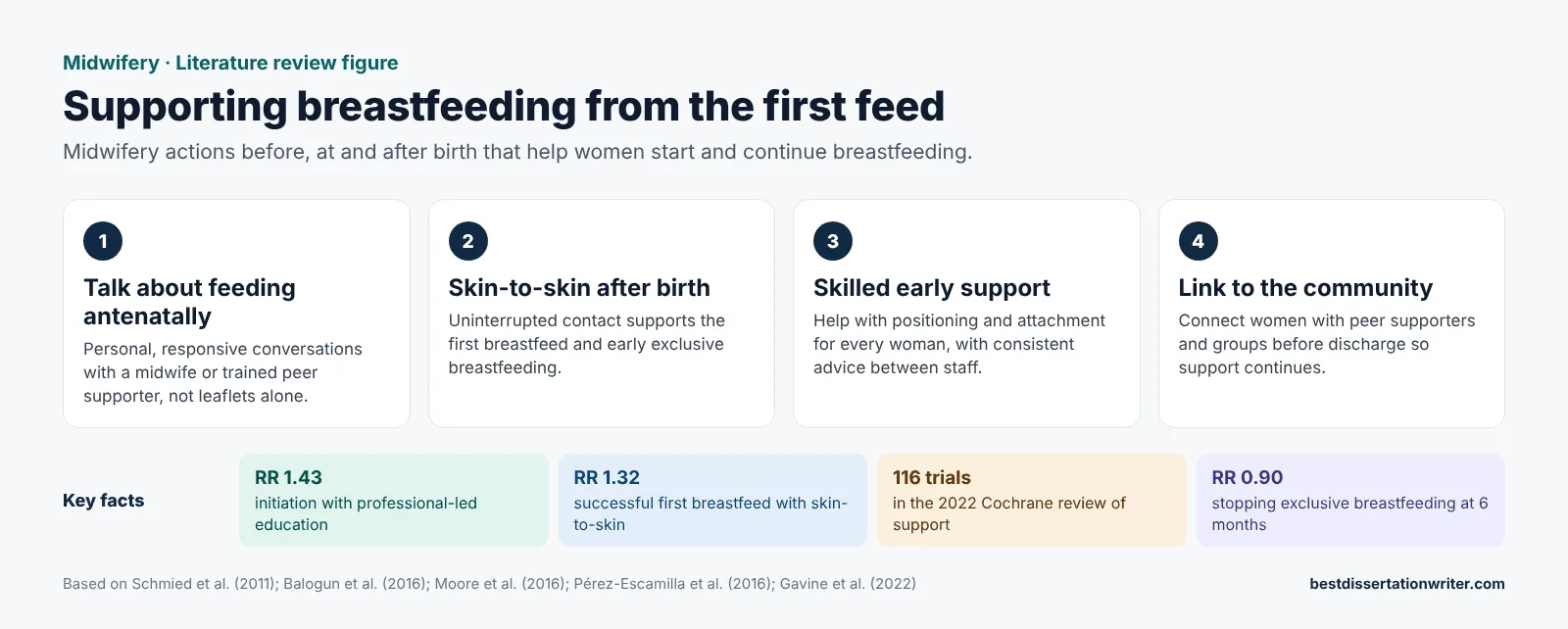
For midwives, the evidence supports discussing infant feeding during pregnancy in a personal and responsive way, offering uninterrupted skin-to-skin contact after birth, supporting the first breastfeed and keeping mothers and babies together. Skilled support with positioning and attachment should be offered to every woman in the early days, and women should be linked to peer supporters or community groups before discharge so that help continues at home. Midwives should record feeding plans clearly so that advice is consistent between staff, and recognise that experiences of birth, including pain relief in labour and fear of childbirth, can affect how confident women feel when they start to feed.
The findings also support organisational change. Services can make early skin-to-skin contact the default after vaginal and caesarean births, implement all Baby-Friendly standards and develop models that provide continuity of carer, so that women receive relational rather than fragmented support. Training should cover communication and building confidence as well as feeding technique.
Conclusion
This systematic review examined midwifery interventions to support breastfeeding initiation and duration. Education and counselling by midwives or trained peers modestly increase the number of women who start breastfeeding, early skin-to-skin contact improves the first feed and exclusive breastfeeding, and ongoing support reduces the risk of stopping exclusive breastfeeding, although much of the evidence is of low to moderate certainty.
Midwives are central to each of these interventions. By combining personal antenatal conversations, skin-to-skin contact, skilled support after birth and links to community help, they can improve both breastfeeding initiation and its continuation, giving more infants and women the benefits of exclusive breastfeeding.
References
Balogun, O. O., O’Sullivan, E. J., McFadden, A., Ota, E., Gavine, A., Garner, C. D., Renfrew, M. J., & MacGillivray, S. (2016). Interventions for promoting the initiation of breastfeeding. Cochrane Database of Systematic Reviews, (11), CD001688. https://doi.org/10.1002/14651858.CD001688.pub3
Gavine, A., Shinwell, S. C., Buchanan, P., Farre, A., Wade, A., Lynn, F., Marshall, J., Cumming, S. E., Dare, S., & McFadden, A. (2022). Support for healthy breastfeeding mothers with healthy term babies. Cochrane Database of Systematic Reviews, (10), CD001141. https://doi.org/10.1002/14651858.CD001141.pub6
Moore, E. R., Bergman, N., Anderson, G. C., & Medley, N. (2016). Early skin-to-skin contact for mothers and their healthy newborn infants. Cochrane Database of Systematic Reviews, (11), CD003519. https://doi.org/10.1002/14651858.CD003519.pub4
Pérez-Escamilla, R., Martinez, J. L., & Segura-Pérez, S. (2016). Impact of the Baby-friendly Hospital Initiative on breastfeeding and child health outcomes: A systematic review. Maternal & Child Nutrition, 12(3), 402–417. https://doi.org/10.1111/mcn.12294
Schmied, V., Beake, S., Sheehan, A., McCourt, C., & Dykes, F. (2011). Women’s perceptions and experiences of breastfeeding support: A metasynthesis. Birth, 38(1), 49–60. https://doi.org/10.1111/j.1523-536X.2010.00446.x
Victora, C. G., Bahl, R., Barros, A. J. D., França, G. V. A., Horton, S., Krasevec, J., Murch, S., Sankar, M. J., Walker, N., & Rollins, N. C. (2016). Breastfeeding in the 21st century: Epidemiology, mechanisms, and lifelong effect. The Lancet, 387(10017), 475–490. https://doi.org/10.1016/S0140-6736(15)01024-7
Cite this example
Best Dissertation Writers (2026) Midwifery Interventions to Support Breastfeeding Initiation and Duration: A Systematic Review. Available at: https://bestdissertationwriter.com/breastfeeding-initiation-review-review/
Best Dissertation Writers
Get expert help with your nursing literature review
Share your topic and deadline with Best Dissertation Writers and get support tailored to your module brief.