

Hermeneutics: a practical, point-form guide to interpretation in texts, culture, and research
- Hermeneutics is the study and practice of interpretation.
- Hermeneutics explains how humans make meaning from texts, speech, symbols, and lived experience.
- Hermeneutics is used in philosophy, theology, law, history, literature, and qualitative research.
- Hermeneutics matters because meaning is rarely “just in the words.”
- Hermeneutics shows how context, history, audience, and assumptions shape understanding.
- Hermeneutics helps you interpret not only what is said, but what is implied, emphasized, or left unsaid.
- Hermeneutics is especially useful when your data is language-based or experience-based.
- If you analyze interviews, policies, narratives, or media, hermeneutics gives you a rigorous lens.
- If you study culture, identity, or values, hermeneutics helps you interpret layers of meaning.
Why hermeneutics is important today
- Information is abundant, but understanding is harder.
- Hermeneutics helps you move beyond surface reading to deeper comprehension.
- Hermeneutics trains you to read critically, not cynically.
- Many conflicts come from interpretation, not facts alone.
- Hermeneutics explains why groups can read the same text and reach different conclusions.
- Hermeneutics offers a method to clarify assumptions and reduce misunderstanding.
- Research fields increasingly value meaning-making and context.
- Hermeneutics supports qualitative and mixed-method approaches, especially in social sciences, education, health, and leadership studies.
- Hermeneutics strengthens your discussion by linking findings to human sense-making.
What hermeneutics is (and what it is not)
- Hermeneutics is not “anything goes.”
- Hermeneutics does not claim all interpretations are equally valid.
- Hermeneutics evaluates interpretations by coherence, evidence, context-fit, and plausibility.
- Hermeneutics is not only about religious texts.
- Hermeneutics historically grew through biblical interpretation, but now applies broadly.
- Hermeneutics is used to interpret laws, novels, interviews, clinical narratives, and social practices.
- Hermeneutics is not simply summarizing.
- Summarizing repeats content.
- Hermeneutics explains meaning, intention, context, and implications.
Core ideas that define hermeneutics
- Meaning is shaped by context
- Hermeneutics emphasizes historical setting, cultural norms, and situational purpose.
- Hermeneutics asks: “What problem was this text responding to?”
- The interpreter matters
- Hermeneutics recognizes that readers bring assumptions, values, and prior knowledge.
- Hermeneutics requires reflexivity: you must examine how your viewpoint shapes interpretation.
- Understanding is iterative
- Hermeneutics treats interpretation as a process of refinement, not a one-pass conclusion.
- Hermeneutics encourages revisiting the text as your understanding evolves.
- Language carries layers
- Hermeneutics looks at metaphors, tone, genre, and rhetorical strategy.
- Hermeneutics studies what words do socially, not only what they denote.
The hermeneutic circle (the most famous concept)
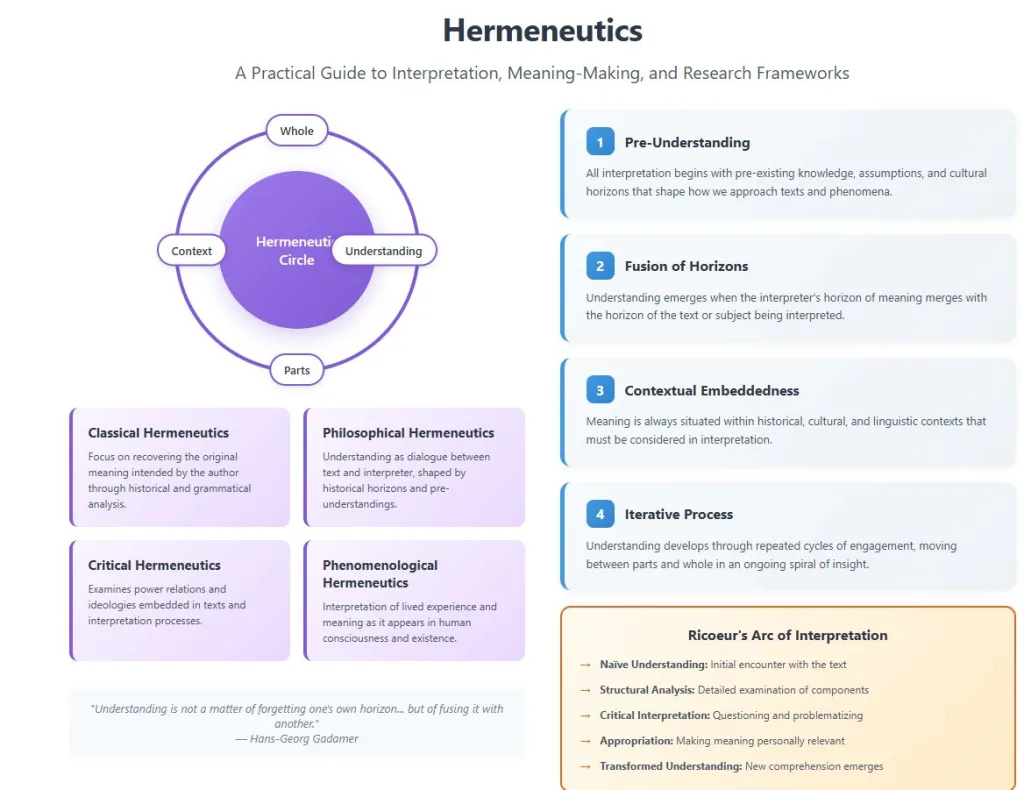
- The hermeneutic circle describes how we understand parts and wholes together.
- Hermeneutics says you interpret a sentence by the paragraph, and the paragraph by the sentence.
- Hermeneutics shows that meaning emerges through movement between detail and overall context.
- How to apply the hermeneutic circle in practice
- Read the whole text once to grasp the general message.
- Re-read small sections to identify key claims, concepts, and tensions.
- Revisit the whole text again to see how those details change your overall understanding.
- Hermeneutics turns reading into a disciplined cycle rather than a linear scan.
Need expert dissertation writing support?
Get structured guidance, clear academic writing, and on-time delivery with Best Dissertation Writers .
Get Started NowKey forms of hermeneutics (with simple explanations)
- Classical hermeneutics
- Focuses on rules of interpretation: grammar, historical setting, author intent, and audience.
- Hermeneutics here aims for faithful understanding based on context.
- Philosophical hermeneutics
- Argues that interpretation is part of human existence, not just a technique.
- Hermeneutics emphasizes tradition, language, and “horizons” of understanding that shape meaning.
- Critical hermeneutics
- Adds a focus on power, ideology, and distortion.
- Hermeneutics in this form asks: “Whose interests does this interpretation serve?”
- Applied hermeneutics
- Uses hermeneutics in practice fields like nursing, education, leadership, law, and social work.
- Hermeneutics helps interpret narratives, values conflicts, and meaning in decision-making.
Key thinkers connected to hermeneutics (in plain language)
- Friedrich Schleiermacher
- Hermeneutics in his tradition includes interpreting both grammar and psychology (how the author thinks).
- Hermeneutics emphasizes understanding the text as a purposeful expression.
- Wilhelm Dilthey
- Hermeneutics supports the “human sciences” by interpreting meaning and lived experience.
- Hermeneutics helps distinguish understanding (meaning) from explanation (causal laws).
- Martin Heidegger
- Hermeneutics becomes existential: interpretation is how humans exist in the world.
- Hermeneutics shifts from technique to a theory of being and understanding.
- Hans-Georg Gadamer
- Hermeneutics highlights “fusion of horizons,” meaning understanding emerges when your horizon meets the text’s horizon.
- Hermeneutics emphasizes dialogue, tradition, and openness to being challenged.
- Paul Ricoeur
- Hermeneutics bridges meaning and critique by exploring symbols, narrative identity, and interpretation at depth.
- Hermeneutics helps interpret how people make sense of their lives through stories.
Hermeneutics in everyday life (quick examples)
- Interpreting a policy
- Hermeneutics helps you ask what problem the policy assumed and what values it prioritizes.
- Hermeneutics highlights ambiguous terms like “appropriate,” “reasonable,” or “professional.”
- Interpreting an interview
- Hermeneutics helps you read tone, metaphor, hesitation, and emotional emphasis as meaning.
- Hermeneutics prevents you from treating quotes as isolated facts.
- Interpreting a news headline
- Hermeneutics helps you analyze framing: what is presented as normal, urgent, or dangerous.
- Hermeneutics asks what is missing and why.
- Interpreting clinical communication
- Hermeneutics supports understanding what patients mean beyond literal symptoms.
- Hermeneutics helps interpret fear, stigma, trust, and hope embedded in words.
A practical, step-by-step method to do hermeneutics
- Step 1: Clarify your interpretive goal
- Are you interpreting meaning, intention, values, identity, or power?
- Hermeneutics becomes stronger when your aim is explicit.
- Step 2: Identify the context
- Historical period, social setting, institutional environment, and audience.
- Hermeneutics treats context as part of the text, not background noise.
- Step 3: Track language choices
- Key terms, metaphors, repeated phrases, silences, and contradictions.
- Hermeneutics asks what these choices reveal about meaning.
- Step 4: Move between parts and whole
- Use the hermeneutic circle deliberately.
- Hermeneutics requires multiple passes for depth and accuracy.
- Step 5: Make your assumptions visible
- Write down your prior beliefs and expectations.
- Hermeneutics uses reflexivity to reduce hidden bias.
- Step 6: Develop an interpretive account
- Explain not just what the text says, but what it means in context.
- Hermeneutics values coherent, well-supported interpretation.
- Step 7: Test plausibility
- Ask whether your interpretation fits:
- The text itself (internal coherence)
- The context (external coherence)
- Alternative readings (comparative plausibility)
- Hermeneutics improves when you consider counter-interpretations.
- Ask whether your interpretation fits:
Common mistakes to avoid in hermeneutics
- Mistake: Treating your first reading as final
- Hermeneutics expects revision through re-reading.
- Strong hermeneutics looks like disciplined iteration.
- Mistake: Ignoring genre
- A poem, legal document, and interview transcript cannot be interpreted the same way.
- Hermeneutics requires genre awareness.
- Mistake: Over-relying on “author intent”
- Author intent can matter, but is often inaccessible or contested.
- Hermeneutics balances intent with text, audience, and context.
- Mistake: Quoting without interpreting
- A quote is evidence, not analysis.
- Hermeneutics requires you to explain what the quote reveals.
- Mistake: Forgetting power and position
- Interpretation is shaped by institutions and social hierarchies.
- Hermeneutics is stronger when reflexive about power dynamics.
Where hermeneutics is used (and why it fits)
- Education research
- Hermeneutics interprets meaning in curricula, classroom narratives, and student identity formation.
- Hermeneutics explains how learners experience policies and teaching practices.
- Health and nursing research
- Hermeneutics interprets patient stories, illness meaning, coping, and communication.
- Hermeneutics supports compassionate understanding beyond symptom lists.
- Leadership and organizational research
- Hermeneutics interprets culture, values, mission statements, and change narratives.
- Hermeneutics helps explain why people accept, resist, or reinterpret strategy.
- Law and public policy
- Hermeneutics clarifies ambiguous terms and competing interpretations.
- Hermeneutics explains how legal meaning evolves through precedent and context.
- Media and cultural studies
- Hermeneutics analyzes symbols, narratives, and ideology in representation.
- Hermeneutics helps interpret identity and belonging in cultural texts.
Hermeneutics compared to close cousins (quick clarity)
- Hermeneutics vs. content analysis
- Content analysis often counts or categorizes text features.
- Hermeneutics interprets meaning and context behind language.
- Hermeneutics vs. discourse analysis
- Discourse analysis emphasizes language-in-use and power.
- Hermeneutics can overlap, but often focuses more directly on understanding meaning through part–whole interpretation.
- Hermeneutics vs. phenomenology
- Phenomenology studies lived experience structures.
- Hermeneutics often interprets meaning in texts and experiences; “hermeneutic phenomenology” combines both.
Using hermeneutics as a theoretical framework in a research paper or dissertation
1) When hermeneutics is the right framework
- Choose hermeneutics if your study focuses on meaning, interpretation, and context
- Interviews about lived experience, identity, coping, ethics, or culture.
- Documents like policies, mission statements, curricula, clinical notes, or media texts.
- Hermeneutics fits when “what it means” is central to your research problem.
2) How to write a strong hermeneutics framework section
- Define hermeneutics clearly for your field
- State that hermeneutics is an interpretive framework concerned with meaning-making.
- Explain whether you lean classical, philosophical, or critical hermeneutics.
- Hermeneutics frameworks are stronger when you state your version and why.
- Explain your assumptions (reflexivity)
- Write your positionality: background, role, and relationship to the topic.
- Explain how you will manage bias through journaling, peer debriefing, or audit trails.
- Hermeneutics requires transparent interpretation.
- Present a conceptual map
- Show how:
- Context shapes language
- Language shapes meaning
- Meaning shapes action or identity
- Hermeneutics benefits from a simple diagram even in text form.
- Show how:
3) How hermeneutics shapes research questions
- Use meaning-centered questions
- What does this experience mean to participants, and how is that meaning formed?
- How do people interpret a policy, diagnosis, or identity label in their daily lives?
- How does language reflect values, assumptions, and power relations in this setting?
- Hermeneutics questions often begin with “how is meaning constructed” or “how is this understood.”
4) How hermeneutics guides methods (data and analysis)
- Data sources that align with hermeneutics
- Semi-structured interviews, focus groups, reflective journals, narratives, diaries.
- Documents: policies, guidelines, reports, emails, lesson plans, media articles.
- Hermeneutics works well with rich, contextual text.
- Hermeneutic analysis steps (usable in your methodology chapter)
- Familiarization: read data repeatedly for overall sense.
- Initial interpretation: annotate key meanings, metaphors, tensions, silences.
- Part–whole movement: interpret passages in relation to whole dataset and vice versa.
- Thematic interpretation: develop themes as meaning structures, not just categories.
- Reflexive checking: document how your perspective shaped theme development.
- Validation strategies: member reflection (if appropriate), peer review, triangulation.
- Hermeneutics requires documenting interpretive decisions clearly.
5) How to write findings and discussion using hermeneutics
- Findings
- Present themes as meaning patterns (not only “topics”).
- Use participant quotes as evidence, then interpret what they reveal.
- Hermeneutics asks you to connect words to context and significance.
- Discussion
- Link themes to your hermeneutics framework: show how context and language shaped meaning.
- Compare your interpretations with prior literature.
- Hermeneutics discussion is stronger when it shows alternative readings and justifies your chosen interpretation.
6) Strengths and limitations of using hermeneutics (for your dissertation)
- Strengths
- Hermeneutics captures depth, nuance, and context.
- Hermeneutics supports ethical sensitivity and human-centered interpretation.
- Hermeneutics can reveal hidden assumptions and values.
- Limitations
- Hermeneutics can be criticized as subjective if reflexivity and rigor are weak.
- Hermeneutics is time-intensive because it requires repeated analysis and documentation.
- Hermeneutics findings may be context-specific and not statistically generalizable (but can be analytically transferable).