

Social Constructivism: A Clear, Practical, and Research-Ready Guide
- Social constructivism is used across education, sociology, psychology, communication studies, and research methodology because it explains how people come to “know” what they know.
- Instead of treating knowledge as a fixed object “out there,” social constructivism focuses on how meaning is built:
- through conversation and negotiation
- through shared routines and institutions (schools, workplaces, families)
- through culture, norms, and values that shape what counts as “true” or “reasonable”
- This matters because many real-world issues are not purely technical.
- For example, ideas like “good leadership,” “professionalism,” “mental illness,” or “quality education” depend heavily on shared social definitions.
- The approach also explains why the same information can produce different interpretations.
- People interpret evidence through language, past experiences, and community expectations.
- In practice, this article helps you:
- understand the theory in plain language
- spot it in everyday life
- apply it in teaching, training, interviews, and academic research
What Is Social Constructivism?
- Social constructivism is a theory of learning and knowledge that argues meaning is created through interaction rather than discovered as a universal, context-free fact.
- It assumes people do not simply “absorb” knowledge.
- They interpret, question, test, revise, and confirm ideas with others.
- Learning becomes a process of making sense together.
- Knowledge is shaped by:
- social interaction (discussion, disagreement, feedback, collaboration)
- language (labels, categories, explanations, narratives)
- culture (norms about what is polite, moral, credible, or acceptable)
- history (what a community has valued and repeated over time)
- A simple way to think about it:
- “What we know” is strongly influenced by “how we talk” and “who we talk with.”
- This does not mean reality is imaginary.
- It means the meaning people assign to events, experiences, and evidence is shaped socially.
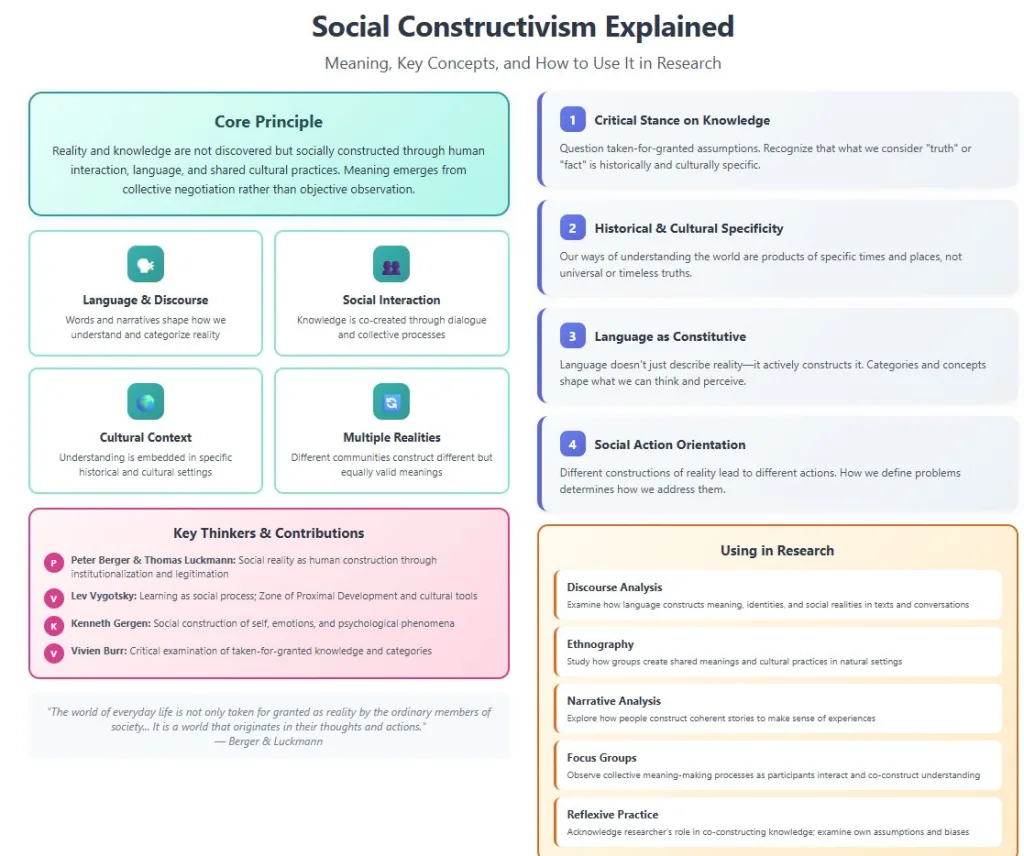
Core Assumptions of Social Constructivism
Knowledge is socially constructed
- Social constructivism argues that knowledge is built through shared meaning-making.
- Understanding grows when people:
- compare perspectives
- justify claims
- challenge assumptions
- co-create explanations
- “Truth” often functions like an agreement within a community.
- A claim becomes accepted when it fits evidence and fits the community’s standards for credibility.
- Example:
- In one field, a “strong argument” may mean statistical significance.
- In another, it may mean depth of interpretation and rich context.
Language shapes meaning
- Language does not only describe reality.
- It also organizes it.
- Words and labels influence what people notice and what they ignore.
- If a behavior is labeled “disruptive,” it can trigger discipline.
- If it is labeled “distress,” it can trigger support.
- Communication builds shared frameworks:
- definitions (what something “is”)
- explanations (why it happens)
- expectations (what should happen next)
- This is why social constructivism pays close attention to:
- discourse (how people speak about topics)
- narratives (the stories people use to explain events)
- categories (how groups are named and treated)
Learning is context-dependent
- Meaning is tied to the environment where it is developed.
- Context includes:
- cultural norms
- institutional rules
- power relationships
- resource availability
- group identities and roles
- Knowledge that works well in one setting may not transfer cleanly to another.
- A communication style that works in one workplace may fail in another due to different norms.
- This context focus is a key difference between social constructivism and theories that treat learning as a purely internal process.
Need expert dissertation writing support?
Get structured guidance, clear academic writing, and on-time delivery with Best Dissertation Writers .
Get Started NowHistorical Origins and Key Thinkers in Social Constructivism
Lev Vygotsky
- Social constructivism is strongly associated with Vygotsky’s work on the social foundations of learning.
- Key idea: learning begins socially, then becomes internal.
- First, the learner participates in shared thinking.
- Later, the learner can perform similar thinking independently.
- Vygotsky highlighted that tools mediate learning:
- language
- symbols
- cultural practices
- teaching routines
- His work supports practical approaches like:
- guided practice
- peer learning
- structured discussion
Later theorists and expansions
- Later scholars widened social constructivism beyond classroom learning.
- They explored how knowledge is shaped by:
- institutions (schools, hospitals, courts, media)
- culture (dominant values and norms)
- discourse (what can be said, and what becomes “normal”)
- power (who gets believed, who gets ignored, whose knowledge counts)
- This is why the theory is common in:
- sociology and anthropology
- qualitative research
- organizational and professional studies
Social Constructivism in Education
Classroom learning as collaboration
- Social constructivism views learning as something learners do together rather than something teachers deliver.
- Effective learning settings include:
- discussion that invites multiple viewpoints
- group problem-solving with clear roles
- peer feedback and peer teaching
- activities that require justification (“Why do you think that?”)
- The teacher’s role shifts toward:
- guiding
- scaffolding
- prompting deeper explanation
- building a safe environment for questions and mistakes
Active learning approaches
- Social constructivism aligns with approaches that treat students as active participants:
- problem-based learning (learning through real problems)
- inquiry learning (learning through investigation)
- project-based learning (learning through building a product or solution)
- peer instruction (learning by explaining to classmates)
- Why these work:
- they force learners to make meaning, not just repeat content
- they create chances to test ideas against others’ reasoning
- they make misunderstanding visible early, so it can be corrected
Assessment implications
- Under social constructivism, assessment should check understanding, not just recall.
- Useful assessment strategies include:
- reflective writing (how thinking changed)
- oral defense (explaining and justifying reasoning)
- portfolios (evidence of growth over time)
- collaborative products with clear individual contributions
- Feedback becomes a dialogue:
- not only “right/wrong”
- but “how did you reason?” and “what could strengthen your explanation?”
Social Constructivism in Research
Understanding multiple realities
- Social constructivism fits research topics where experiences differ by person, group, or setting.
- It assumes:
- people interpret events through culture and identity
- meanings shift across contexts
- the same situation can produce different “realities” for different participants
- Research focus often becomes:
- how people describe their experiences
- how they explain causes and consequences
- how their social world shapes what they believe and do
Common research methods
- Methods often used with social constructivism:
- semi-structured interviews (deep meanings and interpretations)
- focus groups (how meaning forms in group discussion)
- observations (how interaction creates shared norms)
- document and discourse analysis (how institutions shape “truth”)
- Data analysis often emphasizes:
- themes and patterns of meaning
- language choices and repeated narratives
- contradictions and tensions (what is contested, not settled)
Strengths of Social Constructivism
Captures complexity
- It explains why human beliefs and behaviors are shaped by:
- family and peers
- culture and tradition
- institutions and professional norms
- It avoids “one-size-fits-all” explanations when human meaning is central.
Promotes inclusivity
- It values diverse viewpoints because different social positions produce different experiences.
- It challenges assumptions that one group’s knowledge is automatically the standard.
Supports reflective practice
- Social constructivism encourages people to ask:
- “How did we come to believe this?”
- “Who benefits from this definition?”
- “What voices are missing?”
- This is useful in education, healthcare, management, and policy design.
Criticisms and Limitations of Social Constructivism
Risk of relativism
- A common critique is that if meaning is socially constructed, then “anything goes.”
- Strong constructivist research avoids this by:
- using evidence carefully
- showing how interpretations are formed
- being transparent about reasoning
- The goal is not to deny reality.
- It is to explain how meaning is produced around reality.
Limited generalizability
- Findings are often tied to a specific context or group.
- This is a limitation if a study needs broad prediction.
- It can be a strength when the goal is deep understanding.
Researcher influence
- The researcher is part of the meaning-making process.
- This can bias results if unmanaged.
- Constructivist approaches respond by emphasizing:
- reflexivity (tracking assumptions)
- transparency (clear methods and decisions)
- credibility checks (member checking, triangulation where appropriate)
Comparison With Other Theoretical Perspectives
Contrast with positivism
- Positivism assumes:
- an objective reality that can be measured
- knowledge is best produced through control and prediction
- Social constructivism assumes:
- meaning is socially shaped
- knowledge is best understood through context and interpretation
- Both can be useful.
- The choice depends on the research question.
Contrast with cognitive theories
- Cognitive theories emphasize mental processes inside the individual.
- Social constructivism emphasizes:
- interaction, language, and culture as drivers of learning
- In practice, many educators blend both:
- cognition explains internal processing
- constructivism explains how social context shapes that processing
Practical Applications of Social Constructivism Beyond Academia
Workplace learning
- Knowledge often spreads through:
- mentoring
- teamwork
- informal conversations
- “how things are done here” norms
- Social constructivism explains why onboarding works best when new staff join real communities of practice.
Healthcare and social work
- It highlights how patient meaning matters.
- How a person defines illness affects adherence, coping, and help-seeking.
- It also explains professional culture:
- what a team treats as “urgent,” “safe,” or “standard care” is partly socially shaped.
Policy and development work
- Policies succeed more when stakeholders help define the problem and the solution.
- Constructivist thinking supports:
- participatory planning
- community-led definitions of needs
- culturally responsive interventions
Using Social Constructivism as a Theoretical Framework in Research
Framing the research problem
- Social constructivism frames problems as socially produced, not purely technical.
- You position your study around:
- how meanings are formed
- how people interpret experiences
- how social context influences beliefs and actions
- Example framing:
- “This study explores how frontline nurses construct the meaning of patient safety within staffing constraints.”
Guiding research questions
- Research questions align with meaning and interaction.
- Strong question patterns include:
- “How do participants understand…?”
- “How do people construct meaning around…?”
- “How do social interactions shape…?”
- “How does context influence interpretations of…?”
Informing methodology
- Common designs:
- qualitative case study
- phenomenology (lived experience)
- ethnography (culture and practice)
- grounded theory (building theory from data)
- Data collection emphasizes:
- dialogue, narratives, and interaction
- context details (setting, roles, routines)
Shaping data analysis
- Analysis focuses on:
- themes (shared meanings)
- narratives (common storylines)
- discourse (how language shapes reality)
- social processes (how understanding forms over time)
- Findings are reported as:
- interpretations supported by participant evidence
- shaped by context, not claimed as universal law
Ensuring rigor
- Rigor in social constructivism is shown through:
- reflexivity (what you bring as a researcher)
- credibility (do participants recognize the interpretation?)
- audit trail (clear steps in analysis)
- thick description (enough context for readers to judge transferability)
Conclusion
- Social constructivism offers a practical way to understand how people build meaning in real life.
- It is powerful for topics where context, language, identity, culture, and relationships shape what people believe and do.
- In education, it supports collaboration and active learning.
- In research, it provides a strong framework for studying interpretation, experience, and social processes.
- Used well, it helps produce findings that are not only accurate within context, but also useful for improving practice and understanding human behavior.