

Realism Theory: A Clear, Practical Guide for Research and Writing
Realism in Plain Terms
- Realism is a theory about reality.
- It starts from the idea that the world is not “made up” by our opinions.
- Many things are true or false regardless of what we personally believe.
- Realism is also a theory about knowledge.
- It asks how we can know what is real.
- It assumes evidence and careful reasoning can move us closer to accurate understanding.
- Realism is a “reality-check” approach.
- It pushes against exaggerated claims, wishful thinking, and unsupported conclusions.
- It encourages researchers to focus on what can be justified with proof.
- Realism appears in many disciplines.
- In philosophy: it debates truth, existence, and knowledge.
- In science: it supports treating scientific explanations as describing real processes.
- In social science: it helps analyze institutions, power, and systems as real influences.
- In literature and art: it represents everyday life and social conditions faithfully.
- In international relations: it explains power, security, and state behavior.
What Realism Means in One Line
- Definition (simple):
- Realism is the view that reality exists independently of our beliefs, and knowledge aims to describe or explain that reality as accurately as possible.
- What this implies:
- Belief does not create reality (believing something does not make it true).
- Evidence matters (claims should be supported, not just asserted).
- Good research is accountable to the world, not only to interpretation.
- What realism is not:
- It is not “being negative” or “pessimistic.”
- It is not ignoring values or ethics.
- It is not claiming perfect certainty.
Why Realism Matters in Academic Thinking
- It anchors inquiry in evidence.
- It encourages observation, documentation, and verifiable support.
- It reduces the risk of writing “opinion essays” disguised as research.
- It supports explanation, not only description.
- It encourages you to ask “what causes this?” and “how does it happen?”
- It moves you from listing themes to explaining relationships.
- It helps handle complex real-world problems.
- Many outcomes are shaped by multiple interacting forces.
- Realism fits topics involving policy, systems, institutions, inequality, and constraints.
- It strengthens credibility and academic rigor.
- It supports clear reasoning, transparent methods, and defensible conclusions.
- It makes it easier to justify why your findings matter beyond your sample.
- It improves practical usefulness.
- Realism supports applied recommendations that match real conditions.
- It helps you avoid solutions that sound good but ignore constraints.
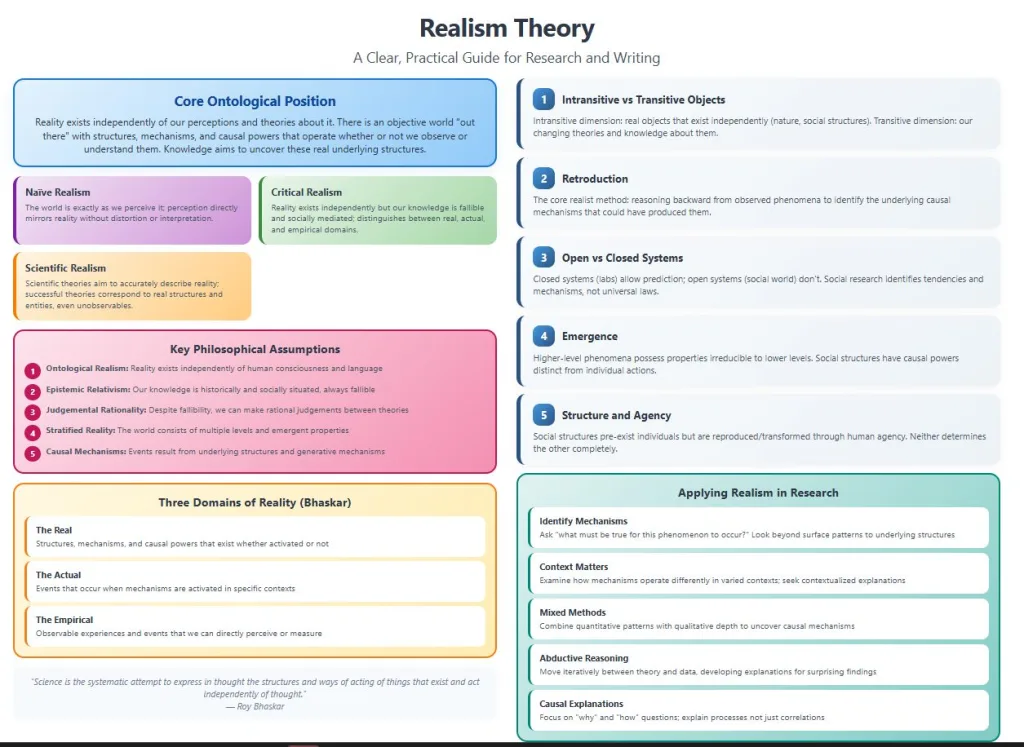
Core Assumptions of Realism
- Reality exists beyond the mind.
- Social and natural worlds have patterns and structures.
- These structures can shape outcomes even if people are not aware of them.
- Knowledge is possible, but imperfect.
- Realism accepts uncertainty and bias risks.
- It emphasizes improvement through better data, better methods, and replication.
- Truth is connected to evidence.
- Claims need support through data, logic, or credible sources.
- Stronger evidence increases confidence in conclusions.
- Explanations should connect causes and effects.
- Realism values causal accounts rather than only descriptions.
- It emphasizes mechanisms (how and why something leads to an outcome).
- Context matters.
- Realism expects outcomes to vary across settings.
- It examines how context shapes whether a mechanism “fires” or fails.
Key Concepts You Should Know
- Ontology (what exists).
- Realism assumes many things exist beyond what we think.
- In social research, it treats institutions, policies, and norms as real influences.
- It also accepts that social realities can be complex and layered.
- Epistemology (how we know).
- Realism supports evidence-based knowledge building.
- It accepts that researchers are human, so methods must reduce error and bias.
- It values transparency: show how you reached your conclusions.
- Causation and mechanisms.
- A mechanism is the “engine” that produces an outcome.
- Example: “fear of punishment” may be the mechanism behind compliance.
- Realism often asks: what process links cause and effect here?
- Objectivity vs. neutrality.
- Objectivity is the goal of reducing distortion.
- Neutrality is not always possible (values influence research choices).
- Realism emphasizes fairness, rigor, and evidence even when values exist.
- Levels of explanation.
- Individual level: beliefs, choices, skills, behavior.
- Institutional level: policies, rules, leadership, culture.
- Structural level: history, economy, inequality, power distribution.
- Realism often uses more than one level at once.
Major Types of Realism
Philosophical Realism
- Main idea:
- The world exists independently of our perceptions and language.
- Why it matters:
- It supports truth claims that are not reduced to opinion.
- It strengthens the idea that arguments must correspond to reality.
- Where it is used:
- Ethics, metaphysics, theory-building, debates about truth and meaning.
- Typical questions:
- What is truth?
- Do moral facts exist?
- Can we know reality or only interpretations?
Scientific Realism
- Main idea:
- Strong scientific theories often describe real entities and processes.
- Even if we cannot directly observe something, it can still be real.
- Why it matters:
- It justifies trusting well-tested explanations (with caution).
- It supports research that investigates hidden causes (genes, pathogens, systems).
- Common examples:
- Viruses, genes, gravity, and neurotransmitters are treated as real because evidence supports them.
- Typical research fit:
- Health sciences, biology, engineering, and other theory-driven empirical fields.
Critical Realism
- Main idea:
- Reality exists, but we access it through social life, language, and institutions.
- Social structures (class, policy, power) create real effects.
- What makes it “critical”:
- It investigates how power shapes outcomes and what gets treated as “truth.”
- It looks at deeper causes behind visible problems.
- Key focus:
- Context → mechanisms → outcomes.
- Structural influences and unequal impacts.
- Typical research fit:
- Education, public health, social work, organizational studies, policy evaluation.
Realism in Literature and Art
- Main idea:
- Ordinary life and social conditions are portrayed with believable detail.
- Core features:
- Everyday settings, realistic characters, plausible conflicts.
- Attention to social class, work, institutions, and social constraints.
- Why it matters academically:
- It can reveal social realities and historical conditions.
- It supports cultural analysis grounded in context rather than fantasy.
- Typical research fit:
- Humanities, cultural studies, media analysis, historical interpretation.
Political Realism (International Relations)
- Main idea:
- States prioritize survival, power, and security in a competitive system.
- Key assumptions:
- The international system lacks a single enforcing authority.
- Power and national interest strongly influence decisions.
- Focus areas:
- Alliances, deterrence, security dilemmas, conflict escalation.
- Typical research fit:
- Foreign policy, security studies, war and peace studies, geopolitics.
Need expert dissertation writing support?
Get structured guidance, clear academic writing, and on-time delivery with Best Dissertation Writers .
Get Started NowWhat Realism Looks Like in Practice
- Treating institutions as real forces.
- Policies can shape choices and outcomes even if people dislike them.
- Organizations influence behavior through incentives and rules.
- Respecting constraints.
- Realism asks what limits action: money, staffing, laws, time, risk, political pressure.
- It avoids “ideal solutions” that ignore feasibility.
- Expecting patterns without oversimplifying.
- Realism looks for recurring trends while acknowledging exceptions.
- It expects partial regularities rather than perfect predictability.
- Welcoming mixed evidence.
- Quantitative: surveys, experiments, administrative data, statistics.
- Qualitative: interviews, focus groups, observations, documents.
- Realism supports triangulation when it strengthens explanation.
- Asking “what is really going on?”
- It checks surface claims against deeper drivers and context.
- It tests whether a popular explanation fits the evidence.
Realism Compared With Other Approaches
- Realism vs. Idealism
- Idealism emphasizes values and what “should be.”
- Realism emphasizes constraints, incentives, and what “is.”
- In research, realism helps test whether ideals can work in real settings.
- Realism vs. Constructivism
- Constructivism emphasizes how meaning and identity are socially built.
- Realism emphasizes that material conditions and structures still shape outcomes.
- Many studies combine insights, but realism keeps the focus on real effects.
- Realism vs. Positivism
- Positivism may prioritize only what is measurable.
- Realism accepts measurement but also studies deeper causal mechanisms.
- Realism is comfortable with “unobservables” if evidence supports them.
- Realism vs. Interpretivism
- Interpretivism prioritizes meaning, experience, and context.
- Realism includes meaning, but also investigates structural causes and constraints.
- Realism asks how systems produce the experiences people report.
Strengths of Realism
- Strong explanatory power.
- It links outcomes to causes, not only correlations.
- It supports mechanism-based explanations.
- High practical relevance.
- It produces recommendations that fit real-world constraints.
- It suits policy, health, education, and organizational problems.
- Strong fit for complex social issues.
- It accommodates context, inequality, and institutional influence.
- It supports multi-level analysis.
- Encourages responsible, defensible claims.
- It demands evidence and transparency.
- It reduces exaggerated conclusions that data cannot support.
- Supports transferability.
- By explaining mechanisms, findings can inform similar contexts.
- It clarifies what conditions are needed for outcomes to repeat.
Common Critiques of Realism
- It may oversimplify human meaning.
- Critics say it can underplay identity, emotions, and lived experience.
- Response: include qualitative evidence and interpret meaning carefully.
- Debates about “social reality.”
- Social facts (money, status, norms) can be real yet socially constructed.
- Response: realism can treat them as real in their consequences and effects.
- Risk of bias toward dominant “facts.”
- Institutions may define what counts as evidence.
- Response: triangulate sources and examine power shaping knowledge.
- Difficulty proving mechanisms.
- Mechanisms can be hidden and context-sensitive.
- Response: use careful theory, multiple data sources, and plausible causal reasoning.
- Concerns about overconfidence.
- Realism can sound too certain if written poorly.
- Response: state limitations and alternative explanations clearly.
How to Use Realism as a Theoretical Framework – A Step-by-Step Guide
Step 1: Align Realism With Your Research Problem
- Use realism when your study is about real-world outcomes shaped by systems.
- Policies and unequal impacts.
- Organizational performance and culture.
- Program effectiveness across different contexts.
- Signals realism is a good match:
- Your topic involves constraints (resources, staffing, law, economics).
- Your outcomes vary by setting and you need to explain why.
- You want causal explanations, not only “what people think.”
Step 2: Write a Framework Statement
- Standard template:
- “This study uses realism as a theoretical framework to examine how structures, contextual conditions, and causal mechanisms shape [outcome] within [setting].”
- Critical realism template (if you want emphasis on structure and power):
- “This study applies realism to explain how institutional structures and social conditions shape the mechanisms that produce [outcome], with attention to contextual variation across [settings].”
- One-sentence justification you can add:
- “This framework is appropriate because the research problem involves outcomes that are influenced by both human agency and real structural constraints.”
Step 3: Define What “Reality” Means in Your Study
- Material conditions (tangible):
- Funding, staffing levels, workload, infrastructure, technology access.
- Institutional conditions (formal):
- Policies, rules, job roles, governance structures, accountability systems.
- Social conditions (informal):
- Norms, expectations, stigma, power dynamics, professional culture.
- Tip for dissertations:
- Define your “real” variables early so your analysis stays consistent.
Step 4: Build a Realist Conceptual Model
- Core realist logic:
- Context → Mechanism → Outcome
- How to expand it:
- Context: setting conditions that enable or block a mechanism.
- Mechanism: the causal process (beliefs, incentives, fear, trust, motivation).
- Outcome: measurable or observable result.
- Example (expanded):
- Context: short staffing + high patient acuity
- Mechanism: rushed handoffs, reduced double-checking, fatigue
- Outcome: increased omissions, delayed interventions, reduced safety
Step 5: Choose Methods That Fit Realist Goals
- Quantitative approach (realist use):
- Identify predictors that represent real constraints or structures.
- Test relationships that map onto your conceptual model.
- Qualitative approach (realist use):
- Explore how participants describe processes that produce outcomes.
- Look for mechanisms and context differences across cases.
- Mixed methods approach (strong realist fit):
- Use quantitative results to identify patterns.
- Use qualitative results to explain mechanisms behind those patterns.
Step 6: Use Realism in Data Analysis (Realist Questions)
- Mechanism-focused questions:
- What processes are producing this outcome?
- What incentives, beliefs, or pressures drive behavior?
- Context-focused questions:
- Under what conditions does the mechanism appear?
- What blocks it in other settings?
- Structure-focused questions:
- What institutional or policy factors shape these processes?
- Where does power sit, and how does it influence outcomes?
- Alternative explanation questions:
- What else could explain this pattern?
- What evidence supports or weakens each explanation?
Step 7: Write Findings in a Realist Way
- Do not only list themes or variables.
- Instead structure findings like this:
- Observed pattern (what happened).
- Context (where, when, and for whom).
- Mechanism (how/why it happened).
- Outcome implications (so what?).
- Example layout:
- Pattern: communication breakdowns increase during peak workload.
- Context: understaffed shifts and high acuity periods.
- Mechanism: time pressure reduces verification and clarity.
- Implication: structured handoff tools may reduce omissions.
Step 8: Strengthen Discussion and Recommendations
- Link recommendations to mechanisms.
- If mechanism is “confusion,” recommend standardization and training.
- If mechanism is “fatigue,” recommend staffing and scheduling changes.
- If mechanism is “policy conflict,” recommend governance alignment.
- Make recommendations realistic.
- Realism demands feasibility: resources, timelines, and accountability must be considered.
- Show transferability carefully.
- Explain which contexts your recommendations apply to.
- Clarify which conditions must be present for success.
Example: Expanded Dissertation-Style Paragraph Using Realism
- Key message:
- The study interprets outcomes as shaped by real structural conditions, not only personal choice.
- How analysis is framed:
- Findings are organized by context, mechanisms, and outcomes.
- What it reveals:
- Institutional rules, resource constraints, and social expectations combine to produce observed patterns.
- Why it matters:
- Explaining mechanisms helps others apply findings in similar settings.
- How it stays accurate:
- The study remains sensitive to contextual differences and avoids overgeneralization.
Common Mistakes to Avoid When Using Realism
- Mistake: treating realism as “common sense.”
- Fix: define it clearly and name its assumptions (reality, evidence, mechanisms).
- Mistake: staying at the surface level.
- Fix: move from “what happened” to “what caused it” and “under what conditions.”
- Mistake: ignoring context differences.
- Fix: compare settings and explain variation using context-mechanism logic.
- Mistake: confusing correlation with causation.
- Fix: justify causal claims with mechanisms and supporting evidence.
- Mistake: overclaiming certainty.
- Fix: state limitations, alternative explanations, and evidence strength.
- Mistake: using theory only in Chapter 2.
- Fix: apply realism throughout methods, analysis, discussion, and recommendations.
Conclusion
- Realism helps research stay grounded in the world as it actually operates.
- It supports explanation by linking outcomes to mechanisms and structures.
- It strengthens credibility through evidence, transparency, and defensible reasoning.
- It produces practical recommendations because it respects real constraints.
- It is highly useful for dissertations and applied research where context shapes outcomes.