

What is a Doctor of Philosophy (PhD)?
- Doctor of Philosophy (PhD): A terminal academic research degree focused on creating original knowledge in a specific field.
- Primary purpose: Trains you to become an expert who can design studies, analyze evidence, and contribute new ideas to the discipline.
- Typical structure: Includes advanced coursework, required program milestones such as comprehensive exams, and supervised independent research.
- Dissertation requirement: Culminates in a dissertation that presents original findings and is defended before a faculty committee.
- Common entry routes: Many students begin after completing a master’s degree, while some programs admit students directly after a bachelor’s degree.
- Outcomes: Prepares graduates for research-intensive careers in academia, industry, government, and policy.
How Long Does It Take to Get a PhD (Ph.D.)?
- A Doctor of Philosophy (Ph.D.) is a major advanced academic degree that usually requires several stages of training, research, and writing before you earn the PhD degree.
- How long it takes depends on the structure of the doctoral degree program, the expectations of your department, and how quickly you move from being a doctoral student to a PhD candidate.
- Many Ph.D. paths start with foundational preparation that helps you pursue a Ph.D with confidence, including choosing a topic, joining a research group, and building strong academic habits early.
- Earning a Ph.D is not only about time spent in classes because a large share of the timeline comes from independent research, developing research skills, and producing original work that meets doctoral standards.
- Many PhD students underestimate the full scope of the PhD degree because the process includes coursework, milestone exams, proposal development, data collection, analysis, and writing.
- How long it takes can feel unpredictable because research can change direction, results can require follow-up studies, and writing often takes longer than expected.
- If you plan well from the beginning you can reduce delays, keep steady momentum, and make your path to earning a Ph.D more manageable.
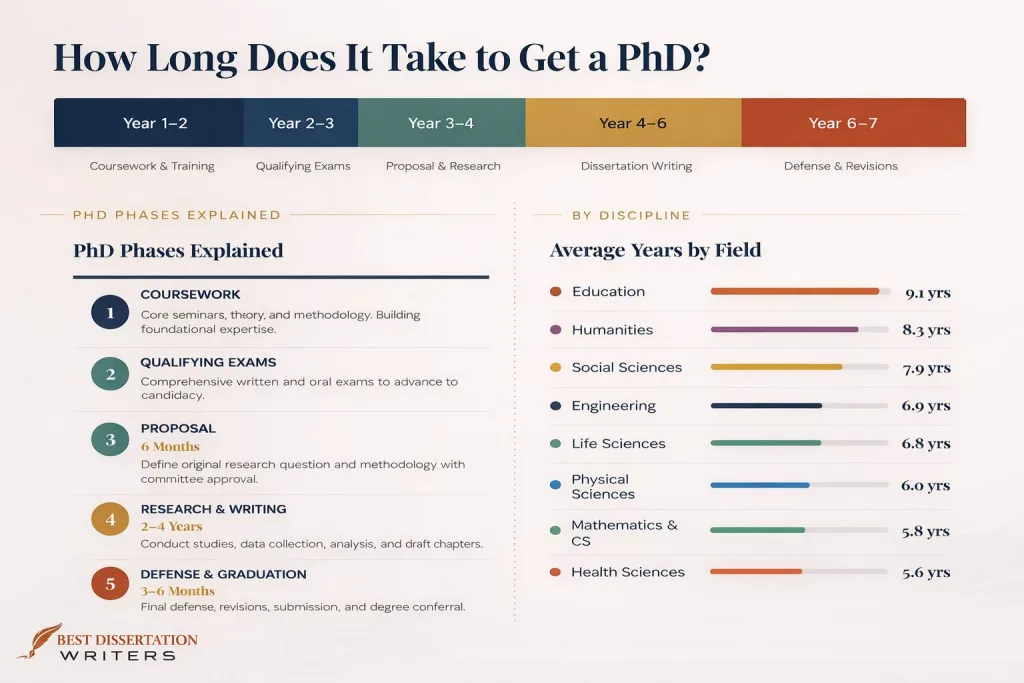
Average Time to Obtain a Doctoral Degree, From Enrollment to Degree Completion
- The time to complete a PhD often falls in a multi-year range, and many programs take several years from enrollment to degree completion.
- A common expectation is four to seven years for full-time doctoral students typically, although this varies by institution and field.
- Many schools describe five to seven years as a realistic window, especially when research and dissertation work are extensive.
- An average of five years is often cited as a helpful benchmark for the average PhD, but the average is not a guarantee for any individual student.
- Years to complete can increase when students take on heavy teaching loads, work outside the program, switch advisors, or change their research topic.
- The process can take several phases that add up over time, including admissions and onboarding, coursework, exams, proposal approval, research, and dissertation writing.
- Years of study are usually front-loaded with classes because the program typically begins with structured training that builds disciplinary foundations and research readiness.
- Years completing the dissertation can stretch when projects require long data collection periods, complicated analysis, multiple studies, or extensive revisions.
- Doctoral students typically progress at different speeds because students take different course loads, find research fit at different times, and develop writing routines at different paces.
- Students take longer when milestones do not align because delays in course availability, committee scheduling, or research approvals can extend the time to complete.
- Programs take longer in practice than on paper if the official plan assumes ideal conditions that do not account for publication cycles or unexpected research issues.
- A PhD program varies widely across universities because some programs emphasize early research immersion while others require extensive coursework before candidacy.
- Many students often take additional time to strengthen publications, gain teaching experience, or pursue internships that improve career options after the PhD degree.
How Long Does a PhD Take Across Different Fields of Study?
- Discipline expectations: Field differences matter because each discipline sets its own standards for training length, research design, publication expectations, and dissertation depth. These expectations directly shape how long a PhD takes.
- Humanity fields: Humanity programs often take longer because students may complete extensive reading, build deep theoretical frameworks, prepare languages, conduct archival work, and produce long-form writing that requires multiple revisions for clarity and argument strength.
- Social sciences: Social sciences can take longer when research depends on complex study design, participant recruitment, fieldwork, institutional approvals, longitudinal data collection, or repeated rounds of analysis and interpretation before writing reaches final form.
- Standardized and narrow-scope fields: Some fields may take a shorter time when the research question stays narrow, methods remain standardized, data access is straightforward, and the dissertation format supports efficient writing and faster committee review.
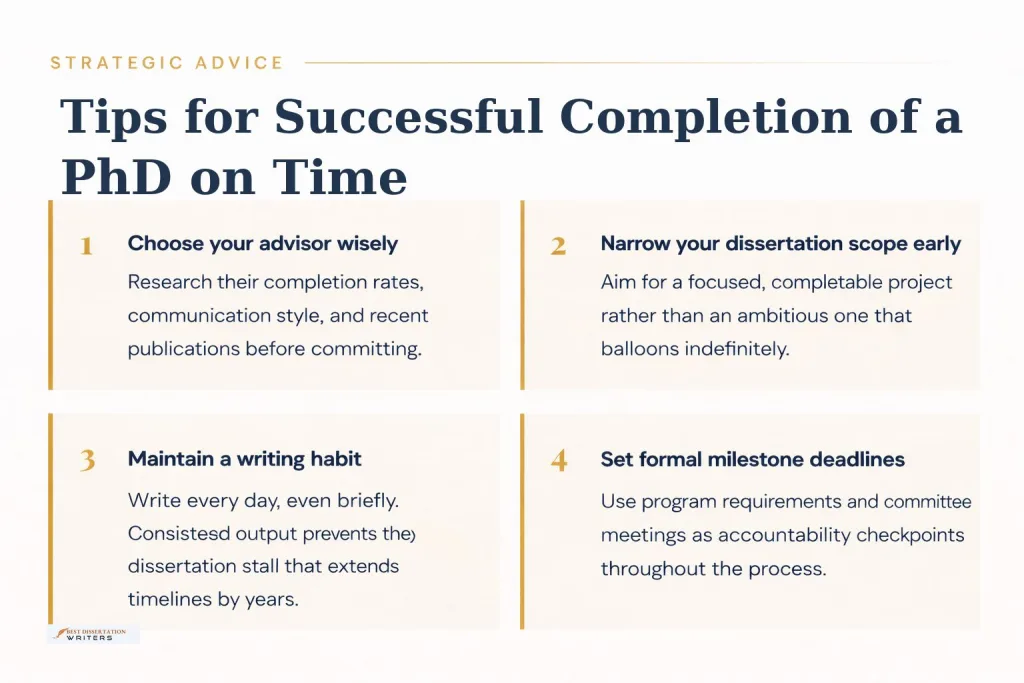
- Advisor expectations: Even within the same field, timelines vary because advisors differ in how many studies they expect, how publication-focused they are, and how much revision they require before approving drafts.
- Funding and resources: Strong funding and accessible resources can speed progress by protecting research time and improving access to tools, data, or lab support. Limited funding can slow degree completion.
- Dissertation scope: A realistic, focused dissertation usually shortens timelines, while broad or high-risk projects extend completion.
- Department culture and completion rules: The PhD program varies by department norms, milestone schedules, and what the doctoral degree program defines as “complete.”
What Changes the Time It Takes to Get a PhD in a Doctoral Program?
- Entry point (bachelor’s degree vs master’s degree): Starting with a bachelor’s degree often adds more years of study because you may need more foundational coursework and training before you begin independent research. Entering with a completed master’s degree can shorten the path because you may have already completed advanced academic preparation and clarified your research interests.
- Doctoral degree program structure: Some doctoral degree programs require more milestones before dissertation work begins, such as additional courses, formal progress reviews, or departmental requirements. When the program sequence is rigid, you can only advance after completing each step, which can extend the overall timeline.
- Advanced coursework load: A heavy schedule of required seminars, methods sequences, or qualifying preparation can lengthen the time to complete because coursework demands time that could otherwise go to research and writing.
- Research skills development: Strong research skills help you move faster from coursework into independent work. Weak early preparation can create delays later because you may need extra time to learn study design, data analysis, and academic writing.
- Advisor fit and committee stability: A supportive advisor and stable committee usually speed up approvals and revisions. Changing advisors or replacing committee members can slow progress because you may need to revise your proposal, redesign methods, or re-align expectations.
- Funding and workload: Stable funding often provides protected research time. When you must work many hours to cover expenses, research and writing move slower, which increases years to complete.
- Research integration in the program: Programs that integrate research early allow you to build momentum sooner. Programs that delay research until later stages push back dissertation progress and can extend the timeline.
- Personal responsibilities in grad school: Health issues, family obligations, relocation, or caregiving can reduce course loads or interrupt research schedules, which can extend time to complete.
- Project complexity and risk: Complex topics, difficult data access, or unpredictable findings can require multiple iterations and added studies. A well-scoped project with clear methods often supports a shorter time to complete.
- Dissertation scope management (most controllable): A focused, realistic dissertation aligned with program expectations reduces rework and prevents scope creep, making it easier to finish on time.
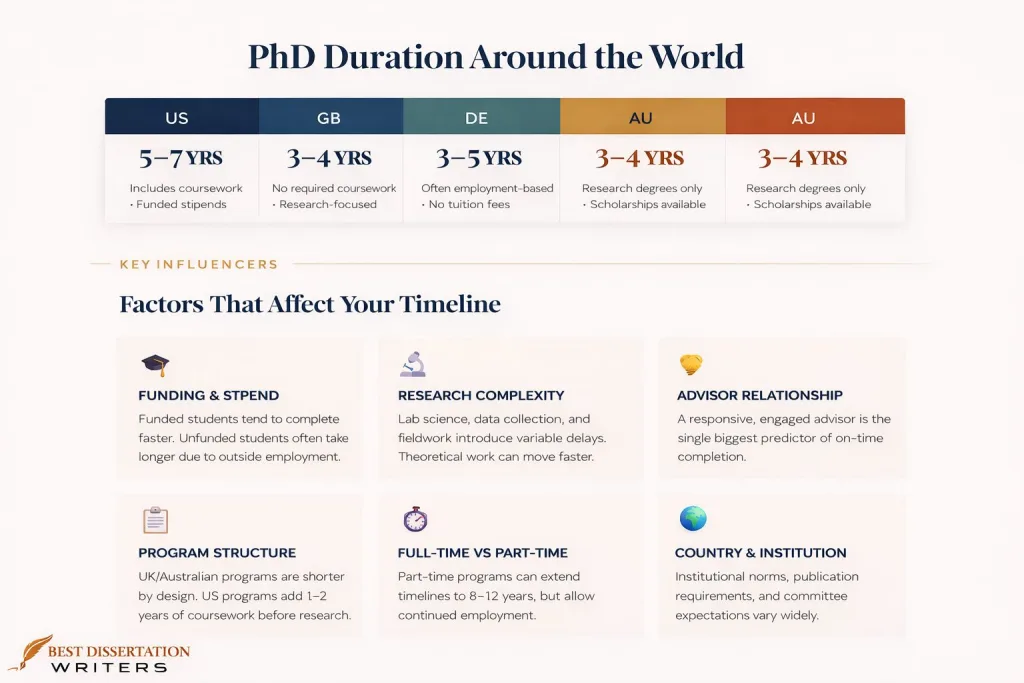
Why Does a Doctorate Take So Long?
- The doctorate is the highest degree you can earn in many academic systems, so standards are intentionally high. A doctoral degree proves you can produce original research, defend your ideas, and contribute new knowledge to your field. That level of rigor explains why the long it takes is not just about “spending time in school.” It is about meeting demanding expectations that protect the value of the credential and ensure you truly earn the degree.
- Doctorates take longer because the work is not fully predictable. Coursework follows a schedule, but research rarely does. Experiments fail, data collection gets delayed, and analyses can reveal problems that require redesign. When your results do not match expectations, you may need additional studies or new methods. That uncertainty is one of the biggest reasons doctorates take longer than many people plan.
- Time constraints matter because doctoral students typically work while studying. Many PhD students and doctoral candidates work as teaching assistants, research assistants, tutors, or employees outside the university. Work responsibilities reduce the number of uninterrupted hours available for reading, analysis, and writing. Even when the workload is manageable, splitting time across work and school extends the time to complete and can add years to degree completion.
- The doctorate is earned through performance, not just participation. Unlike some degrees where completing classes may be enough, a doctorate requires you to meet research and dissertation standards. You do not “get your doctorate” by clocking time alone. You earn the degree by passing specific evaluations and producing a dissertation that your committee approves. Because these requirements rely on quality and judgment, timelines often extend.
What Makes a PhD Take So Long in a Doctoral Program
- Coursework and years of coursework take time because they build the foundation for research. Many programs require multiple semesters or years of coursework to ensure you understand theory, methods, and the literature. In some departments, advanced coursework is required before you can move forward to candidacy. If key courses only run once per year or have prerequisites, your progress follows a fixed sequence that can extend your timeline.
- Advanced coursework can be intensive and slow progress on research. Seminars often require heavy reading, long papers, and presentations. Methods courses may include complex assignments, programming, or statistical training. While these courses strengthen your research ability, they also demand time that could otherwise go toward dissertation planning.
- The comprehensive exam is a major reason the process takes longer. A comprehensive exam tests whether you can synthesize broad knowledge across your field. Preparing often requires months of reading and review. Many students must pass a comprehensive exam before they can advance to PhD candidate status. If a student does not pass on the first attempt, retakes can extend the time to complete.
- The dissertation is the largest time driver. The dissertation is an original research project that typically includes a proposal, a study design, data collection, analysis, and a final written product. Writing a dissertation can take longer than expected because chapters often require multiple drafts, revisions, and formatting changes. Committees may request substantial revisions, and students may need to collect additional data or redo analyses to strengthen the study.
Doctoral Student Responsibilities While Pursuing a PhD
- Teaching responsibilities can extend timelines. Many doctoral candidates and PhD students serve as teaching assistants, lab instructors, or graders. Teaching develops communication and leadership skills, but it also reduces research time. During heavy teaching semesters, it is common for dissertation progress to slow, which contributes to longer completion times.
- Research assistant work can compete with dissertation work. Students may work on funded projects that are not directly tied to their dissertation. This work may be required for funding, but it can delay degree completion if it pulls attention away from the dissertation timeline. Managing these competing demands is a common challenge for many doctoral candidates.
- Administrative and professional expectations add workload. Many PhD students attend departmental meetings, complete annual progress reports, participate in conferences, or submit manuscripts for publication. These activities help build a professional profile and may be necessary to earn their doctorate in competitive fields, but they also add time and effort beyond core dissertation tasks.
- Life management becomes part of the doctoral workload. Doctoral students typically work while balancing housing, health, family responsibilities, and financial pressures. These realities can affect focus and energy. Even strong students can slow down when life demands increase, which extends the time to complete.
- Pressure to meet the standards set by doctoral degree holders can raise the bar. Students often aim to match the productivity and expectations modeled by doctoral degree holders in their department. That can be positive, but it can also lead students to take on extra projects, publish more papers, or expand the scope of the dissertation, which can increase years to complete.
Dissertation Writing Help You Can Trust
Get expert, research-driven dissertation support from Best Dissertation Writers . We help you strengthen your topic, refine your proposal, structure chapters, and polish your final draft to meet graduate-level standards.
Get Dissertation Help NowKey Milestones That Impact Degree Completion
- Comprehensive exam: This milestone often determines how quickly you become a PhD candidate. Passing a comprehensive exam requires preparation time, and any delay or retake extends the overall timeline.
- Dissertation proposal approval: Before full research begins, many programs require formal approval of your proposal. Scheduling meetings and responding to committee feedback can take weeks or months and can affect the time to complete.
- Data collection and analysis: This stage often takes longer than expected due to recruitment delays, access issues, equipment problems, or the need to refine methods after early results.
- Writing a dissertation: Writing is not one step at the end. It is a long process of drafting, revising, and responding to feedback. The number of revision rounds strongly affects years to complete.
- Defense scheduling and final revisions: Even when the dissertation is close to finished, scheduling the defense and completing final edits can add additional time before degree completion.
PhD Program and Doctorate Program Formats That Affect Time
- Degree program format changes the pace. The degree program you choose affects scheduling, access to support, and how quickly you can move through milestones, so programs take different lengths of time even when they award the same credential.
- A PhD program varies by school and department culture. Some programs run on strict sequences with fixed timelines, while others allow flexible pacing, which can increase or reduce years to complete depending on how consistently you progress.
- Structure vs flexibility affects years to complete. Highly structured programs typically take a more predictable number of years to complete because deadlines and milestones are built into the calendar. Flexible programs can take longer when students slow down without fixed checkpoints.
- Resource access influences how long programs take. Programs with strong advising, research infrastructure, and clear dissertation support typically take fewer years to complete than programs where students must build support and research access on their own.
Traditional Doctoral Program vs Online Doctorate
- Traditional doctoral degree program: in-person structure. A traditional doctoral degree program usually offers scheduled coursework, frequent face-to-face advising, and easy access to campus resources, which can help students stay on track and reduce delays.
- Traditional programs often support research logistics. If the advanced degree requires lab work, specialized equipment, or frequent collaboration, traditional formats can shorten time because access is built into the program environment.
- Online doctoral programs provide flexibility. An online doctoral option can reduce commute time and offer scheduling control, which helps students who need flexibility to pursue an advanced degree while managing other responsibilities.
- Online doctorate formats require strong self-management. Online doctoral success depends on consistent routines because fewer in-person checkpoints can allow procrastination, which can increase years to complete.
- Mentorship and collaboration look different online. Online doctoral students may need more planning for meetings, feedback, and peer support, which can affect momentum and completion speed.
- Research access can be a major difference. Online doctoral students may need to secure local research sites, data access, or tools independently, and this can add time if research resources are harder to arrange.
Online Programs and Online PhD Programs: Time It Takes
- Online programs vary widely in structure. Some online programs run in cohorts with fixed schedules and dissertation checkpoints, which can keep time to complete closer to traditional programs. Others allow open pacing, which can extend years to complete.
- Online PhD programs can be faster in coursework only. Shorter terms or accelerated course schedules may reduce coursework time, but they only help if you can sustain the workload without falling behind.
- Dissertation support determines how long it takes to get a Ph.D online. Online PhD programs with clear advising systems, frequent review cycles, and structured milestones usually shorten time to complete. Weak advising access often increases years to complete.
- Residency requirements can affect scheduling. Some online doctoral programs require in-person residencies, and missing a residency window can delay progress and extend years to complete.
- Research feasibility affects completion time. If your dissertation requires in-person data collection, specialized settings, or approvals, online delivery does not remove those timelines and may add coordination time.
- Bottom line for online formats. The time to complete in online PhD programs depends less on “online” and more on how the doctoral degree program is designed, supported, and paced.
Part-Time vs Full-Time PhD Program Timelines
- Full-time study often leads to a shorter time. Full-time students typically take fewer total years to complete because they can dedicate consistent hours to coursework, research, and writing, which supports steady momentum.
- Part-time study often takes longer because doctoral students typically work. When you typically work while studying, research and writing time decreases, so students take more years of study and more years completing the dissertation.
- Reduced weekly hours slows dissertation progress. Dissertation tasks require deep focus, and limited weekly time can stretch timelines for analysis, drafting, and revisions, which increases years to complete.
- Milestones take longer part-time. Coursework spans more semesters, exams may be delayed, and committee scheduling can be harder, which extends the time to complete.
- Stop-start progress is more common part-time. Work and life demands can interrupt progress, and these interruptions often take longer to recover from than students expect.
- Part-time can still be efficient with planning. Clear weekly goals, fixed writing blocks, and a focused dissertation scope can reduce delays, even if total years to complete remain longer than full-time.
- Full-time is not automatically faster. Funding gaps, poor advising fit, or research barriers can still cause full-time students to take longer than planned.
- Best fit matters most. Choosing the format that matches your real schedule improves consistency and helps you finish, even if the program typically takes more years to complete in a part-time track.
How to Earn a Doctorate Degree Faster
- Clarify your goal early to get your doctorate in a shorter time. Many students extend their timeline because they treat the doctorate like an open-ended journey. If your goal is to earn the degree efficiently, you need a clear definition of “done” based on your doctoral degree program requirements. When you focus on the exact standards needed to earn the degree, you reduce unnecessary detours that add years to complete.
- Choose an achievable dissertation scope to protect years to complete. Many students take longer because the dissertation expands over time. A focused research question and a realistic plan keep the project manageable. When the scope stays aligned with what the program typically expects, you improve your chances to earn their doctorate without added years.
- Build momentum through consistent progress. Small, steady milestones matter more than occasional bursts of productivity. Consistency reduces the stop-start pattern that often take students off schedule. A steady approach helps you get your doctorate faster, even when unexpected challenges appear.
Strategies to Earn Your Doctoral Degree Efficiently
- Strengthen research skills early. Research skills determine how quickly you can move from ideas to results. The faster you learn how to design studies, manage data, analyze findings, and write academically, the more likely you are to finish in a shorter time. Students who delay building these skills often lose months later fixing methods, redoing analysis, or rewriting sections.
- Treat advanced coursework as dissertation preparation. Advanced coursework is not just a requirement. Use it to build your dissertation foundation. Choose course papers that become dissertation literature review sections, methods drafts, or pilot studies. When you recycle course outputs ethically into dissertation components, you reduce duplicate work and shorten the overall time needed to earn the degree.
- Write early and write continuously. Do not wait until research ends to begin writing. Start writing in the first year through literature summaries, annotated outlines, and early drafts. Continuous writing makes the dissertation less intimidating and reduces final-year pressure, supporting a shorter time to completion.
- Use feedback strategically. Seek feedback early, but limit it to what moves the dissertation forward. Too much feedback from too many people can slow decision-making. A small, reliable feedback loop helps you revise faster and stay aligned with what your committee expects so you can earn the degree efficiently.
- Work in cycles, not perfection. Perfectionism is a major reason PhD timelines take longer. Plan draft cycles with clear deadlines. Submit “good enough” drafts for review, then revise based on feedback. This approach protects your years to complete and keeps you moving toward earning the degree.
Planning to Take to Earn a Doctorate and Earn a Doctorate Degree
- Select the right degree program for your timeline. Different programs take different lengths of time because the doctoral degree program structure affects pacing. Before committing, review program milestones, dissertation expectations, and completion statistics if available. A degree program with clear timelines and strong dissertation support is more likely to help you earn a doctorate degree faster.
- Understand what the program typically requires for completion. Some programs typically require specific publications, teaching hours, or multiple exams. If you ignore these expectations early, you may face delays later. Planning around the program typically required milestones helps you reduce surprises that add years to complete.
- Use prior preparation to shorten your path. If you completed a master’s degree, you may start with stronger research and academic writing skills. Some doctoral degree programs allow students with a completed master’s degree to transfer credits or waive certain requirements, which can reduce time. The benefit depends on the program rules, but planning around your master’s degree background can support a shorter time to completion.
- Align your dissertation topic with available resources. Choose a topic that fits your advisor’s expertise, available data, and realistic methods. A topic that requires hard-to-access data can make the process can take several extra months or years. A feasible topic supports faster progress and increases your chance of earning the degree on schedule.
- Build a milestone map from year one. Break the doctorate into clear phases: coursework, exams, proposal, data collection, analysis, writing, defense. Put target dates on each. This map becomes your accountability tool and helps you make decisions that protect years to complete.
Avoiding Delays in Pursuing a Doctorate Degree
- Avoid scope creep, the top reason doctorates take longer. Scope creep happens when you keep adding questions, variables, or chapters. It often take students off track because it creates extra analysis and writing. Protect your dissertation scope by sticking to your approved proposal unless changes are necessary.
- Prevent bottlenecks in approvals and scheduling. Committee reviews, ethics approvals, and defense scheduling can delay progress. Start these processes early. Submit paperwork ahead of deadlines and schedule meetings months in advance when possible. These delays often take longer than expected and can extend years to complete.
- Plan for life constraints that slow progress. Many doctoral students work, move, or manage family responsibilities. If you expect these realities, you can build realistic weekly goals and avoid burnout. Ignoring life constraints increases the risk that the time to complete a PhD stretches unnecessarily.
- Manage the research timeline like a project. Treat each dissertation stage as a mini-project with tasks, deadlines, and risks. Identify what could go wrong and create backups. For example, plan alternative data sources, secondary analyses, or replacement sites. This reduces the likelihood that a research problem stalls progress for months.
- Stay consistent even when motivation drops. Motivation fluctuates during graduate study. Systems matter more than motivation. When you keep a stable schedule for reading, writing, and analysis, you reduce the stop-start pattern that makes pursuing a Ph.D take longer.
- Bottom line. You can earn their doctorate in a shorter time by choosing a supportive degree program, building research skills early, treating coursework as dissertation preparation, and managing the dissertation scope tightly. These steps do not remove the rigor of the doctorate, but they do help you earn the degree efficiently and protect your planned years to complete.